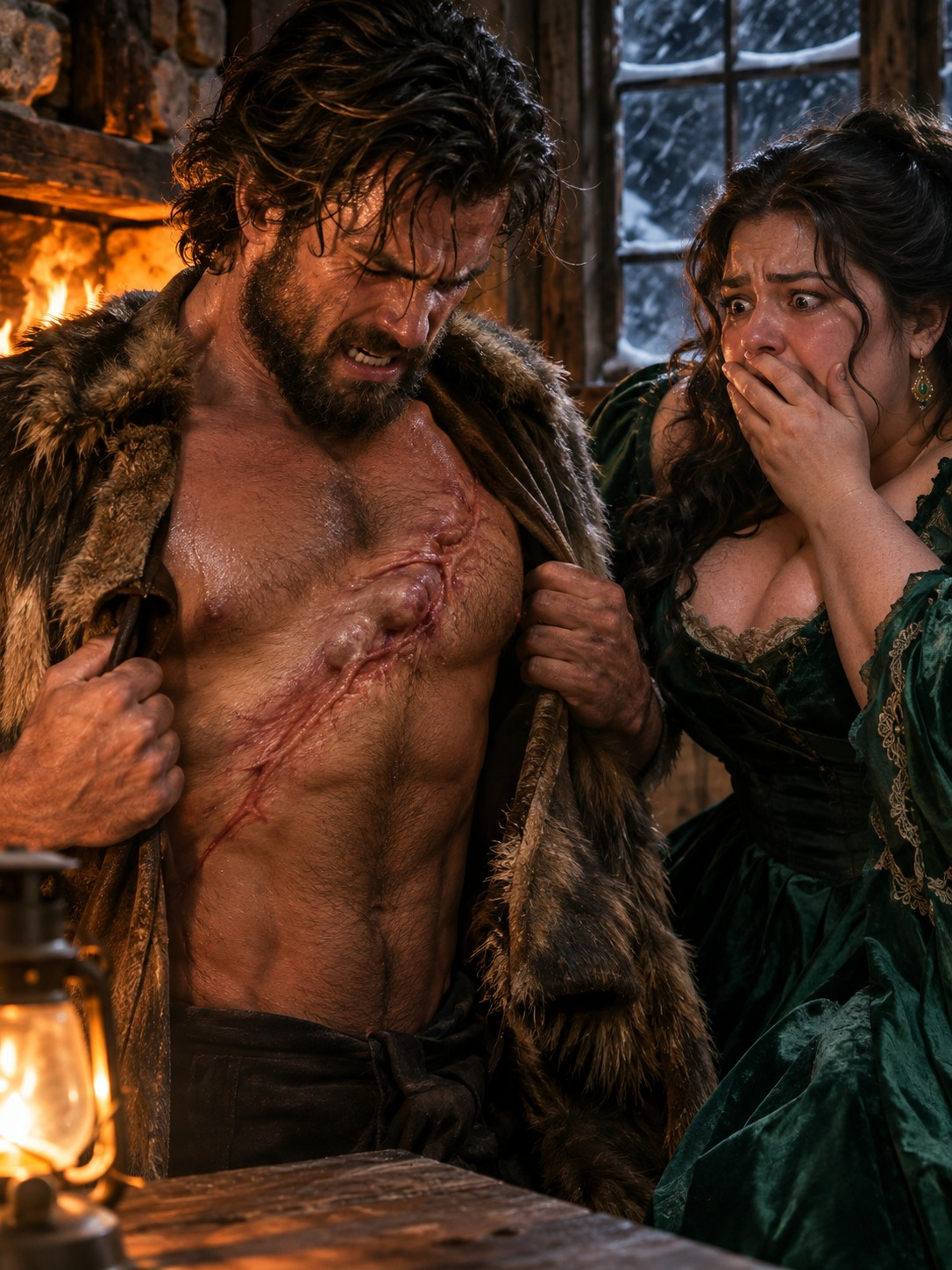
"Don't read another word!" Caleb shouted.
Eleanor Whitmore stood beside the wooden table, clutching a nineteen-year-old letter that bore her dead husband's name.
Across from her, the enormous mountain man gripped his chest as something beneath his scar twisted violently.
But Eleanor wasn't looking at the scar anymore.
She was staring at the handwriting.
Because the man who had made her life miserable for six years had apparently known her new husband's darkest secret long before she was born into his world.
And the letter suggested that Henry Whitmore had left behind something far more terrible than an unhappy widow.
The fire cracked inside the stone hearth.
Outside, the Colorado blizzard hurled snow against the cabin windows with enough force to rattle the glass.
Eleanor barely heard it.
Her attention remained fixed on the unfinished sentence.
Henry, if your son ever learns what we put inside Caleb Mercer, he will...
She read those words again.
Then a third time.
Her fingers tightened around the yellowed paper.
"Caleb," she whispered. "Did you know my husband?"
Caleb stood with one enormous hand pressed against his chest.
His face was pale beneath his sandy-blond beard.
"No."
"Think carefully."
"I've never heard that name before tonight."
"Henry Whitmore."
Caleb shook his head.
"I swear to you."
Eleanor searched his expression.
She had spent years living with a man who could lie without changing his breathing. Henry had taught her to recognize the smallest signs of deception.
A delayed answer.
A sudden change in tone.
A smile that appeared a moment too late.
She saw none of those things in Caleb.
Only confusion.
And fear.
"Then how could your mother's letter be addressed to him?"
"I don't know."
She lowered her gaze to the paper.
Something about the sentence troubled her beyond the obvious horror of its meaning.
Your son.
Henry Whitmore had been forty-seven when he died.
If the letter had truly been written nineteen years earlier, Henry would have been twenty-five.
Old enough to have fathered a child.
But Eleanor had never known him to have one.
He had always insisted that he was childless.
More than that, he had blamed Eleanor for their failure to have children, despite refusing to seek a doctor's opinion.
She remembered one particularly cruel evening when Henry had looked at her across their dining table and said, "Perhaps God knows better than to give a child a mother like you."
The memory struck with unexpected force.
She swallowed.
"Henry told me he had no children."
Caleb looked at the letter.
"Maybe your husband wasn't the Henry Whitmore she meant."
Eleanor wanted to believe him.
Then she noticed the writing beneath the first line.
A faint address had been added in a different hand.
Mr. Henry Whitmore, Blackthorn Creek, Colorado Territory.
Eleanor's stomach tightened.
Henry had once told her that he had spent part of his youth in Colorado.
He had described it as an unpleasant chapter of his life.
Nothing worth remembering.
Nothing worth discussing.
Whenever she asked about it, he changed the subject.
Now she wondered whether those silences had been deliberate.
"Henry lived near here," she said.
Caleb frowned.
"When?"
"Before we married. Before I knew him."
"How long ago?"
"I don't know exactly."
Caleb stared at the address.
"Blackthorn Creek."
"You know it?"
"It's the settlement where I collect supplies."
Eleanor felt a cold pressure beneath her ribs.
The coincidence was becoming impossible to dismiss.
She turned the paper toward the firelight.
There was more writing, but the lower half had been folded inward and sealed with a strip of dark wax.
The wax carried the same symbol carved into the wooden box.
Three overlapping circles.
One line passing through their centers.
Eleanor touched the mark.
"Have you ever seen this symbol anywhere else?"
Caleb's expression changed.
He looked toward the fireplace.
Then toward the cabin door.
"Caleb?"
"My father carved it into the trees."
"What trees?"
"The ones around the property."
"Why?"
"He said they marked the boundary."
"Of your land?"
Caleb hesitated.
"Of the place I was allowed to go."
Eleanor looked at him.
"What do you mean, allowed?"
He lowered his eyes.
"When I was younger, he wouldn't let me walk beyond the marked trees."
"Even after you grew older?"
"Especially then."
She waited.
Caleb's voice became quieter.
"He told me there were places in these mountains where people disappeared."
Eleanor looked toward the frost-covered windows.
The darkness beyond them suddenly seemed less empty.
"Did you believe him?"
"I believed everything he told me."
"Do you still?"
Caleb's face tightened.
"I don't know what to believe anymore."
Eleanor placed the letter carefully on the table.
"Sit down."
Caleb shook his head.
"I'm all right."
"You're trembling."
"It's nothing."
"Caleb."
He looked at her.
She pointed toward the chair.
"Please."
For a moment, the enormous man seemed prepared to argue.
Then his shoulders sagged.
He lowered himself into the sturdy wooden chair.
It creaked beneath his weight.
Eleanor moved closer.
"May I look at your scar?"
His eyes widened.
"Why?"
"Because something happened to you, and I want to understand it."
"You saw what it did."
"Yes."
"And you still want to come near me?"
She hesitated only long enough to choose her words.
"I'm frightened of what I saw. That doesn't mean I'm frightened of you."
Caleb stared at her.
His expression changed in a way that made her chest ache.
As though she had offered him something he had stopped expecting from another human being.
He nodded.
Slowly, he opened his shirt.
The enormous scar stretched across his chest.
In the flickering firelight, its raised ridges looked almost like twisted roots beneath his skin.
Eleanor leaned forward.
She did not touch it.
"Does it hurt now?"
"A little."
"Where?"
He pointed to the thickest portion near his ribs.
"Here."
She studied the scar.
There was no fresh blood.
No broken skin.
Nothing that suggested an ordinary wound reopening.
Yet she had seen the tissue move.
She knew what she had witnessed.
"How often did this happen when you were younger?"
Caleb swallowed.
"At first, every night."
Eleanor looked up.
"Every night?"
He nodded.
"Sometimes it was just a little movement. Sometimes it hurt so badly I couldn't stand."
"What did your father do?"
Caleb stared at the fire.
"He tied me to the bed."
Eleanor went still.
"He did what?"
"He said I might hurt myself."
"Did you?"
"I don't remember."
"Caleb."
He rubbed his forehead.
"There are things from that time I can't remember."
"How much?"
"Days. Sometimes weeks."
Eleanor felt a chill.
"Did your father give you medicine?"
"Yes."
"What kind?"
"Something bitter. He mixed it with water."
"Did it make you sleep?"
Caleb nodded.
"For a long time."
Eleanor thought of Henry.
Of the bottles he had kept locked inside his study.
Of the bitter-smelling medicines he had insisted were necessary whenever she complained of headaches or exhaustion.
She had refused them more often than not.
Henry had always seemed offended by her reluctance.
A terrible thought began to form.
She pushed it away.
Not yet.
She needed facts.
"Caleb, did anyone else ever come here?"
His expression changed.
"When?"
"When you were thirteen. When your father first brought you into the mountains."
He stared at the floor.
"I remember a man."
Eleanor's pulse quickened.
"What man?"
"I don't know his name."
"What did he look like?"
Caleb closed his eyes.
"He wore a dark coat. Had a gold watch."
Eleanor's breath caught.
Henry had owned a gold pocket watch.
An expensive one.
He had carried it everywhere.
She remembered the engraved initials on its cover.
H.W.
"Anything else?" she asked.
Caleb pressed his fingers against his temples.
"He smelled like tobacco."
"What kind?"
"I don't know."
"Try to remember."
His face tightened.
"Sweet. Almost like cherries."
Eleanor stepped backward.
Henry had smoked cherry-scented pipe tobacco every evening.
The smell had lingered in their curtains long after his death.
Caleb noticed her expression.
"What is it?"
She shook her head.
"Nothing."
"Eleanor."
She looked at him.
"My first husband carried a gold watch."
Caleb said nothing.
"And he smoked cherry tobacco."
The silence that followed seemed to swallow the room.
Finally, Caleb whispered, "You think he came here?"
"I think we need to read the rest of that letter."
The wax seal broke beneath Eleanor's thumbnail.
Caleb flinched at the sound.
She unfolded the paper.
The handwriting continued in narrow, hurried lines.
Henry, if your son ever learns what we put inside Caleb Mercer, he will come looking for answers. And when he does, he must never be allowed to reach the northern chamber.
Eleanor stopped.
"The northern chamber?"
Caleb's face changed.
"What?"
She read the sentence aloud.
He stood so suddenly that the chair scraped across the floor.
"No."
"Caleb?"
"That's impossible."
"What is?"
He looked toward the cabin's rear wall.
"The northern chamber."
Eleanor followed his gaze.
A narrow wooden door stood beyond the fireplace.
She had assumed it led to a storage room.
"What's behind that door?"
Caleb's jaw tightened.
"Nothing."
"Caleb."
"An old storeroom."
"Have you been inside?"
"Not in years."
"Why?"
His expression became distant.
"My father kept it locked."
Eleanor glanced at the door.
There was a heavy iron latch.
No visible keyhole.
"Is it locked now?"
Caleb shook his head.
"I took the lock off after he died."
"Then why haven't you opened it?"
He looked at her.
"Because I hear things in there."
Eleanor felt the hairs rise along her arms.
"What kind of things?"
Caleb's lips moved.
For a moment, no sound emerged.
Then he whispered, "Knocking."
She stared at him.
"From inside the room?"
He nodded.
"Sometimes."
"When?"
"At night."
Eleanor looked toward the wooden door.
The cabin seemed suddenly much smaller.
"What did you find when you checked?"
Caleb's expression tightened.
"Nothing."
"Nothing?"
"Just old furniture. Empty crates. Tools."
"Then what was knocking?"
"I told myself it was the wind."
"Did you believe that?"
He looked away.
"No."
Eleanor lowered her eyes to the letter.
There was another paragraph.
Your son must not be told what happened to Miriam. He believes the child died. Let him continue believing it. If he learns the truth, he will destroy everything we have worked to conceal.
Eleanor read the words twice.
"Miriam," she whispered.
Caleb looked up.
"What?"
"Who was Miriam?"
His face drained of color.
"My mother."
Eleanor stared at him.
"Your mother's name was Miriam?"
"Miriam Mercer."
She looked back at the letter.
The writer had referred to Miriam in the third person.
Which meant—
"This letter wasn't written by your mother."
Caleb stared at her.
"What?"
"The handwriting may look familiar, but listen to the words."
She read the paragraph aloud.
Caleb's eyes widened.
His mother would not have referred to herself that way.
Unless someone had forced her to write the letter.
Or someone had copied her handwriting.
Eleanor turned the page over.
There was no signature.
Only a final sentence.
The living vessel must remain isolated until the appointed time.
Below it appeared the same symbol.
Three circles.
One line.
Caleb gripped the table.
"Living vessel."
Eleanor looked at him.
"What does that mean?"
He shook his head.
"I don't know."
But his expression suggested that the words had awakened something inside his memory.
Something he did not want to see.
A heavy gust of wind struck the cabin.
The shutters rattled.
Eleanor startled.
Caleb moved instinctively toward her.
Then stopped himself.
"Sorry."
She looked at him.
"For what?"
"I didn't mean to frighten you."
"You didn't."
He glanced at the letter.
"Maybe you should burn it."
Eleanor shook her head.
"No."
"It could be dangerous."
"Then we need it even more."
Caleb stared at her.
She folded the paper carefully.
"Someone lied to you about your childhood. Someone lied to me about my husband's past. And those lies are connected."
He looked toward the fire.
"My father was all I had."
Eleanor's expression softened.
"I know."
"He fed me. He taught me to hunt. He kept me alive through winters that killed other men."
"That doesn't mean he told you the truth."
Caleb's jaw tightened.
"He wasn't always cruel."
"I believe you."
"He used to read to me."
Eleanor said nothing.
"Before we came here, he would sit beside my bed and read stories about explorers and sailors."
His voice cracked.
"He told me brave men weren't the ones who never felt afraid. They were the ones who did what was necessary despite being afraid."
Eleanor watched his face.
"Then maybe he was afraid too."
Caleb looked at her.
"Of what?"
She glanced at the scar.
"I don't know."
He followed her gaze.
For several moments, neither spoke.
Then Caleb whispered, "I remember my mother singing."
Eleanor leaned closer.
"What did she sing?"
"A song about a little bird."
His eyes became distant.
"She used to sit beside my bed and sing it when I couldn't sleep."
"Do you remember the words?"
He shook his head.
"Only part."
"Tell me."
He hesitated.
Then, in a low, rough voice, he recited:
"Little bird beneath the stone,
Find the road that leads you home."
His expression changed.
He stopped.
Eleanor waited.
"Is there more?"
"I don't remember."
But as he spoke, something beneath his scar shifted.
Only slightly.
A narrow ripple traveled beneath the raised tissue.
Caleb gasped.
Eleanor caught his arm.
"Sit down."
He shook his head.
"No."
"Caleb—"
"I remembered something."
His eyes widened.
"My mother wasn't singing to me."
Eleanor stared at him.
"What?"
He looked toward the scar.
"She was singing to this."
The words hung in the air.
Eleanor felt the fire's warmth against her face, but her hands had gone cold.
"How do you know?"
Caleb pressed his palm against his chest.
"Because when she sang, it stopped hurting."
Eleanor stared at him.
"Every time?"
He nodded.
"I remember lying in bed. My chest burning. Something moving beneath the bandages."
His breathing quickened.
"My mother would sit beside me and sing."
He closed his eyes.
"And it would become quiet."
Eleanor thought carefully.
"Maybe the song helped calm you."
"Maybe."
"Pain can become worse when someone is frightened."
Caleb looked at her.
"Do you think I'm imagining this?"
"No."
She answered immediately.
"I saw your scar move."
He swallowed.
"Then what do you think it is?"
Eleanor looked down.
"I don't know."
It was the truth.
And for the first time, she understood how much courage it had taken for Caleb to admit the same thing.
He had lived with something inexplicable inside his body for nineteen years.
He had endured pain.
Isolation.
Fear.
And the terrible belief that showing another person would lead to death.
Yet he had still written a marriage advertisement.
He had still dared to hope someone might love him.
Eleanor felt a fierce tenderness rise inside her.
She placed her hand over his.
"Whatever this is, we're going to find out."
Caleb stared at her.
"We?"
"Yes."
"You don't have to do this."
"I know."
"You could leave when the storm passes."
"I know that too."
His eyes filled with tears.
"Then why stay?"
Eleanor took a breath.
"Because I spent six years with a man who made me feel like a burden."
She tightened her fingers around his.
"And you've spent nineteen years believing you're something terrible."
Caleb looked away.
She continued quietly.
"I don't think either of us deserves to keep living that way."
For a long moment, Caleb said nothing.
Then his enormous hand closed gently around hers.
"Thank you."
Eleanor nodded.
But she was already looking toward the northern chamber.
They searched the wooden box again.
Beneath the bloodstained cloth lay a small leather notebook.
Its cover had cracked with age.
Several pages were missing.
Others were covered in numbers, dates, and strange symbols.
Caleb recognized his father's handwriting.
Eleanor opened the first page.
October 14.
The subject survived the third procedure.
She looked up.
"Subject?"
Caleb's face tightened.
She continued reading.
Temperature elevated. Pulse irregular. Movement beneath the incision observed at approximately midnight.
Eleanor felt sick.
The description was clinical.
Detached.
As though whoever had written it was recording the condition of an animal.
Not a thirteen-year-old boy.
She turned the page.
October 17.
The subject reports hearing a voice during sleep. No external source identified.
Caleb stared at the notebook.
"I remember that."
Eleanor looked at him.
"What voice?"
He swallowed.
"I thought someone was calling me."
"Who?"
"I never knew."
She turned another page.
October 21.
The presence responds to auditory stimulation. Miriam's singing produces temporary cessation of movement.
Eleanor's heart pounded.
There it was.
Proof that Caleb's mother had known.
And proof that someone had deliberately studied whatever was happening inside him.
She continued.
October 23.
Henry insists the procedure was successful. I disagree. The subject is deteriorating, and the presence appears to be developing independent responses.
Eleanor stopped.
"Henry."
Caleb looked at her.
"Your husband?"
"Possibly."
She read the sentence again.
The word procedure made her skin crawl.
Whatever had happened to Caleb had not been an accident.
Someone had done something to him.
And someone named Henry had believed it was successful.
She turned the page.
October 27.
Miriam attempted to remove the subject from the property. Henry discovered her preparations.
Eleanor's mouth went dry.
She turned another page.
It was blank.
The next had been torn out.
So had the one after it.
Then came a final entry.
November 2.
Miriam is gone.
Henry says she cannot interfere again.
The boy has stopped asking questions.
I pray he never remembers what he saw.
Caleb slowly lowered himself into the chair.
Eleanor watched his face.
"Caleb?"
He shook his head.
"I don't remember."
She knelt beside him.
"That's all right."
"No."
His voice cracked.
"It's not."
He stared at the notebook.
"My mother tried to save me."
Eleanor said nothing.
"And my father let me believe she was dead."
Tears gathered in his eyes.
"Why?"
Eleanor wished she had an answer.
She had none.
They sat beside the fireplace while the storm continued outside.
Caleb held the small silver locket.
He had opened it again and was studying his mother's portrait.
Eleanor examined the notebook.
Several entries contained measurements she did not understand.
There were references to temperature, pulse, sedation, and something called resonance.
The word appeared repeatedly.
Resonance increased.
Resonance diminished following auditory exposure.
Resonance absent during deep sedation.
She frowned.
The writer had treated sound as though it influenced whatever moved beneath Caleb's scar.
She thought of the song.
Then of the strange symbol.
Three circles.
One line.
"Caleb?"
He looked up.
"Did your father ever play music?"
He considered.
"Sometimes."
"What kind?"
"He had a little metal instrument."
"What did it look like?"
Caleb frowned.
"Like a fork."
"A tuning fork?"
"Maybe."
"Did he strike it?"
Caleb nodded slowly.
"He would hit it against the table and hold it near my chest."
Eleanor's pulse quickened.
"What happened?"
Caleb looked down at his scar.
"It moved."
She stared at him.
"Every time?"
"Not always."
"Did the sound hurt?"
His expression darkened.
"Sometimes it felt like something was trying to crawl out."
Eleanor closed the notebook.
The implications were terrifying.
But they also offered something Caleb had never possessed.
A pattern.
The movements were not entirely random.
Certain sounds appeared to affect them.
His mother's singing calmed the scar.
The metal instrument disturbed it.
And whatever had been done to him had been observed and recorded.
She looked toward the northern chamber.
"Your father kept his tools in there?"
"Some of them."
"Could the instrument still be inside?"
"Maybe."
Eleanor stood.
"Then we should look."
Caleb caught her hand.
"No."
She turned.
"Why?"
He stared toward the narrow wooden door.
His expression had changed again.
Not merely frightened.
Almost pleading.
"Please don't go in there."
"Caleb, we need answers."
"I know."
"Then why?"
He swallowed.
"Because I remember something else."
Eleanor waited.
He stared at the door.
"When I was thirteen, my father told me there were three rules."
"What rules?"
"Never cross the marked trees."
She nodded.
"Never show anyone the scar."
"And the third?"
His voice dropped.
"Never answer the knocking."
Eleanor stared at him.
"What knocking?"
Caleb looked toward the northern chamber.
"The kind that comes from the other side of that door."
She felt her heartbeat quicken.
"You said it was probably the wind."
"That's what I told myself."
"But you didn't believe it."
He shook his head.
Eleanor studied the narrow door.
The wood was dark.
The iron latch looked old.
There was no light beneath it.
No movement.
Nothing unusual.
"How long has it been happening?"
"Since my father died."
"Every night?"
"No."
"When, then?"
Caleb hesitated.
"Usually when the scar starts hurting."
Eleanor looked at his chest.
"Has it happened recently?"
"Not for years."
"Seven years?"
He nodded.
The same length of time since the scar had last moved.
Eleanor felt the pieces beginning to fit together.
The scar.
The knocking.
The forbidden room.
The strange instrument.
The missing pages.
Everything seemed connected.
She moved toward the door.
Caleb stood.
"Eleanor."
She stopped.
"I won't open it without you."
He stared at her.
For several seconds, he seemed unable to decide whether he was more frightened of what might be behind the door or of allowing her to face it alone.
Finally, he approached.
The floorboards creaked beneath his boots.
He stood beside her.
Together, they examined the latch.
Eleanor noticed scratches around the iron plate.
Deep scratches.
Not on the outside.
On the edge nearest the doorframe.
As though something had repeatedly struck the wood from the other side.
She touched one of the marks.
"How old are these?"
Caleb shook his head.
"I don't know."
She leaned closer.
There were three long grooves beneath the latch.
Each nearly parallel.
Eleanor thought of the symbol.
Three circles.
One line.
Then she noticed something else.
A small metal plate had been nailed above the door.
It was almost hidden beneath years of soot.
She wiped it with her sleeve.
Numbers appeared.
13 — 19 — 7
Eleanor stared.
Thirteen.
The age Caleb had been when his father brought him to the mountains.
Nineteen.
The number of years he had lived in isolation.
Seven.
The number of years since the scar had last moved.
Her mouth went dry.
"Caleb."
He leaned closer.
"What?"
She pointed toward the numbers.
"Did your father put these here?"
Caleb's face went white.
"No."
"Are you certain?"
He nodded.
"I've never seen them before."
Eleanor stepped back.
Something was terribly wrong.
The numbers described Caleb's life too precisely.
And if he had never seen them, someone had placed them there without his knowledge.
She looked toward the windows.
The blizzard still raged.
No one could have reached the cabin unnoticed.
Could they?
Then she remembered the final entry in the notebook.
Miriam is gone.
Not dead.
Gone.
And Henry had supposedly ensured that she could not interfere again.
Eleanor turned toward Caleb.
"Your father told you your mother died."
"Yes."
"But the notebook doesn't say she died."
He stared at her.
"What are you saying?"
"I'm saying we don't know what happened to her."
His expression changed.
A fragile hope appeared in his eyes.
It frightened Eleanor almost as much as the scar.
Because hope could be cruel when built on uncertainty.
"Do you think she could still be alive?" he whispered.
Eleanor hesitated.
"I think someone wanted you to believe she wasn't."
Caleb pressed a hand against the wall.
His breathing became uneven.
For nineteen years, he had mourned a mother whose death he had never witnessed.
Now the possibility that she had survived threatened to overturn everything he knew.
He looked toward the northern chamber.
"What if she came back?"
Eleanor said nothing.
"What if she tried to find me?"
His voice cracked.
"What if I've been sitting here all these years, afraid to open a door, while she was somewhere out there?"
Eleanor reached for his hand.
"Caleb—"
A sound interrupted her.
Both froze.
It came from the northern chamber.
A dull impact.
Wood against wood.
Eleanor stared at the door.
Caleb's fingers tightened around hers.
Another impact followed.
Then a third.
Three slow knocks.
From the other side.
Eleanor stopped breathing.
Caleb's face became completely white.
"Don't answer," he whispered.
The cabin fell silent.
Eleanor stared at the door.
She could hear the storm outside.
The fire crackling behind them.
Caleb's uneven breathing.
Nothing else.
Then came a sound so faint she almost missed it.
A woman's voice.
Soft.
Weak.
Coming from behind the wooden door.
"Caleb?"
His entire body went rigid.
Eleanor turned toward him.
He was staring at the door with tears in his eyes.
"Caleb?" she whispered.
He shook his head.
"That's impossible."
The voice came again.
Closer this time.
"Caleb, sweetheart..."
His lips parted.
Eleanor felt his hand begin to tremble.
The voice continued.
"Don't be frightened."
Caleb made a broken sound.
Eleanor looked at him.
"Do you recognize her?"
He nodded slowly.
A tear rolled down his cheek.
"My mother."
Eleanor's blood turned cold.
The woman behind the door spoke again.
And this time, she sang.
"Little bird beneath the stone..."
Caleb staggered backward.
His scar began moving violently beneath his shirt.
Eleanor grabbed his arm.
The voice finished the line.
"Find the road that leads you home."
Then everything stopped.
The knocking.
The singing.
The movement beneath Caleb's scar.
Complete silence.
Eleanor stared at the door.
Caleb stood beside her, shaking.
She slowly reached toward the iron latch.
"Don't," he whispered.
But Eleanor had noticed something.
The latch was lifting.
Not from her side.
From the other side of the door.
She stepped backward.
Caleb caught her hand.
The iron bar rose another inch.
Then another.
A narrow black gap appeared between the door and its frame.
And through that gap, a woman's pale fingers slowly reached into the room.






Comments 0