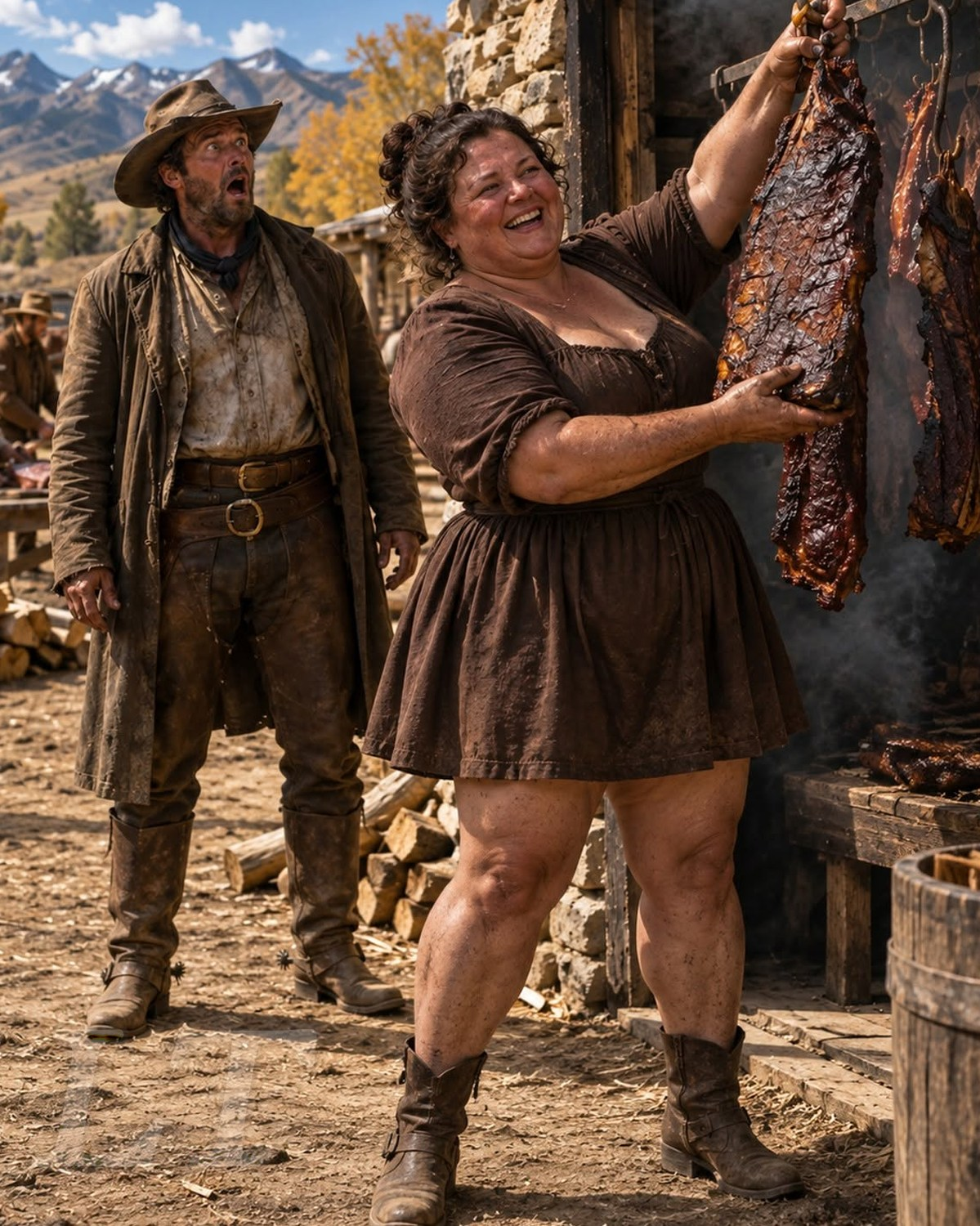
Martha Sanders grabbed the railroad agent's wrist before he could unfold the document.
"Don't say that name out loud."
The stranger froze.
Jared stepped between them.
"What name?"
Martha looked at the paper, then toward the dark road beyond the ranch gate.
For fifteen years, she had believed the man connected to that signature was dead.
Now someone had come all the way from Denver to tell her otherwise.
And the worst part was that Grant Fletcher appeared to know it too.
"Inside," Martha said.
The stranger hesitated.
"Mrs. Higgins, I was instructed—"
"My name is Sanders now. And if you've ridden this far carrying information that could put people in danger, you'll explain yourself somewhere we can close a door."
Jared glanced at Thaddius.
"Keep an eye on the road."
The foreman nodded.
Martha led the stranger into the ranch kitchen.
The room was still warm from supper. A kettle sat beside the stove, and the smell of roasted pork lingered in the air.
Billy Carter appeared in the doorway.
"Mrs. Sanders? Everything all right?"
"Bring fresh coffee, Billy."
"Yes, ma'am."
"And tell the men to leave the smokehouse fire alone until I return."
Billy hurried away.
Jared closed the kitchen door.
The stranger removed his hat.
He was perhaps forty, with a narrow face, tired eyes, and a neatly trimmed beard. His coat was dusty from the road, but his boots and leather document case suggested a man accustomed to offices rather than open country.
"My name is Samuel Whitcomb," he said. "I'm a freight clerk with the Denver office of the Colorado Central."
Jared crossed his arms.
"And why does a railroad clerk care about my mortgage?"
Whitcomb looked at Martha.
"Because your wife placed a substantial freight order two days ago."
"I know about the order."
"Then perhaps you know she requested that the shipment bypass Fletcher's local distribution company."
Jared frowned.
"She paid for it."
"Yes, sir. In gold."
Martha remained silent.
Whitcomb opened his document case.
"That payment attracted attention."
"From whom?" Jared asked.
"Men who prefer certain businesses to remain dependent on their arrangements."
Martha pulled out a chair.
"Sit down, Mr. Whitcomb."
He obeyed.
She remained standing.
"Now tell me what you came here to say."
The clerk unfolded the document.
At the bottom was a signature written in dark ink.
Edwin Harrow.
Martha felt a cold pressure settle beneath her ribs.
She knew that handwriting.
The long downward stroke of the H.
The unusually narrow E.
The flourish beneath the final letter.
She had seen it on contracts, receipts, and shipping orders during her years in Chicago.
And she had seen it on a document that had destroyed the business of the first man who ever trusted her with responsibility.
Jared noticed her expression.
"Martha?"
She did not answer.
Whitcomb lowered his voice.
"Mr. Harrow is listed as a financial representative for the company holding an interest in several Colorado ranch mortgages."
Jared leaned forward.
"Fletcher's company?"
"Among others."
Martha looked at Whitcomb.
"You said he wasn't supposed to be alive."
The clerk swallowed.
"According to the records I found, Edwin Harrow died in Chicago eleven years ago."
Silence filled the kitchen.
Jared looked from the document to his wife.
"Then somebody's using a dead man's name."
"Possibly," Whitcomb answered.
Martha slowly shook her head.
"Or the wrong man was buried."
Fifteen years earlier, Martha Higgins had been a young woman with very little money and no family willing to support her.
Chicago had not been kind to her.
She had worked wherever someone needed strong hands.
First in a laundry.
Then in a boardinghouse kitchen.
Finally, at a meatpacking operation on the city's industrial outskirts.
The work was exhausting.
The hours were long.
And the wages were never enough.
But Martha had discovered something important.
She was good at it.
Not merely good at cutting meat or tending fires.
She understood how the work fit together.
How much salt was needed.
Which cuts could be sold fresh.
Which were better suited to curing.
How careful handling reduced waste.
How a small operation could survive by making use of things larger businesses discarded.
Her first real teacher had been a German butcher named Otto Reinhardt.
He was a broad, gray-haired man who rarely smiled and considered wasting food a personal insult.
One winter evening, after Martha had worked fourteen hours without complaint, Otto had handed her a small notebook.
"Write things down," he told her.
"Why?"
"Because men forget. Paper doesn't."
She had followed his advice.
Every measurement.
Every technique.
Every useful supplier.
Every mistake.
By the time she was thirty, she knew more about preserving meat than most of the men who supervised her.
But knowledge did not always bring opportunity.
Especially for a woman.
And especially when the people controlling the business had no intention of sharing their profits.
That was how she had first encountered Edwin Harrow.
He had been a businessman with polished shoes, a gold watch, and a voice smooth enough to make a lie sound like a favor.
He arranged freight contracts for packing companies.
He financed shipments.
He purchased debts.
And when struggling businesses could no longer pay, he acquired their equipment for almost nothing.
Martha had watched him ruin Otto Reinhardt.
The old butcher had signed a contract he believed would provide affordable transportation for his products.
Instead, hidden fees accumulated.
Shipments were delayed.
Payments disappeared.
Within six months, Otto's business was gone.
Martha had never forgotten the sight of him standing outside his locked shop, holding the notebook in which he had recorded twenty years of work.
Harrow had called it business.
Martha had called it theft.
And she had never forgiven him.
Back in the Ironwood kitchen, Whitcomb watched her carefully.
"You recognize him."
Martha nodded.
"I knew him in Chicago."
Jared sat down slowly.
"How well?"
"Well enough to know he wasn't an honest man."
Whitcomb looked relieved.
"Then you understand why I came."
"Not entirely."
The clerk leaned forward.
"When your freight order reached Denver, someone asked why a woman from Chicago was purchasing commercial quantities of curing supplies for a nearly bankrupt ranch."
Martha's eyes narrowed.
"Someone?"
"A man connected to Fletcher's office."
"Did he ask for my name?"
"Yes."
"And you gave it to him?"
Whitcomb looked uncomfortable.
"The information was already on the shipping documents."
Martha folded her arms.
"What happened next?"
"That afternoon, I was instructed to hold your order until a local distribution fee had been paid."
Jared struck the table with his palm.
"She paid the freight charges!"
"I know."
"Then they had no right—"
"I know, Mr. Sanders."
Whitcomb raised one hand.
"That's why I reviewed the paperwork."
He took another sheet from his case.
"Your wife requested direct delivery. The contract allows it. There was no legal reason to redirect the shipment through Fletcher's company."
Martha studied the paper.
"And you released it."
"Yes."
"Why?"
Whitcomb hesitated.
Then he answered quietly.
"Because my father lost his farm to men who made money from debts they had no business collecting."
Jared stopped speaking.
The clerk continued.
"I've spent twelve years watching people sign papers they don't understand. Most of the time, there's nothing I can do."
He looked at Martha.
"This time, there was."
Martha's expression softened slightly.
"Thank you."
Whitcomb nodded.
"But that wasn't the only thing I found."
He placed the document bearing Harrow's signature on the table.
"The company handling the Ironwood mortgage has changed names twice in six years. Its ownership records lead back to an investment partnership in Chicago."
Martha stared at the signature.
"And Harrow?"
"His name appears on documents dated only last spring."
Jared rubbed his forehead.
"So what does that mean for us?"
Whitcomb looked toward the door.
"It means I wouldn't sign anything Grant Fletcher puts in front of you until someone independent examines the records."
After Whitcomb departed, Jared remained at the kitchen table.
Martha stood beside the stove.
Neither spoke for several minutes.
Finally, Jared broke the silence.
"Why didn't you tell me?"
She looked at him.
"Tell you what?"
"That you knew people like Harrow."
Martha gave a tired sigh.
"Jared, we've been married less than a week."
"That's not what I meant."
"I know."
He leaned forward.
"I'm not accusing you of anything."
"Then what are you doing?"
"Trying to understand how a woman who came here to cook for my men somehow knows more about the people threatening my ranch than I do."
Martha considered his words.
Then she sat across from him.
"I spent fifteen years learning how money moves through the meat business."
Jared waited.
"Not just the cooking. The contracts. The freight. The buyers. The people who make fortunes without ever touching a knife."
She looked toward the window.
"I learned that a good product isn't always enough. Sometimes the person who controls the road to market controls everything."
Jared thought about Fletcher.
The mercantile.
The freight wagons.
The bank.
For the first time, he saw those things as parts of the same problem.
"That's what Fletcher's doing," he said.
Martha nodded.
"He's making sure everyone in this valley has to come through him."
"And if they don't?"
"They pay for it."
Jared looked at the mortgage notice.
"Then what do we do?"
Martha's answer came without hesitation.
"We make something worth selling."
He stared at her.
"That's your plan?"
"It's the beginning of one."
"With wild hogs?"
"With whatever we have."
Jared shook his head.
"Fletcher owns half the valley."
Martha leaned forward.
"And does he own every hungry man in Colorado?"
Jared stopped.
She continued.
"Mining camps need food. Railroad crews need food. Travelers need food. And most of those people are tired of eating hard bread and beans."
He watched her.
"If we can make something good enough, and preserve it well enough to transport, we won't need to sell it through Fletcher."
Jared looked toward the smokehouse.
The chimney was still sending a thin ribbon of smoke into the evening sky.
For the first time, the building seemed larger than he remembered.
The next morning, Martha returned to work before sunrise.
She did not mention Edwin Harrow to the ranch hands.
There was no reason to frighten them with something she did not yet understand.
Instead, she focused on what she could control.
The smokehouse.
The meat.
The supplies.
The men.
Thaddius arrived carrying a fresh load of firewood.
"Morning, Mrs. Sanders."
"Morning."
"Where do you want this?"
"Beside the east wall. Keep it off the damp ground."
He nodded.
Then he looked toward the hanging pork.
"How's it coming?"
"Slowly."
"That good?"
"For smoked meat? Very."
He scratched his beard.
"Never thought I'd see this place working again."
Martha checked the temperature near the hearth.
"Your grandfather's smokehouse was built to last."
"Jared's grandfather," Thaddius corrected.
"That's what I meant."
The foreman smiled.
"Old Mr. Sanders used to say a ranch that couldn't feed its own men wasn't much of a ranch."
Martha looked at him.
"Sounds like a sensible man."
"He was."
Thaddius hesitated.
"Mrs. Sanders?"
"Yes?"
"I've been meaning to ask you something."
She continued working.
"Go ahead."
"Why'd you come all the way out here?"
Martha paused.
The question was simple.
But the answer was not.
She could have said she needed a husband.
She could have said she wanted a home.
She could have said Chicago had become too expensive, too crowded, too full of memories.
Instead, she answered with the truth.
"I wanted a chance to build something of my own."
Thaddius looked around the smokehouse.
"Well, you picked a hard place to start."
Martha gave a small smile.
"I've noticed."
By the end of the week, the first properly cured pork was ready for inspection.
Martha gathered Jared, Thaddius, Billy, and several of the older ranch hands around the worktable.
She placed a slab of smoked meat on a clean wooden board.
The surface was dark and rich.
The aroma filled the room.
Billy leaned forward.
"Can we eat it?"
"Not until I cut it."
He stepped back immediately.
Martha took a knife.
She sliced carefully.
The blade passed through the meat, revealing a firm, beautifully preserved interior.
She inspected the cut.
Then offered a piece to Thaddius.
The foreman tasted it.
His eyes widened.
"Well, I'll be."
Jared took the next piece.
He chewed slowly.
Then looked at Martha.
"This is better than what we ate the first night."
"It should be."
"How?"
"Time. Proper curing. Better seasoning."
Billy reached for another piece.
Martha tapped his hand lightly with the flat of her knife.
"That one's for inspection."
He withdrew his fingers.
"Yes, ma'am."
The men laughed.
Jared looked at the hanging meat.
"How much can we make?"
"That depends on what we can get."
"More hogs?"
"Some."
She turned toward the cattle pens.
"But I have another idea."
Jared followed her gaze.
His expression changed.
"No."
Martha looked at him.
"I haven't asked anything yet."
"I know what you're thinking."
"Do you?"
"Those cattle are all I've got left to sell."
Martha folded her arms.
"And how much will a buyer give you for the oldest one?"
Jared hesitated.
"Not much."
"How much?"
"Maybe eight dollars. Perhaps less."
"And how much does it cost to keep feeding an animal nobody wants?"
He looked away.
Martha continued.
"I'm not asking you to slaughter the herd. I'm asking you to consider what one animal might be worth if we stopped selling it as a tired old cow."
Jared stared at her.
"You're talking about beef."
"I'm talking about value."
He shook his head.
"The meat will be tough."
"Then we'll cook it differently."
"Nobody wants old cattle."
Martha looked toward the smokehouse.
"Nobody wanted those wild hogs either."
Jared had no answer.
That afternoon, Martha finally opened her iron-bound trunk in front of her husband.
She had waited until the house was quiet.
Jared stood near the bedroom doorway.
The trunk was enormous, its corners reinforced with iron, its wooden panels scratched by years of travel.
He had wondered about it since the day she arrived.
Martha knelt beside the lock.
"Come here."
He approached.
She opened the lid.
There were no wedding linens.
No lace dresses.
No delicate keepsakes.
Instead, Jared saw carefully wrapped knives, heavy iron molds, specialized butchering tools, measuring instruments, and bundles of cloth.
He stared.
"Good Lord."
Martha lifted a long, narrow knife.
"Boning knife."
Then another.
"Breaking knife."
She showed him several iron molds.
"These are for sausage."
Jared picked one up.
It was heavy.
"You brought all this from Chicago?"
"Yes."
"Why?"
"Because I knew I'd need tools."
He looked at her.
"You didn't know what kind of ranch you were coming to."
"I knew you had twenty-two men who needed feeding."
He slowly replaced the mold.
Then he noticed the leather notebook.
Martha picked it up.
The cover was worn.
The pages were crowded with handwriting.
"What's that?"
"Fifteen years of mistakes I don't intend to repeat."
She opened it.
Inside were recipes, supply lists, measurements, sketches of equipment, and names of people she had worked with.
Jared turned a page.
Then another.
"This is remarkable."
Martha shook her head.
"It's practical."
He looked at her.
"Most people would have left this behind."
"Most people don't know what it cost me to learn it."
Jared closed the notebook carefully.
For the first time, he understood that the trunk contained something far more valuable than money.
It held the knowledge of a woman who had spent most of her life being underestimated.
Martha reached beneath a folded cloth.
She removed the velvet pouch.
Jared recognized it immediately.
"The gold."
She nodded.
"What's left of it."
She placed it in his hand.
He felt the weight.
"Martha, I can't take this."
"I'm not giving it to you."
He looked up.
"I'm showing you what I'm risking."
She took the pouch back.
Then placed it inside the trunk.
"I didn't come west to become somebody's charity case. And I didn't come here to watch twenty-two men starve while I sat on my savings."
Jared remained silent.
Martha closed the lid.
"I came here because your letter offered something I couldn't buy in Chicago."
"What?"
"A place where my work might actually belong to me."
Jared looked at her for a long moment.
Then he said quietly, "It does."
Martha's expression softened.
He continued.
"The kitchen. The smokehouse. Whatever we build with them. You have my word."
She studied his face.
"Your word?"
"My word."
She nodded.
"Then we'd better make it worth something."
The following morning, Jared led Martha to the oldest section of the cattle pens.
Several thin animals stood near the fence.
Most were past their prime.
A few had been rejected by buyers more than once.
Jared stopped beside a large, aging cow.
"That one."
Martha studied the animal.
"How old?"
"Too old for a decent price."
"Healthy?"
"As far as I can tell. Just old and tough."
She inspected the cow carefully.
Then looked toward the smokehouse.
"We'll use her."
Jared hesitated.
"If this doesn't work—"
"I know."
"That's one less animal to sell."
"I know that too."
He removed his hat.
"All right."
Martha nodded.
"Then let's get started."
The work took much of the day.
She insisted on careful handling and proper inspection.
Nothing was rushed.
The usable meat was separated according to its purpose.
Some cuts would become sausage.
Others would be cooked for the ranch hands.
But Martha reserved the brisket.
Jared watched her place it on the worktable.
"That?"
"That."
"It's the toughest part."
"I know."
"Then why are you smiling?"
Martha looked at him.
"Because tough doesn't mean worthless."
She prepared the meat with salt, pepper, molasses, and spices.
Then she placed it inside the smokehouse.
The fire was kept low.
The heat steady.
The smoke gentle.
Hours passed.
Then an entire night.
Martha checked the fire repeatedly.
Billy helped carry wood.
Thaddius took a turn watching the chimney.
Jared insisted on staying awake for part of the night.
By the following afternoon, the entire ranch smelled of smoked beef.
Men gathered near the building.
They had never experienced anything quite like it.
Martha refused to hurry.
"Good meat doesn't care how impatient you are," she told them.
Finally, after nearly two days of careful cooking, she announced that the brisket was ready.
Jared stood beside her.
Billy and Thaddius waited nearby.
Martha lifted the meat onto the cutting board.
Its crust was dark mahogany.
Rendered fat glistened beneath the surface.
She allowed it to rest.
Then she took her knife.
The first slice revealed tender meat beneath the smoky crust.
Jared stared.
Martha handed him a piece.
"Try it."
He took a bite.
Then stopped chewing.
His eyes widened.
The meat was tender.
Rich.
Full of flavor.
Nothing like the tough beef he had expected.
He swallowed.
"Martha."
She watched him.
"What?"
He looked down at the brisket.
Then back at her.
"How did you do that?"
She smiled faintly.
"Smoke, salt, and patience."
Thaddius tasted a piece.
Then another.
He shook his head.
"I've eaten beef my whole life."
Martha waited.
"Never tasted anything like this."
Billy reached for a slice.
This time, Martha let him take it.
The young cowboy closed his eyes.
"Mrs. Sanders, people would pay money for this."
Martha looked at Jared.
"Yes," she said.
"They would."
That evening, the ranch house was filled with conversation.
For the first time in months, the men were not discussing unpaid wages or the possibility of leaving.
They were talking about meat.
About smoke.
About flavor.
About what could be done with animals nobody wanted.
Jared sat at the kitchen table with Martha.
A plate of sliced brisket lay between them.
He looked at it as though it were a gold nugget.
"You really think we can sell this?"
"I know we can."
"Where?"
"Mining camps. Railroad crews. Freight stations."
He leaned forward.
"How?"
"We preserve it properly. Pack it carefully. Find buyers who aren't tied to Fletcher."
Jared shook his head.
"That's a lot of work."
Martha raised an eyebrow.
"Have you got something better to do?"
He laughed.
A real laugh.
The kind he had not managed in months.
Then he grew serious.
"How far do you intend to take this?"
Martha looked toward the smokehouse.
Smoke drifted from the chimney.
The men were laughing outside.
The old ranch was beginning to sound alive again.
She turned back toward him.
"As far as the market will carry us."
Jared studied her.
"And Fletcher?"
Her expression hardened.
"He can buy every acre in this valley if he wants."
She tapped the table beside the brisket.
"But he doesn't own what I know."
Later that night, after Jared had gone to check the horses, Martha returned to her bedroom.
She opened the trunk again.
This time, she removed the leather notebook and turned to the pages containing her old Chicago contacts.
She found Otto Reinhardt's handwriting beside a recipe.
For a moment, she remembered the old butcher standing outside his shuttered shop.
Then she turned another page.
A folded letter slipped from between the papers.
Martha caught it before it reached the floor.
She had not opened it in years.
The envelope was yellowed.
The edges were worn.
Across the front, written in a familiar hand, were three words.
For Martha Higgins.
She sat on the edge of the bed.
Slowly, she unfolded the letter.
It had been written shortly before Otto Reinhardt lost his business.
Most of it concerned a shipment of preserved meat that had never reached its destination.
But near the bottom was a warning.
Otto had believed Edwin Harrow was using false companies to purchase debts and seize property.
He had also mentioned a partner.
A man who had recently begun buying land in Colorado.
Martha's eyes moved down the page.
She had read the letter many times.
But she had never paid much attention to the final paragraph.
Now, after seeing Harrow's signature on the mortgage documents, the words seemed different.
She leaned closer to the lantern.
The old ink had faded.
She brought the paper toward the light.
And there, beneath Otto's signature, was a name she had not noticed in fifteen years.
Grant Fletcher.
Martha sat perfectly still.
Outside, footsteps approached the house.
She folded the letter.
Then she heard the front door open.
Jared's voice came from the hallway.
"Martha?"
She quickly returned the letter to the notebook.
"I'm here."
His footsteps stopped outside her room.
"There's someone downstairs."
She frowned.
"At this hour?"
"Yes."
"Who?"
Jared hesitated.
Then he answered.
"Calvin Rusk."
Martha stood.
"What does he want?"
Jared's voice was tight.
"He says Grant Fletcher knows about your gold."
A cold silence settled over the room.
Then Jared added something that made her blood run colder.
"And he says Fletcher wants to know what else you brought from Chicago."
Martha looked toward the trunk.
Its iron lock was still open.
She crossed the room and reached for the key.
But before she could turn it, a heavy knock sounded against the bedroom door.
Jared had not moved.
The knock came again.
Then a man's voice spoke from the hallway.
A voice Martha had not heard in fifteen years.
"Open the door, Martha."
She froze.
The voice continued.
"We need to talk about Otto Reinhardt."






Comments 0