I printed the document.
Then I printed it again, as though a second copy might reveal something the first had concealed.
My name was there.
The signature looked familiar enough to make me uncomfortable, but not familiar enough to convince me it was mine.
The first letter was too large.
The final stroke curved upward instead of downward.
At work, I reviewed payment authorizations every day. I understood the difference between a legitimate signature and one that merely resembled it.
Still, I resisted the obvious conclusion.
Trevor was my brother.
There had to be an explanation.
I called him.
He answered on the fourth ring.
"Are you ready to apologize?"
"I need to ask you something about Grandma's trust."
Silence.
Not confusion.
Not curiosity.
Silence.
"What about it?"
"There's a withdrawal for twenty-four thousand dollars."
He sighed.
"You're seriously doing this tonight?"
"I don't remember authorizing it."
"It was an administrative thing."
"What kind of administrative thing?"
"Something with the investments. I'll explain later."
"Why is my signature on the withdrawal?"
He didn't answer immediately.
In the background, I heard a television and the sound of a cabinet closing.
"You're upset about the party," he said. "Don't start making accusations because your feelings got hurt."
"I'm asking about my signature."
"And I'm telling you that you're overreacting."
He hung up.
I stared at my phone.
There were many things my brother could have said.
He could have told me when I signed the document.
He could have sent me an email showing my authorization.
He could have explained the purpose of the withdrawal.
Instead, he had told me I was emotional.
It was a familiar strategy.
Whenever I raised a concern, Trevor found a way to make the conversation about my reaction instead of his behavior.
I had accepted that pattern for years.
But the numbers on my screen were not emotional.
They were numbers.
And they weren't adding up.
I downloaded every available statement.
There were withdrawals, transfers, and fees I couldn't immediately explain.
Some appeared to be ordinary investment transactions.
Others looked different.
One transfer had occurred shortly before Trevor moved into his new house.
Another appeared during the month he leased his Audi.
A third was dated two weeks before a vacation he had taken with Maddie.
I didn't know where the money had gone.
Not yet.
I knew only that the account balance was dramatically lower than the figure Trevor had reported in his annual summaries.
I opened a spreadsheet.
Date.
Amount.
Transaction description.
Authorization.
Destination, if available.
I worked until after midnight.
My phone continued vibrating.
My mother called three times.
Trevor sent a message telling me to stop behaving irrationally.
A cousin wrote that Maddie had been crying.
That message nearly broke me.
I wanted to call her.
I wanted to tell her I was sorry for what I had said about her father.
But I also knew that calling a twelve-year-old while her father and I were fighting could place her in the middle of something she didn't understand.
I wrote an apology and saved it without sending it.
Then I returned to the statements.
At one in the morning, I found a withdrawal authorization dated during a work conference I had attended in another state.
I checked my calendar.
I checked my hotel receipt.
I checked the email Trevor had sent that week asking me to collect Maddie from school.
I had replied that I was traveling.
He knew I wasn't home.
Yet the authorization listed both of us as having signed in person.
I printed that document, too.
By morning, my kitchen table looked like my desk at work.
I had slept for approximately forty minutes.
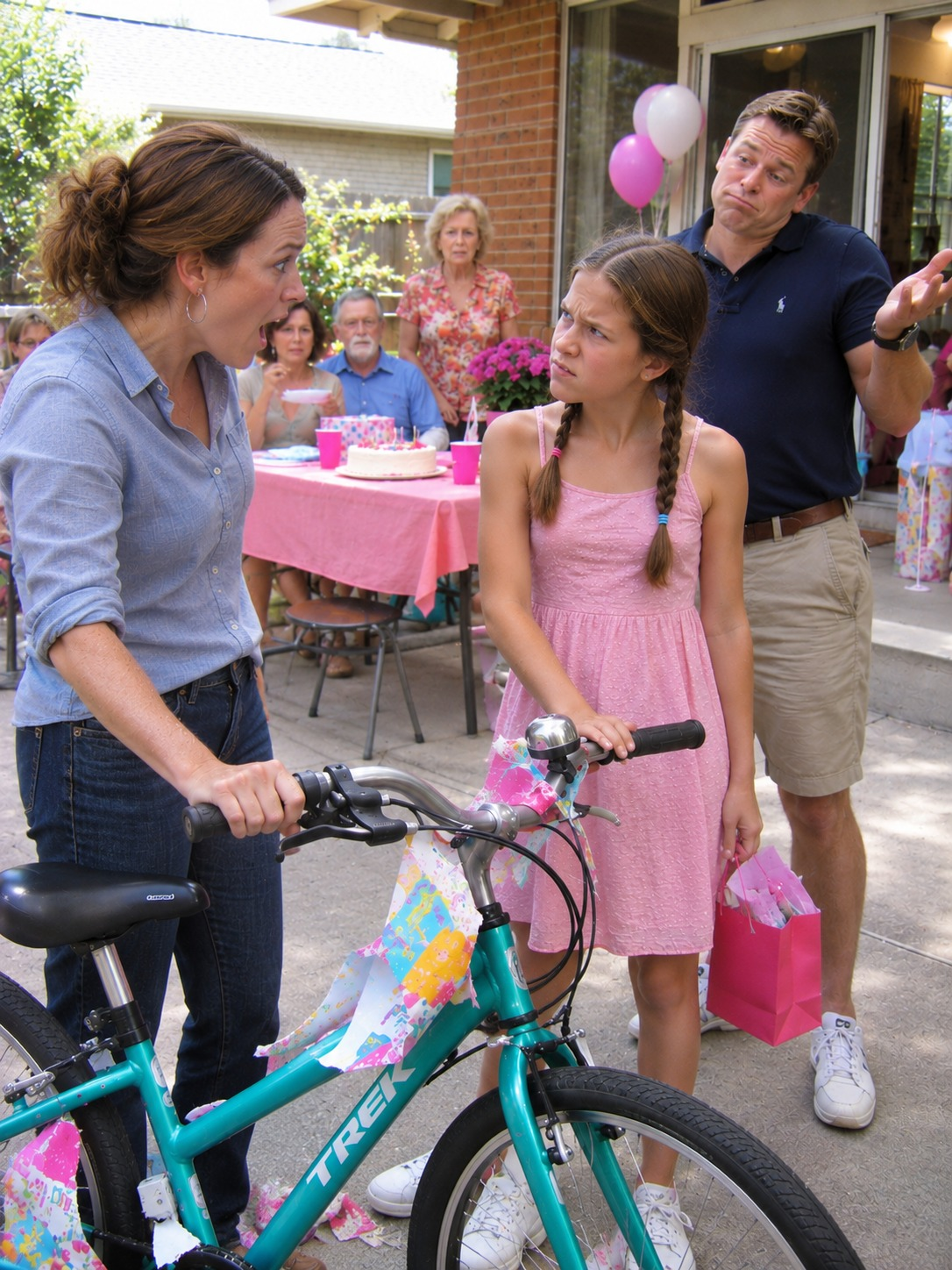
The bicycle was still in the garage.
When I walked past it to retrieve my purse, the wrapping paper shifted in the breeze from the opening door.
I thought about Maddie.
Ninety thousand dollars had originally been set aside for her education.
Grandma Ruth had wanted her to begin adulthood without being crushed by debt.
She had talked about it repeatedly before she died.
"Give a girl choices," she once told me, "and she'll surprise you with what she does."
I wondered how many of those choices remained.
At eight thirty, I called the financial institution.
The representative verified my identity and confirmed that I was listed as a co-trustee.
I explained that I had discovered signatures I did not recognize.
Her voice changed.
She became more formal.
She asked whether I had authorized anyone to sign on my behalf.
"No."
Whether I had given Trevor a power of attorney.
"No."
Whether I had approved the disputed withdrawals through another method.
"No."
She transferred me to a specialist.
The specialist explained that the institution would need to review the transactions and authorization records. He could not determine what had happened during a single telephone conversation.
I requested copies of the original documents and asked what steps were available to prevent additional disputed withdrawals.
He explained the process.
I followed his instructions.
For the first time since opening the account, I felt as though I was doing something useful.
Then he asked a question.
"Are you aware of the amendment submitted approximately eighteen months ago?"
"What amendment?"
He paused.
"I'll include it in the records we provide."
"Can you tell me what it says?"
After another identity verification, he explained that the document purported to change certain administrative arrangements concerning the trustees.
I felt cold.
"I never agreed to an amendment."
He made a note.
The records would be sent through a secure channel.
I thanked him and ended the call.
At nine fifteen, someone knocked on my front door.
It was my mother.
She was carrying a container of leftover birthday cake.
She walked inside before I invited her.
"I thought we'd talk like adults."
I pointed toward the kitchen table.
"That's exactly what I want to do."
She looked at the papers.
Her expression tightened.
"What's all this?"
"Grandma's trust."
"Oh, honey."
She said it with the weary affection people used when they believed someone was being unreasonable.
"Trevor has enough on his plate."
"Mom, money is missing."
"He manages investments. They go up and down."
"These aren't investment losses. They're withdrawals."
She placed the cake on the counter.
"You're angry with him."
"Yes. But that's not why these signatures are here."
I handed her one of the documents.
She examined it.
"That looks like your signature."
"It isn't."
"Are you sure?"
"Yes."
She set the document down.
"Maybe you signed something and forgot."
I looked at her.
For thirty-five years, I had believed that if something truly serious happened, my mother would listen to me.
Not automatically agree.
Just listen.
Instead, she was standing in my kitchen, trying to explain why I might have forgotten authorizing a twenty-four-thousand-dollar withdrawal.
"Mom, did you know he was taking money?"
Her face changed.
It was barely noticeable.
But I saw it.
"Your brother wouldn't steal from his own family."
"That wasn't my question."
She picked up her purse.
"You need to be very careful about what you're doing."
"Why?"
"Because accusations like this destroy families."
I looked at the documents spread across the table.
"Sometimes the thing that destroys a family happens before anybody talks about it."
She left without touching the cake.
An hour later, the secure records arrived.
I opened the disputed amendment.
There were three pages.
The first contained legal language.
The second described the proposed administrative changes.
The third contained signatures and a witness acknowledgment.
Trevor's name appeared first.
Mine appeared second.
Below them was the name of the person who claimed to have witnessed the signing.
I recognized it immediately.
It was my mother's name.






Comments 0