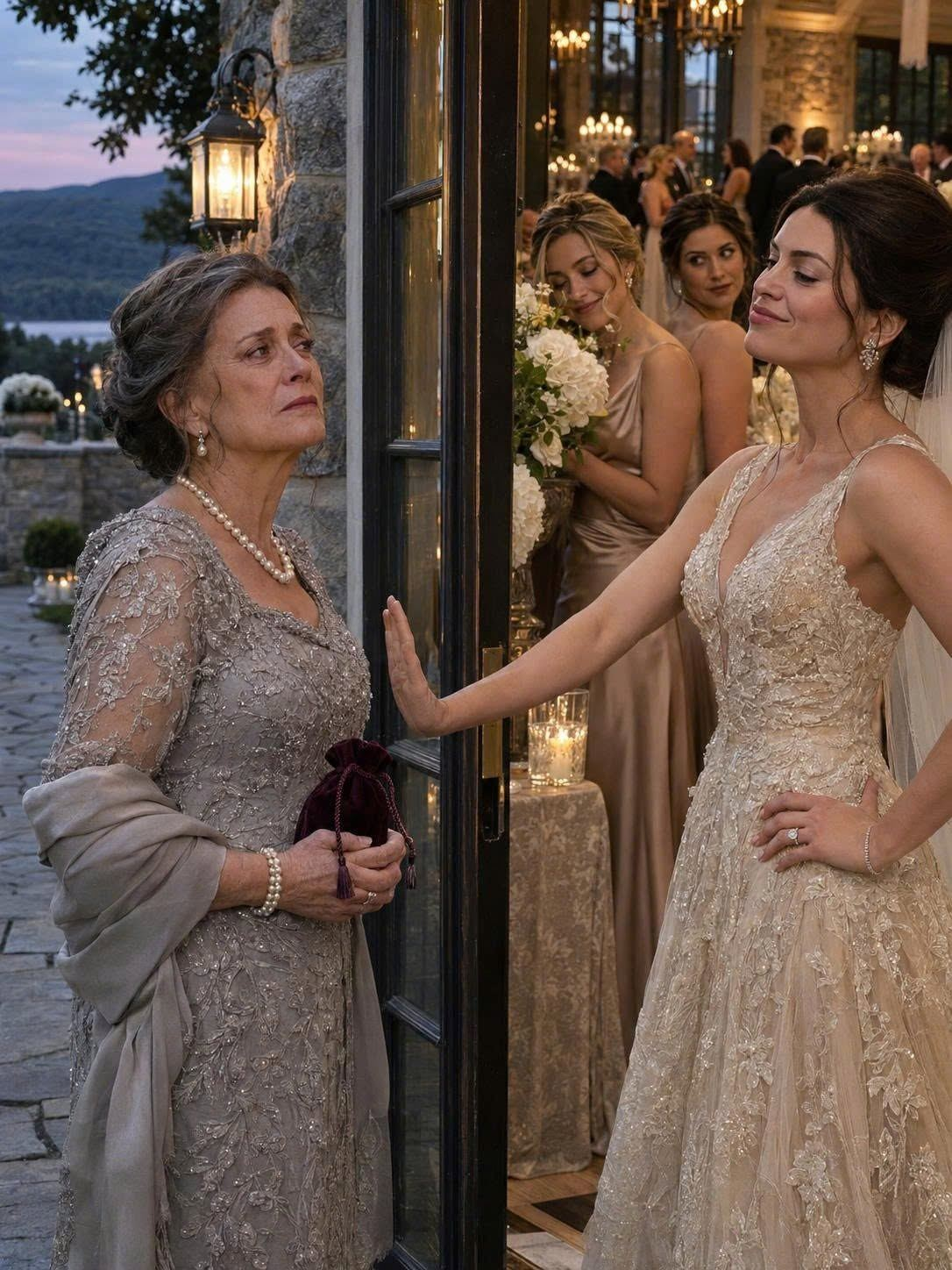
"My son was looking for me?"
I gripped the telephone so tightly that my fingers began to ache.
On the other end, Margaret Hollander hesitated.
"Yes, Desiree. Approximately forty minutes after you left, Bryce came to the front entrance with another man."
I stared at the photograph of Daniel sitting beside my computer.
"Who was the man?"
"Our head of security. His name is Thomas Reed."
"Why was security involved?"
"That's what I want to show you."
I sat forward.
"Margaret, please don't make me guess. Did Bryce know what happened to me?"
"I don't know what he knew when he came downstairs. But I know what happened afterward."
"Tell me."
She took a breath.
"According to the security report, Bryce asked whether his mother had arrived. Thomas told him you had checked in at the entrance and then departed."
My chest tightened.
"He asked whether I'd arrived?"
"Yes."
"After his wife had already sent me away?"
"Yes."
I closed my eyes.
For six days, I had imagined Bryce knowing exactly what Joselyn had done.
I had pictured him standing somewhere inside that beautiful estate, deciding that his mother's humiliation was an acceptable price for keeping his bride happy.
Now Margaret was telling me something different.
He had come looking for me.
Perhaps he hadn't known.
Perhaps he had believed whatever explanation Joselyn gave him.
Or perhaps the truth was more complicated than either possibility.
"What did he say when security told him I'd left?"
Margaret paused.
"He asked whether anyone had spoken to you."
"And?"
"Thomas told him that the bride had met you at the entrance."
I swallowed.
"What happened next?"
"Bryce went back inside."
"That's all?"
"Not quite."
I waited.
"About fifteen minutes later, Joselyn came to the security office and asked whether the entrance cameras recorded audio."
My fingers went still.
"Why would she ask that?"
"She told Thomas there had been a misunderstanding involving a guest, and she wanted to make sure no private conversation had been recorded."
I looked at the printed invoice lying on my desk.
"Did he tell her?"
"He told her that the entrance cameras recorded video only."
I felt a small, unexpected disappointment.
There would be no recording of Joselyn's words.
No unmistakable proof of what she had said.
Only my memory.
And the expressions of the people who had watched it happen.
"Desiree," Margaret continued, "Thomas also documented something else."
"What?"
"Joselyn asked whether footage could be deleted at the request of the wedding party."
I stopped breathing.
"Deleted?"
"Yes."
"Did he agree?"
"Absolutely not. Our security recordings are controlled by estate management. He told her that footage could only be released or removed according to company policy."
I leaned back.
The room seemed suddenly colder.
Joselyn had sent me away.
Then she had apparently worried about whether anyone could prove it.
And sometime during that same afternoon, a document bearing my name had been submitted for seventy-four thousand dollars.
The pieces were beginning to fit together.
But I wasn't ready to decide what they meant.
Not yet.
"Margaret, I need to see that footage."
"I understand."
"And the security report."
"I'll ask Thomas to prepare the relevant records. There may be privacy restrictions on some footage, but we can preserve everything while the matter is reviewed."
"Thank you."
"Desiree?"
"Yes?"
"Please be careful about confronting anyone until you've spoken with an attorney."
I looked at the signature on the second invoice.
"Why?"
"Because if that signature isn't yours, this is no longer just a disagreement about wedding expenses."
I knew she was right.
I had spent more than twenty years running a business.
I understood contracts.
I understood financial responsibility.
And I understood that a document could create enormous trouble when someone was willing to misrepresent who had signed it.
But knowing those things professionally was different from seeing my own name on a document connected to my son's wedding.
"Margaret," I said, "there's something I need to ask you."
"Go ahead."
"Did you know I was turned away that evening?"
Her silence answered before her words did.
"Not until afterward."
"When did you find out?"
"The following morning. Thomas included it in his report, and one of the coordinators mentioned that you had left shortly after arriving."
"Did anyone ask why?"
"Yes."
"And what were they told?"
Margaret's voice became heavy.
"That you had decided not to attend because you were unhappy about the wedding arrangements."
I looked down at my hands.
There it was again.
The same story Bryce had repeated.
I had been difficult.
I had been offended.
I had chosen to leave.
The truth had been replaced before anyone had even bothered to ask me what happened.
"Thank you, Margaret."
"I'll send what I can today."
We ended the call.
For several minutes, I sat without moving.
Then I picked up Daniel's cufflinks.
I had removed them from the velvet bag after returning home, but I hadn't been able to put them back in their drawer.
They rested beside my computer now, two small pieces of silver that had somehow become heavier than anything else in the room.
I turned one over.
The engraved D caught the light.
Daniel had always believed that people revealed themselves most clearly when they thought no one was paying attention.
He used to say it when Bryce was little.
"Watch what someone does when there's nothing in it for them," he would tell our son. "That's when you learn who they are."
I wondered what he would have said about the wedding.
I wondered whether he would have called Bryce immediately.
Or whether he would have done exactly what I was doing.
Waited.
Watched.
Collected the facts.
Then decided.
My computer chimed.
Linda Foster had sent me a message.
I've reviewed the documents. Please call me before you speak to Bryce again.
I dialed her number.
She answered immediately.
"Desiree, I have a question."
"All right."
"Did you sign the original contract electronically?"
"No. I signed it in person when I visited the estate."
"And the additional authorization?"
"I never saw it until today."
"That's what I thought."
I frowned.
"Why?"
"Because the two signatures appear to have been produced in completely different ways."
I looked at the documents.
"What do you mean?"
"The original signature is clearly from a scanned paper document. The ink has small variations. The pressure changes. The lines aren't perfectly uniform."
"And the second?"
"It appears to have been inserted digitally."
I sat upright.
"Inserted?"
"Possibly copied from another source. I can't establish that from a PDF alone, but there are enough differences that I'd want the original electronic file examined."
I stared at the screen.
Someone might not merely have imitated my signature.
Someone might have taken an existing image of it and placed it onto a new agreement.
"Can you tell where it came from?"
"Not from what Margaret sent. We'd need the native document, its history, and whatever system records show how it was created."
I rubbed my forehead.
"How could someone get my signature?"
Linda hesitated.
"Desiree, how many wedding documents did you sign?"
"Several. The original contract, payment authorization, and a few administrative forms."
"Did Bryce have copies?"
"Yes."
"Did Joselyn?"
I thought about it.
Months earlier, Joselyn had asked me to forward the venue paperwork because she wanted to review the payment schedule.
I had sent her the entire folder.
Every signed page.
Every confirmation.
Every document.
My stomach sank.
"Yes," I whispered.
Linda was quiet.
Then she said, "That doesn't prove she did anything. But it means she had access to a signature that could potentially be reused."
I closed my eyes.
I remembered the email.
Joselyn had written that she wanted to make sure the venue arrangements were properly organized.
She had thanked me warmly.
She had even added a little heart at the end.
I had been touched.
I had thought she was trying to include me.
Now I wondered whether I had mistaken convenience for affection.
"What should I do?" I asked.
"First, preserve everything. Don't edit the files. Keep the original emails and attachments."
"All right."
"Second, contact your attorney."
"I have a business attorney."
"Good. Ask whether they can recommend someone who handles contract disputes and suspected signature misuse."
"And Bryce?"
Linda sighed.
"He's your son, Desiree. I can't tell you how to handle that relationship. But financially, you need to stop discussing payment until the documents are verified."
I looked at Daniel's cufflinks.
"Understood."
After the call, I opened my contact list and found the number for my attorney, Robert Ellis.
Robert had represented my company for nearly fifteen years.
He was practical, cautious, and rarely impressed by dramatic explanations.
When I described the situation, he listened carefully.
Then he asked me to send the paperwork.
Twenty minutes later, he called back.
"Desiree, I want you to answer one question clearly."
"All right."
"Did you authorize anyone to sign additional wedding expenses on your behalf?"
"No."
"Did you verbally agree to pay seventy-four thousand dollars beyond the original contract?"
"No."
"Did you approve the services listed?"
"No."
"Then you should dispute the additional authorization in writing immediately."
I took notes.
Robert continued.
"The estate may have its own concerns about how the document was accepted. We need to determine who created it, who submitted it, and what representations were made."
"Can they hold me responsible?"
"Not simply because your name appears on a document. But we need to establish the facts before drawing conclusions."
I appreciated that.
Robert never promised easy victories.
He dealt in evidence.
"There's something else," I said.
I told him about the wedding entrance.
About Joselyn's words.
About Bryce apparently searching for me afterward.
About the request to delete security footage.
Robert remained quiet until I finished.
Then he asked, "Do you believe your son participated in creating the disputed document?"
The question hurt more than I expected.
"I don't know."
"That's an acceptable answer."
"I want to believe he didn't."
"Wanting to believe something and proving it are different matters."
I looked toward the window.
"I know."
"Then we'll investigate the document without making accusations we can't support."
For the first time that day, I felt a little steadier.
Robert agreed to draft a formal dispute notice and request preservation of the relevant records.
He also advised me to keep any future communication about the invoice in writing.
When we ended the call, I opened a new folder on my computer.
I named it:
HOLLANDER WEDDING — RECORDS.
Inside, I saved the contracts, payment confirmations, emails, and notes from my conversations.
It was an ordinary administrative task.
But it felt strange.
I had never imagined creating an evidence folder connected to my son's wedding.
That evening, Bryce sent me a text.
Mom, Joselyn says you're accusing her of fraud. This is getting out of hand.
I stared at the message.
I had not accused Joselyn of anything.
I had asked questions.
I had reviewed documents.
I had spoken with the estate owner and my attorney.
Somehow, that had already become an accusation.
I typed a response.
Bryce, I did not authorize the additional charges. My signature appears on a document I never signed. I am having it reviewed.
His reply arrived almost immediately.
Why can't you just help us?
I read those words several times.
Help us.
I thought about the college tuition.
The apartment down payment.
The emergency money when Bryce changed jobs.
The wedding venue.
I had helped him for most of his life.
And until that moment, I had never thought of those things as evidence that I loved him.
They had simply been things I did.
But now he was asking me why I couldn't help.
As though everything before this had somehow disappeared.
I typed slowly.
I have helped you, Bryce. I paid the original venue cost in full. But I will not accept responsibility for an agreement I never made.
Three dots appeared.
Disappeared.
Appeared again.
Then his message arrived.
Joselyn says you promised to cover everything.
I felt a sharp ache beneath my ribs.
I remembered the first time I met Joselyn.
She had come to Anchorage with Bryce for Thanksgiving.
She was charming.
Beautiful.
Confident.
She complimented the house, asked about my business, and listened politely when I spoke about Daniel.
At dinner, she had asked whether Bryce had always been close to his father.
I told her yes.
I told her about the fishing trips and the terrible jokes Daniel used to tell.
I told her how Bryce had sat beside his father's hospital bed during the final week.
Joselyn had reached across the table and squeezed my hand.
"You're such a strong woman," she had said.
I had believed her kindness.
Now I wondered whether she had been studying me.
Learning what mattered.
Learning what I would do for my son.
I answered Bryce.
I promised to pay the original venue contract. I fulfilled that promise. Please ask Joselyn to show you any message where I agreed to additional charges.
He didn't respond.
I set the phone down.
Then I made dinner.
A simple bowl of soup.
A piece of toast.
I ate at the kitchen counter because the dining table felt too large for one person.
Daniel and I had bought that table when Bryce was twelve.
It had been scratched during birthday parties, homework sessions, and family dinners.
There was still a faint mark near one corner where Bryce had accidentally spilled blue paint during a school project.
I ran my fingers over it.
I had never wanted a perfect family.
I had only wanted an honest one.
At eight forty-three, another email arrived from Margaret.
This one contained a formal incident report prepared by Thomas Reed.
I opened it immediately.
The report listed the time of my arrival.
6:12 p.m.
It noted that I had been greeted by an event coordinator.
It recorded Joselyn approaching the entrance.
Then came a line that made my throat tighten.
Guest identified as Desiree Whitmore departed the property at approximately 6:17 p.m. following a private conversation with the bride.
Five minutes.
That was how long I had been allowed to stand at my only son's wedding.
Five minutes after fourteen hours of travel.
I continued reading.
At 6:54 p.m., Bryce Whitmore approached the entrance with Thomas Reed.
He asked whether his mother had arrived.
Thomas confirmed that she had.
Bryce reportedly appeared confused and asked why she was no longer present.
Thomas informed him that the bride had spoken with her before her departure.
The next sentence caught my attention.
Mr. Whitmore requested that staff contact Mrs. Whitmore's transportation provider to determine whether she remained nearby.
I stopped.
Bryce had tried to find me.
I pressed my fingers against my lips.
For six days, I had believed he hadn't cared enough to notice I was gone.
But according to this report, he had noticed.
He had asked.
He had tried to find out where I went.
Why hadn't he called me?
Why hadn't he sent a message?
I continued.
At 7:09 p.m., Joselyn approached the security office.
She asked whether the entrance cameras recorded audio.
She then asked whether footage could be removed.
Thomas declined.
The report ended with a note that the matter had been referred to estate management for routine review.
I read it twice.
Then a third time.
There was no mention of Bryce signing the additional authorization.
No mention of the seventy-four thousand dollars.
No explanation for why he had stopped looking for me.
I opened the second attachment.
It contained several still images from the entrance camera.
The first showed me approaching the doorway.
I recognized my pearl-gray dress.
My shawl.
The velvet bag in my hand.
The second showed Joselyn standing directly in front of me.
The third showed me turning away.
I stared at that image.
There was something unbearable about seeing yourself at the exact moment your heart had broken.
I looked small.
Not physically.
Emotionally.
I looked like a woman who had arrived expecting love and found a locked door.
Then I opened the fourth image.
Bryce stood near the entrance with Thomas Reed.
His face was turned toward the driveway.
He appeared to be searching for someone.
Me.
My eyes filled.
I had wanted him to come.
He had come.
Just too late.
I sat back and pressed my hands over my face.
For the first time since the wedding, I cried without feeling ashamed.
Not because I had been rejected.
But because I could see how close we had come to finding each other that evening.
A few minutes.
One telephone call.
One honest conversation.
That might have changed everything.
Instead, someone had filled the silence between us with a different story.
My phone rang.
It was Margaret.
"Did you receive the report?"
"Yes."
"Have you looked at the photographs?"
"Yes."
She paused.
"Desiree, there's another document I need to discuss with you."
I wiped my eyes.
"What document?"
"The original electronic submission record for the additional authorization."
I straightened.
"Did you find out who submitted it?"
"We've identified the email account used to send it."
My heart began pounding.
"Whose account?"
"That's the problem."
"What do you mean?"
Margaret hesitated.
"The email address was created to look like yours."
I stared at the phone.
"Mine?"
"Yes. It used your name and a variation of your company's domain."
I felt cold.
Someone had not simply attached my signature to a document.
Someone had apparently created an email address designed to impersonate me.
"Can you send me the details?"
"I already have."
My computer chimed.
I opened the message.
There it was.
An email address that looked almost identical to my business address.
One letter had been changed.
A tiny difference.
Easy to miss.
Especially for someone expecting to receive documents from me.
I enlarged the screen.
Then I noticed the time stamp.
The message had been sent at 6:41 p.m.
Twenty-four minutes after I left the estate.
I was in the back of a car at that moment.
Holding Daniel's cufflinks.
Trying not to cry.
Someone else had been pretending to be me.
"Margaret," I whispered, "who received this email?"
"Our event manager."
"Did she speak with the sender?"
"No. She replied asking for confirmation, and the sender responded in writing."
"What did the response say?"
Margaret's voice tightened.
"It said you had already left the property and would not be available for further questions."
I closed my eyes.
The words were too precise.
Whoever sent them knew I had been turned away.
Knew I had left.
Knew the staff might try to contact me.
And knew exactly how to prevent that.
"There's more," Margaret said.
I looked at the screen.
"What?"
"The sender attached a scanned copy of your driver's license."
My mouth went dry.
I had provided that identification during the original venue arrangements.
The copy had been included in the administrative folder I forwarded to Joselyn months earlier.
"Desiree?"
"I'm here."
"Do you recognize the document?"
"Yes."
"Did you authorize anyone to use it?"
"No."
Margaret was silent.
I looked at Daniel's photograph.
For years, I had believed that being generous meant giving without keeping score.
But this wasn't generosity anymore.
This was someone treating my identity as something they could borrow whenever they wanted money.
I opened my notebook and wrote three words.
Who sent it?
Then I underlined them.
"Margaret, I need the original message files preserved."
"They are."
"And I need to know whether the estate has any record showing where the submission originated."
"We've asked our technical provider to preserve the available logs."
"Thank you."
She hesitated.
"Desiree, I should tell you something else."
"What?"
"The event manager remembers receiving a telephone call shortly after that email arrived."
"From whom?"
"Someone claiming to be your assistant."
I frowned.
"My assistant?"
"Yes. The caller said you were traveling and had authorized the additional expenses."
I stood up.
I had an assistant.
Her name was Caroline Mercer.
She had worked for me for six years.
She handled my calendar, travel arrangements, and correspondence.
She had helped organize the trip to New York.
But Caroline had never been involved in the wedding payments.
And she certainly hadn't called the estate on my behalf.
"Did the caller give a name?"
Margaret paused.
"Yes."
I held my breath.
"What name?"
"Caroline Mercer."
For a moment, I couldn't speak.
Caroline had access to my schedule.
My business correspondence.
My travel itinerary.
And some of my financial records.
But she was also one of the people I trusted most.
She had helped me through the worst months after Daniel died.
She had brought groceries when I forgot to eat.
She had stayed late at the office when I couldn't concentrate.
She had never given me a reason to question her loyalty.
"Margaret," I said slowly, "are you certain?"
"That's the name in the event manager's notes."
I looked toward the office door.
Caroline had left work hours earlier.
I had spoken with her that morning.
She had asked how my trip went.
I had told her it was difficult.
She hadn't pressed.
Now I wondered whether she had already known.
"Did the caller leave a number?"
"Yes. I'll send it to you."
I thanked her and ended the call.
Then I sat down and opened my contacts.
Caroline's number appeared on the screen.
I almost pressed it.
But Robert's warning returned to me.
Don't confront anyone until the records are preserved.
I lowered the phone.
A few seconds later, Margaret's email arrived.
I opened the attached call record.
The number was listed beneath the name Caroline Mercer.
I compared it with the number saved in my phone.
They were different.
Not even close.
I felt a small wave of relief.
Someone had used Caroline's name.
That didn't mean Caroline had made the call.
But it meant the impersonation had gone further than I realized.
My name.
My signature.
My identification.
My assistant's name.
Every detail had been chosen to make the authorization appear legitimate.
I forwarded the records to Robert.
Then I sent Caroline a simple message asking her to preserve any emails or documents connected to the wedding arrangements.
She replied within minutes.
Of course. Is something wrong?
I stared at the question.
I typed:
I'm reviewing a disputed invoice. We'll discuss it tomorrow.
Her response came quickly.
Understood. I'll have everything ready.
I placed the phone down.
It was nearly ten o'clock.
The house was quiet.
I walked into the living room and stood beside the fireplace.
Daniel's photograph sat on the mantel.
I picked it up.
He was smiling in the picture, wearing a blue shirt with his sleeves rolled up.
Bryce stood beside him, twelve years old, holding a fishing rod.
They looked so happy.
I touched the glass.
"Daniel," I whispered, "I don't know what happened to our boy."
The room offered no answer.
I returned to my office.
A new email had arrived from Robert.
He had reviewed the latest documents and wanted to meet the next morning.
At the bottom of his message, he had written:
Do not assume the person who benefited from this transaction is necessarily the person who created it.
I read that sentence several times.
It was a warning.
A reminder that evidence mattered more than anger.
I was about to close my computer when another message appeared.
This one came from an unfamiliar address.
There was no subject line.
Only one attachment.
A photograph.
I hesitated.
Then I opened it.
The image showed the estate's private administrative office.
A desk.
A computer.
A stack of wedding documents.
And two people standing beside the printer.
One was Joselyn.
The other was a man whose face was turned away from the camera.
He wore a dark suit.
His right hand rested on a folder marked with my name.
I enlarged the image.
Something silver caught the light near his wrist.
A watch.
I recognized it immediately.
I had given that watch to Bryce for his thirtieth birthday.
My heart began pounding.
Then I noticed a handwritten message beneath the photograph.
Ask your son who was in the office at 6:41.
I stared at the words.
At the time stamp.
At the watch.
At the folder bearing my name.
For several seconds, I couldn't move.
Then my phone vibrated.
Another message from the same unknown sender.
This time, there was no photograph.
Only six words.
The person beside Joselyn wasn't Bryce.
I looked back at the image.
The watch was identical.
The suit was similar.
But the man's posture was different.
And suddenly I noticed something I had missed.
His left hand.
A dark ring.
Bryce didn't wear a ring like that.
Not before his wedding.
Not afterward.
My phone vibrated again.
A third message appeared.
If you want to know who signed your name, open the next attachment.
I watched the screen.
A new file began downloading.
Its title appeared beneath the message.
HOLLANDER_ESTATE_PRIVATE_OFFICE_6-41PM.mp4
The download finished.
I reached for the play button.
And before I could touch it, my phone rang.
The caller ID showed a name I had never expected to see.
JOSELYN WHITMORE.






Comments 0