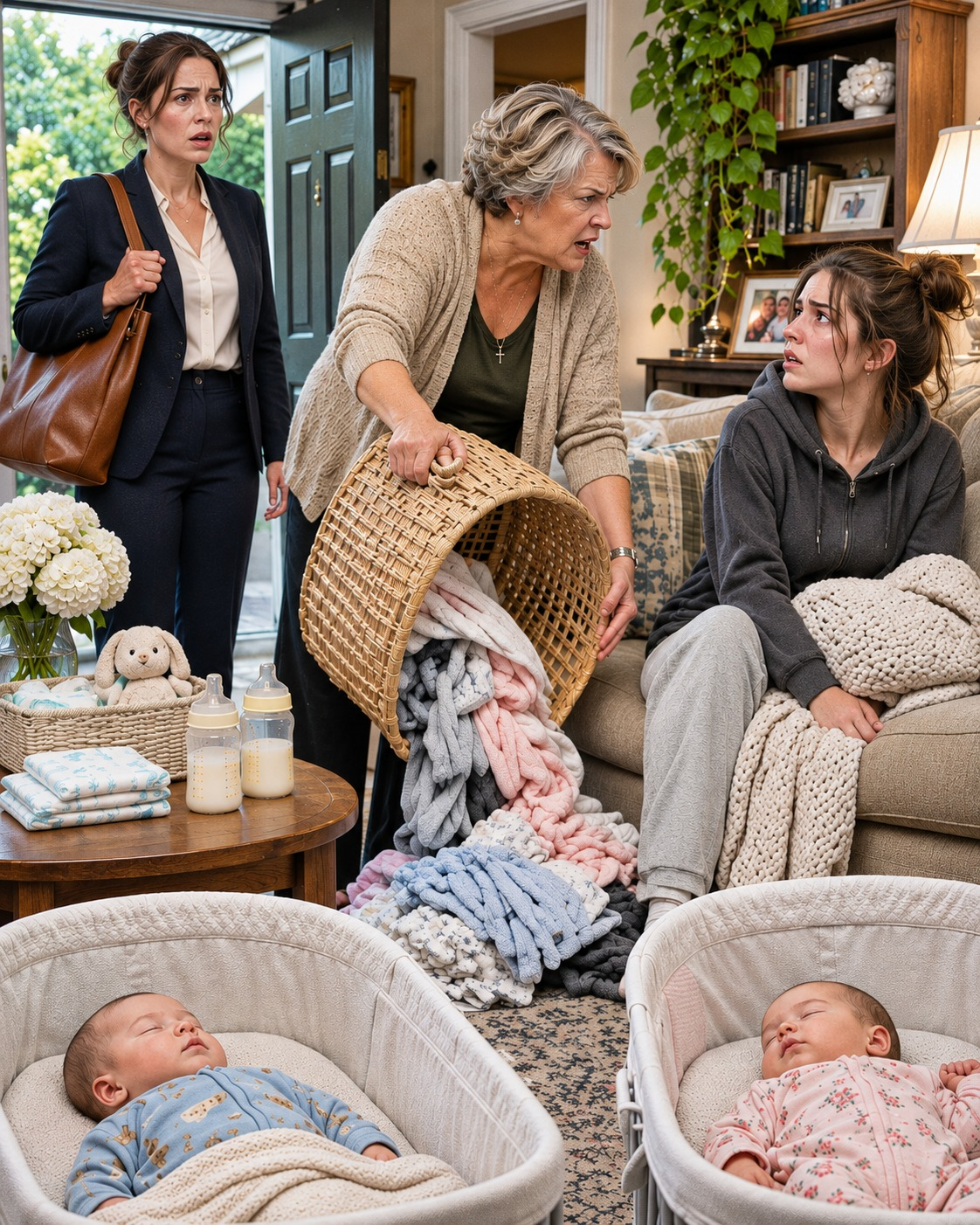
"If your mother ever finds out why you've really been missing school, I'll make sure she knows exactly what kind of daughter she's raising."
I read the message once.
Then again.
My fifteen-year-old daughter stood beside our bed, gripping her phone so tightly that her knuckles had turned white.
The message had been sent by my mother-in-law at 6:14 that morning.
The woman I had paid $2,400 to care for my newborn twins.
The woman who had spent three weeks telling me my daughter was lazy, dishonest, and jealous of her baby brother and sister.
I looked up at Hadley.
"What does this mean?"
She didn't answer.
Instead, she glanced toward the bedroom door.
"Is Dad downstairs?"
"He's taking the trash out."
"Can you close the door?"
Something about that request frightened me more than the message itself.
Hadley had never been afraid to talk in her own home.
Not before the twins.
Not before Judith started coming every weekday.
I got up carefully, feeling the familiar pulling sensation near my C-section incision, and closed the door.
When I turned around, Hadley was sitting on the edge of the bed.
Her shoulders were hunched.
Her eyes were fixed on the floor.
"Sweetheart," I said, sitting beside her, "you can tell me anything."
She gave a small, humorless laugh.
"That's what you said last time."
The words landed harder than I expected.
"What last time?"
"When I told you Grandma was making me do everything."
I remembered.
It had been late October.
I had come home after a particularly difficult day at work, with a headache that made every sound feel too loud.
Hadley had tried to tell me Judith was leaving her alone with the twins.
I had barely listened.
I remembered saying, "Your grandmother is helping us. You need to help her, too."
At the time, it seemed reasonable.
Now I could barely stand remembering it.
"Hadley, I didn't understand."
"I know."
She said it so quietly that I almost wished she'd yelled.
Anger would have been easier.
Anger would have meant she still expected me to listen.
Instead, she sounded like someone who had already given up.
I reached for her hand.
She let me take it, but her fingers remained stiff.
"Tell me what happened."
She stared at the phone.
"Grandma said you were having a hard time after the surgery."
"That's true."
"And that Dad was worried about money."
"That's true, too."
"She said if I loved you, I would stop making things harder."
I felt my throat tighten.
"What things?"
"School. Homework. Complaining about being tired."
I looked at her.
"Your grandmother told you school was making things harder for me?"
Hadley nodded.
"Not exactly like that. She said you needed your job, and if the babies weren't taken care of, you'd have to quit."
I stared at her.
"Hadley, why would I have to quit? We hired her."
My daughter looked up.
For the first time that evening, something sharp flashed across her face.
"That's what I kept telling her."
The room went silent.
From the bassinets beside our bed, Ellie made a soft sleeping noise.
Miles shifted his head slightly.
Both babies remained asleep.
I watched Hadley glance toward them automatically.
Even exhausted, she checked on them without thinking.
It was the movement of someone who had been doing it all day.
Every day.
And suddenly, the six absences on my laptop began to look very different.
"Start at the beginning," I whispered.
Hadley swallowed.
"The first day was October twentieth."
I remembered that date.
It was my second day back at work.
I had been terrified of leaving the twins.
Judith had assured me everything would be fine.
She had even sent photographs of Ellie and Miles sleeping peacefully in their bassinets.
I had shown those pictures to two coworkers, telling them how lucky we were to have family helping.
"Grandma called me at school," Hadley said.
"During class?"
"She texted first. I didn't answer because we weren't supposed to have our phones out."
"What did she say?"
Hadley scrolled through her messages.
Then she handed me the phone.
The first message was timestamped 9:17 a.m.
Grandma Judith: Your mother isn't answering. I need you home.
At 9:23, another message followed.
Grandma Judith: Miles has been crying for an hour. I can't manage both babies alone.
At 9:31:
Grandma Judith: If something happens because you refused to help, you'll have to live with that.
I stopped reading.
My stomach turned.
"She told you something might happen to Miles?"
Hadley nodded.
"I thought he was sick."
"Why didn't you call me?"
"I tried."
She opened her call history.
There it was.
October 20.
9:36 a.m.
An outgoing call to my number.
I remembered missing it.
I had been in a meeting.
When I saw the missed call afterward, Judith had already texted me that everything was fine.
I had assumed Hadley wanted something ordinary.
Maybe permission to stay after school.
Maybe money for lunch.
I hadn't called her back until late afternoon.
And by then, according to Judith, my daughter had been skipping school.
I pressed my hand against my mouth.
"What happened when you got home?"
"Grandma was watching television."
I stared at her.
"What?"
"She was sitting on the couch. Ellie was asleep. Miles was asleep, too."
"Then why did she tell you he wouldn't stop crying?"
Hadley shrugged.
"She said he'd finally settled down."
"And then?"
"She told me to wash the bottles and fold the baby clothes."
I closed my eyes.
"Hadley."
"She said since I'd already come home, I might as well make myself useful."
I wanted to stand up.
I wanted to drive to Judith's house.
I wanted to demand an explanation for every message, every lie, every minute my daughter had spent worrying about babies who were supposed to be in an adult's care.
But Hadley was still talking.
And for once, I was going to listen to every word.
"The second time was October twenty-second," she said.
"She told me Ellie had a fever."
My heart jumped.
"A fever?"
"That's what she said."
"Did Ellie actually have one?"
"I don't think so."
"Why?"
"Because when I got home, Grandma said she'd checked again and the thermometer was wrong."
I remembered October 22.
Judith had told me Hadley left school because she was angry about being grounded from her phone.
I had believed her.
Worse, I had confronted Hadley about it that evening.
I remembered standing in the kitchen, holding a bottle of expressed milk, telling my daughter that she couldn't use the twins as an excuse to avoid school.
Hadley had stared at me.
Then she had said, "Okay, Mom."
Nothing else.
Now I understood why.
"Why didn't you tell me Grandma said Ellie was sick?"
"I did."
I shook my head.
"No, honey. You told me the school made a mistake."
"Because Grandma told me not to mention the fever."
"Why?"
"She said you'd panic and think she couldn't handle the babies."
I looked at her.
"And you believed her?"
Hadley's face crumpled slightly.
"She said you were still healing. She said stress could put you back in the hospital."
I felt tears sting my eyes.
I hadn't cried when I saw the attendance report.
I hadn't cried when I read Judith's threatening message.
But hearing that my daughter had been frightened into silence by the possibility of hurting me nearly broke something inside my chest.
"Hadley, listen to me."
She looked up.
"You are not responsible for my recovery."
Her eyes filled.
"You are not responsible for our money."
A tear slipped down her cheek.
"And you are not responsible for raising your brother and sister."
She looked away.
"Grandma said families help each other."
"Families do help each other."
"Then why was it wrong?"
I took a breath.
"Because helping is something you can choose to do. What she did was make you afraid that something terrible would happen if you said no."
Hadley wiped her cheek quickly.
"She said I was selfish."
I shook my head.
"No."
"She said you were disappointed in me."
My voice cracked.
"No, sweetheart."
"She said you told her I was becoming difficult."
I froze.
That one was close enough to the truth to hurt.
A few weeks earlier, I had told Judith that Hadley seemed withdrawn.
I had asked whether teenagers normally became distant after a new baby arrived.
Judith had smiled and told me not to worry.
"She's just testing boundaries," she'd said.
I had trusted her.
She had taken my concern and turned it into a weapon.
"I never said I was disappointed in you," I told Hadley.
"But you believed her."
There was no accusation in her voice.
Only a fact.
And that made it worse.
I nodded slowly.
"Yes."
She looked surprised.
"I believed things I should have questioned," I continued. "And I am sorry."
Hadley stared at me.
I could tell she hadn't expected an apology.
Maybe she had expected another lecture.
Maybe she had expected me to explain why I had been too tired or too busy to notice.
I could have done that.
I had plenty of explanations.
None of them would have changed what happened.
"I should have listened," I said. "You tried to tell me, and I didn't listen."
She began crying then.
Not loudly.
She simply leaned forward, covered her face, and cried into her hands.
I pulled her close.
For a moment, she resisted.
Then she folded against me.
I held her carefully, mindful of my incision, and let her cry.
"I'm sorry," she whispered.
I tightened my arms around her.
"For what?"
"For missing school."
"Oh, baby."
"I know I shouldn't have."
"You were trying to protect your brother and sister."
She shook her head.
"I should've told somebody."
"You did tell somebody."
She pulled back.
I looked directly into her eyes.
"You told me."
She started crying harder.
I wished I could go back to October twentieth.
I wished I could answer that first missed call.
I wished I could see what was happening before my daughter learned that silence was safer than telling the truth.
But wishes weren't going to fix six missed school days.
They weren't going to undo the threats.
And they weren't going to explain why Judith had needed my daughter home so badly.
I reached for a tissue.
"Hadley, what happened on the other four days?"
She wiped her face.
"Mostly the same thing."
"Mostly?"
She hesitated.
"Sometimes Grandma said she had appointments."
"What appointments?"
"Hair appointments. Errands. Once she said she needed to meet somebody."
I stared at her.
"She left you alone with the twins?"
Hadley nodded.
"How long?"
"Sometimes a couple hours."
My pulse quickened.
"How many times?"
"I don't know."
"Hadley."
She looked frightened again.
I softened my voice.
"I'm not angry with you. I need to understand."
She picked at a loose thread on her sweatshirt.
"She left almost every day."
The words seemed to hang in the air.
Almost every day.
I thought about my work schedule.
Eight hours.
Twenty weekdays.
I thought about the money.
$2,400.
I thought about Judith's insistence that she was sacrificing her time to help us.
And I thought about my fifteen-year-old daughter sitting alone in our living room with two newborn babies.
"Even on days you went to school?" I asked.
"Sometimes she waited until I got home."
"What time?"
"Usually around three."
I looked at the clock.
It was almost ten.
My daughter should have been sleeping.
Instead, she was explaining how she had become an unpaid childcare worker while the adult we hired disappeared.
"Did Grandma ever tell you where she was going?"
Hadley shook her head.
"She said grown-ups didn't have to explain themselves to children."
I looked down at her phone.
There were dozens of messages.
Some demanding.
Some guilt-inducing.
Some strangely affectionate.
You're such a good big sister.
Your mother would be proud if she knew how much you helped.
Don't bother Celia with this. She has enough problems.
Then, only hours later:
Stop acting spoiled.
You live in that house for free.
If you can't do one simple thing, maybe your mother needs to know what kind of girl you've become.
I scrolled farther.
The messages followed a pattern.
Judith would ask Hadley to come home.
Hadley would hesitate.
Judith would mention my health, the family's money, or the babies' safety.
Hadley would agree.
Then Judith would tell her not to mention it.
I felt sick.
"Did she ever tell you to lie to the school?"
Hadley nodded.
"She said if anyone asked, I should say I wasn't feeling well."
"Did you?"
"Sometimes."
"What about the days you were marked absent all day?"
"She told me to stay home before school started."
I stared at her.
"How?"
"She'd text me really early."
I remembered the 6:14 message.
"She'd say she wasn't feeling well or that she needed help with the babies. She said if you missed work, we might lose the house."
I looked toward the bassinets.
Ellie slept with one hand beside her cheek.
Miles made a tiny sound and settled again.
They were innocent.
Hadley was innocent.
And Judith had used all three of them to frighten a child into doing an adult's job.
I opened the attendance report again.
Six dates.
Six opportunities for someone to notice.
Six days I had paid for childcare that my daughter had apparently provided.
"Hadley, did you do your homework on those days?"
She nodded.
"After the babies went to sleep."
"What time?"
"Sometimes ten. Sometimes eleven."
"That's why you've been so tired."
She looked down.
"I tried to keep up."
"How are your grades?"
Her silence answered before she did.
"Not good."
I felt another wave of guilt.
Hadley had always been a strong student.
Not perfect.
But responsible.
She cared about her grades.
She wanted to join the school's health sciences program the following year.
She had talked about becoming a pediatric nurse.
Now she was missing classes to care for babies while the woman we paid told everyone she was irresponsible.
"Did your teachers ask what was happening?"
"Ms. Parker did."
"Your English teacher?"
Hadley nodded.
"She asked if everything was okay at home."
"What did you say?"
"That I was tired because of the twins."
I closed my eyes.
"And?"
"She told me I could talk to the counselor."
"Did you?"
"Once."
I looked at her.
"When?"
"Last Thursday."
November 5.
The day before her sixth full-day absence.
"What did you tell the counselor?"
Hadley rubbed her palms against her jeans.
"Not everything."
"Why not?"
"Because Grandma said if people thought you couldn't take care of us, they might take Ellie and Miles away."
For a moment, I couldn't speak.
I had spent nine weeks worrying about whether I was doing enough as a mother.
Judith knew that.
She knew I was terrified of failing my children.
And she had used that fear against Hadley.
I took my daughter's hands.
"Listen carefully. Asking for help does not mean someone automatically takes your babies away. And you never have to hide something unsafe or unfair to protect me."
Hadley nodded, but I could tell the fear hadn't disappeared.
It had been planted too deeply.
"Did the counselor call me?"
"She said she would."
I remembered a missed call from an unfamiliar school number.
I had assumed it was another attendance reminder.
I hadn't returned it.
Another missed chance.
I looked at the clock.
10:18 p.m.
I needed to speak to the school first thing in the morning.
I needed to document everything.
And I needed to make certain Judith would never again be alone with my children until I understood exactly what had happened.
I picked up my phone and opened my calendar.
"You're going to school tomorrow," I told Hadley gently. "But I'm coming with you."
Her eyes widened.
"Am I in trouble?"
"No."
"Are they going to suspend me?"
"I don't know what the school will decide about the absences. But we're going to tell them the truth."
She looked relieved and terrified at the same time.
"What about Grandma?"
I took a breath.
"She won't be watching the twins tomorrow."
Hadley stared at me.
"But you have work."
"I'll call Denise."
"And Dad?"
"We'll talk to him."
Her expression changed.
She looked down again.
"What if he believes Grandma?"
I didn't have an easy answer.
Travis loved his mother.
He defended her automatically.
He had spent his entire life explaining away her behavior.
She was stubborn.
She was old-fashioned.
She meant well.
She didn't know how to express affection.
Those explanations had become so familiar that neither of us questioned them anymore.
But this wasn't about Judith's personality.
This was about our daughter.
"I'll make sure he hears you," I said.
Hadley studied my face.
Then she asked the question I deserved.
"Will you believe me even if Grandma says I'm lying?"
I felt tears rise again.
"Yes."
She searched my eyes.
"Promise?"
"I promise."
She nodded.
Then she looked toward the door.
"There's something else."
My heart sank.
"What?"
She reached for her phone.
"Grandma told me not to tell you because it would make Dad really angry."
I waited.
Hadley opened her photo gallery.
There were pictures of the twins.
Bottles.
Laundry.
A screenshot of a school assignment.
Then she stopped scrolling.
Her thumb hovered over a photograph taken inside our living room.
"She made me take this," Hadley whispered.
"Why?"
"She said she needed proof."
"Proof of what?"
Hadley didn't answer.
She turned the phone toward me.
Before I could see the photograph clearly, my own phone vibrated on the nightstand.
A message from Judith.
I looked at the screen.
Judith: Celia, we need to talk about Hadley before she tells you something that isn't true.
A second message arrived immediately.
Judith: And whatever you do, don't let Travis see the picture she took.
Then a third message appeared.
This one contained an attachment.
A photograph.
I tapped it.
The image began to load.
And when the first few inches appeared on my screen, I recognized the person standing beside my daughter's bedroom door.






Comments 0