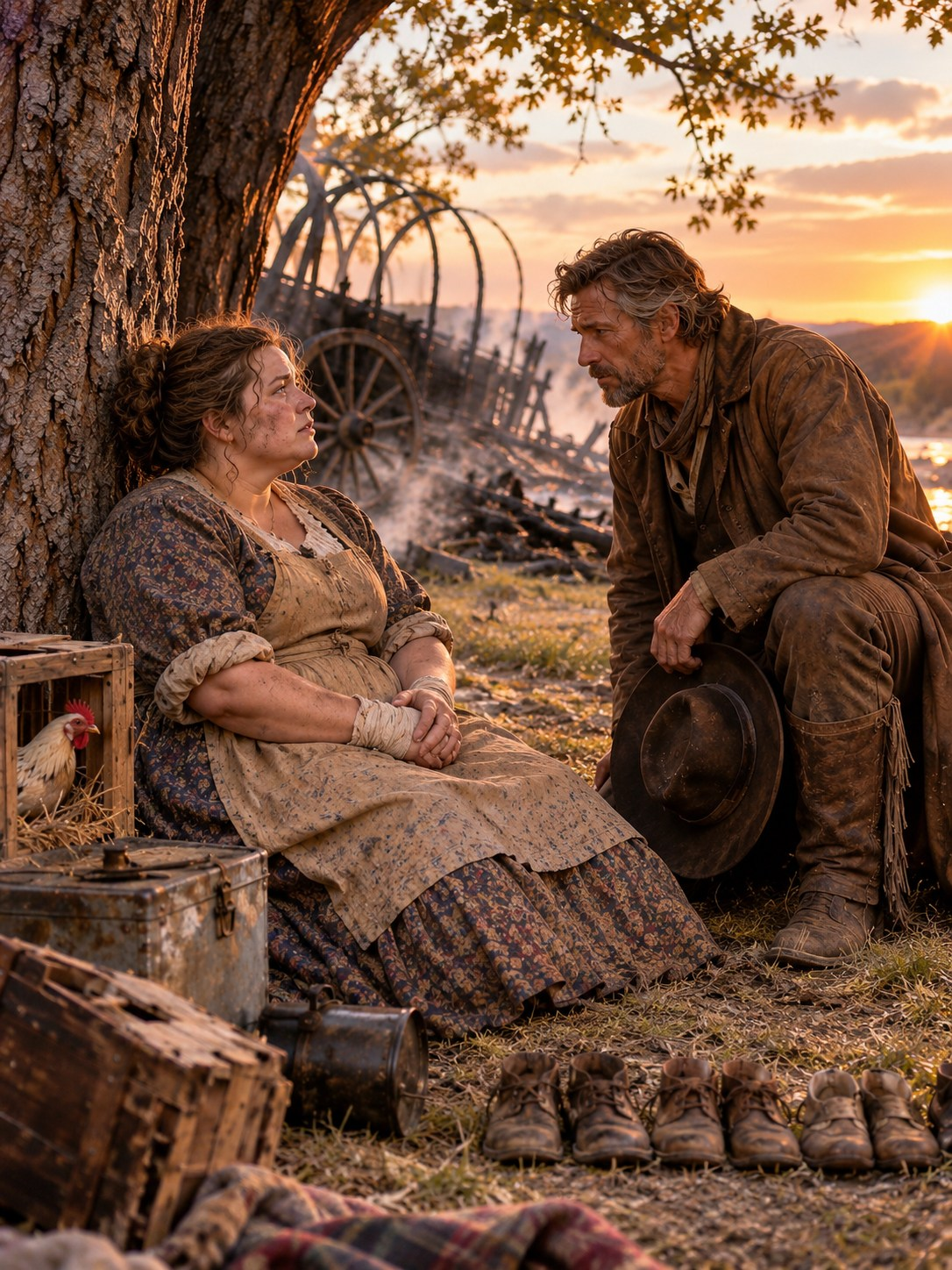
"Stay back, mister! I'll use this axe if you come any closer!"
My fifteen-year-old son stood between a stranger on horseback and the six children huddled behind me.
His hands shook around the wooden handle.
The stranger had just ridden up beside our burned wagon.
He looked down at us from a tall gray horse, his weathered face hidden beneath the shadow of a dark cowboy hat.
Then he noticed the little metal can lying in the ashes.
And suddenly, he stopped looking at us like strangers.
He looked at us like witnesses.
My name is Octavia Vandermeer.
Five weeks before that morning, I had buried my husband.
Five weeks before that morning, I had still believed that if a person worked hard enough, prayed sincerely enough, and held her family together tightly enough, the world would eventually offer her a fair chance.
I no longer believed that.
My husband, Jan, had died of fever on the Platte.
He had been buried beneath a simple wooden cross, far from the home we had once imagined building together.
Before his death, he had purchased a quarter section of land near Ash Creek for two hundred dollars.
It was supposed to be our beginning.
We had seven children, a wagon full of necessities, a rooster in a wooden crate, and a small metal box containing our most important papers.
We had no fortune.
We had no influential relatives.
But we had land waiting for us, and Jan had believed that would be enough.
He had been wrong about many things during his final weeks.
I wished he had been wrong about dying, too.
The journey had been difficult, but I had never allowed myself to complain where the children could hear.
Hendrick, our oldest, had begun behaving more like a man than a boy.
Greta helped me prepare meals.
Anneke guarded the document box.
The twins, Willem and Pieter, argued over everything from breakfast to sunset.
Joost followed his older siblings everywhere.
And little Lise, barely two years old, seemed to believe that the entire world existed to carry her from one pair of arms to another.
They were my whole life.
That was why I had done what I did when the fire began.
I had run back into the burning wagon.
I had burned my hands.
I had twisted my ankle.
I had nearly lost consciousness from the smoke.
But I had gotten every child out.
Every single one.
I repeated those words whenever exhaustion threatened to overwhelm me.
I got them all out.
That morning, I was sitting beneath a cottonwood tree beside the remains of our wagon.
The wooden wheels had burned.
The canvas had disappeared.
The iron frame was still hot enough in places to make the air shimmer.
Our belongings lay scattered across the grass.
The few things I had managed to save looked pitiful beside the destruction.
My hands were wrapped in strips torn from my own petticoat.
My right ankle had swollen badly.
I could barely move it.
The children had gathered around me.
Lise slept against my side with one tiny fist pressed against her mouth.
The rooster occasionally moved inside its crate, apparently unaware that we had lost nearly everything.
I had not cried.
Not because I did not want to.
But because I knew that if I started, I might not be able to stop.
Then we heard the horse.
Hendrick noticed it first.
He rose immediately, found the small axe we had carried for cutting wood, and stepped in front of his siblings.
"Stay behind me," he whispered.
I recognized the fear in his voice.
He was trying to sound brave because the others were watching.
A rider appeared beyond the creek.
He came down the slope quickly, his gray horse moving with the confidence of an animal accustomed to difficult country.
When he saw the wagon, he pulled hard on the reins.
The horse stopped so abruptly that its hindquarters dropped.
The man stared at the wreckage.
Then he saw us.
I watched his expression change.
He was tall and lean, with a long face, a thick gray beard, and silver beginning to show at his temples.
His clothes were practical rather than decorative.
A dark hat.
A weathered leather vest.
A faded green shirt.
He looked like someone who had spent most of his life outdoors.
Hendrick raised the axe.
"Stay back!"
The stranger immediately lifted both hands.
"I'm not coming any closer than you want me to, son."
His voice was deep but calm.
"My name's Ichabod Hightower. I run cattle on the bench up yonder. I saw the smoke."
He looked toward me.
"Ma'am, are you hurt bad?"
I studied him carefully.
There was something unusual about his eyes.
They were tired.
Not merely the tiredness of a man who had worked too many hours.
It was a deeper exhaustion, the kind that seemed to have settled permanently behind his expression.
"My name is Octavia Vandermeer," I said.
I forced myself to sit straighter.
"These are my children. Hendrick, put the axe down. He is a neighbor."
Hendrick hesitated.
Then the axe lowered slightly.
The stranger did not move.
That helped me more than I could explain.
"My hands are burned," I continued. "Not too deeply, I think. My ankle is worse. I twisted it when I jumped from the wagon with Lise."
I glanced at the children.
"The others are not hurt."
My voice broke slightly.
I swallowed.
"I got them all out."
Ichabod Hightower looked at the bandages covering my hands.
He seemed to understand that there was nothing useful he could say.
Instead, he slowly dismounted.
He left his horse standing and approached only after Hendrick had lowered the axe another inch.
The rancher knelt in the grass beside me.
He examined my hands without touching them.
"Where's your man, Mrs. Vandermeer?"
"Buried."
The word came out harder than I intended.
"On the Platte. Five weeks ago. Fever."
He lowered his eyes briefly.
"I'm sorry."
I nodded.
There was no point explaining that I had already heard those words from too many people.
I looked toward the burned wagon.
"We have a paper for a quarter section on this creek. My husband paid two hundred dollars for it in Omaha. We were supposed to file at the land office in Ash Creek this week and begin building before winter."
I looked down at my hands.
"Now we have the paper and nothing else."
A small movement beside me caught my attention.
Anneke had been clutching the dented metal box against her chest.
She stepped forward and lifted it slightly.
"I saved it, Mama."
I looked at her.
For the first time that morning, something resembling a smile almost reached my face.
"Yes, darling. You did."
"Good girl," I whispered.
Ichabod looked at the box.
Then he glanced toward the burned wagon.
He rose slowly.
Something about his expression had changed.
He walked around the wreckage.
At first, I thought he was simply examining the damage.
But then I noticed the way he studied the ground.
He looked at the wagon's iron frame.
The direction in which the canvas had burned.
The blackened remains of a trunk.
Then he moved toward the creek.
I watched him bend down.
He picked something up.
It was a small metal can.
Even from where I sat, I could see the way he held it carefully.
He turned it once in his hand.
Then he looked toward the muddy bank.
I could not see what he had found there.
But I saw his shoulders become rigid.
He walked farther along the creek.
A few moments later, he returned.
His face had lost what little softness it had shown earlier.
"Mrs. Vandermeer?"
"Yes?"
"Did you hear anything last night before the fire?"
I thought about it.
The children had been asleep.
The journey had exhausted all of us.
"I heard a horse," I answered.
His eyes sharpened.
"Where?"
"Near the creek. Very late. I thought I was dreaming."
I looked toward the remains of the wagon.
"Then Willem woke screaming. The wagon was burning."
Ichabod glanced at the metal can.
He said nothing for a moment.
Then he spoke carefully.
"Someone may have brought this here."
My stomach tightened.
"What is it?"
"Coal oil."
I stared at him.
He looked toward the wagon.
"A cook fire doesn't usually burn a wagon from the back end forward. And that canvas..."
He paused.
"Someone knew what they were doing."
I felt cold despite the warmth of the morning.
Someone.
Not an accident.
Not a careless lantern.
Someone had deliberately set fire to the wagon while seven children and their mother slept inside.
My fingers curled around the edge of my dress.
"Why would anyone do that?"
"I don't know yet."
He looked toward the creek again.
"But I intend to find out."
Nobody spoke.
The rooster crowed inside its crate.
The sound was so ordinary that it almost seemed cruel.
Then Joost, who had been watching Ichabod without taking his eyes off him, asked a question.
"Mister?"
The rancher turned.
"Yes, son?"
Joost looked toward the gray horse.
Then at the ruined wagon.
Then at me.
"Are you going to leave us here too?"
The question struck me harder than the fire had.
I reached for my son.
"Joost..."
But he was still looking at the stranger.
He was only five.
He did not understand the cost of land.
He did not understand the legal difficulties facing a widow.
He did not understand that seven children without a home could become a burden that even good people might hesitate to accept.
He understood only that strangers had appeared before, and people had left.
Ichabod did not answer immediately.
He looked at Joost.
Then at Hendrick, who still held the axe.
Then at Greta, who had one hand on Lise's blanket.
He looked at Anneke and the metal box.
At the twins.
At the seven small lives gathered beneath that tree.
Something moved across his face.
It was not pity.
It was something heavier.
A memory.
He lowered his head briefly.
Then he looked back at Joost.
"No," he said.
His voice was quiet.
"No, son. I'm not leaving anybody anywhere."
I stared at him.
He looked toward his horse.
Then back at me.
"I have a place up on the bench. Three miles from here. There's food, clean water, and a doctor in Ash Creek who can look at those hands and that ankle."
I tried to speak.
He raised one hand gently.
"You don't have to decide what happens after today. Just let me get you somewhere safe."
"Mr. Hightower, I cannot ask you to take responsibility for seven children."
"You're not asking."
He said it simply.
Like a man stating something he had already decided.
I looked down at Lise.
Then at my other children.
My pride wanted to refuse.
My fear wanted to run.
But my injured ankle throbbed, my hands burned, and the children had eaten almost nothing since the previous evening.
I had no strength left to pretend we could manage alone.
"Thank you," I whispered.
Ichabod nodded.
He lifted Lise carefully and placed her in front of his saddle.
Then he helped me onto the horse behind her, taking care not to disturb my injured foot.
Hendrick watched every movement.
"You're coming too," Ichabod told him.
The boy looked surprised.
"I can walk."
"I expect you can. But you can also help me with the reins."
Hendrick glanced at me.
I nodded.
He finally stepped forward.
Greta gathered the youngest children.
Anneke secured the metal box.
The twins carried the rooster crate between them.
Joost took Greta's hand.
And Ichabod began walking beside the gray horse.
He did not ride ahead.
He did not hurry us.
He walked every step of the three miles toward his ranch.
I remember looking back once.
The burned wagon stood beneath the cottonwood tree.
Our former life lay scattered around it.
I thought of Jan.
I thought of the house we had planned.
I thought of the winter we might not survive.
Then I looked ahead.
Ichabod Hightower walked beside us with his hat pulled low against the morning sun.
He had not asked for payment.
He had not asked for an explanation.
He had simply refused to leave us behind.
I did not know then that the man walking beside my horse had once lost his own family to a prairie fire.
I did not know about Martha.
I did not know about the empty rooms in his house.
And I certainly did not know that the small metal can he had found beside our wagon would soon draw the attention of men who had believed they could burn away an entire family's future.
But I was about to learn that the fire had not been the end of our troubles.
It had been the beginning.
As we reached the first rise above Ash Creek, Ichabod suddenly stopped.
He looked toward the distant road.
A rider was standing there.
Watching us.
And when the stranger turned his horse, Ichabod recognized the crooked mark left by its front hoof.
END OF INSTALLMENT 1
Chapter 1 đã kết thúc bằng cliffhanger. Chapter 2 sẽ tiếp tục ngay từ khoảnh khắc Ichabod nhận ra dấu móng ngựa có hình chữ V, không kể lại hay lặp lại phần trước. Các chương tiếp theo sẽ giữ đúng thứ tự sự kiện và tiến triển liên tục cho đến Chapter 15, nơi câu chuyện được khép lại trọn vẹn với một kết thúc có hậu.






Comments 0