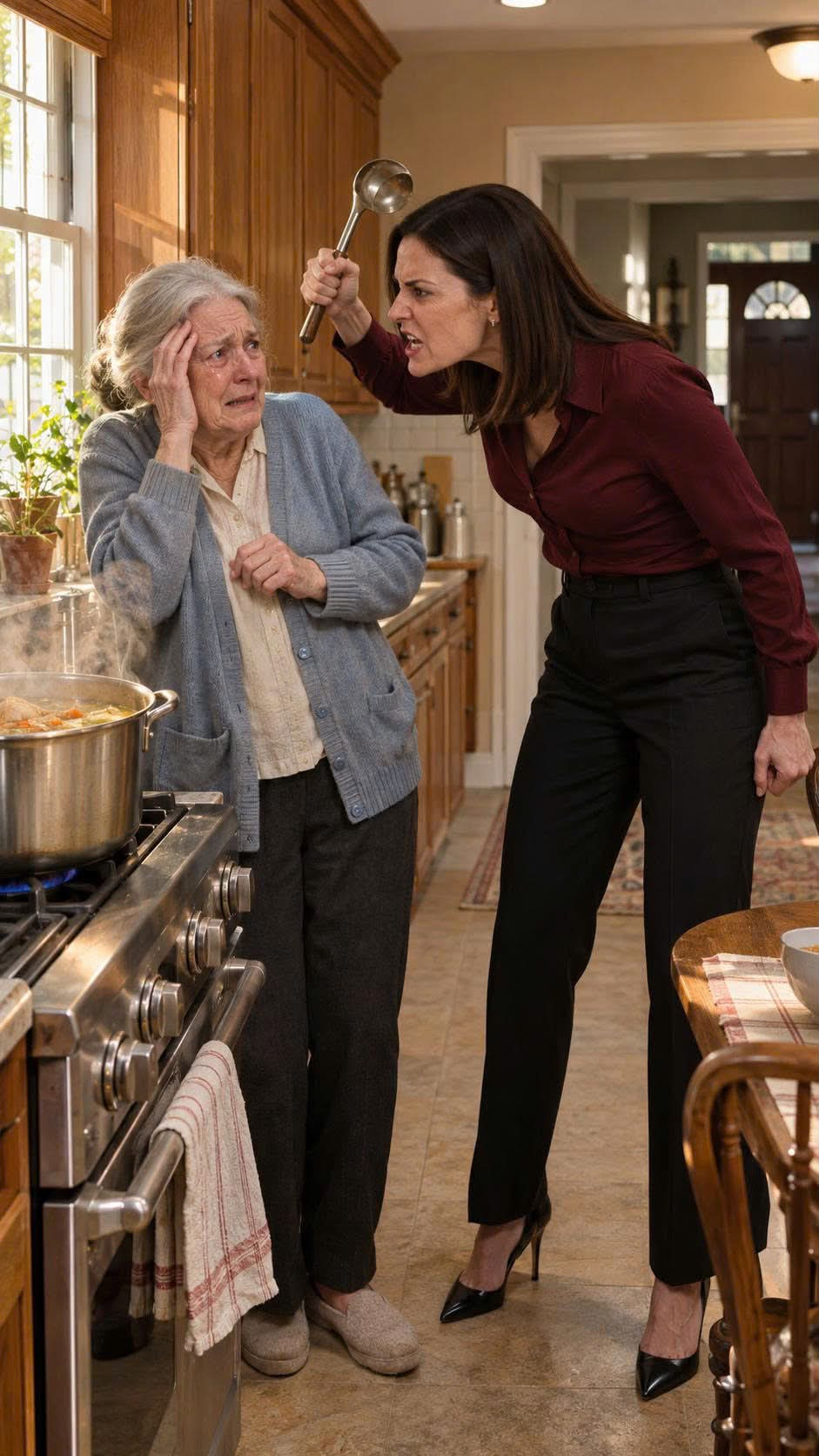
"Mom, tell Claire to stop. Vanessa said you attacked her!"
My son's voice came through the phone so loudly that Claire could hear every word.
I was sitting in the passenger seat of her car, holding a folded tissue against my aching temple.
"Mark," I whispered, "I didn't attack anyone."
There was a pause.
Then he said something that hurt worse than the metal ladle.
"Mom, you know how you get when you're upset."
I closed my eyes.
My own son had already decided who was telling the truth.
And he hadn't even asked whether I was hurt.
Claire pulled into the parking lot of a small urgent care clinic about fifteen minutes from my house.
She had insisted on taking me somewhere I could be examined immediately. The ringing in my ears had faded, but my head still throbbed, and I felt slightly dizzy whenever I turned too quickly.
"Mom, don't answer him right now," she said.
My phone continued ringing.
Mark.
Again.
I looked at his name on the screen.
It was the same name that had appeared on my phone thousands of times over the years.
When he was a teenager, he called because he'd forgotten his lunch money.
When he was in college, he called because he didn't know how to wash a wool sweater.
When he started his first job, he called to tell me he'd gotten a promotion.
And after his father died, he called every Sunday evening, sometimes just to ask what I'd had for dinner.
I used to look forward to those calls.
Now I was afraid to answer.
"He's worried," I said quietly.
Claire turned off the engine.
"About whom?"
I didn't respond.
She looked at me for a long moment.
"Mom, he hasn't asked once if you're okay."
I stared at my phone.
She was right.
Mark had called four times since we left the house.
He had sent three messages.
Every one of them was about Vanessa.
None mentioned my injury.
I felt a familiar urge to defend him.
"He's probably confused."
"Then he should ask questions before accusing you."
"Vanessa must have been very upset when she called."
Claire gave me a look that was almost painful to see.
"Mom, Vanessa hit you with a metal ladle. Why are you worried about whether she's upset?"
I lowered my eyes.
"I don't know."
But that wasn't entirely true.
I did know.
I had spent so many years trying to prevent arguments that I had begun treating everyone else's anger as my responsibility.
If someone raised their voice, I apologized.
If someone misunderstood me, I explained myself.
If someone treated me badly, I searched for something I might have done to deserve it.
And if Mark was unhappy, I felt as though I had failed as his mother.
Claire reached across the center console and gently squeezed my hand.
"Come on. Let's get you checked."
Inside the clinic, the receptionist asked what had happened.
I opened my mouth.
Then stopped.
Claire stood beside me.
"My mother was struck on the head with a metal cooking utensil," she said.
The receptionist's expression changed.
"Was there any loss of consciousness?"
"No," I answered.
"Any dizziness?"
"A little."
"Blurred vision?"
"No."
She asked several more questions before arranging for a nurse to see me.
I sat in the waiting room with my handbag in my lap.
There were three other patients nearby.
A young father held a sleeping toddler.
An older man was reading a newspaper.
A woman in a blue coat stared at her phone.
They all looked so ordinary.
I wondered whether any of them could tell what had happened to me.
Whether the mark on my temple was visible.
Whether my trembling hands gave me away.
I had never felt so exposed.
Claire sat beside me.
"Mom, I need to ask you something."
I looked at her.
"Has Vanessa ever hurt you before?"
The question made my stomach tighten.
"Not like this."
Claire became very still.
"Not like this?"
I realized what I had said.
I looked away.
"She's had difficult days."
"Mom."
"She's under a lot of pressure at work."
"That's not what I asked."
I swallowed.
Claire waited.
She had always been patient when she wanted the truth.
Even as a little girl, she could sit quietly through an entire explanation without interrupting.
Mark had been different.
He was quick to react, quick to speak, and quick to forgive.
Claire preferred to understand things completely.
That difference had never seemed particularly important before.
Now it felt enormous.
"She's grabbed my arm a few times," I admitted.
Claire's face tightened.
"How hard?"
"Hard enough to leave marks once."
"Once?"
I looked at my hands.
"Maybe twice."
Claire leaned back in her chair.
She didn't speak for several seconds.
Then she asked, "Did Mark know?"
"I didn't tell him."
"Why?"
"Because I didn't want trouble between them."
She looked at me with an expression I couldn't bear.
"Mom, there was already trouble. You were just carrying it alone."
I felt tears gathering.
Before I could answer, a nurse called my name.
"Eleanor Bennett?"
Claire stood immediately.
"I'm coming with her."
The nurse nodded.
As we followed her down the hallway, my phone vibrated again.
This time, Mark had sent a message.
Vanessa is crying. I hope you're happy.
I read it once.
Then again.
My chest tightened so painfully that I stopped walking.
Claire noticed.
"Mom?"
I handed her the phone.
She read the message.
Her expression went cold.
"He's going to regret sending that."
The nurse led us into a small examination room.
A few minutes later, a physician came in and introduced herself as Dr. Patel.
She was a calm woman with dark hair pulled into a neat bun.
She examined my temple, checked my pupils, asked me to follow her finger with my eyes, and tested my balance.
She asked whether I had nausea, confusion, or a worsening headache.
I answered as carefully as I could.
Then she asked how the injury had happened.
I hesitated.
Claire looked at me.
I knew what she wanted.
She wanted me to tell the truth.
But saying it aloud to a stranger felt different from telling my daughter.
It made everything real.
"My daughter-in-law struck me with a soup ladle," I finally said.
Dr. Patel stopped writing.
She looked at me.
"I'm sorry that happened to you."
I nodded.
She didn't ask what I had done to upset Vanessa.
She didn't suggest that perhaps there had been a misunderstanding.
She simply treated what I said as something that mattered.
For reasons I couldn't explain, that kindness made my eyes fill.
Dr. Patel explained that a head injury needed to be taken seriously, especially at my age. Because I had dizziness after the impact, she recommended further evaluation at the emergency department, where imaging could be considered.
She also asked whether I felt safe returning home.
I looked at Claire.
My daughter answered before I could.
"She's staying with me."
Dr. Patel turned back toward me.
"Is that what you want, Mrs. Bennett?"
The question surprised me.
What did I want?
I had spent so much time thinking about what Mark wanted, what Vanessa wanted, and what would keep the family together that I had almost forgotten how to answer that question.
I looked at Claire.
Then at the doctor.
"Yes," I whispered. "I think I'd like that."
Claire squeezed my shoulder.
Dr. Patel documented the injury and explained the next steps.
Before leaving, she asked whether I wanted information about reporting the assault or speaking with someone who could help me make a safety plan.
I felt embarrassed.
The word assault seemed too large for what had happened in my kitchen.
I was just an elderly woman who had been making soup.
But I knew that if a stranger had struck me with a metal utensil, I wouldn't have hesitated to call it violence.
Why was it different because the person was family?
"I'd like the information," I said.
Claire looked at me.
She didn't smile.
But I could see the relief in her eyes.
By the time we reached the emergency department, Mark had called seven more times.
I finally asked Claire to put my phone on silent.
She did.
Then she helped me into a chair while we waited.
I watched her fill out the paperwork.
She knew my birthday.
My medications.
My emergency contact information.
She even remembered the name of the doctor who treated my arthritis.
I wondered when my daughter had become the person who knew so much about my life.
And when my son had stopped asking.
That thought made me feel guilty.
Mark wasn't a bad boy.
He had been a wonderful child.
I remembered the summer he was nine years old and found an injured bird beneath our porch.
He carried it inside in both hands, crying because he thought it might die.
He refused to leave its side until his father found a wildlife rehabilitator.
That was my Mark.
The boy who cried over a bird.
The boy who once gave his sister his favorite blanket because she was frightened during a thunderstorm.
The boy who hugged me so tightly after his father's funeral that I thought my heart would break.
Where had that boy gone?
Or had I simply been too determined to see him as the child I remembered?
"Mom?"
Claire was watching me.
"You look pale."
"I'm just tired."
She sat beside me.
"You don't have to keep protecting him."
I looked at her.
"He's your brother."
"I know."
"He's a good man."
Claire's expression softened.
"Then he needs to start acting like one."
I looked down.
She wasn't trying to turn me against him.
She was asking me to see what was happening.
And that frightened me more than I wanted to admit.
The hospital evaluation took several hours.
Fortunately, the doctor found no evidence of a serious acute injury, and the imaging showed no bleeding.
I was given instructions about warning signs that would require immediate medical attention and told to rest with someone checking on me.
Claire listened carefully.
She asked questions.
She took notes.
She made sure I understood everything.
I felt grateful.
And terribly sad.
Because somewhere in the back of my mind, I kept waiting for Mark to appear.
I imagined him rushing through the hospital doors.
I imagined him kneeling beside my chair.
"Mom, are you okay?"
I imagined him apologizing for the messages.
I imagined him telling me that Vanessa had admitted what happened.
But he didn't come.
Instead, at six forty-three that evening, my phone received another message.
I'm at your house. We need to talk.
Claire read it.
Then she looked at me.
"He's at your house?"
I nodded.
"With Vanessa?"
"I suppose so."
She exhaled slowly.
"Mom, you're not going back there tonight."
"I know."
"Do you?"
I looked at her.
She sat closer.
"Because I'm worried that if Mark asks you to come home, you'll go."
I wanted to tell her she was wrong.
But I couldn't.
For most of my life, when my children needed something, I found a way to give it to them.
And when Mark needed me, I had always gone.
Even when I was tired.
Even when I was sick.
Even when I knew I should say no.
Claire took my hand.
"Please don't make a decision just because you're afraid he'll be angry."
I nodded.
Then my phone rang.
Mark again.
This time, I answered.
"Hello, sweetheart."
His voice was sharp.
"Mom, where are you?"
"I'm at the hospital."
Silence.
Then he asked, "Why?"
I stared at the wall.
"Because Vanessa hit me."
He sighed.
A long, impatient sigh.
"Mom, we've already talked about this."
"No, Mark. We haven't."
"Vanessa told me what happened."
"Then she didn't tell you the truth."
"She said you were waving the ladle around and she tried to take it away."
I closed my eyes.
"That's not what happened."
"She said you lost your balance."
"Mark..."
"And now Claire is making it into some kind of criminal situation."
Claire sat very still beside me.
I could see her jaw tighten.
"Your sister didn't make anything happen," I said.
"She always does this."
"What?"
"She always assumes the worst about Vanessa."
I looked at Claire.
My daughter shook her head slowly.
Not because she wanted me to argue.
Because she couldn't believe what she was hearing.
"Mark, I was standing at my stove making chicken soup."
"I know, Mom."
"Vanessa took the ladle from my hand."
"She says you handed it to her aggressively."
I felt my throat tighten.
"How does someone hand over a soup ladle aggressively?"
He didn't answer.
I continued.
"She struck me near my temple."
"Mom, she says it was an accident."
"She didn't apologize."
"She was scared."
"Of what?"
He hesitated.
Then he said, "Of what you might tell people."
For several seconds, I couldn't speak.
My son had just told me that his wife's greatest concern was what I might say about being hurt.
Not whether I was injured.
Not whether I needed help.
Not whether I was frightened.
What I might tell people.
I felt something inside me shift.
It wasn't anger.
Not yet.
It was disappointment so deep that I could barely recognize it.
"Mark," I said quietly, "do you believe I would lie about something like this?"
He didn't answer immediately.
Then he said, "I think you and Vanessa have never gotten along."
I looked down.
That wasn't true.
At least, it hadn't always been true.
When Mark first introduced Vanessa to me, I had welcomed her.
I had invited her to dinner.
I had helped them move into their first apartment.
I had even paid for the flowers at their wedding when the original florist canceled.
I remembered standing beside Vanessa on her wedding day, fastening a small bracelet around her wrist.
She had looked at me and said, "Thank you for treating me like a daughter."
I had meant every word when I answered, "You are one now."
But somewhere along the way, kindness had become an obligation.
And obligation had become permission.
Permission to criticize me.
To embarrass me.
To make decisions about my home.
To speak to me as though I were a child.
And eventually, to strike me.
"Mark," I whispered, "I'm your mother."
His response came immediately.
"And Vanessa is my wife."
The words were simple.
But something about the way he said them made me feel as though he had placed us on opposite sides of a courtroom.
As though loving one of us required rejecting the other.
"I know she's your wife," I said.
"Then you need to respect that."
I looked at Claire.
She had tears in her eyes.
Not because she was frightened.
Because she was furious.
I swallowed.
"I have always respected your marriage."
"Then stop trying to interfere."
I stared at the phone.
I could hear Vanessa speaking faintly in the background.
I couldn't make out every word.
But I heard my name.
Then Mark said, "Mom, Vanessa wants an apology."
I thought I had misunderstood.
"What?"
"She says you frightened her."
I looked at the discharge papers in my lap.
The doctor's instructions.
The description of my injury.
The information about support services.
All of it was sitting there in black and white.
And my son wanted me to apologize.
"For what?" I asked.
"For the way you behaved."
I felt my hands begin trembling again.
Claire gently took the phone from me.
"Mark, this is Claire."
His voice changed.
"Oh, great."
"Mom has been examined at the hospital."
"I heard."
"She has a documented head injury."
"Vanessa said—"
"I don't care what Vanessa said."
"Claire, don't start."
"No. You listen to me."
Her voice remained controlled.
But every word was clear.
"Your wife struck our mother with a metal ladle. Mom was dizzy afterward. She needed medical attention. And you've spent the entire afternoon accusing her instead of asking whether she's okay."
"That's not fair."
"Neither is what happened to Mom."
"You weren't there when it started."
"I saw what happened immediately afterward."
"Then you don't know the whole story."
Claire looked at me.
Then she said something I had never expected.
"You're right. I don't know the whole story. But I intend to find out."
Mark went quiet.
Claire continued.
"Mom is staying with me tonight. She is not going back to that house while Vanessa is there."
"You can't decide that."
"Neither can you."
"Claire—"
"She's seventy-nine years old, Mark. She's injured. And she's frightened."
There was a pause.
Then Mark said, "Mom has always been sensitive."
Claire's face went completely still.
I had seen my daughter angry before.
But this was different.
She wasn't losing control.
She was becoming more certain.
"Sensitive?" she repeated.
"That's not what I meant."
"Then tell me what you meant."
Mark sighed.
"Vanessa says Mom has been acting strangely for months."
I looked up.
"What?"
Claire turned toward me.
Mark continued.
"She says Mom forgets things, gets confused, and sometimes becomes aggressive when people correct her."
My mouth went dry.
I had never heard that accusation before.
I was seventy-nine.
Yes, I occasionally misplaced my glasses.
Yes, I sometimes forgot why I had walked into a room.
But I managed my own bills.
I kept my appointments.
I cooked.
I read.
I volunteered at the church library twice a month.
And I knew exactly what had happened in my kitchen.
Claire spoke slowly.
"Mark, are you suggesting Mom doesn't know what happened to her?"
"I'm saying we should consider the possibility."
"The possibility of what?"
"That she's confused."
I felt a terrible coldness spread through me.
This was no longer just about the ladle.
Vanessa was trying to make my own son question whether I could trust my memory.
And he was listening.
Claire glanced at me.
I could see that she understood the danger immediately.
"Mark, we're ending this conversation."
"Claire, wait."
"No. Mom needs rest."
"Tell her I'll come by tomorrow."
Claire looked at me.
I shook my head.
She nodded.
"Not until she's ready."
Then she ended the call.
We sat in silence for several minutes.
The hospital waiting area was nearly empty.
Somewhere down the hallway, a cart rattled across the floor.
I stared at my hands.
They looked older than I remembered.
The skin was thin.
The veins were visible.
My wedding ring still rested on my finger, though my husband had been gone for nearly eleven years.
I touched it gently.
When he was alive, he used to tell me that being kind didn't mean allowing people to walk over me.
I had always laughed.
"You're too stubborn," I would say.
"And you're too forgiving," he would answer.
I wished he were there.
Not because I needed him to fight my battles.
But because I wanted someone who remembered who I had been before I became frightened of my own family.
Claire sat beside me.
"Mom, there's something I need to know."
I looked at her.
"Has Vanessa ever told you that you're losing your memory?"
I hesitated.
Claire noticed.
"Mom?"
"She has mentioned it."
"When?"
I thought for a moment.
"At Thanksgiving."
Claire leaned forward.
"What happened at Thanksgiving?"
I remembered the dinner clearly.
Vanessa had insisted on rearranging the kitchen cabinets.
She moved my baking dishes, my measuring cups, and several containers of spices.
The next morning, I couldn't find the cinnamon.
When I asked where it had gone, she laughed.
"See? This is exactly what I'm talking about. You're forgetting everything."
I had been embarrassed.
Mark was sitting at the table.
He looked up and said, "Mom, maybe you should write things down."
I hadn't argued.
I had simply found another jar of cinnamon.
There had been other incidents.
Vanessa sometimes moved my mail from the kitchen counter.
Then she asked why I hadn't paid attention to important letters.
She once changed the location of my spare keys.
When I couldn't find them, she suggested I should stop driving.
And twice, she told Mark that I had forgotten conversations I was certain had never happened.
I had dismissed each incident.
One at a time, they seemed small.
But now, sitting beside Claire, they no longer felt unrelated.
I told her everything.
She listened without interrupting.
When I finished, she looked deeply troubled.
"Mom, why didn't you tell me?"
"I didn't want you and Mark fighting."
She rubbed her forehead.
"How long has this been going on?"
"Maybe a year."
"A year?"
I nodded.
Claire looked away.
I could see her trying to control her emotions.
Then she asked, "Does Vanessa have a key to your house?"
"Yes."
"Does Mark?"
"Of course."
"Does she ever come over when you're not home?"
"Sometimes. She says she helps with things."
Claire became quiet.
I watched her.
"What is it, sweetheart?"
She shook her head.
"I'm trying to understand something."
"What?"
She looked at me.
"Why would Vanessa spend so much time convincing Mark that you're confused?"
I didn't know.
The question frightened me.
Because until that moment, I had never considered that Vanessa's behavior might have a purpose beyond anger.
I had always assumed she simply disliked me.
But Claire was looking at the situation differently.
She was looking for a pattern.
And the more she looked, the more worried she became.
It was almost nine o'clock when we finally arrived at Claire's apartment.
She lived in a quiet neighborhood about twenty minutes from my house.
Her apartment was smaller than mine, but comfortable.
She helped me settle on the couch, brought me water, and placed the hospital instructions on the coffee table.
Then she went into the kitchen.
"Are you hungry?"
I shook my head.
"You need to eat something."
"I don't think I can."
She returned with a small plate of crackers and cheese.
"Just a little."
I managed two crackers.
Then I leaned back against the cushions.
For the first time all day, I felt safe enough to close my eyes.
But sleep wouldn't come.
Every time I tried, I remembered the sound of the ladle striking my head.
The sharp pain.
Vanessa's expression.
Mark's voice.
Mom, you know how you get when you're upset.
I opened my eyes.
Claire was sitting at the dining table with her laptop.
"What are you doing?"
She looked up.
"Writing down what happened."
"Why?"
"Because tomorrow, someone might try to convince you it happened differently."
I stared at her.
She closed the laptop halfway.
"Mom, I want you to remember something."
"What?"
"You don't have to prove you're a good mother by accepting bad treatment."
I looked down.
She continued.
"And you don't have to choose between loving Mark and protecting yourself."
Tears slipped down my cheeks.
I wiped them away quickly.
"I'm afraid he'll stop speaking to me."
Claire came over and sat beside me.
"Then that will be his decision."
I shook my head.
"You don't understand."
"Then help me understand."
I looked at her.
"When your father died, I thought I could survive anything as long as I still had you and Mark."
My voice broke.
"I can't lose him too."
Claire wrapped her arms around me.
For a long time, neither of us spoke.
I cried quietly against her shoulder.
Not because of the pain in my head.
Not even because Vanessa had struck me.
I cried because I had spent so many years trying to hold my family together that I had never imagined my own son might be the person who made me feel most alone.
A little after ten, Claire helped me into the guest bedroom.
She brought me a clean nightgown and an extra blanket.
She checked that I had water beside the bed.
Then she placed my phone on the nightstand.
"Try to rest."
I nodded.
She turned toward the door.
"Claire?"
She looked back.
"Yes, Mom?"
"Thank you."
Her eyes softened.
"You don't have to thank me for being your daughter."
Then she turned off the light.
I lay awake for a long time.
The apartment was quiet.
I could hear the distant hum of traffic outside.
My head still ached, but the pain had become duller.
I reached for my phone.
There were several unread messages from Mark.
I knew I shouldn't look.
But I did.
The first said:
Vanessa is devastated.
The second:
I can't believe you let Claire take this so far.
The third:
We need to discuss your living situation.
I sat up slowly.
My living situation?
I read the message again.
Then another appeared.
Vanessa thinks it might be time for you to stop living alone.
I stared at the screen.
My heart began beating faster.
I had lived in my house for thirty-eight years.
My husband and I had bought it when Mark was six and Claire was still a baby.
We had painted the bedrooms ourselves.
We had planted the roses along the front walkway.
We had celebrated birthdays, graduations, anniversaries, and Christmas mornings beneath that roof.
After my husband died, I had kept the house because it was where I felt closest to him.
It was mine.
Not Mark's.
Not Vanessa's.
Mine.
Why were they discussing whether I should live there?
I read the message a third time.
Then I noticed something.
Mark hadn't written, I think.
He had written, Vanessa thinks.
I opened the message thread and scrolled backward.
For months, he had been asking questions about my finances.
Whether I had updated my will.
Whether I still handled my own banking.
Whether I had considered selling the house.
At the time, I had assumed he was being responsible.
He was my son.
Of course he wanted to make sure I was prepared for the future.
But now those questions felt different.
I remembered Vanessa mentioning that maintaining a large house was becoming difficult for someone my age.
I remembered her suggesting that Mark should help manage my bills.
And I remembered something else.
A conversation from two weeks earlier.
Vanessa had asked whether I kept important papers in the upstairs bedroom or the study.
I had told her they were in the study.
I hadn't thought anything of it.
Until now.
My hands began trembling.
I opened my banking application.
Everything looked normal at first.
Then I checked my recent account activity.
There was a small transaction I didn't recognize.
It wasn't a large amount.
Just forty-eight dollars.
The description was unfamiliar.
I frowned.
Perhaps it was something I had forgotten.
I checked the date.
It had happened on a Tuesday afternoon.
The same afternoon Vanessa had come over to help me organize the study.
I felt cold.
I knew I shouldn't jump to conclusions.
There could be a perfectly innocent explanation.
But I couldn't stop looking at that transaction.
I took a screenshot.
Then I sent it to Claire.
A moment later, I heard footsteps in the hallway.
She appeared at my bedroom door.
"Mom? Are you okay?"
I held up the phone.
"I don't recognize this."
She sat beside me.
She studied the transaction.
Then she looked at the date.
"Was Vanessa at your house that day?"
I nodded.
Claire's expression changed.
She took out her own phone and made a note.
"We'll call the bank tomorrow."
I looked at her.
"Do you think someone took money?"
"I don't know. And I don't want to guess."
She paused.
"But I think we need to check more than one thing."
I swallowed.
"What things?"
"Your accounts. Your important documents. Anything Mark or Vanessa may have asked you to sign."
I stared at her.
"Sign?"
Claire looked at me carefully.
"Mom, has Vanessa ever brought you paperwork?"
I thought for a moment.
Then I remembered.
Three weeks earlier, Vanessa had brought a folder to my house.
She said it contained documents Mark wanted me to review.
I had been busy preparing lunch.
She told me it was nothing complicated.
Just routine paperwork.
I remembered signing one page.
Or perhaps two.
I couldn't remember exactly.
But I remembered the folder.
It was dark blue.
And Vanessa had taken it with her when she left.
"Mom?"
Claire was watching me.
I felt my mouth go dry.
"There was a folder."
"What kind of folder?"
"Blue. Vanessa said Mark needed some signatures."
Claire became very still.
"What did you sign?"
"I don't know."
She stared at me.
I could see the fear in her eyes.
Not fear of Vanessa physically hurting me again.
Something else.
Something I hadn't understood yet.
"Mom," she said carefully, "did you read the documents?"
I shook my head.
"She said they were routine."
Claire stood.
She walked toward the window.
Then turned back.
"Did you get copies?"
"No."
She closed her eyes.
For several seconds, she didn't speak.
Then she returned to the bed.
"We need to find out what those papers were."
I nodded.
She reached for my phone.
"Can you show me the messages Mark sent about your living situation?"
I handed it to her.
She read them carefully.
Then her own phone vibrated.
A message appeared.
She glanced at the screen.
Her expression changed so suddenly that I sat up straighter.
"Claire?"
She didn't answer.
She read the message again.
Then she looked at me.
"Mom, do you remember the name of the woman who helped you update your estate documents after Dad died?"
I frowned.
"Margaret Ellis. Why?"
Claire swallowed.
"Because she just sent me something."
I stared at her.
"Margaret? At this hour?"
Claire nodded.
"She said she received an unusual request concerning your property."
My heart began pounding.
"What request?"
Claire opened the message.
Her eyes moved slowly across the screen.
Then she looked up at me.
"Mom, Margaret says someone contacted her office this morning."
I gripped the blanket.
"Who?"
Claire turned the phone toward me.
There was a document attached.
At the top were three words.
PROPERTY TRANSFER AUTHORIZATION
Beneath them was my full name.
Eleanor Bennett.
And at the bottom of the page—
there was a signature that looked exactly like mine.
Claire touched the attachment.
"Mom, did you sign this?"
I leaned closer.
My breath caught.
The signature was familiar.
The date was not.
I had been in the hospital when that document was supposedly signed.
Claire's finger hovered over the next page.
Then she whispered, "There's another name listed here."
She opened it.
And the moment I saw whose name appeared beside mine, I stopped breathing...






Comments 0