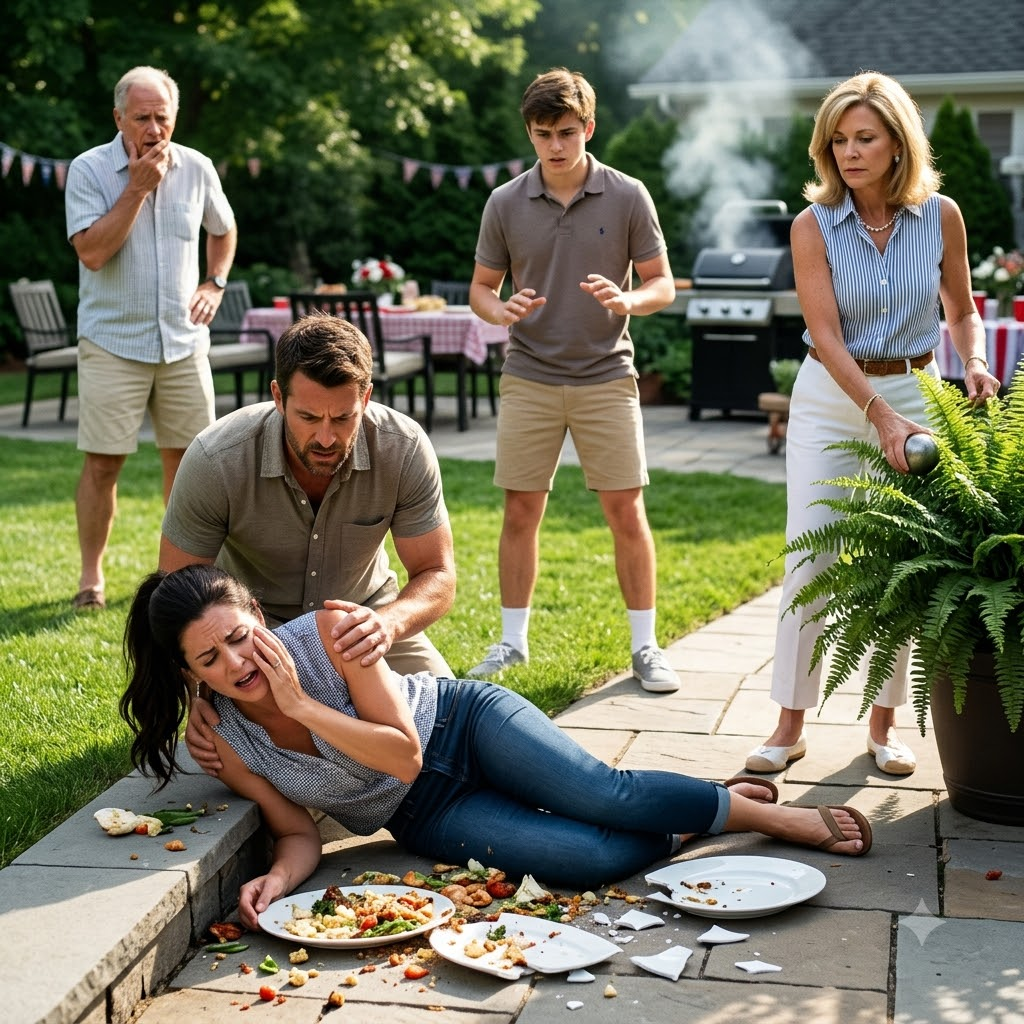
"Time to teach this blue-collar bitch a lesson!" Kale Mercer shouted as he raised a steel ball toward my face.
My husband, Hayes Mercer, turned from the barbecue grill just as the ceramic platters slipped from my hands.
The metal ball had a tiny engraved number on its surface.
17.
Hayes recognized that number.
And suddenly, the attack was no longer just about me.
Ten minutes earlier, I had been standing beside a folding buffet table, wondering how much humiliation a person was supposed to tolerate in the name of family.
My name is Marin Mercer.
I was thirty-four years old, married to a man I loved, and the owner of a freight brokerage company that had earned more than eleven million dollars in revenue the previous year.
I had negotiated shipping contracts with men who thought intimidation was a business strategy. I had survived fuel shortages, lawsuits, dishonest carriers, and a recession that nearly wiped out everything I owned.
But nothing had prepared me for my husband's family.
Especially his cousin Kale.
"Hey, Marin!"
His voice carried across the backyard.
I didn't turn immediately.
I was arranging grilled vegetables on a serving platter while the rest of the Mercer family enjoyed cocktails beneath expensive patio umbrellas.
"Marin!" he called again. "You hear me, truck stop?"
A few people laughed.
I placed the last piece of asparagus on the platter.
Then I turned.
Kale was nineteen, tall, handsome in the carefully manufactured way that came from expensive clothes and absolutely no responsibility.
He wore a designer polo shirt that probably cost more than my first week's groceries when I started my company.
His father, Orson Mercer, paid for his car, his apartment, his credit cards, and apparently his belief that consequences were something that happened to other people.
"What is it, Kale?" I asked.
He leaned back in his chair.
"I was just wondering something."
"That's encouraging."
His smile tightened.
"Does your little trucking company actually make money, or do you just drive around pretending you're important?"
His friends laughed.
I smiled politely.
"I don't own a trucking company. I own a freight brokerage."
"Same thing."
"Not remotely."
He lifted his drink.
"Whatever. You call truck drivers all day. Doesn't exactly scream businesswoman."
I looked at him for a moment.
Then I said, "My company moved twenty-eight thousand loads last year."
He shrugged.
"And?"
"And every one of those loads generated revenue without my father paying my bills."
The laughter stopped.
Kale's face changed.
Across the patio, his mother, Vesta, lowered her glass.
"Marin," she said sharply.
I turned toward her.
"Yes?"
"There's no need to embarrass him."
I looked back at Kale.
"Then perhaps he shouldn't embarrass himself."
Nobody laughed that time.
Except Hayes.
My husband was standing near the grill, holding a pair of stainless-steel tongs.
He tried to hide his smile.
He failed.
And that made Kale angrier than anything I had said.
"You think you're better than us?" Kale demanded.
"No."
"Sure sounds like it."
"I think people should earn the respect they expect."
He stood.
For one second, something ugly moved across his face.
Then Vesta touched his arm.
"Kale. Enough."
He looked at me with an expression I would remember for the rest of my life.
"You'll learn," he muttered.
I should have walked away.
I should have told Hayes I wanted to leave.
Instead, I returned to the buffet table.
Because I had spent most of my adult life believing that the best way to defeat cruelty was to refuse to participate in it.
That belief nearly cost me my life.
The Mercer family's Fourth of July barbecue was an annual performance disguised as a celebration.
Everything had to look perfect.
The lawn had been cut into precise stripes. Red, white, and blue decorations hung along the patio. The catering company had delivered enough food for fifty guests, even though fewer than twenty people had been invited.
And somehow, I was the one serving dinner.
Vesta had made that decision shortly after we arrived.
"Oh, Marin, darling," she'd said, handing me an apron. "You're so much more comfortable doing practical things than sitting around making conversation."
I had looked at the apron.
Then at her.
"I actually spend most of my days in meetings."
"Of course you do."
She had smiled the way wealthy people sometimes smile when they want you to understand that they don't believe a word you're saying.
"But you have such a natural working-class energy."
I could have corrected her.
Instead, I took the apron.
Not because she intimidated me.
Because Hayes had asked me to give his family one more chance.
And because I loved him.
That was the difficult part.
Hayes was nothing like his relatives.
He had inherited money, yes, but he had also worked hard to build a respectable career managing commercial real estate investments.
He never mocked the way I grew up.
He never treated my work as something embarrassing.
When we met, I was wearing steel-toed boots and arguing with a warehouse supervisor over a damaged shipment.
Hayes had been visiting the property for an inspection.
He watched me win the argument.
Then he asked if he could buy me coffee.
I told him I didn't have time.
He came back the following morning with coffee anyway.
That was Hayes.
Patient.
Thoughtful.
Stubborn in the quietest possible way.
But when it came to his family, he carried a weakness I had never fully understood.
He believed people could change if you loved them enough.
I knew better.
I had spent my childhood watching my mother clean office buildings after midnight.
She raised me alone after my father disappeared.
By sixteen, I was working weekends at a truck stop.
By twenty-two, I was coordinating shipments for a small logistics company.
At twenty-seven, I had saved enough money to rent a corner of an old warehouse.
My first office had a folding table, a secondhand laptop, and a phone that disconnected whenever it rained.
I named the company Ironline Freight Solutions.
My first year, I made forty-three thousand dollars.
My second, I nearly went bankrupt.
My third, I landed a regional manufacturing contract that changed everything.
I built that business one shipment at a time.
Nobody handed me anything.
And the Mercers hated that.
Not because I lacked money.
Because I had earned mine without asking their permission.
"Hey."
Hayes appeared beside me while I was carrying another tray toward the patio.
He gently took it from my hands.
"You okay?"
"I'm fine."
"Marin."
I looked at him.
He knew me too well.
"I'm trying," I admitted.
He sighed.
"I know."
"Your aunt just told me I have working-class energy."
He closed his eyes.
"God."
"And your cousin apparently thinks freight brokerage means I drive a semi."
"I'll talk to him."
"You've talked to him before."
"This time—"
"Hayes."
He stopped.
I lowered my voice.
"I don't need you to fight every battle for me. I just need you to stop asking me to stand in the middle of them."
He looked genuinely hurt.
Not by my tone.
By the truth.
"You're right," he said.
I wasn't expecting that.
He set the tray down.
"We'll leave after dinner."
"Really?"
"Really."
I touched his arm.
"Thank you."
He leaned down and kissed my forehead.
From across the lawn, someone made a theatrical kissing noise.
Kale.
Of course.
"Look at that!" he shouted. "The princess and her personal bodyguard!"
Hayes turned.
"Kale, knock it off."
Kale raised both hands.
"Relax, cousin. Just having fun."
Hayes stared at him.
Something in his expression must have registered, because Kale finally looked away.
But as Hayes turned back toward me, I noticed something else.
Kale was standing beside a wooden rack holding several polished steel bocce balls.
He picked one up.
Rolled it between his palms.
Then set it down.
I thought nothing of it.
I wish I could say I recognized the danger.
That I saw the decision forming behind his eyes.
But people like Kale survive because normal people don't expect them to do the unthinkable.
Ten minutes later, Vesta asked me to bring the remaining serving platters outside.
I was tired.
My feet hurt.
I had already decided that I would never attend another Mercer family barbecue.
I stacked three ceramic platters against my chest and started across the patio.
Behind me, the grill hissed.
Someone laughed.
A glass clinked against another.
Everything sounded ordinary.
Then I heard Kale.
"Hey, truck stop!"
I kept walking.
"Don't ignore me!"
I stopped.
Slowly, I turned.
He stood about twelve feet away.
His face was flushed.
His right hand held a steel bocce ball.
A heavy one.
Solid metal.
Not the lightweight plastic kind children played with.
I knew enough about weight and machinery to recognize the danger immediately.
"Kale," I said carefully.
He smiled.
Not a playful smile.
Not even an angry one.
Something colder.
"You really think you can come into this family and talk down to me?"
I looked toward the grill.
Hayes had his back partially turned.
"Kale, put that down."
His fingers tightened around the ball.
"Say you're sorry."
"For what?"
"For humiliating me."
I felt my heartbeat change.
"You're embarrassing yourself again."
His expression twisted.
And then he shouted the words that would replay in my nightmares.
"Time to teach this blue-collar bitch a lesson!"
His arm went back.
Like a baseball pitcher.
I remember the sunlight catching the metal.
I remember the sound of my own breath.
I remember thinking he couldn't possibly be serious.
Then he threw it.
There are moments when the human mind refuses to accept what the body has already experienced.
The impact was one of them.
A violent crack exploded through the left side of my face.
For half a second, I heard nothing.
Then everything became noise.
The ceramic platters shattered against the patio.
My knees gave way.
Something warm filled my mouth.
I tried to swallow.
Couldn't.
Tried to breathe.
Couldn't do that properly either.
The world tilted sideways.
I saw grass.
Stone.
Broken white plates.
A piece of grilled tomato resting beside my hand.
I remember that ridiculous detail with perfect clarity.
A tomato.
Bright red against gray stone.
Then the pain arrived.
It was beyond anything I had ever experienced.
My cheek felt as though it had been crushed beneath a truck tire.
My jaw no longer seemed connected to the rest of my face.
I tried to scream.
Only a wet, broken sound came out.
My tongue found empty spaces where teeth had been.
Blood spilled across my lips.
I reached toward my face.
The movement sent another wave of agony through my head.
Someone screamed my name.
"MARIN!"
Hayes.
I saw him running.
Then he was on his knees beside me.
"Oh my God. Oh my God, Marin."
His hands hovered near my face.
He didn't know where to touch me.
Neither did I.
"Don't move," he whispered. "Baby, please don't move."
I tried to say his name.
Blood ran down my chin.
His expression changed to pure terror.
"Somebody call 911!"
Nobody moved.
"NOW!"
That command broke the silence.
Somewhere behind him, a chair scraped across the patio.
I heard Orson swear.
Then another voice.
Vesta.
"Oh, for heaven's sake!"
I could barely see her.
My vision kept narrowing.
But I heard every word.
"What happened?"
Hayes looked up.
"KALE THREW A METAL BALL AT HER!"
A pause.
Then Vesta said something I would never forget.
"Don't be ridiculous."
Hayes stared at her.
"What?"
"It was an accident."
I tried to lift my head.
Pain exploded behind my eyes.
Hayes gently steadied my shoulder.
"Don't move, sweetheart. Please."
Vesta approached.
Her shoes clicked against the stone.
"Kale was playing a game. Marin must have stepped into the way."
I wanted to tell her she was lying.
I wanted to scream that her son had looked directly into my eyes before throwing that ball.
But I couldn't form the words.
And then I saw her do it.
The steel ball had rolled into the grass near the patio.
It rested a few feet from a large potted fern.
Vesta glanced toward it.
Then toward Hayes.
He was focused on me.
She moved quickly.
Too quickly for someone who claimed nothing serious had happened.
She bent down.
Picked up the ball.
I saw the red stain on its polished surface.
My blood.
Her fingers closed around it.
Then she stepped behind the fern and pushed it deep into the space between the ceramic pot and the hedge.
She straightened.
Smoothed her blouse.
And looked down at me.
"Get up, Marin! It slipped. Stop acting so dramatic!"
I couldn't believe what I was hearing.
My mouth was full of blood.
My cheek was swelling.
I was struggling to breathe.
And this woman was worried about protecting her son.
Hayes turned slowly.
"What did you just say?"
Vesta crossed her arms.
"I said she's making this worse than it needs to be."
Hayes stared at her.
His face went strangely still.
"She's bleeding."
"Obviously."
"Her jaw is broken."
"You don't know that."
"LOOK AT HER!"
Vesta flinched.
For the first time since I had met her, she seemed genuinely surprised that someone had raised their voice to her.
Orson approached from the lawn.
"Hayes," he said firmly. "Lower your voice."
My husband looked at him.
"Call an ambulance."
"Someone already has."
"Then tell them to hurry."
Orson glanced toward Kale.
His son stood frozen beside the bocce rack.
The arrogance had disappeared from his face.
He looked like a child who had broken an expensive vase and was waiting for someone else to explain it away.
Orson exhaled.
"Let's not make accusations until we understand what happened."
Hayes didn't answer.
He looked back down at me.
I could feel him trembling.
Not from fear.
From rage.
"Marin," he whispered. "Can you hear me?"
I blinked.
"Good. That's good."
He gently brushed a strand of hair away from my forehead.
"Stay with me."
I tried to speak.
He leaned closer.
"What is it?"
My lips moved.
The words came out distorted.
"She... hid..."
His eyes narrowed.
"What?"
I struggled to breathe.
"Ball."
He looked toward the fern.
Then back at Vesta.
And something changed.
I watched it happen.
His face didn't twist with anger.
He didn't shout.
He simply stopped looking confused.
As though a question he had been asking himself for years had finally received its answer.
The ambulance arrived seven minutes later.
I know because Hayes told me afterward.
To me, those minutes felt like an eternity.
I remember a paramedic kneeling beside me.
I remember hearing the words "facial trauma" and "airway."
I remember someone carefully positioning my head.
I remember Hayes refusing to leave my side.
And I remember Kale speaking for the first time since the attack.
"It slipped."
His voice sounded small.
Nobody answered.
"I didn't mean to hit her."
Hayes turned toward him.
Kale swallowed.
"It was just a game."
My husband stared at him.
Then he asked one question.
"Did you throw it at her?"
Kale looked toward his mother.
Vesta immediately stepped forward.
"Hayes, he's upset."
"Did you throw it at her?"
Kale's eyes darted between his parents.
"I was messing around."
"Answer me."
Orson intervened.
"That's enough."
Hayes stood.
Slowly.
I had never seen him look like that.
He was a gentle man.
The kind who apologized when someone else bumped into him.
The kind who remembered birthdays and bought flowers for people who had never done anything kind for him.
But the man standing on that patio was someone I barely recognized.
He looked at Kale.
Then Vesta.
Then Orson.
And said, very quietly, "Nobody touches that ball."
Vesta's expression flickered.
"What ball?"
Hayes looked directly at the fern.
"The one you hid."
Silence.
Even through the pain, I felt the atmosphere change.
Orson turned toward his wife.
Vesta's lips parted.
"I don't know what you're talking about."
Hayes didn't argue.
He simply took out his phone.
And photographed the fern.
Then the broken plates.
Then the blood on the patio.
Then Kale.
Kale stepped backward.
"Why are you taking pictures of me?"
Hayes lowered the phone.
"Because I don't intend to forget what happened here."
The paramedics prepared to move me.
Hayes returned to my side.
He held my hand.
And when I looked into his eyes, I saw something I had never seen before.
A decision.
Not a temporary burst of anger.
Not a threat he would forget tomorrow.
A decision that had already been made.
The ride to the hospital blurred into flashes.
A ceiling.
Bright lights.
The pressure of an oxygen mask.
Hayes's voice.
"She's allergic to penicillin."
A paramedic asking questions.
"Any loss of consciousness?"
"I don't know. Maybe a few seconds."
"Any other medical conditions?"
"No."
I wanted to tell them that I was afraid.
Not of dying.
Not exactly.
I was afraid that I would never speak normally again.
That I would never smile without pain.
That my face would become something strangers stared at.
I had worked so hard to build a life where nobody could make me feel powerless.
And now I couldn't even tell my husband that I loved him.
I squeezed his fingers.
He leaned closer.
"I'm here."
I squeezed again.
His eyes filled with tears.
"I'm not going anywhere."
Then the world disappeared.
When I woke, everything was white.
The ceiling.
The sheets.
The bandages.
My mouth felt enormous.
My face throbbed with a deep, relentless ache.
A monitor beeped beside me.
For a moment, I couldn't remember where I was.
Then I tried to move my jaw.
Pain shot through my skull.
I made a frightened sound.
"Marin?"
Hayes appeared beside the bed.
He looked terrible.
His shirt was wrinkled.
There was dried blood on one sleeve.
His eyes were red.
He took my hand.
"Hey. Hey, you're okay."
I tried to speak.
He shook his head gently.
"Don't. The doctors said not to push it."
I stared at him.
He swallowed.
"You had surgery."
My heart began racing.
"They repaired what they could tonight. There's swelling, and you'll need more treatment."
I felt tears sliding down my temples.
Hayes leaned closer.
"Look at me."
I did.
"You're still you."
I closed my eyes.
He kissed my hand.
"Nothing they did changes that."
I wanted to believe him.
But the memory of Kale's face wouldn't leave me.
That smile.
The steel ball.
The way Vesta had looked at my blood and decided her son's reputation mattered more.
Hayes seemed to understand.
He reached for a small notepad on the bedside table.
"Here."
He placed a pen in my hand.
I struggled to write.
My fingers felt clumsy.
Finally, I managed three words.
Did they arrest him?
Hayes read the note.
His expression darkened.
"Not yet."
I stared at him.
He continued carefully.
"The police came to the hospital. I told them everything I saw."
I wrote again.
The ball?
His jaw tightened.
"Vesta moved it."
I nodded.
He leaned forward.
"But I know where she put it."
I wrote another question.
Will they believe me?
He looked at the paper for a long moment.
Then he took the pen from my hand.
Underneath my question, he wrote:
I will make sure they hear you.
I stared at those words.
And cried harder.
Not because I was weak.
Because for the first time since the attack, I didn't feel completely alone.
Later that evening, a doctor explained the injuries.
Multiple facial fractures.
Severe damage to my jaw.
Several broken or missing teeth.
A concussion.
Additional surgeries likely.
Months of recovery.
Possibly longer.
I listened without speaking.
There was nothing to say.
When the doctor left, Hayes pulled his chair closer.
"I need to tell you something."
I turned toward him.
He hesitated.
"My father called."
I waited.
"He wants us to handle this privately."
I stared.
Hayes gave a humorless laugh.
"Apparently, Kale is a good kid who made a terrible mistake."
My fingers tightened around the blanket.
"He said a criminal investigation would destroy Kale's future."
I reached for the notepad.
My hand shook as I wrote.
What about mine?
Hayes read the words.
His face crumpled.
Then he nodded.
"Exactly."
He sat back.
For a long moment, he said nothing.
Then he took out his phone.
"I've been thinking about something."
I watched him unlock the screen.
"My grandfather left me a substantial estate when he died."
I knew that.
Hayes had always been uncomfortable discussing the exact amount.
His grandfather had been the only Mercer who treated me with genuine kindness.
He once told me that money revealed character more often than it created it.
Hayes continued.
"Most of it is held separately from the family's shared investments. My father has always assumed I'll keep it tied to Mercer Holdings."
I watched him carefully.
"He uses that assumption to control me."
I had suspected as much.
But Hayes had never admitted it.
"Every time I disagree with him, he reminds me what I'm risking."
He looked down at his phone.
"Well, today he reminded me of something else."
I raised my eyebrows.
"That there are things worth more than an inheritance."
He opened a secure document application.
I could see several files.
Trust agreements.
Property schedules.
Investment statements.
Then one document with a title that made me blink.
IRREVOCABLE ESTATE TRANSFER AGREEMENT
I looked at Hayes.
He gave me a small, sad smile.
"I started preparing this months ago."
My eyes widened.
"Not because I expected anything like this. Because I was tired of my family treating our marriage like a temporary inconvenience."
He scrolled through the document.
"I wanted you to have complete control over what belongs to me. No family interference. No threats. No conditions."
I tried to shake my head.
He understood.
"Marin, I know you don't need my money."
I reached for the notepad.
He waited while I wrote.
You don't have to prove anything.
He read it.
Then looked at me.
"I'm not trying to prove anything."
His voice was quiet.
"I'm choosing my wife."
I looked at the screen again.
The document represented almost everything Hayes had inherited.
Properties.
Investments.
Trust distributions.
Millions of dollars.
Enough money to walk away from the Mercer family forever.
Enough money to fight a legal battle without asking anyone's permission.
But also enough to make him a target.
I wrote one more question.
Are you sure?
Hayes read it.
Then he nodded.
"Completely."
He showed me the final page.
His signature was already there.
He had signed it earlier, after speaking with his attorney.
Now he was waiting for the final electronic acknowledgment.
I looked at him.
He looked back.
Then he pressed the confirmation button.
A small notification appeared.
TRANSFER EXECUTED.
For a moment, neither of us moved.
Then Hayes put down the phone.
He took my hand.
And whispered, "They don't get to use my money against us anymore."
I should have felt relieved.
Instead, I felt something colder.
Because I knew the Mercers.
They didn't lose gracefully.
They didn't apologize when they were wrong.
And they certainly didn't tolerate losing control.
I reached for the notepad again.
They'll come after you.
Hayes read it.
"I know."
I wrote:
Orson won't accept this.
He nodded.
"No."
I hesitated.
Then wrote the question I was afraid to ask.
What if they hurt you?
Hayes stared at the page.
His expression softened.
He leaned forward and kissed my forehead.
"Then we'll deal with that together."
I wanted to believe it would be that simple.
But somewhere deep inside, I knew we had crossed a line.
Not because Hayes had transferred his fortune.
Because for the first time in his life, he had made a decision his family couldn't reverse with a phone call.
His phone vibrated.
He glanced at the screen.
His expression changed.
I watched him read the message.
Then read it again.
"Who?" I tried to ask.
The word came out painfully distorted.
He turned the phone facedown.
"Nobody you need to worry about."
I stared at him.
He sighed.
"My father."
Of course.
I held out my hand.
He hesitated.
Then gave me the phone.
The message was short.
You have made a very serious mistake. Call me before this becomes permanent.
I looked up at Hayes.
He took the phone back.
"Too late."
Another message arrived.
Then another.
Hayes ignored them.
Finally, his phone rang.
ORSON MERCER
He answered.
"Hello, Dad."
I couldn't hear the words on the other end.
But I could hear the volume.
Orson was shouting.
Hayes listened.
Then said, "No."
More shouting.
"No, I'm not coming over."
A pause.
"Because my wife is in a hospital bed."
His voice hardened.
"And your son put her here."
Another pause.
"Kale's future is not my priority."
I watched his jaw tighten.
"No. You don't get to threaten me anymore."
He listened for several seconds.
Then something Orson said made him sit perfectly still.
"What did you just say?"
Silence.
Hayes slowly stood.
His face had gone pale.
"Dad."
Another pause.
"How do you know about that?"
I felt my stomach tighten.
Hayes looked toward the hospital room door.
Then back at me.
His voice dropped.
"Who told you?"
The answer came through the phone.
I couldn't hear it.
But I saw what it did to him.
For the first time that night, my husband looked genuinely frightened.
He ended the call without saying goodbye.
I reached for the notepad.
What happened?
Hayes didn't answer immediately.
He walked toward the window.
Stared into the darkness.
Then returned to my bedside.
"Marin, there's something about my grandfather's estate I never told you."
I felt my heartbeat quicken.
He sat down.
"The transfer I signed today wasn't supposed to be possible without a second authorization."
I stared at him.
He swallowed.
"I thought the requirement had expired years ago."
I slowly reached for the pen.
Whose authorization?
Hayes looked at the hospital door.
Then back at me.
Before he could answer, his phone vibrated again.
This time, it wasn't a call.
It was an email from his attorney.
The subject line read:
URGENT: SECOND SIGNATURE VERIFIED
Hayes opened the attachment.
A scanned legal document appeared on the screen.
At the bottom were two signatures.
The first belonged to my husband.
The second had been written in dark blue ink.
Hayes enlarged the page.
His breathing stopped.
Then he whispered, "That person was supposed to be dead."
At that exact moment, someone knocked on my hospital room door.
Hayes slowly turned.
The handle began to move.
And a familiar voice on the other side said, "Hayes, don't open that document until you've heard what I have to say."






Comments 0