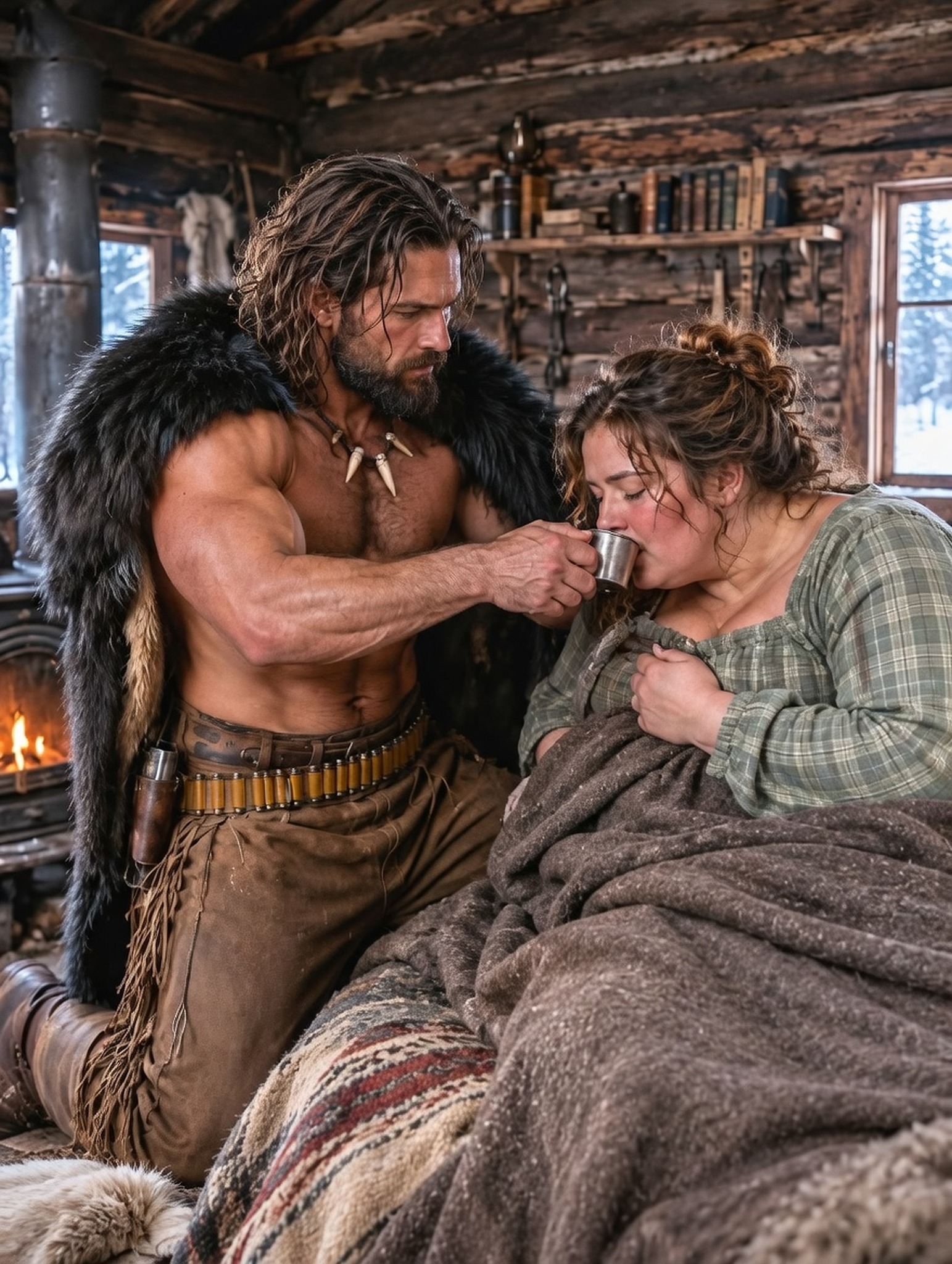
"Please—look this way!" Erin Lawson shouted as her knees sank into the snow.
Darren Ellison lowered his axe and noticed a small brass button lying beside the young woman's torn coat.
Four tiny letters had been scratched into its underside.
L.M.O.H.
The mountain rancher knew those letters.
And suddenly, the stranger at his woodpile was no longer just a stranger.
Three days earlier, Erin Lawson had walked out of a mining camp with nothing but the clothes on her back, a few pieces of dried bread, and the knowledge that staying would have gotten her killed.
The camp boss had given her two choices.
A rope.
Or the wilderness.
He had delivered the ultimatum in front of six miners, with his thumbs hooked into his suspenders and a look of satisfaction on his face.
Erin had stood before him with blood on her apron.
Not her blood.
The blood belonged to a miner named Walter Briggs, a man who believed paying for whiskey entitled him to whatever else he wanted.
When Briggs had grabbed her behind the stove, Erin had told him to let go.
He had laughed.
When he pulled harder, she reached for the cast-iron skillet hanging beside the fire.
She had struck him once.
His nose broke with a sound she would remember for the rest of her life.
He fell backward, howling.
By morning, the story had changed.
Briggs was suddenly an innocent customer.
Erin was a dangerous woman who had attacked a paying miner without provocation.
The camp boss had listened to Briggs's version and refused to hear hers.
"You've got until sundown to clear out," he told her. "After that, I'll let the boys decide what to do with you."
She understood.
The men watching from the doorway made certain she understood.
So she left.
She did not cry as she passed the last mining shack.
She did not look back when someone shouted something filthy after her.
She kept walking.
Only when the camp disappeared behind the trees did she allow herself to acknowledge how badly her hands were shaking.
She was twenty-four years old.
For three years, since the orphanage fire, she had survived by doing work other people considered beneath them.
She had scrubbed saloon floors until her knuckles split.
She had emptied chamber pots, washed blood from bedding, hauled coal, and cleaned stables so foul that even the horses seemed ashamed of the smell.
She had worked through fevers.
She had accepted wages that barely paid for bread.
And she had learned that hunger was not the worst thing a person could endure.
There were men who watched a woman work all day and decided that paying her gave them ownership of the night.
Erin had escaped those men before.
But never by walking into a mountain wilderness with winter closing around her.
By the second day, she had eaten the last of her bread.
By the third, she had stopped feeling hungry.
That frightened her.
She remembered the men she had seen lying motionless beside alleys in Laramie after bitter nights.
From a distance, they looked asleep.
Up close, their faces told another story.
She had promised herself she would never sit down in the snow.
Now, kneeling in a clearing with both hands buried in the frozen crust, she realized promises meant very little when the body stopped obeying.
The rancher was watching her.
He stood beside a chopping block, his enormous frame wrapped in a heavy buffalo-hide coat.
His beard was dark, streaked with gray.
His shoulders seemed nearly as wide as the cabin door behind him.
In one hand, he held an axe.
Erin looked at the blade.
Then at the man.
She had spent enough time around dangerous men to know that a weapon was not always the most frightening thing about one.
Sometimes it was the patience with which he held it.
"Are you hurt?" he asked.
His voice was deep and rough, but not loud.
Erin tried to stand.
Her right knee buckled.
She caught herself against the woodpile.
"No, sir."
The lie sounded ridiculous.
He looked down at her soaked boots.
"How long have you been walking?"
She hesitated.
"Three days."
His eyes narrowed.
"From where?"
"South."
"South is a direction."
"I know."
For a moment, neither spoke.
The wind moved between them.
Erin's teeth began chattering so hard she pressed her lips together.
The rancher set the axe against the chopping block.
He did not come closer.
That small decision surprised her.
Most men who saw a woman struggling immediately reached for her.
Some called it helping.
Others did not bother with a name.
This man simply waited.
"What's your name?" he asked.
"Erin Lawson."
"Darren Ellison."
She nodded.
"Mr. Ellison, I don't mean to interrupt your work."
"You've already interrupted it."
There was no anger in the words.
Only fact.
Erin swallowed.
Her throat felt scraped raw.
She lifted one trembling hand toward the stacked firewood.
"Could I earn something to eat before it gets dark?"
Darren said nothing.
"I can split wood," she continued. "Not as fast as you, probably, but I can do it. I can cook. Wash clothes. Mend shirts. Clean stalls if you've got animals."
He studied her.
She could feel his gaze moving over her torn coat, her cracked gloves, and the wet hem of her skirt.
"You're in no condition to swing an axe."
"I'll manage."
"You can barely stand."
"I've worked in worse condition."
He looked toward the mountain trail behind her.
"Nearest town's twenty miles downhill."
Erin's stomach tightened.
Twenty miles.
She knew what waited at the end of that road.
Men who would remember Walter Briggs.
Men who might have heard the camp boss's version of what happened.
Men who believed a woman accused of violence had already forfeited the right to defend herself.
"I know," she whispered.
"Then you know you shouldn't be up here."
She stared at the woodpile.
"I didn't have many choices."
"Most people don't climb into the Sawtooths in winter unless they're running from something."
Erin raised her eyes.
He had not asked whether she was running.
He had already decided.
For a terrible moment, she imagined him ordering her away.
She imagined stumbling back toward the trees, losing sight of the chimney, and finally sitting down beneath a pine because she could not make herself take another step.
She had survived too much to die within smelling distance of supper.
"I won't bring trouble to your place," she said.
Darren's expression remained unreadable.
"Didn't ask if you would."
"I won't steal."
"Didn't ask that either."
"I just want to work."
His gaze settled on her face.
"Why?"
She almost laughed.
The question seemed absurd.
"Because I need to eat."
"Why not ask for food?"
Her throat tightened.
She thought of the orphanage.
Of the women who had taught her to scrub floors and sew hems.
Of the first winter after the fire, when she had accepted a meal from a stranger and discovered, too late, that he believed generosity created a debt.
She looked Darren directly in the eyes.
"Because I like knowing what something costs before I take it."
Something changed in his expression.
Not much.
A slight movement near his eyes.
Then it disappeared.
"Fair enough," he said.
Erin nearly collapsed from relief.
But he had not agreed to anything.
He stepped toward the woodpile and picked up a split log.
"How old are you?"
"Twenty-four."
"You look younger."
"I've been told."
"Where's your family?"
She looked away.
"Don't have any."
"No husband?"
"No."
"Anyone coming after you?"
The question struck too close.
Erin's fingers tightened around her coat.
"No one who has any right to."
Darren stopped moving.
He looked at her for a long moment.
Then he set the log down.
"That's not the same as no."
Erin said nothing.
A gust of wind pushed through the clearing.
Her coat opened slightly.
She pulled it shut.
As she did, something small fell from the worn lining and landed beside her boot.
A brass button.
Erin did not notice.
Darren did.
He bent and picked it up.
The button was old, dulled by years of handling.
It had come from a child's coat, not the garment Erin wore now.
On its underside were four tiny letters scratched into the metal.
L.M.O.H.
Darren's fingers went still.
Erin noticed the change immediately.
"That's mine," she said.
He did not answer.
"Please."
He turned the button over.
"Where did you get this?"
"It belonged to my coat when I was little."
"Who gave it to you?"
"I don't know."
His eyes lifted.
"You don't know?"
"I grew up in an orphanage."
"Which one?"
Erin hesitated.
She had learned not to tell strangers more than necessary.
But there was something in his voice now.
Something different from suspicion.
"Little Mercy Orphans' Home," she answered. "Outside Laramie."
Darren's face lost its color.
The wind rattled the loose boards of the wood shelter.
Erin watched him.
"Mr. Ellison?"
He stared at the button.
"How long ago did you leave?"
"Three years."
"Why?"
Her chest tightened.
"There was a fire."
His jaw moved.
"Who survived?"
Erin stared at him.
The question was too precise.
Too immediate.
"Some of the children," she said. "A few workers."
"And the woman who ran it?"
"Mrs. Whitcomb?"
Darren nodded once.
Erin lowered her eyes.
"She died."
For several seconds, the rancher did not move.
Then he closed his hand around the button.
His knuckles turned white.
Erin's fear returned.
She had come asking for supper.
Now she was standing before a stranger who knew the name of an orphanage that had burned three years earlier.
"How do you know about Little Mercy?" she asked.
Darren looked toward the cabin.
For the first time, he seemed uncertain what to say.
Finally, he spoke.
"I knew someone who lived there."
Erin waited.
"Who?"
He did not answer.
Instead, he glanced at her shaking hands.
"Can you walk?"
She stiffened.
"Are you sending me away?"
"No."
The word came quickly.
Almost sharply.
He seemed to regret his tone.
"There's a fire inside. Food on the stove. You can sit near it."
Erin looked at the cabin door.
Warm light glowed through the small window.
She imagined the heat.
The smell of meat.
A chair.
A cup of water that was not frozen.
Every part of her body wanted to move toward it.
But she remembered what she had promised herself.
"What work do you need done?"
Darren looked at her.
"We'll talk about that after you've eaten."
"I'd rather agree on it now."
His expression softened.
"All right. You can mend a shirt."
"How many?"
"One."
"That isn't enough for a whole supper."
"It is if the shirt's bad enough."
She studied him suspiciously.
He held her gaze.
Then, with deliberate care, he placed the brass button in her open palm.
She closed her fingers around it.
"Come inside before you freeze."
Erin took one step.
Her legs failed.
Darren moved instinctively, catching her by the elbow before she struck the ground.
She flinched.
He immediately loosened his grip.
"Easy," he said. "I'm not going to hurt you."
She looked up at him.
His hand was enormous around her narrow arm.
But he was holding her only firmly enough to keep her upright.
"Can you make it to the door?" he asked.
She nodded.
He released her.
She took another step.
Then another.
They reached the porch slowly.
Darren opened the heavy wooden door and stood aside.
Erin paused on the threshold.
Inside, a fire burned in a stone hearth.
A black iron pot hung above the coals.
A rough wooden table stood beside the window.
Two chairs faced each other.
There was nothing luxurious about the cabin.
But it was dry.
It was warm.
And there was food.
Erin's eyes stung.
She blinked hard.
She would not cry.
Not now.
Not in front of him.
"Go on," Darren said.
She stepped inside.
The heat touched her face.
For one brief moment, she almost forgot the cold.
Darren closed the door behind them.
Then he turned toward a small wooden chest beneath the window.
He stood over it for several seconds.
Erin watched him.
"Mr. Ellison?"
He knelt.
Opened the chest.
And removed a folded piece of yellowed paper.
His hands were no longer steady.
Erin recognized the seal before he unfolded it.
A small stamped cross surrounded by four letters.
L.M.O.H.
The same mark as her button.
Darren slowly looked up at her.
"Erin," he said, his voice barely above a whisper. "There's something you need to know about the night that orphanage burned."
He unfolded the paper.
At the top was a name.
Her name.
And beneath it, written in faded black ink, were five words that made Darren's face turn white.
He stared at the final line.
Then he looked toward the locked door at the back of the cabin.
Someone had just knocked from the other side.






Comments 0