My daughter Lucy dropped my phone onto the kitchen counter and whispered:
"Mom, Grandma just told us we're not part of the family anymore."
When I looked at the message, I found a photograph of my mother's tomato plants sitting above three sentences that changed our summer.
But there was something my mother had forgotten.
The beach house she was giving away wasn't hers.
My name was Erin Mitchell, and until that Tuesday evening, I had spent most of my adult life believing that being a good daughter meant making things easier for everyone else.
I was thirty-eight years old, divorced, and raising two children on my own. I worked as a property claims adjuster, a job that required me to inspect damaged buildings, review ownership documents, negotiate settlements, and occasionally tell people things they desperately didn't want to hear.
I was good at my job.
I knew how to remain calm when someone was screaming about a flooded basement or demanding compensation for a roof that had been leaking for ten years.
Unfortunately, I had never learned how to use that same confidence with my own family.
My mother, Linda, had a way of making unreasonable requests sound like perfectly ordinary arrangements. My younger sister, Paige, had a way of making those arrangements benefit her.
And somehow, I always ended up being the person expected to understand.
That Tuesday, I was standing at the stove stirring chicken and rice when my phone vibrated.
My mother had sent me a photograph of her tomato plants.
Underneath it was a reminder that my aunt Denise's birthday was Thursday.
Then came the message.
"Paige's in-laws are coming to the beach this year. We're completely full, sweetheart. Maybe you and the kids can go another week."
I stopped stirring.
The wooden spoon remained suspended above the pan while I read the message again.
Eleven summers.
For eleven consecutive summers, my children and I had spent the third week of June at the same beach house on Emerald Isle.
It wasn't a small family gathering. It was practically an annual reunion.
My parents came down early. My sister brought her husband, Caleb, and their two daughters. Cousins arrived with coolers, folding chairs, beach umbrellas, and enough groceries to feed a small football team.
There were always extra people.
There were always extra beds.
There was always room for another suitcase in the hallway.
Except, apparently, this year.
I counted the names in my head.
My parents.
Paige, Caleb, and their girls.
Caleb's sister and her family.
Several cousins.
Aunts and uncles.
Fourteen people.
My mother was telling me there wasn't enough room for three more.
I typed my response.
"No problem, Mom. Have fun."
I put the phone facedown and returned to the stove.
The rice had started sticking to the bottom of the pan.
I turned down the heat, added a little water, and tried to concentrate on dinner.
It was strange how ordinary everything looked.
The kitchen lights were warm. The dishwasher hummed. A school permission slip lay beside the fruit bowl.
Nothing in the room suggested that something important had just happened.
Yet my chest felt hollow.
I wasn't even particularly angry.
I was tired.
Not the kind of tired that came from working a long day or getting too little sleep.
It was the exhaustion of recognizing a familiar pattern and realizing that you had participated in it for so long that everyone else had stopped noticing.
Twenty minutes later, Lucy walked into the kitchen.
She was twelve, with shoulder-length chestnut hair and the serious expression she had inherited from her father.
She picked up my phone to check the weather.
I was wiping the counter when she stopped moving.
"Mom?"
Something in her voice made me turn around.
She held the phone with both hands.
"What's this?"
I immediately understood.
"Just a message from Grandma."
Lucy read it again.
Her eyebrows pulled together.
"She's saying we can't go?"
"Not this year, sweetheart."
"Why?"
"They have more people coming."
Lucy looked toward the ceiling, as if she were mentally walking through the bedrooms.
"There's the bunk room."
"I know."
"And the little room near the stairs."
"I know, honey."
"And Grandpa's room."
"Lucy."
She lowered the phone.
"Is Grandma mad at us?"
I put down the dish towel.
"No. Of course not."
"Then why can't we come?"
I had prepared answers before she even asked.
There weren't enough beds.
The house was crowded.
August would be quieter.
Maybe we could plan something different.
I had a dozen explanations ready, each one designed to make my mother's decision sound less hurtful.
Instead, I heard myself saying, "It's just complicated this year."
Lucy studied my face.
She was old enough to recognize when adults were avoiding the truth.
She placed my phone carefully on the counter.
"There are always enough beds," she said.
Then she picked up her plate and walked to the dining table.
I watched her leave.
There was no dramatic crying. No shouting. No slammed doors.
That almost made it worse.
Ben came running into the kitchen a few minutes later.
He was nine and had a remarkable ability to turn any hallway into a racetrack.
His socks slid across the hardwood floor.
"Mom! Do you think Grandpa Sam's fishing rod can catch a shark?"
I smiled despite myself.
"Probably not unless the shark is very patient."
Ben laughed.
He had been talking about that fishing rod for weeks.
It was an old rod with a worn cork handle and faded green thread around the guides. My grandfather had used it for years, and Ben considered it one of the most important objects in the world.
"Can I bring it to the beach?"
I hesitated.
"Maybe another time."
His smile faded slightly.
"Why not this summer?"
I glanced toward the dining room.
Lucy was eating quietly.
I could have told him then.
I could have explained that Grandma had decided there was no room for us.
But I couldn't bring myself to watch his face change.
"Let's talk about it later," I said.
He accepted the answer because he was nine.
Then he climbed onto his chair and began talking about a science project.
Dinner continued.
I asked about school.
Ben explained a complicated experiment involving magnets.
Lucy answered my questions with short sentences.
Afterward, she carried her plate to the sink without being asked.
That was unusual.
She usually needed at least two reminders.
I was rinsing the dishes when she picked up a towel.
She dried one plate.
Then another.
Finally, she spoke.
"You always say 'no problem' when Grandma does something you don't like."
I stopped washing.
Water continued running over a plate that was already clean.
"What do you mean?"
Lucy shrugged.
"Last Christmas, when she gave Paige the necklace you wanted. And when she changed your birthday dinner because Paige had something else to do. And when she told you to bring the kids another weekend because everyone wanted to see Paige's girls."
I looked at her.
She wasn't angry.
She wasn't trying to hurt me.
She was simply listing things she had noticed.
"I don't mind," I said automatically.
Lucy dried another plate.
"Then why do you look sad every time?"
I had no answer.
She placed the towel on the counter and went upstairs.
For several seconds, I remained beside the sink.
Then I turned off the water.
The silence in the kitchen felt different.
It wasn't the silence of an argument that hadn't happened.
It was the silence after someone had finally said something true.
The following afternoon, I called my mother.
I was sitting in my car outside an orthodontist's office. One of my work appointments had been delayed because a supply line had burst inside the building, soaking three treatment rooms.
My job required me to ask uncomfortable questions.
Who owned the damaged equipment?
Who was responsible for maintenance?
When had the plumbing last been inspected?
I could ask strangers those questions without blinking.
With my mother, I rehearsed the first sentence three times.
She answered on the fourth ring.
"Hi, sweetheart."
"Hey, Mom."
"How are the kids?"
"Fine. Listen, I wanted to ask you about the beach house."
A pause.
"What about it?"
"I was wondering why Lucy and Ben couldn't use the bunk room this year."
My mother sighed.
Not loudly.
Just enough to communicate that I was already becoming inconvenient.
"Erin, don't make this difficult."
I looked through the windshield.
Across the parking lot, a restoration crew was carrying wet drywall into a dumpster.
"I'm just asking where you were planning for the kids to sleep."
"Grant and Meredith Harper have never stayed at the house before. Paige is bringing Caleb and the girls, and Caleb's sister is coming with her family. Paige wants everything to be nice."
"Nice?"
"You know what I mean. Grant and Meredith are used to a certain level of hospitality."
I stared at the dumpster.
"So we're not part of that?"
"Don't twist my words."
"I'm not twisting anything, Mom."
"Paige is hosting this year."
That sentence made me sit straighter.
"Her turn to host where?"
Silence.
I could hear a television playing somewhere in my mother's house.
Then she said, "Please don't start. You've always been the flexible one."
I closed my eyes.
There it was.
The sentence that had followed me through birthdays, holidays, family emergencies, and years of small humiliations.
You've always been the flexible one.
It sounded like a compliment.
It functioned like an instruction.
My mother suggested August.
She said the island would be quieter then.
She mentioned that the children might enjoy having more space.
I told her I would think about it.
Before ending the call, she said, "I knew you'd understand."
A minute later, a red heart appeared on my phone.
I stared at it.
For the first time in my life, I didn't send one back.
That evening, I found Ben in the hallway holding a pencil.
He was standing with his back against the trim beside the linen closet, trying to mark the top of his head.
"What are you doing?"
"Measuring myself."
"Why?"
"So I don't miss a year."
I understood immediately.
The hallway in the beach house had pencil marks recording the height of every child in our family.
My grandfather had started the tradition when Paige and I were little.
Every summer, someone added another line.
Some marks were dated.
Some had names.
A few had little drawings beside them.
Ben wanted to make sure his height was recorded when we returned.
I took the pencil from him and carefully marked the wall.
He stepped away and examined the line.
His expression changed.
"It isn't the same."
"What isn't?"
"The beach house one has everybody."
I swallowed.
Lucy was standing at the end of the hallway with a book against her chest.
She looked at Ben's new pencil mark.
Then she looked at me.
"Mom?"
"Yes?"
"If Grandma can tell us we're not allowed there, does that mean it isn't really our family house anymore?"
I didn't answer.
Because the question had reached somewhere I had spent years avoiding.
Everybody called it Grandpa Sam's house.
Then they started calling it the family beach house.
Nobody seemed to remember that my grandfather had sold it eleven years earlier.
He had sold it to me.
I had never hidden the purchase.
I had simply never forced anyone to think about it.
And now, standing in my own hallway, watching my children wonder whether they still belonged in a place that held eleven summers of their childhood, I began to understand how much my silence had cost them.
I went upstairs after they were asleep.
I opened the bottom drawer of my bedroom dresser.
Inside was a brown leather folder containing the original purchase agreement, property records, insurance documents, and the closing paperwork from eleven years earlier.
I hadn't looked at those papers in months.
I ran my fingers over the first page.
My name was printed clearly beneath the ownership information.
Erin Mitchell.
I closed the folder.
Then my phone vibrated.
An unfamiliar number appeared on the screen.
I almost ignored it.
Instead, I answered.
"Hello?"
A man's voice came through.
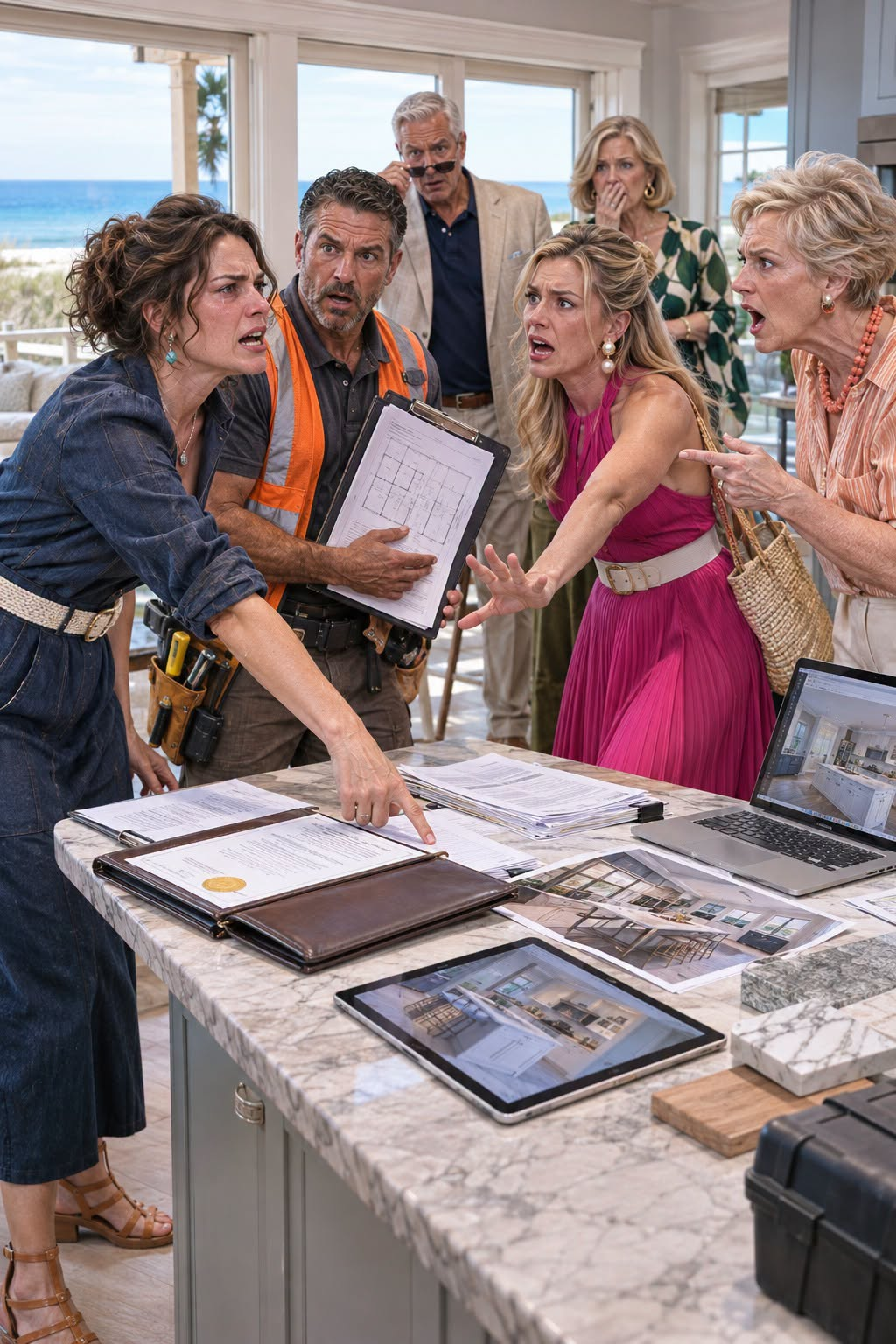
"Good evening. Is this Erin Mitchell? My name is Daniel. I'm a contractor working on the Emerald Isle beach house renovation. I was given your number because we need the property owner's signature before we can proceed with the fifty-two-thousand-dollar project."
I sat completely still.
"The what?"
"The renovation. Your sister Paige told us she was handling the property, but the paperwork lists you as the owner."
I looked down at the leather folder.
"Who authorized this work?"
There was a brief silence.
Then the contractor said something that made my stomach tighten.
"Well, that's actually why I'm calling. Your sister has already approved the design, and we've received instructions about the payment arrangement. But before we schedule the demolition, there's one more document you need to see."
I stood up.
"What document?"
He hesitated.
"Ma'am, I think you should come down here and look at the plans yourself. Because there's something on the renovation agreement that doesn't make sense."
Then he read me the name printed beside the payment authorization.
And it wasn't Paige's.






Comments 0