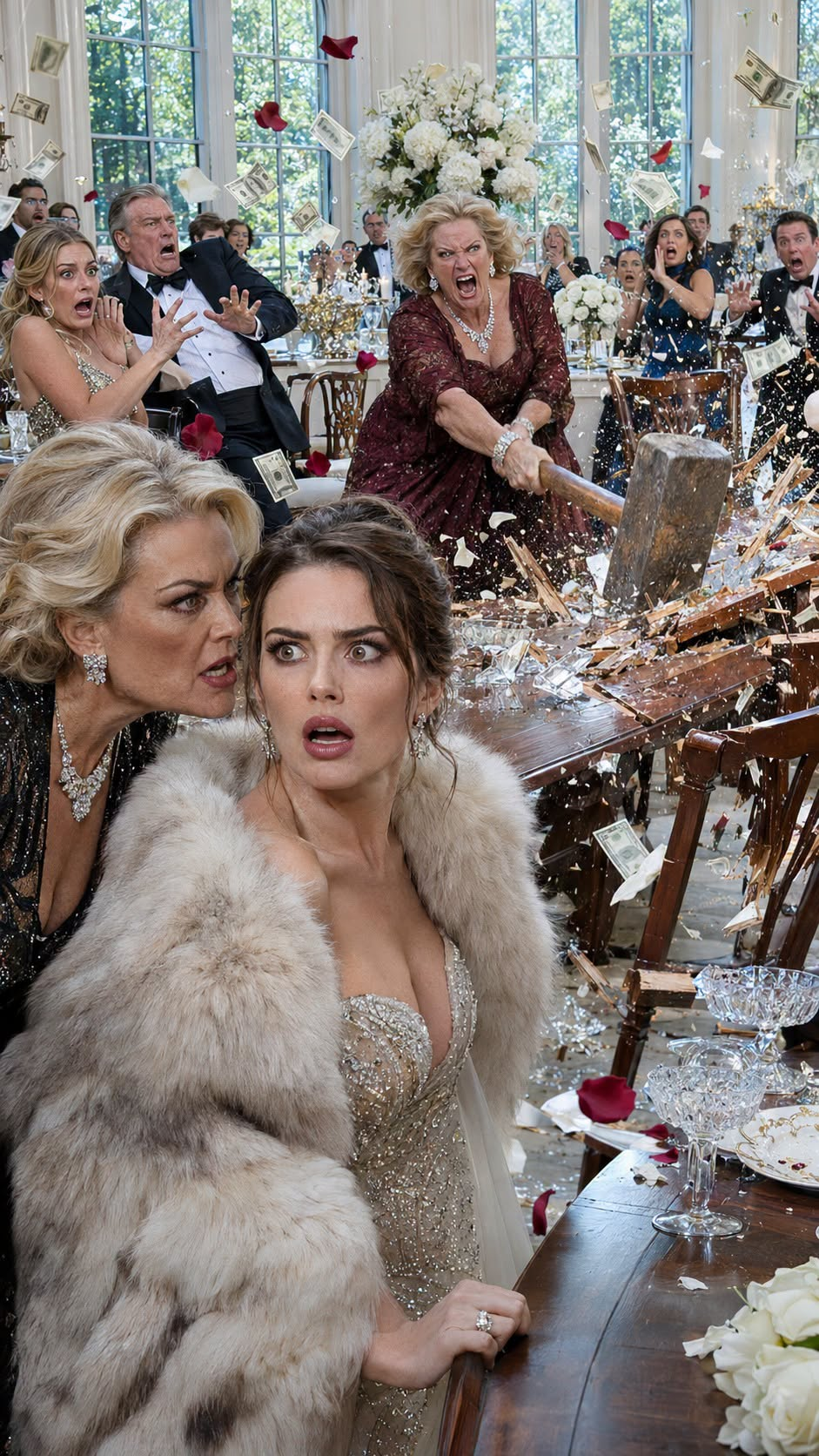
"She does temp work when she can find it," my mother announced, smiling.
Across the table, billionaire property executive Vivian Harrington froze with her hand above a wine glass.
Beside my plate sat an ivory card bearing two words: AVERY QUINN.
Vivian saw the name.
And suddenly, my mother's little joke wasn't funny anymore.
My name is Avery Quinn, and three seconds before my mother publicly reduced my entire existence to a punch line, I had been trying to decide whether I could survive another two hours without walking out.
I was twenty-nine years old.
I owned a logistics company with contracts across eleven states, employed more than four hundred people, and had spent the previous six weeks negotiating a transportation agreement worth nearly eighteen million dollars.
But according to my mother, I was the daughter who couldn't hold down a real job.
The irony might have been amusing if it hadn't followed me for most of my adult life.
My younger sister, Claire, was getting married in three weeks.
Her fiancé, Nathan Harrington, came from one of those families whose name appeared on hospital wings, museum plaques, and charitable foundations. His mother, Vivian, ran Harrington Property Group, a national commercial real estate company.
And tonight, at a pre-wedding charity gala benefiting children's educational programs, my mother had finally achieved what she considered her greatest social accomplishment.
She was becoming related to the Harringtons.
That mattered more to her than almost anything.
Including the truth.
"Honestly, Avery," she'd told me two days earlier, "please don't make this evening uncomfortable."
I'd been standing in my kitchen, holding a mug of coffee and reviewing a freight acquisition proposal on my laptop.
"What exactly would make it uncomfortable?"
"You know what I mean."
"I really don't."
She'd sighed.
That long, theatrical sigh she'd perfected when I was a teenager.
"Claire's future in-laws are important people. They don't need to hear about your employment difficulties."
I had looked at the spreadsheet on my screen.
Quarterly revenue.
Expansion projections.
A proposed warehouse purchase in Ohio.
Employment difficulties.
Right.
"I wasn't planning to discuss work," I'd answered.
"Good. And wear something appropriate. Nothing that looks borrowed."
I remembered staring at my phone after she hung up.
The emerald-green gown I'd selected for the gala had been custom-made.
It cost more than my mother's first car.
But I hadn't bought it to prove anything.
I simply liked the color.
That was something my family had never understood.
Not everything I did was about them.
At least, that was what I kept telling myself.
The truth was more complicated.
Because some part of me still wanted my mother to look at me and see a daughter worth loving.
Not a problem to be explained away.
Not an embarrassment.
Not the family disappointment.
Just me.
And that was why I was sitting at Table Four instead of enjoying a quiet Friday evening at home.
"You're twisting that poor napkin to death."
My grandmother's voice brought me back to the present.
I glanced toward her.
Eleanor Quinn was seventy-eight, sharp-eyed, and possessed the kind of quiet authority that didn't require anyone's permission.
She wore a dusty-rose gown and the pearl necklace my grandfather had given her on their fortieth anniversary.
Her white hair was pinned into a neat chignon.
Unlike my mother, she had never confused expensive jewelry with character.
"Sorry, Grandma."
She looked at my hands.
"That napkin didn't insult you."
"Not yet."
Her lips twitched.
"There's my girl."
I relaxed my fingers.
A little.
Across the table, Vivian Harrington was speaking to my father about commercial property development.
I had known she would attend.
Of course I had.
She was the groom's mother.
What I hadn't expected was to be seated directly opposite her.
Vivian and I had met in a very different setting six weeks earlier.
She had walked into my company's headquarters with three executives, two attorneys, and a reputation for destroying negotiations that wasted her time.
I had arrived with one legal adviser, my chief operating officer, and a proposal I'd rewritten fourteen times.
We spent seven hours discussing freight corridors, regional distribution costs, and the consolidation of Harrington's commercial supply network.
Vivian challenged nearly every assumption in my presentation.
I challenged several of hers.
By the end of the day, she'd offered me her hand.
"You're younger than I expected, Ms. Quinn."
"I get that a lot."
"You also know exactly what you're doing."
"I try."
She had smiled.
"Don't be modest. It doesn't suit you."
Three weeks later, we'd signed the agreement.
And now here she was, sitting across from me, listening politely while my father discussed investment opportunities he barely understood.
She hadn't recognized me yet.
That wasn't entirely surprising.
At our meetings, I'd worn tailored business suits, kept my dark hair pulled back, and spent most of my time standing in front of financial projections.
Tonight, I wore an evening gown, understated diamond earrings, and the uncomfortable expression of a woman attending a family function against her better judgment.
Besides, Vivian had probably met hundreds of people since our negotiations.
Still, I could tell something about my face was bothering her.
Twice, she'd glanced toward me.
Once, she'd narrowed her eyes.
I had responded with a polite nod.
Nothing more.
I wasn't hiding.
But I wasn't volunteering information, either.
There was a difference.
"Claire looks absolutely radiant," my mother announced.
My younger sister smiled.
Claire was twenty-five, beautiful, and had inherited our mother's talent for making every room feel like an audience.
She wore a pale lavender gown and a diamond engagement ring large enough to catch the attention of people seated three tables away.
Nathan sat beside her.
He was handsome, polite, and, from what little I knew of him, considerably kinder than the people who had raised my sister.
"Thank you, Mom," Claire said.
My mother turned toward Vivian.
"She's always been our ambitious one."
I almost laughed.
Claire had graduated with a communications degree, worked briefly for a public relations agency, and then decided she wanted to focus on wedding planning.
There was nothing wrong with any of that.
What bothered me was the implication that ambition had somehow skipped over me.
"She has such wonderful instincts," my mother continued. "Even as a little girl, Claire knew exactly what she wanted."
"That can be a valuable quality," Vivian replied.
Her tone was polite.
Measured.
I knew that tone.
It was the same voice she used when someone tried to impress her with information she hadn't requested.
My father nodded enthusiastically.
"Claire's always had a good head on her shoulders."
I stared at my water glass.
Grandma Eleanor reached for her wine.
"And Avery?" she asked pleasantly.
My mother's smile tightened.
"What about Avery?"
"She's sitting right here, Margaret."
A small silence settled over our end of the table.
I felt it immediately.
The familiar shift.
The moment when my family remembered I existed.
My mother turned toward me.
"Oh, of course."
She gave a little laugh.
The kind that sounded charming to strangers and like a warning to me.
"This is our other daughter."
Other.
Not older.
Not Avery.
Other.
"She does temp work when she can find it."
Claire smiled.
It was quick.
Almost automatic.
My father looked away.
And across the table, Vivian Harrington went perfectly still.
I noticed her hand first.
She had been reaching for her wine glass.
Now her fingers hovered above the stem.
Motionless.
Her eyes moved from my mother to me.
Then down.
To the ivory place card beside my plate.
AVERY QUINN.
Her expression changed.
I watched recognition arrive in stages.
Confusion.
Concentration.
Disbelief.
Then certainty.
I knew the exact moment she remembered.
Because her shoulders straightened.
And her eyes widened just enough to tell me that she had finally connected the woman in the emerald gown with the CEO who had spent seven hours arguing freight economics across a boardroom table.
My stomach tightened.
Oh, no.
Not here.
Not tonight.
I hadn't planned to reveal anything.
For years, my family had assumed that because I didn't discuss my work, I didn't have work worth discussing.
I had let them believe it.
At first, because I was struggling.
Later, because I was tired.
And eventually, because I wanted to know whether they could love me without being impressed by me.
That experiment had gone badly.
But I still hadn't intended to end it in front of thirty wealthy strangers.
Vivian slowly rose.
My mother blinked.
"Mrs. Harrington? Is something wrong?"
Vivian didn't answer her.
Instead, she looked directly at me.
The room seemed to narrow.
The chandeliers.
The music.
The low conversations.
The clinking glasses.
Everything receded behind the expression on Vivian's face.
She leaned slightly across the table.
And whispered three words.
"Madam Chairwoman Quinn."
Silence.
Not the comfortable silence that follows a toast.
Not the distracted quiet of guests listening to music.
This was the kind of silence that happened when everyone realized something important had just occurred, but only a few people understood what it meant.
My mother stared at Vivian.
"I'm sorry?"
Vivian remained standing.
Her gaze never left mine.
"Ms. Quinn," she said, more clearly now. "I didn't realize you were Claire's sister."
I drew a careful breath.
"Good evening, Vivian."
My mother's head turned toward me.
Then back to Vivian.
Then toward me again.
I could practically hear the calculations failing inside her head.
"Wait," she said. "You two know each other?"
Vivian looked surprised by the question.
"Of course."
"From where?"
"Our companies work together."
My mother's expression remained fixed.
"Companies?"
I felt Grandma Eleanor's fingers close gently around my wrist beneath the table.
A warning.
Or encouragement.
Possibly both.
Vivian glanced at my mother.
"Your daughter is the founder and chief executive of Quinn Meridian Logistics."
The name landed between the crystal glasses.
My father frowned.
"Quinn Meridian?"
Nathan leaned forward.
"Wait. The national logistics company?"
I looked at him.
He looked back at me.
His eyes widened.
"You're Avery Quinn?"
"Apparently," I said.
Grandma made a small sound that might have been a suppressed laugh.
Nathan shook his head.
"I've read about your company."
Claire's smile disappeared.
"What company?"
"The one that handled the Mid-Atlantic distribution consolidation last year," Nathan replied. "Dad mentioned them during our infrastructure review."
Vivian nodded.
"That was Avery's team."
My mother laughed.
It was a terrible sound.
Thin.
Forced.
Almost desperate.
"Well, there must be some misunderstanding."
I turned toward her.
"Mom."
"No, sweetheart, I'm sure Mrs. Harrington is confusing you with someone else."
Vivian's expression cooled.
"I assure you, I'm not."
My mother swallowed.
"But Avery doesn't—"
She stopped.
For the first time in my life, I watched my mother run out of a sentence.
Vivian turned back to me.
"I owe you an apology."
That surprised me.
"For what?"
"For not recognizing you immediately. I should have."
"There's no reason to apologize."
"Still."
She smiled faintly.
"I spent six weeks preparing for our negotiations. I ought to recognize the woman who convinced my board to change its entire distribution strategy."
My father slowly placed his fork down.
The sound against the porcelain was painfully loud.
"Six weeks?" he asked.
Vivian nodded.
"An extremely thorough process."
Nathan looked impressed.
"Mom doesn't change her mind easily."
"No," Vivian said. "I don't."
I wished everyone would stop looking at me.
Not because I was ashamed.
Because this was the exact kind of attention I'd spent years trying to avoid at family gatherings.
The attention that turned ordinary accomplishments into weapons.
My mother had always made sure Claire's successes were celebrated.
A new internship.
A promotion.
A successful charity committee meeting.
All deserved recognition.
But when I got my first major client, Mom told me not to talk about it at Thanksgiving because Claire was having a difficult month.
When I leased my first warehouse, Dad asked whether I was sure I could afford it.
When I hired my fiftieth employee, Mom asked whether the company was legitimate.
And when I stopped telling them anything at all, they decided that silence meant failure.
Now Vivian Harrington was standing at their table, treating me like someone whose time mattered.
And my mother looked as though the floor had disappeared beneath her chair.
"How large is your company?" Nathan asked.
I hesitated.
Vivian answered before I could.
"Large enough that my executive team spent months trying to secure a meeting with her."
I closed my eyes briefly.
Vivian.
Please.
But she wasn't finished.
"Quinn Meridian manages freight and distribution networks across eleven states. Avery built it from the ground up."
Claire stared at me.
"You own a trucking company?"
I looked at her.
"A logistics company."
"That's the same thing."
"No," Vivian said quietly. "It isn't."
Claire's cheeks reddened.
My mother reached for her wine glass.
Her hand shook.
I noticed because she'd always criticized me for nervous habits.
Don't fidget, Avery.
Don't slouch.
Don't look uncertain.
People judge weakness.
Now she couldn't hold a glass steady.
"Well," she said, "Avery has always been very private."
I almost admired the speed of the revision.
Thirty seconds earlier, I had been unemployed.
Now I was private.
"Yes," I said. "I have."
My father cleared his throat.
"Why didn't you tell us?"
I looked at him.
Really looked at him.
At the man who had missed my college graduation because Claire had a dance competition.
At the man who'd once told me that starting a business was a fantasy for people who couldn't accept reality.
At the man who had asked me, three years earlier, whether I needed help finding a receptionist job.
"I tried," I said.
He looked confused.
"When?"
"Several times."
My mother interrupted.
"Well, surely this isn't the place to discuss old misunderstandings."
"No," I agreed. "It isn't."
She seemed relieved.
For about half a second.
Then Grandma Eleanor set down her glass.
"Actually, Margaret, I think this is exactly the place."
Every head turned toward her.
My mother stiffened.
"Mother, please."
Grandma smiled.
It was a pleasant expression.
Dangerously pleasant.
"You introduced Avery to these people as a woman who struggles to find temporary work."
"I was only joking."
"Nobody laughed."
Claire looked down.
Grandma continued.
"You chose to embarrass your daughter in public. You don't get to complain when the truth becomes public, too."
My mother stared at her.
The conversation at nearby tables continued, but several guests had begun glancing in our direction.
I could feel my mother's panic rising.
Public embarrassment was the one thing she feared more than losing control.
"Let's not make a scene," she whispered.
Grandma tilted her head.
"Then stop making one."
I nearly smiled.
Nearly.
But there was something deeply painful about watching my grandmother defend me against my own mother.
I was almost thirty.
I ran a company.
I negotiated contracts with executives who had been in business longer than I'd been alive.
And still, sitting at this table, I felt sixteen.
Small.
Unwanted.
Desperate to be understood.
Vivian seemed to sense it.
She finally sat down.
"Ms. Quinn," she said gently, "I hope you won't mind if I say something."
"Of course."
"Your professional reputation is exceptional. Whatever misunderstandings exist within your family, I would hate for anyone here to leave with an inaccurate impression of your accomplishments."
My throat tightened.
"Thank you."
She inclined her head.
"You're welcome."
Nathan leaned toward Claire.
"Did you know?"
Claire shook her head.
"No."
Her voice was flat.
But I knew my sister.
I recognized the look forming behind her eyes.
It wasn't pride.
It wasn't happiness.
It was resentment.
The same resentment I'd seen when I received a scholarship she hadn't expected me to win.
The same resentment that appeared whenever someone complimented me at a family gathering.
Claire didn't necessarily want me to fail.
She simply wanted me to remain beneath her.
And tonight, in front of her future mother-in-law, that arrangement had been shattered.
My father leaned forward.
"Avery, I think we should talk."
"About what?"
"About your company."
I looked at him.
"Why?"
He blinked.
"Because I'm your father."
The words were so familiar that I almost laughed.
Being my father had never stopped him from dismissing my plans.
Apparently, it now entitled him to information about their success.
"I don't discuss business at family celebrations," I said.
My mother seized the opportunity.
"Exactly. This is Claire's evening."
I nodded.
"Then let's celebrate Claire."
For a moment, I thought the conversation might finally end.
The servers began bringing the next course.
Music swelled near the ballroom entrance.
Nathan's hand found Claire's beneath the table.
Vivian asked Grandma Eleanor about the charity's scholarship program.
The room gradually returned to its earlier rhythm.
But something had changed.
My mother's smile no longer reached her eyes.
My father kept studying me as though I were a stranger.
Claire barely touched her food.
And Vivian Harrington, who had arrived as the mother of the groom, now seemed to regard me as the most interesting person at the table.
I didn't enjoy it.
Not the way I might once have imagined.
There had been a time when I dreamed of proving my parents wrong.
I imagined showing them magazine articles.
Financial reports.
Photographs of new offices.
I imagined my mother finally saying she was proud.
But when the moment arrived, I felt mostly tired.
Because their sudden interest wasn't love.
It was recognition of status.
And I had never wanted status from them.
I wanted kindness.
"Avery."
Grandma's voice was barely audible.
I turned.
She was watching me with an expression I couldn't immediately identify.
Pride.
Sadness.
And something else.
Worry.
"Are you all right?" she asked.
I nodded.
"I will be."
She squeezed my wrist.
Then she glanced toward my father.
Something passed across her face.
A decision.
I recognized it because I'd seen the same expression when she told my grandfather's attorney that she wouldn't sign a document until she'd read every page.
Grandma Eleanor had never been easy to pressure.
She reached into her small evening bag.
"What is it?" I whispered.
"Something I should have given you a long time ago."
My stomach tightened.
"Grandma?"
"Not here."
She looked toward my mother.
"Keep your voice down."
From the bag, she withdrew a small cream-colored envelope.
It was old.
The edges had yellowed.
A faint crease ran diagonally across the front.
There was no stamp.
No return address.
Only my name.
AVERY.
Written in handwriting I recognized.
My grandfather's.
I stared.
Grandpa had died eleven years earlier.
He'd been the only person besides Grandma who had encouraged me to study business.
When I was fourteen, he gave me a battered accounting textbook.
When I was sixteen, he helped me open my first savings account.
When I was eighteen, he told me something I had never forgotten.
"People who need you to stay small are frightened of what happens when you grow."
I had carried those words into every difficult meeting of my career.
And now his handwriting was staring back at me from an envelope my grandmother had apparently kept hidden for more than a decade.
"Where did you get this?" I whispered.
Grandma's expression tightened.
"Your grandfather left it for you."
"Why didn't you give it to me?"
Her eyes moved toward my father again.
"Because I made a promise."
"To Grandpa?"
She shook her head.
"To your mother."
A cold feeling spread through my chest.
I looked down at the envelope.
My grandfather had died when I was eighteen.
That was the same year my parents told me they couldn't afford to help with college.
The same year Claire began attending an expensive private school.
The same year I worked two jobs while taking business classes at night.
My grandmother's hand trembled slightly.
I had never seen that before.
"There's something you need to understand," she whispered.
Before she could continue, my mother appeared beside us.
I hadn't noticed her leave her chair.
"What are you two whispering about?"
Grandma calmly closed her evening bag.
"Nothing that concerns you."
My mother's eyes dropped to the envelope in my hand.
Her expression changed so abruptly that I stopped breathing.
For one instant, she looked genuinely terrified.
Then she reached toward me.
"Avery, give me that."
I pulled my hand back.
"Why?"
"Because it doesn't belong to you."
I stared at her.
"My name is on it."
"Your grandmother is confused."
Grandma straightened.
"I am not confused, Margaret."
My mother ignored her.
"Avery, I'm asking you nicely."
I looked at the envelope again.
At my grandfather's handwriting.
At the yellowed paper.
At the way my mother's fingers trembled as she reached for it.
Something was wrong.
Something much bigger than a humiliating introduction.
"What's inside?" I asked.
My mother glanced around the table.
"Not now."
"Then when?"
"Tomorrow."
I shook my head.
"No."
Her expression hardened.
"Avery."
I had heard that tone a thousand times.
The warning.
The command.
The expectation that I would surrender because she was my mother.
But I wasn't sixteen anymore.
And whatever was inside that envelope had been waiting for eleven years.
I slipped one finger beneath the flap.
My mother grabbed my wrist.
Hard.
"Don't open it."
The sharpness in her voice drew my father's attention.
He stood.
"Margaret?"
She didn't look at him.
Her eyes remained fixed on the envelope.
Grandma Eleanor rose slowly beside me.
"Take your hand off her."
My mother released me.
I looked from one face to the other.
Then I opened the envelope.
Inside was a folded letter.
And a second document.
Older.
Official-looking.
A legal seal had been pressed into the bottom corner.
I unfolded the first page.
My grandfather's handwriting filled the top half.
The first sentence made my pulse jump.
My dearest Avery, if you are reading this, then the truth about what happened to your inheritance has finally become impossible to hide.
I stopped.
Inheritance?
I looked up at Grandma.
Her eyes were wet.
My mother had gone completely pale.
And my father—
My father was staring at the document beneath the letter.
Not with confusion.
With recognition.
He knew exactly what it was.
I slowly pulled out the second page.
Across the top were the words:
THE QUINN FAMILY EDUCATIONAL AND BUSINESS TRUST
Beneath them was my full legal name.
And a number.
A number so large that I thought I'd misread it.
Then I noticed the signature at the bottom.
It wasn't my grandfather's.
It was my father's.
Dated six months after Grandpa died.
Beside it was a handwritten authorization transferring control of the trust.
My mother made a small, strangled sound.
Grandma Eleanor leaned toward me.
"Avery," she whispered, "there's one more page."
I looked inside the envelope.
A final sheet remained folded at the bottom.
On its outer edge, someone had written:
THE PERSON WHO AUTHORIZED THE TRANSFER.
I reached for it.
My father suddenly stepped forward.
His voice cracked.
"Don't read that here."
I looked straight into his eyes.
"Why not?"
He said nothing.
I unfolded the page.
And there, beneath the official seal, was a name I never expected to see.
The signature belonged to—






Comments 0