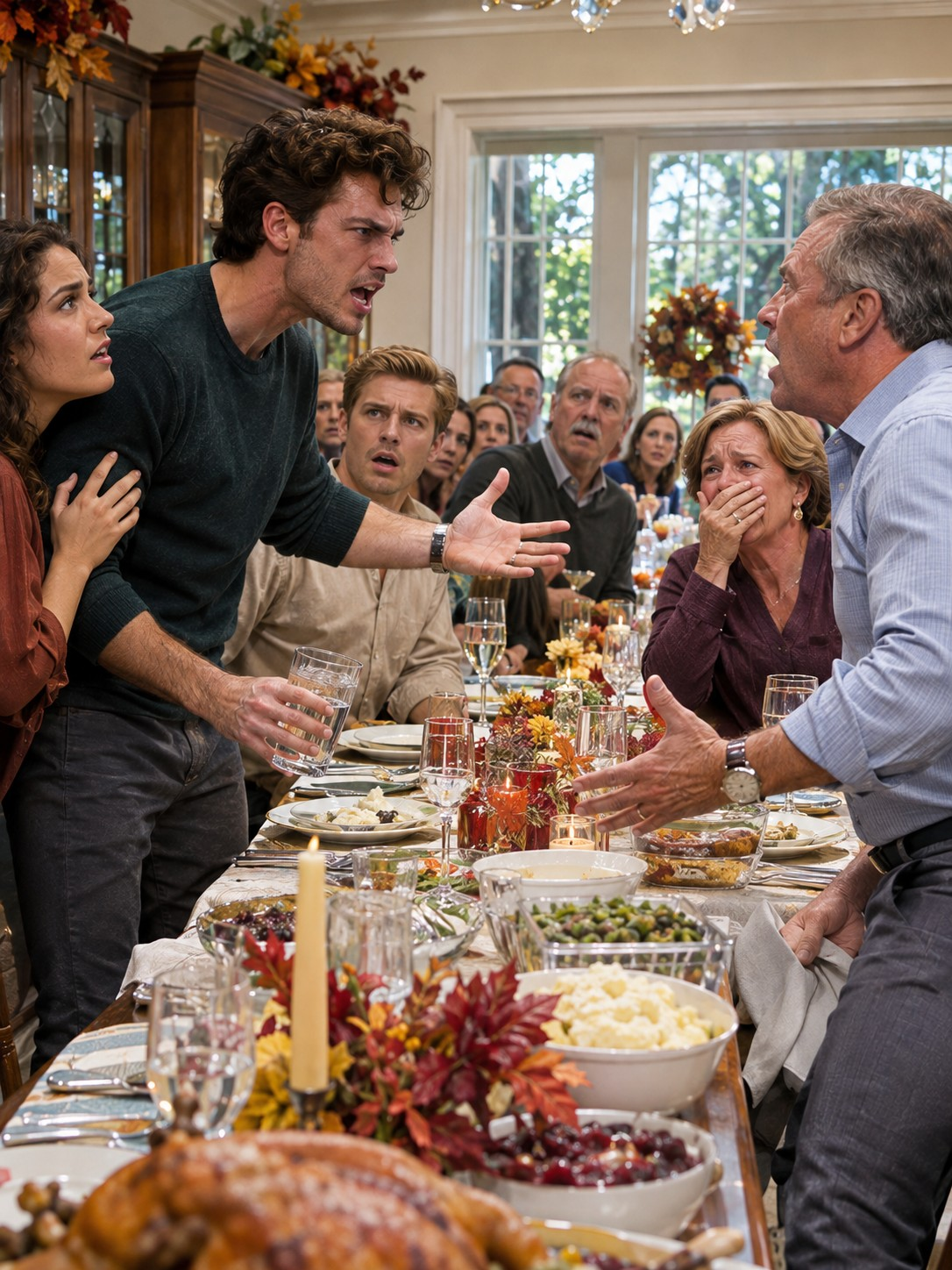
I raised my glass in front of thirty-two relatives and said:
"Before we celebrate what a wonderful family we are, there's something my father said twelve years ago that everyone deserves to hear."
My father, Greg, stopped smiling.
My uncle Vince slowly put down his fork.
And my mother covered her mouth.
Nobody knew that the most uncomfortable Thanksgiving dinner of their lives had just begun.
My name is Aaron Mitchell. I was twenty-six years old that Thanksgiving, and until that evening, my family had spent most of my life believing I was the son who would never amount to much.
They weren't particularly cruel about it.
That was the strange part.
There were no screaming matches, no dramatic punishments, and no moments when someone explicitly told me I didn't belong.
Instead, there were thousands of little decisions.
Every birthday, every Christmas, every school achievement, every family celebration seemed to reinforce the same unspoken message.
My older brother Tyler mattered more.
And I was expected to understand that without making anyone uncomfortable.
But before I tell you what happened at that Thanksgiving dinner, I need to explain something.
Because the words I spoke that night weren't invented out of anger.
They had been sitting inside me since I was fourteen.
And I remembered every single one.
Twelve years earlier, I was a freshman in high school living with my parents in Harrisburg, Pennsylvania.
My father worked as an operations manager at a packaging company. He was organized, ambitious, and extremely proud of being the kind of man who provided for his family.
My mother, Stephanie, taught third grade at Riverside Elementary.
She was warm with neighbors, generous with church friends, and always remembered to send birthday cards to distant relatives.
From the outside, our family looked perfectly ordinary.
We attended church.
We celebrated holidays.
We took photographs in matching sweaters.
My father grilled hamburgers in the summer, and my mother made Thanksgiving dinner every year.
People regularly complimented my parents on raising two wonderful boys.
Those compliments always seemed to make my father especially happy.
He had two sons.
Tyler was the first.
I was the second.
Tyler was two years older, played quarterback, and had the kind of personality adults immediately liked.
He was confident without appearing arrogant.
He could walk into a room full of strangers and somehow leave with three new friends.
Teachers remembered him.
Coaches praised him.
My father's coworkers knew his name.
I was different.
I liked computers, books, and figuring out how things worked.
I could spend hours trying to solve a programming problem or taking apart an old laptop just to understand what was happening inside it.
I wasn't particularly athletic.
I didn't enjoy being the center of attention.
And I rarely asked my parents for anything.
For years, I thought those differences explained why Tyler received more attention.
I didn't understand how deep the distinction went until I began noticing the details.
When Tyler turned sixteen, my father surprised him with a brand-new Honda Civic.
The entire family gathered in the driveway.
My mother cried.
My father handed Tyler the keys and told him he was proud of the young man he was becoming.
Two years later, when I turned sixteen, my father gave me Tyler's old bicycle.
The chain slipped every few rides.
I thanked him anyway.
When Tyler received his SAT results, my parents spent an entire evening discussing his college prospects.
My father printed information about universities and scholarships.
My mother bought folders to organize his applications.
When I received my own grades, Dad glanced at the report card and nodded.
"Good job, bud."
Then he asked Tyler whether he had spoken to his football coach.
I learned to celebrate quietly.
I also learned not to expect anyone to ask follow-up questions.
The real turning point happened on a Thursday evening in October.
I was fourteen.
I had been studying for a history test and went downstairs to get a glass of water.
As I approached the kitchen, I heard my name.
I stopped.
My father and Uncle Vince were sitting at the kitchen table.
There were two beer bottles between them, and my father's voice had dropped into the low, serious tone he used when discussing money.
Uncle Vince had been asking about college savings.
His own children were approaching high school, and he was worried about tuition.
"Have you figured out what you're doing for both boys?" Vince asked.
My father gave a short laugh.
"We've got a plan."
"Must be expensive."
"That's why you have to be strategic."
I stood in the hallway.
Then Dad said something about Tyler's potential.
He mentioned football, leadership, and how Tyler was already showing signs of becoming somebody important.
Vince asked about me.
I remember the silence that followed.
Then my father answered.
"We're putting everything into Tyler. Aaron's just not worth the investment."
I stopped breathing for a moment.
Vince didn't respond immediately.
Finally, he said, "Come on, Greg. The kid's only fourteen."
My father shrugged.
"Exactly. He's fourteen and there's nothing there. Tyler was already starting varsity at fourteen."
I didn't wait to hear anything else.
I walked upstairs without getting my water.
My bedroom door closed quietly behind me.
I sat on the edge of my bed and stared at the wall.
I didn't cry.
I didn't throw anything.
I didn't even feel particularly angry.
What I felt was something much more difficult to describe.
It was the sudden understanding that my father had already decided who I was going to become.
And he had made that decision without ever asking me what I wanted.
The next morning, I went downstairs for breakfast.
Dad was reading the newspaper.
Mom was packing lunches.
Tyler was talking about an upcoming football game.
Everything looked exactly the same.
My father looked up.
"Morning, bud."
"Morning."
He went back to reading.
I poured cereal into a bowl and sat down.
Nobody knew what I had heard.
Nobody knew that something inside me had shifted.
And I decided they never would.
For the next twelve years, I carried those words quietly.
I didn't tell my friends.
I didn't confront my father.
I didn't ask my mother why Tyler seemed to receive everything.
I simply stopped expecting anything.
At first, that decision hurt.
Then it became a habit.
And eventually, it became the foundation of the life I built.
But my father had no idea.
He continued treating Tyler like the family's greatest achievement.
He continued telling relatives about his older son's accomplishments.
And whenever somebody asked about me, he gave the same answer.
"Aaron's doing fine. He's into computers."
As if I were describing a hobby rather than building a future.
By the time I graduated high school, I had already started teaching myself programming.
I spent evenings watching tutorials, reading technical documentation, and experimenting with code on an old laptop.
It wasn't glamorous.
Sometimes the computer crashed.
Sometimes I spent six hours solving a problem that turned out to be a missing character.
But I loved it.
For the first time, I had found something that didn't depend on my father's approval.
Something that responded to effort rather than family favoritism.
When I applied to college, I did it myself.
I researched universities.
I completed financial aid applications.
I wrote essays.
I submitted everything before the deadlines.
My parents barely noticed.
When I received my acceptance letter from Shippensburg University, I printed it and placed it on the kitchen counter.
Mom hugged me.
"That's wonderful, sweetheart."
Dad glanced at the paper.
"Good for you, bud."
Then he turned toward Tyler.
"Have you heard anything about Penn State yet?"
I stood there holding my acceptance letter.
I remember looking at the two of them and realizing that I could spend the rest of my life trying to earn the same enthusiasm they gave my brother without effort.
Or I could stop trying.
That summer, I chose the second option.
I left for college with a secondhand laptop, a modest amount of savings, and absolutely no expectation that my parents would help me.
I didn't know it then, but the most important thing I carried out of that house wasn't my computer or my clothes.
It was a decision.
I was going to build a life that nobody could dismiss.
And twelve years later, when my father handed me that Thanksgiving glass, he still had no idea what his younger son had become.
But there was one person at that dinner table who remembered the kitchen conversation almost as clearly as I did.
And just as I finished speaking, Uncle Vince slowly pushed his chair backward...






Comments 0