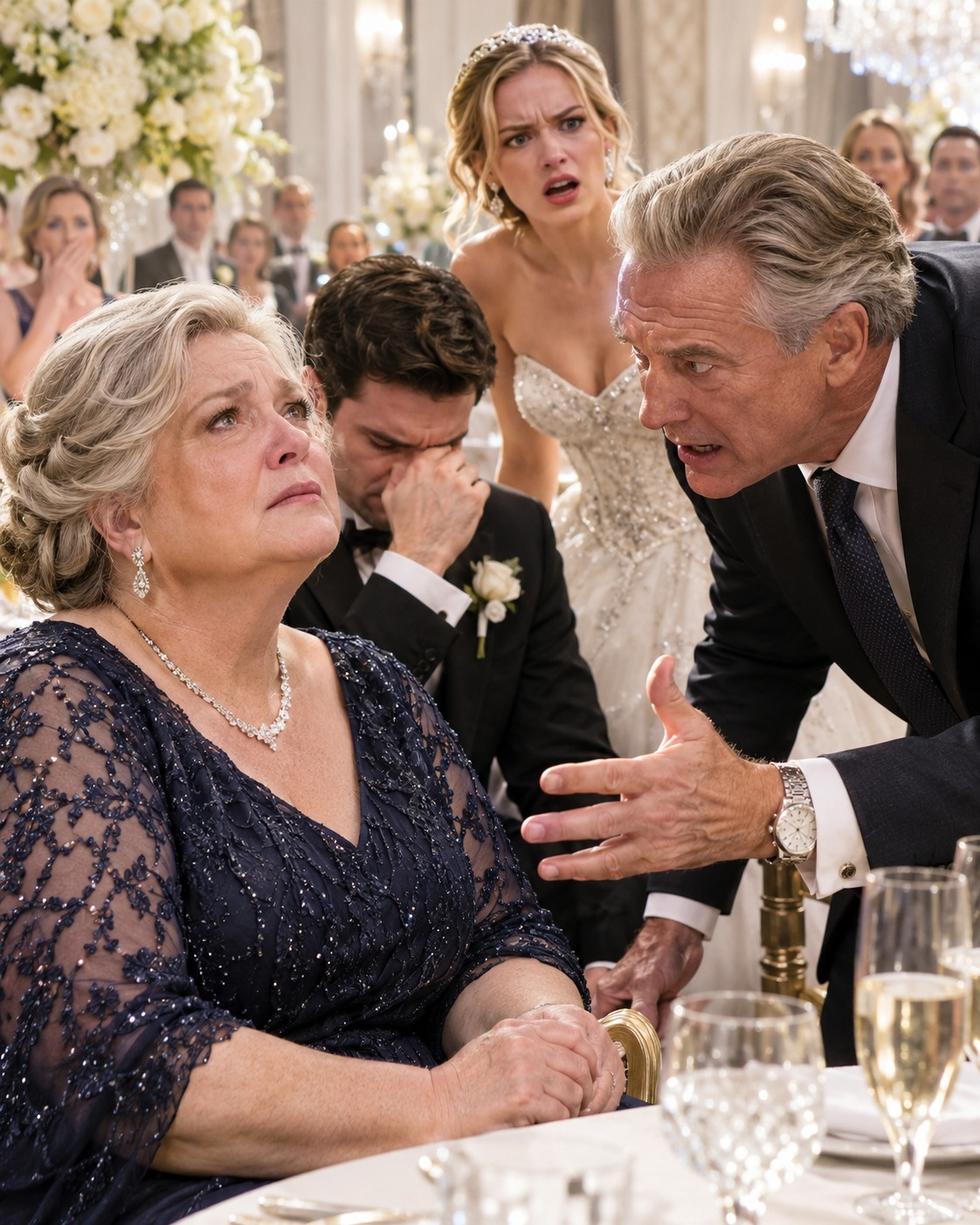
A bride raised her champagne glass and pointed at me.
"Here's to the fat old pig we all have to tolerate!"
Richard Sterling dropped his champagne glass.
On the marble floor beside his chair, the broken crystal scattered around a tiny silver name card.
My name was printed on it.
He suddenly realized he had insulted the wrong woman.
My daughter-in-law, Tiffany, was still smiling when the first pieces of crystal stopped sliding across the floor.
She stood beneath a magnificent chandelier, holding the microphone like a queen addressing her subjects. Her white wedding gown shimmered with gold embroidery, and the diamonds around her wrist caught the light every time she moved her hand.
Two hundred guests had gathered to celebrate her marriage to my son, Caleb.
And apparently, to celebrate my humiliation.
For a moment, nobody knew whether to laugh or pretend they hadn't heard her.
Then someone near the front table chuckled.
Another person joined in.
Within seconds, several guests were laughing openly.
I remained seated.
My fingers were folded around a linen napkin, and beneath the tablecloth, my left hand was trembling.
I was seventy-one years old.
I had buried my husband, raised our only child, survived years of financial uncertainty, and built a business that had grown far beyond anything either of us had imagined.
Yet there I was, sitting at my son's wedding, being called a pig by the woman he had chosen to marry.
I looked at Caleb.
He was sitting beside me in his charcoal-gray tuxedo. His shoulders were stiff, and his cheeks had turned red.
He knew what Tiffany had said.
He had heard every word.
I waited.
I waited for him to stand.
I waited for him to take the microphone away from his bride.
I waited for him to say something as simple as, "That's my mother. Show her some respect."
He did none of those things.
Instead, he lowered his eyes toward his dinner plate.
That was the moment I felt something inside me break.
Not because Tiffany had insulted me.
I had heard worse things in my life.
It was because my son had decided that his comfort was more important than my dignity.
Tiffany laughed into the microphone.
"Oh, come on! Don't look so serious. It was just a joke."
She glanced at her friends.
"They know I love making people laugh."
A few more guests laughed nervously.
I noticed a young woman at the next table lower her phone. She looked uncomfortable, almost ashamed to have witnessed what had happened.
I wished I could tell her that she didn't need to feel sorry for me.
But I couldn't find the words.
My eyes returned to Caleb.
He finally looked up.
For one brief second, our eyes met.
I saw embarrassment.
I saw fear.
But I didn't see courage.
He mouthed something.
"Mom, please."
Please what?
Please don't react?
Please don't embarrass him?
Please accept the humiliation so his wedding photographs would remain beautiful?
I slowly placed my napkin beside my plate.
Then I turned toward Tiffany.
She was already looking away.
To her, the matter was settled.
She had delivered her little performance, received her laughter, and demonstrated her superiority to the woman she considered an unfortunate addition to her new family.
She had no idea that the most important person in that ballroom wasn't standing beside her.
It was sitting quietly at table seven.
And I had spent decades making sure nobody knew it.
My name is Martha Vance.
For most of my life, people believed I was an ordinary woman.
I had been married to Thomas Vance for forty-two years. He was a gentle man with a sharp mind, a stubborn sense of fairness, and an extraordinary ability to recognize opportunities other people overlooked.
When we married, neither of us had much money.
We rented a small apartment, bought secondhand furniture, and learned to stretch every paycheck.
Thomas worked long hours in commercial logistics.
I handled bookkeeping for a small distribution company.
We were never ashamed of being poor.
We were simply determined not to remain that way forever.
Our son, Caleb, was born three years after our wedding.
Thomas used to carry him around the apartment on his shoulders, pretending the boy was a king inspecting his kingdom.
I can still remember Caleb's laughter.
He was a sweet child.
When he fell, he ran to me.
When he had nightmares, he climbed into our bed.
When other children teased him because his shoes were old, Thomas worked extra shifts so we could buy him a new pair.
We wanted him to have choices.
We wanted him to grow up without the constant fear that one unexpected bill could destroy a family.
But life has a way of changing people.
And sometimes, the people you spend your entire life protecting become the ones who hurt you most.
Thomas died eleven years before the wedding.
It happened suddenly.
One afternoon, he complained about pressure in his chest. He insisted it was indigestion and refused to let me call an ambulance.
By evening, he was gone.
The doctor called it a massive heart attack.
I remembered standing beside his hospital bed, holding his hand and wondering how I was supposed to explain to our son that his father wasn't coming home.
Caleb was twenty-one.
He cried for days.
I did too.
But I had no choice except to keep going.
The business Thomas and I had built was struggling at the time. We owned a small logistics company with a handful of employees and several commercial contracts.
I could have sold everything.
Many people advised me to do exactly that.
They said I was too old to run a business alone.
They said I should take whatever money I could get and retire.
I refused.
Not because I was especially brave.
Because I knew how hard Thomas had worked.
I knew what we had sacrificed.
And I knew that if I gave up, everything we had built together would disappear.
So I worked.
I studied financial reports until my eyes burned.
I learned how to negotiate with banks.
I hired people smarter than me in areas where I lacked experience.
I made mistakes.
I lost money.
I nearly lost everything twice.
But slowly, the company grew.
A transportation contract became a regional distribution network.
The regional network became a national operation.
Then came acquisitions, infrastructure investments, technology subsidiaries, and international partnerships.
Eventually, the small company Thomas and I had started became Vance Global.
Its holdings expanded into logistics, commercial property, private infrastructure, and financial investments.
The business became worth billions.
I never changed my lifestyle.
I still preferred simple clothes.
I still shopped at ordinary stores.
I still drove the same practical car for years after I could have afforded a garage full of expensive vehicles.
I didn't need people to know how much money I had.
In fact, I preferred that they didn't.
My husband used to say that money was a useful servant but a terrible master.
I remembered those words every time someone treated me differently because of my appearance.
And I remembered them when Caleb began dating Tiffany.
I first met Tiffany at a restaurant in Manhattan.
Caleb had called me that morning.
"Mom, I'd like you to meet someone."
His voice sounded different.
Excited.
Nervous.
Almost boyish.
I was happy for him.
I had worried that he was becoming too focused on work and too isolated after his father's death.
When he arrived at the restaurant, Tiffany was walking beside him.
She was beautiful.
There was no denying it.
Her hair was perfectly styled, her makeup flawless, and her clothing looked as though every piece had been selected by a professional stylist.
She smiled when Caleb introduced us.
"Martha, it's so wonderful to finally meet you."
Her voice was sweet.
She leaned forward and kissed the air beside my cheek.
I smiled.
"It's nice to meet you too, Tiffany."
We sat together for lunch.
She talked about her family, their vacations, their social circle, and the charitable events her mother organized.
Her father, Richard Sterling, owned Sterling Development, a real estate company known for luxury residential projects and commercial properties.
I recognized the company immediately.
I didn't mention it.
Tiffany described her childhood in a way that suggested ordinary comforts were beneath her.
She spoke about private schools, exclusive clubs, international travel, and expensive weddings.
Caleb listened with admiration.
I watched him carefully.
He looked happier than I had seen him in years.
That mattered to me.
I wanted my son to find love.
I wanted him to have a family.
I wanted him to feel the kind of security Thomas and I had once shared.
So when Tiffany made a small comment about my inexpensive handbag, I ignored it.
When she asked whether I had ever considered dressing more elegantly for special occasions, I smiled.
And when she suggested that my neighborhood was a little too ordinary for someone of Caleb's professional standing, I changed the subject.
I told myself that she was young.
I told myself that people from different backgrounds sometimes needed time to understand one another.
I made excuses.
It was easier than accepting the truth.
Three months before the wedding, Tiffany invited me to lunch.
She said she wanted to discuss the wedding arrangements.
I arrived early.
She arrived twenty minutes late.
After ordering a sparkling water, she opened a folder containing seating diagrams, floral arrangements, and sample photographs.
Everything looked expensive.
"Now, Martha," she began, "we want the wedding to feel cohesive."
I nodded.
"Of course."
She turned the folder toward me.
"My mother will be sitting in the front row."
"That's lovely."
"And our family will enter through the grand staircase."
I smiled.
"Very elegant."
She hesitated.
Then she pointed to a seating arrangement near the back of the ballroom.
"We thought you might be more comfortable sitting here."
I looked at the diagram.
Three rows behind the main family table.
Near the service entrance.
I looked up.
"Why there?"
Tiffany gave me a patient smile.
"Well, we're trying to maintain a certain visual aesthetic."
I waited.
She continued.
"It's a very formal event, Martha. Photographs are important. My mother has a particular idea of how everything should look."
I understood.
She didn't want me near the front.
She didn't want me in the important photographs.
She didn't want the guests comparing her wealthy family with a woman wearing inexpensive clothing.
I closed the folder.
"Is that what Caleb wants?"
Her smile faltered for half a second.
"Caleb doesn't want any conflict."
"That isn't what I asked."
She sighed.
"Martha, please don't make this difficult. We just want everything to look beautiful."
I stood.
"I understand."
I paid for my own lunch and left.
That evening, I called Caleb.
I asked him one question.
"Are you happy?"
He was silent for a moment.
"I love Tiffany, Mom."
"That wasn't what I asked."
He exhaled.
"Please don't make things complicated today. She's under a lot of pressure."
I closed my eyes.
"All right, sweetheart."
He thanked me for understanding.
Then he changed the subject.
I didn't tell him how much his answer had hurt.
I wanted to believe that after the wedding, things would improve.
I wanted to believe that he would eventually see Tiffany's behavior clearly.
I wanted to believe that love would make him stronger.
Now, sitting at table seven, I understood how foolish that hope had been.
Across the ballroom, Richard Sterling was still staring at me.
He hadn't moved since his champagne glass shattered.
At first, I wondered whether he was simply shocked by his daughter's behavior.
Then I noticed his expression.
It wasn't embarrassment.
It wasn't anger.
It was recognition.
His eyes moved from my face to the silver name card beside my plate.
Then back to my face.
His lips parted.
I knew what he was remembering.
Eleven months earlier, Richard Sterling had requested a meeting with Vance Global.
His company was in serious trouble.
Several large development projects had stalled. Construction costs had increased, lenders were demanding repayment, and a number of expected property sales had failed to close.
His company needed emergency financing.
Without it, Sterling Development could face a catastrophic liquidity crisis.
The requested financing package was worth $480 million.
My chief operating officer, Daniel Mercer, had led the negotiations.
Richard had met me personally during two meetings.
He had been polite.
Very polite.
He had called me Mrs. Vance.
He had shaken my hand.
He had thanked me for considering his company's proposal.
But the meetings had been short, and I had been dressed in a dark business suit.
Apparently, he hadn't connected that woman with the overweight widow in the inexpensive emerald dress.
Until tonight.
I looked down at my handbag.
My phone vibrated.
A message from Daniel appeared on the screen.
"Final financing recommendation ready. Awaiting your authorization."
I opened the conversation.
The ballroom seemed strangely quiet.
Tiffany was still speaking into the microphone.
Someone was rearranging a fallen chair.
Caleb remained motionless beside me.
Richard was beginning to move.
I read Daniel's message again.
Then I typed three words.
Project Sterling. Cancel.
My thumb hovered above the screen.
I thought about the employees who worked for Richard.
I thought about the contractors whose livelihoods depended on his projects.
I thought about the people who had trusted his company.
I wasn't interested in destroying innocent lives.
But I also wasn't obligated to rescue a man whose family had just demonstrated exactly how little respect they had for mine.
My eyes returned to Caleb.
He was still looking at his plate.
I pressed Send.
Across the ballroom, Richard suddenly shoved his chair backward.
And when he started running toward my table, Tiffany finally stopped smiling.






Comments 0