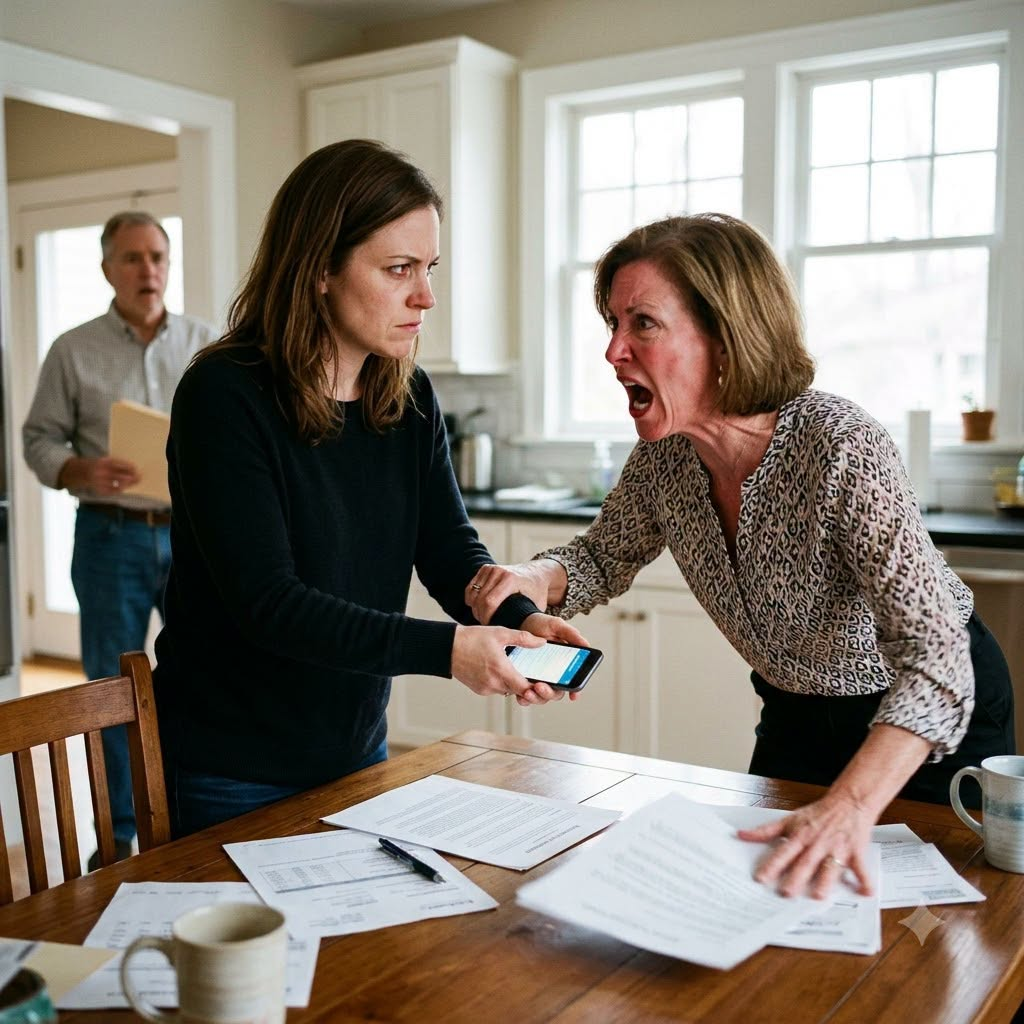
"Emily, we've found a third financial account—and its opening date is the same day your mother claimed you were traveling."
Erin's words echoed in my head as I stared at the bank transfer record.
For several seconds, I couldn't speak.
A bank account had apparently been opened using my identity five years earlier. Money had moved through it. My name appeared on financial documents I had never signed.
And now there was evidence that someone had claimed to verify my identity in person on a day when I was hundreds of miles away.
"Erin, I was in Chicago that day," I finally said. "I have airline records, hotel receipts, and work emails."
"Good. Preserve everything. We may need those records to establish that you couldn't have attended the account-opening appointment."
"Who opened the account?"
"We're requesting the original application and the available verification records. I don't want to identify someone without evidence."
I looked again at the transfer.
Two hundred thousand dollars had been paid to my mother.
Eighty-five thousand had gone to Jason.
And $480,000 had become the center of a financial arrangement that my family had concealed from me.
"Can the bank freeze the account?"
"That request has already been submitted. The institution is reviewing the disputed account and has been instructed to preserve its records."
I exhaled.
"Thank you."
"Emily, there's something else. I want you to prepare for a formal meeting with the investigators. We have enough evidence to establish serious discrepancies, but we need to let the investigation determine who did what."
I agreed.
After ending the call, I sat quietly at my dining table.
For the first time, I wasn't trying to understand how I could save my family.
I was trying to understand how I could protect myself.
And that difference changed everything.
Two days later, I met Erin at her office.
She had received additional records from the financial institution.
The third account had been opened using my personal information.
The application included an old copy of my identification and the altered authorization form.
But there was something even more important.
The account-opening records contained a handwritten acknowledgment from my mother.
She had signed as the person presenting my documents.
A separate declaration stated that I had authorized her to complete the process.
I stared at the page.
"She opened an account in my name?"
Erin nodded.
"The institution is investigating the circumstances. The records indicate that your mother submitted the application. However, the account's authorization remains disputed."
"What happened to the money?"
She opened another document.
Several transfers had been made from the account into Brooks Family Holdings.
Others had gone toward payments connected to Richard's development company.
One transfer matched the $85,000 Jason had received.
Another matched the $200,000 distribution paid to my mother.
I looked at the dates.
Everything had happened while I believed I was simply helping my parents manage their household finances.
"Did Mom use the account to receive the investment money?"
"The records suggest that some of the funds passed through the account. We'll need the complete transaction history to determine the precise flow."
I leaned back.
"Can we establish that I never authorized it?"
"We have your original one-page authorization, the altered version, your travel records, and Laura's statement. The document examiner has also identified differences between the original and the later copies."
Erin placed another report in front of me.
The handwriting and document examination had identified evidence consistent with additional text being inserted after the original form was signed.
The examiner could not identify every person involved in the alteration, but the report strongly supported my account that the original document had been changed.
I felt my eyes sting.
Not because I was sad.
Because someone had finally examined the evidence instead of asking me to trust another family explanation.
"What happens now?"
"We've submitted the evidence through the appropriate channels. The financial institutions are reviewing the disputed accounts and agreements. Your personal guarantee has been formally challenged, and the second loan application is under investigation."
I nodded.
"And the $480,000?"
"Brooks Family Holdings remains responsible for addressing its obligations. Nothing in the evidence we've reviewed establishes that you voluntarily assumed that debt."
For the first time in weeks, I could breathe.
The following week, Richard Hayes requested another meeting.
This time, Erin agreed to attend.
We met in a conference room at her office.
Richard arrived wearing an expensive navy suit. He carried a leather briefcase and wore the same confident expression I remembered from his photographs.
My mother came with him.
Dad followed a few steps behind.
Jason arrived last.
Nobody spoke when I entered.
Richard placed several documents on the table.
"Emily, I believe we can resolve this."
I remained seated.
"Then explain why my identity was used to open an account I never authorized."
He looked toward Erin.
"Those matters are being investigated."
"Then explain why a financial guarantee was submitted with my signature."
"Your family provided the relevant documentation."
"My family didn't have authority to sign for me."
My mother interrupted.
"Emily, please. We can discuss this without attacking each other."
I turned toward her.
"You told Richard I didn't need to know about the company debt until the property transaction was irreversible."
Her face changed.
"I was trying to protect the family."
"From what?"
She looked down.
Richard cleared his throat.
"The financial arrangement was complicated. Everyone believed the property transaction would allow the outstanding obligations to be settled."
"Everyone except me."
He said nothing.
I continued.
"You received money from my mother's investment. Jason received money. The company transferred funds. My identity was used to support financial obligations. And you expected me to purchase a $720,000 house so the entire arrangement could be completed."
Richard folded his hands.
"The company had legitimate financial difficulties."
"Then the company should deal with them."
He leaned forward.
"Your parents are facing a serious housing problem."
I looked directly at him.
"They sold their house. I didn't make that decision for them."
My mother began crying.
"Emily, we thought you would help us."
I felt an ache in my chest.
"I wanted to help you. I was buying you a house because I wanted you to have somewhere comfortable to live. I never agreed to give Jason half of it, guarantee Richard's debt, or become responsible for a company I didn't own."
Dad finally spoke.
"We should have told you."
I looked at him.
"Yes. You should have."
Richard opened his briefcase.
He removed a settlement proposal.
It offered to release my disputed guarantee in exchange for a financial contribution toward the company's outstanding obligations.
I didn't even read the entire document.
"No."
He frowned.
"You haven't considered the terms."
"I don't need to."
Erin took the proposal and placed it in her folder.
"Any further settlement discussions must be conducted through counsel. My client will not make payments or assume obligations based on disputed documents."
Richard's expression hardened.
"This could become expensive for everyone."
I met his eyes.
"Then you should have thought about that before using my name."
For the first time, he had nothing to say.
The investigation continued over the following weeks.
The financial institution confirmed that the third account had been opened using documentation that did not establish my authorization.
The disputed account was restricted while the investigation proceeded.
The $250,000 application was withdrawn after the authorization could not be independently verified.
The second financial institution also placed the alleged personal guarantee under formal dispute.
The document examination, original emails, Laura's statement, and my travel records became important parts of the evidence.
Laura provided a formal declaration confirming that she had never witnessed me signing the original company guarantee.
She also supplied the archived correspondence showing that my father and Jason had attended the meeting instead.
Jason eventually provided the remaining company records.
His statement confirmed that he had received $85,000 and had signed an acknowledgment claiming I had agreed to provide financial support.
He admitted that he had done so without speaking to me.
Richard's role became increasingly difficult to separate from the altered documentation and the financial transactions.
The company records showed that he had received payments connected to the disputed arrangement.
The investigation also established that the $200,000 paid to my mother had been a distribution from the property investment, not money that she had been forced to borrow for household expenses.
That discovery was particularly painful.
For years, I had believed my parents were struggling because they had no financial resources.
I had sacrificed holidays, postponed personal purchases, and worked extra hours to help them.
Meanwhile, my mother had received a substantial investment payment and concealed it.
When the investigation concluded, the institutions confirmed that I had no verified contractual obligation to repay the $480,000 company debt.
The disputed guarantee was not accepted as evidence of my personal consent.
The company remained responsible for its own outstanding obligations.
Richard was required to address the financial claims through the appropriate legal and commercial processes.
My parents and Jason also had to deal with their own financial responsibilities.
For the first time, those responsibilities belonged to the people who had actually entered into them.
Not me.
My parents' house sale eventually closed.
They received the proceeds, but the expected arrangement with Richard was no longer possible.
They could not move into my proposed house because I had canceled the purchase.
Instead, they rented a modest apartment within their budget.
It wasn't the luxury home my mother had imagined.
But it was somewhere they could afford without depending on my finances.
Jason returned the remaining portion of the $85,000 and entered into a repayment arrangement for the rest.
He also began working full-time for a local logistics company.
He had a difficult adjustment.
For the first time, nobody was promising to rescue him whenever he made a mistake.
But he gradually began paying his own bills.
Dad contacted me several times.
At first, I didn't answer.
I needed space.
Eventually, I agreed to meet him for coffee.
He arrived looking tired.
"I don't expect you to forgive me," he said.
I stirred my coffee.
"Then why did you ask to meet?"
"Because I owe you an apology."
I waited.
He looked down at his hands.
"I knew there were documents involving your name. I didn't ask enough questions. I believed your mother when she told me everything was under control. And when I realized something was wrong, I stayed quiet because I was afraid of what would happen to the family."
I looked at him.
"You let me pay for things while knowing there were financial problems you weren't telling me about."
"Yes."
"You allowed someone to use my identity."
He nodded.
"Yes."
"And when I discovered it, you asked me to wait."
His eyes filled with tears.
"I'm sorry."
I believed that he was sorry.
But an apology didn't erase five years of decisions.
"I want a relationship with you, Dad. But it has to be different."
He nodded.
"I understand."
"No financial requests. No secret agreements. No documents signed on my behalf. If something concerns me, I need to hear it directly."
"I promise."
I took a breath.
"Then we can start slowly."
He reached across the table and held my hand.
For the first time, I didn't feel responsible for making him feel better.
I simply let him apologize.
Jason came to see me a week later.
He looked different.
His clothes were simpler, his hair shorter, and the expensive watch he used to wear was gone.
He sat on my sofa.
"I know I don't deserve another chance," he said.
I handed him a glass of water.
"Why are you here?"
"To apologize."
I sat opposite him.
He looked down.
"I knew Mom was using your name. I didn't understand everything, but I knew enough to ask questions. Instead, I accepted the money and kept quiet."
I didn't interrupt.
"I was jealous of you," he continued. "You had a stable career. You could afford things I couldn't. Mom kept telling me that you had enough money to help everyone, and I started believing I was entitled to some of it."
I felt a lump form in my throat.
"Jason, I never wanted you to fail."
"I know."
"I wanted you to become independent. I wanted you to have a good life."
He nodded.
"I understand that now."
He reached into his jacket and placed a small envelope on the table.
Inside was a handwritten repayment schedule and a first payment toward the money he owed.
"It's not much," he said. "But it's mine."
I looked at him.
"Keep making the payments. Don't promise me anything you can't afford."
He nodded.
We didn't hug.
We didn't pretend everything was fixed.
But when he left, I felt that something had finally changed.
For once, Jason was taking responsibility instead of asking someone else to take it for him.
Three months later, I found another house.
It wasn't $720,000.
It wasn't intended to accommodate my parents or Jason.
It was a beautiful two-bedroom home in a quiet neighborhood, with large windows, a small garden, and a kitchen that received morning sunlight.
I purchased it entirely in my own name.
The closing documents were reviewed by Erin.
Every page was checked.
Every signature was mine.
No hidden agreements.
No family guarantees.
No mysterious financial arrangements.
On moving day, I stood in the living room holding a box of books.
Sunlight fell across the wooden floor.
For the first time in years, the money I had earned was being used to build a life that belonged entirely to me.
That afternoon, Dad arrived with a small housewarming gift.
It was a framed photograph of the two of us from when I was a child.
"I thought you might like this," he said.
I smiled.
"Thank you."
He helped me carry a few boxes.
Mom didn't come.
Our relationship remained distant, and I had stopped trying to force it back into what it had once been.
She eventually sent me a letter admitting that she had hidden the investment distribution and allowed Richard to use my old authorization.
She apologized for treating my financial support as an obligation rather than a gift.
I read the letter twice.
I didn't immediately forgive her.
But I no longer needed her explanation to determine whether I had done the right thing.
I could care about my mother without allowing her to control my life.
That was enough for now.
On the first Sunday after moving in, Dad, Jason, and I had dinner together.
It was simple.
Roast chicken, vegetables, and a homemade apple pie.
Nobody discussed property guarantees.
Nobody asked for money.
Nobody made promises about future investments.
Jason told us about his new job.
Dad talked about a fishing trip he wanted to take.
For a moment, the conversation felt ordinary.
And ordinary had never felt so valuable.
After dinner, I stepped outside into the garden.
My phone vibrated.
It was a message from Erin.
The financial institutions have completed their reviews of the disputed applications. Your personal guarantee has not been established as valid, and the disputed account has been closed following the investigation. Keep your records, but you can finally move forward.
I read the message.
Then I looked through the window.
Dad was laughing at something Jason had said.
They weren't perfect.
Our family wasn't magically repaired.
But the lies had stopped controlling our lives.
I put my phone away and looked at my new home.
For years, I had believed being a good daughter meant solving every problem, paying every bill, and sacrificing whatever I needed to keep everyone comfortable.
Now I understood something different.
Love was not a financial obligation.
Family was not permission to use someone's identity.
And helping people did not mean surrendering the right to protect yourself.
I had lost the illusion that my family would always put me first.
But I had gained something much more valuable.
My independence.
My peace.
And a future that no one else could sign away.
That evening, I locked my front door, turned off the lights, and stood for a moment in the quiet living room.
No angry messages.
No demands.
No unexpected financial documents.
Just my home.
My life.
My choices.
And for the first time in a very long time, I knew that everything inside those walls belonged to me.






Comments 0