SHE WAS NEVER THE REAL TARGET.
The six words glowed on Paul's computer screen.
My mother stood beside me, one hand pressed against her mouth. Aunt Denise gripped the back of the office chair. Behind us, Paul Mercer blocked the doorway, his face drained of color.
For a moment, nobody moved.
Then I reached for the mouse.
"Don't open it," Paul whispered.
I turned toward him.
"Why?"
His eyes flickered toward the screen.
"Because Michael Lawson is dangerous."
I stared at him.
"Is he more dangerous than the man who forged my signature on a half-million-dollar insurance policy?"
Paul flinched.
My mother made a small sound.
"Madison," she whispered.
I looked at her.
She was staring at the document still open beneath the email notification.
My name.
My date of birth.
A signature that wasn't mine.
Five hundred thousand dollars.
I had spent three weeks defending myself against a false accusation of drunk driving. Now I was standing in my stepfather's office, looking at paperwork that appeared to place a price on my life.
And somehow, Paul still wanted me to stop asking questions.
I clicked the email.
The message opened.
There were only three sentences.
Paul, you told Derek the policy would solve everything.
You never told him who the original insured person was.
If Karen is still in that house, get her out before he comes looking for the other file.
I read it twice.
Then a third time.
My mother leaned closer.
"Karen?"
Her voice cracked.
"Why is my name in that email?"
Paul didn't answer.
I looked at him.
"What other file?"
He stared at the floor.
"Paul."
Nothing.
My mother stepped toward him.
"Why is Michael Lawson telling you to get me out of my own house?"
Paul finally raised his head.
"Karen, I need you to trust me."
She laughed.
It was a terrible sound.
Small.
Broken.
Almost unrecognizable.
"Trust you?"
He took a step toward her.
"Please."
She backed away.
"You told me Madison crashed your truck."
"I know."
"You told me she was drunk."
He closed his eyes.
"You made me accuse my own daughter of lying."
"Karen—"
"And now there's an insurance policy with her name on it?"
Her voice rose.
"What have you done?"
Paul rubbed his forehead.
For a moment, he looked like a man who had run out of places to hide.
Then he said, "The policy wasn't supposed to be used."
I felt the room tilt.
"What?"
He looked at me.
"It was paperwork."
"Paperwork?"
"Something Derek wanted."
My mother stared at him.
"Why would Derek want an insurance policy on my daughter?"
Paul shook his head.
"You don't understand."
I stepped closer.
"Then explain it."
He looked toward the hallway.
I recognized that movement.
He was looking for an exit.
For a distraction.
For some way to turn the conversation into something he could control.
But Denise moved into the doorway beside him.
"You're not walking away from this, Paul."
He glared at her.
"Denise, stay out of it."
She folded her arms.
"My sister is standing in front of a document that may have been used to threaten her daughter. I'm not staying out of anything."
Paul looked back at the computer.
Then he said something I hadn't expected.
"The policy might not even be real."
I stared at him.
"What does that mean?"
"Derek knew people who could make documents look official."
My heart hammered.
"So you admit the signature is forged?"
He hesitated.
"I didn't say that."
"You just said the document might not be real."
"I said it could be paperwork Derek created."
I looked at my mother.
Her expression had changed.
For a moment, I saw hope.
Not relief.
Hope.
The desperate hope of someone who had been given a possible explanation that didn't require believing her husband had planned something terrible.
"Maybe it's fake," she whispered.
I felt my stomach tighten.
"Mom."
She looked at me.
"Madison, if Derek made it—"
"Then we need to verify it."
She nodded quickly.
"Yes. Exactly."
Paul seized the opportunity.
"That's what I've been trying to tell you."
I turned toward him.
"No. You've been trying to stop us from looking at it."
He opened his mouth.
I continued.
"And even if the policy isn't valid, someone used my personal information and forged my signature. That still matters."
Paul's face hardened.
"You always have to make everything worse."
My mother flinched.
I stared at him.
There it was.
The familiar accusation.
Whenever Paul couldn't explain his behavior, he blamed someone else for reacting to it.
But I wasn't interested in that argument anymore.
I turned back to the screen.
The document showed an insurer's name, a policy reference number, and a date two days before the truck accident.
I photographed the screen with my phone, making sure the date and reference number were visible.
Then I saved a copy of the email as well.
Paul stepped forward.
"What are you doing?"
"Preserving what we found."
"You have no right to take my private documents."
I looked at him.
"My name is on them."
He stopped talking.
I glanced toward my mother.
"Mom, did you know anything about this?"
She shook her head.
"No."
"Did you ever sign an insurance application involving me?"
"No."
"Did Paul ask you to?"
She hesitated.
My stomach tightened.
"Mom?"
She looked down.
"He asked me for some family information a few months ago."
"What information?"
"Birth dates. Addresses. Social Security numbers."
I went cold.
"Mine?"
She nodded.
"He said he was updating our emergency contacts."
I stared at her.
"Did you give him my Social Security number?"
Her eyes filled with tears.
"I had it in an old tax folder."
For a moment, I couldn't speak.
My mother looked devastated.
"Madison, I didn't know."
I believed her.
But believing her didn't make the situation less frightening.
Someone had gathered enough information to impersonate me.
Someone had used my name at the hospital.
Someone had tried to change my work records.
Someone had forged my signature on a vehicle release form.
And now there was an insurance document connected to my identity.
I took a slow breath.
"Mom, we're going to need to protect our information."
She nodded.
"Okay."
"Both of us."
"Okay."
Paul shook his head.
"You're overreacting."
I looked at him.
"You're the last person who gets to tell me that."
Before he could respond, footsteps sounded in the hallway.
Robert appeared behind Denise.
"Police are here."
The room went silent.
Paul's expression changed.
For the first time, I saw genuine panic in his eyes.
He looked toward the window.
Then toward the desk.
Then at the computer.
"Karen," he said quickly, "don't show them that."
My mother stared at him.
"Why?"
"Because they'll misunderstand."
I felt a chill.
"What will they misunderstand?"
Paul looked at me.
Then he said, "If they see that document, they'll think I wanted you dead."
Nobody spoke.
The words hung in the air.
My mother slowly stepped away from him.
"Paul," she whispered, "did you?"
His face crumpled.
"No."
"Look at me."
He raised his eyes.
She repeated the question.
"Did you want my daughter dead?"
Paul shook his head.
"No, Karen."
I watched him carefully.
He looked frightened.
But I couldn't tell whether he was frightened because he was innocent of that particular accusation or because the truth was getting closer.
My mother waited.
Then she asked another question.
"Did you know someone was using her identity?"
Paul closed his eyes.
And that was answer enough.
Two officers arrived at Denise's house shortly after five.
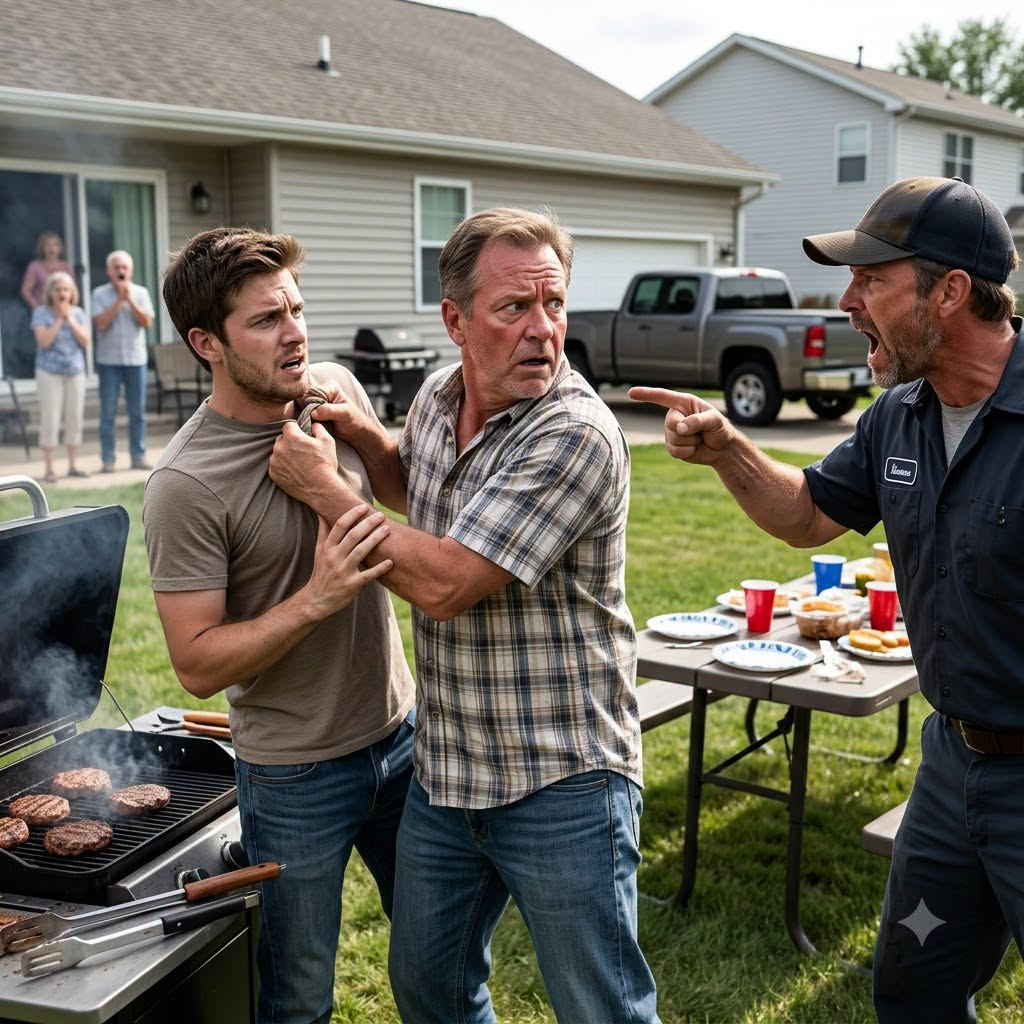
The fireworks wouldn't start for hours, but the neighborhood was already filling with the sounds of children playing, lawn chairs scraping across driveways, and distant music drifting from open garages.
It felt obscene that the world could continue so normally.
A woman in a blue sundress walked her golden retriever past the house while I stood on the front porch explaining why my stepfather had grabbed my wrist.
The older officer introduced himself as Officer Daniel Price.
His partner was Officer Elena Martinez.
They listened while I described the confrontation, the false accusation, and the evidence we'd discovered.
I showed them the red marks on my wrist.
Officer Martinez photographed them after asking my permission.
Then she asked whether I wanted medical attention.
I shook my head.
"I don't think anything's broken."
"All right," she said. "If the pain or swelling gets worse, get it checked."
She spoke gently, but there was nothing casual about the way she took notes.
For the first time that day, I felt as though someone was treating the situation seriously without demanding that I prove my innocence first.
Inside the house, Officer Price spoke separately with Paul.
Robert remained near the living room.
Thomas waited on the patio with Ben.
My mother sat beside Denise, holding a glass of water she hadn't touched.
I told Officer Martinez about the truck accident.
Ben's photographs.
The dispatch time of 11:43 p.m.
Thomas's account of being in the passenger seat.
The bank transfer.
The forged timekeeping request.
The hospital bracelet.
The storage lot footage.
And finally, the insurance document.
She listened without interrupting.
When I finished, she looked at her notes.
"That's a lot of separate issues."
"I know."
"Some may involve different jurisdictions or investigators."
I nodded.
"Okay."
"Do you have copies of the messages and documents?"
"Yes."
"Keep the originals wherever possible. Don't alter anything."
"I won't."
She glanced toward the house.
"And don't try to investigate the people threatening you on your own."
I thought of Derek Lawson.
Michael Lawson.
Claire Bennett.
The anonymous messages.
The storage unit.
"I understand."
She studied me.
"Do you?"
I looked down.
"Honestly? I'm trying."
Her expression softened slightly.
"That's fair."
She gave me information about the report and explained that the identity-related documents would need further review.
She also advised me to contact the relevant financial institutions directly and consider taking steps to protect my credit.
I nodded, trying to remember everything.
Then she asked a question that made me stop.
"Ms. Reed, has anyone threatened you directly?"
I thought of Derek's phone call.
The anonymous messages.
Paul grabbing my wrist.
Then I remembered the words Derek had spoken through Ben's phone.
There's something she needs to know about the night her stepfather tried to get her killed.
I looked at Officer Martinez.
"Yes."
Her pen stopped.
"Tell me."
I repeated the words.
She wrote them down.
Then she asked, "Did he explain what he meant?"
"No."
"Do you know whether the person making the threat was involved in the accident?"
"I don't know."
She nodded.
"That's important to establish."
I glanced toward the house.
"Do you think I'm in danger?"
She didn't offer me a comforting answer she couldn't guarantee.
Instead, she said, "I think you should take the threats seriously."
My stomach tightened.
Then she added, "And I think you should stay somewhere you feel safe tonight."
I looked toward my mother.
She was staring at the floor.
For nine years, I'd believed my greatest problem with Paul was that he didn't like me.
Now I was wondering whether he'd allowed other people to use my identity in something far more dangerous.
The officers stayed for nearly an hour.
They spoke with Ben and Thomas.
They took information about the storage lot and the disputed vehicle release.
They also told Paul to remain separated from me while they documented the incident.
I watched from the patio as Officer Price spoke to him.
Paul's shoulders were slumped.
His hands moved constantly.
He kept pointing toward the house, then toward the driveway, then toward Thomas.
Even from a distance, I could tell he was trying to explain everything at once.
But explanations weren't evidence.
And for the first time, Paul was speaking to people who weren't required to believe him simply because he raised his voice.
When the officers finished their initial interviews, they explained that the more complicated allegations would require follow-up investigation.
I was disappointed.
Part of me had imagined that once the truth began coming out, someone would immediately take Paul away.
But real life didn't work like that.
There were documents to verify.
People to interview.
Records to obtain.
And several competing accounts of what had happened.
I understood that.
I worked in a hospital.
I knew how dangerous it could be to draw conclusions before the evidence was complete.
Still, watching Paul stand on the patio with his hands in his pockets made me furious.
He looked almost ordinary.
A tired man at a family barbecue.
Not someone whose lies had nearly destroyed my reputation.
Officer Martinez handed me a card.
"Call if you receive additional threats or if anything changes."
I nodded.
"Thank you."
Then she looked toward my mother.
"Mrs. Mercer, do you have somewhere else you can stay tonight?"
Mom hesitated.
Paul looked up immediately.
"She's staying with me."
My mother turned toward him.
"No."
He stared.
"What?"
She took a breath.
"I'm staying with Denise."
For several seconds, Paul didn't move.
Then he laughed bitterly.
"You're leaving me because of this?"
My mother looked at him.
"Because of what you've done."
He shook his head.
"Karen, we've been married nine years."
"I know."
"You can't throw that away over one misunderstanding."
My mother's eyes filled with tears.
"One misunderstanding?"
She looked toward me.
Then back at him.
"You told me my daughter was a drunk driver."
Paul opened his mouth.
She continued.
"You took money from my savings. You lied about the accident. You knew someone was using her information."
Her voice trembled.
"And when she asked questions, you grabbed her."
Paul looked down.
My mother took another breath.
"I don't know what else you've done."
For a moment, she seemed about to lose her nerve.
I could see it.
The old fear.
The instinct to soften her words before Paul became angry.
Then Denise took her hand.
My mother straightened.
"But I'm going to find out."
Paul stared at her.
He looked genuinely stunned.
As though he'd never imagined she might choose to leave.
"Karen," he whispered.
She shook her head.
"Not tonight."
Then she turned and walked into the house with Denise.
Paul watched her go.
And for the first time, he didn't follow.
By the time the officers left, the sun was beginning to sink behind the neighboring houses.
The barbecue food had gone cold.
The paper plates were still stacked beside the grill.
A bowl of potato salad sat untouched beneath a plastic cover.
Nobody seemed hungry.
Ben was gathering his things when I approached him.
"Thank you," I said.
He looked up.
"For what?"
"For speaking up."
He gave a small shrug.
"I told the truth."
"That's more than most people did today."
He studied my face.
"You okay?"
I considered lying.
Then I shook my head.
"No."
He nodded.
"Understandable."
I looked toward the driveway.
"Do you think Derek really believes Paul tried to get me killed?"
Ben hesitated.
"I think Derek wanted you to believe something."
"That's not the same thing."
"No."
He folded his arms.
"Madison, the accident happened three weeks ago. Your stepfather was driving. Thomas says he was a passenger. I can confirm Paul was behind the wheel when I arrived."
I nodded.
"Everything beyond that needs to be checked."
I looked at him.
"You're careful with your words."
He gave a faint smile.
"Tow truck drivers spend a lot of time around people who are upset. Saying more than you know usually makes things worse."
I almost smiled.
Then I remembered the photograph of the man in the Titans jacket.
"Ben, do you think Michael Lawson was really at the accident scene?"
He looked thoughtful.
"The photo shows someone near a dark vehicle."
"Thomas recognized him."
"Thomas believes he recognized him."
I nodded slowly.
"Right."
Ben continued.
"And the storage lot footage shows a man who may be the same person. But we need better confirmation."
I looked down at my phone.
"Michael emailed Paul."
"Yes."
"He knew about the policy."
"Apparently."
"And Claire says he's at the storage unit."
Ben nodded.
"Which is why I'm glad you told the officers."
I exhaled.
"I just want to know what's going on."
He looked at me.
"I know."
For a moment, we stood in silence.
Then he said, "Sometimes the fastest way to get an answer is to stop letting the person who created the problem control the questions."
I looked toward the house.
Paul was standing alone near the patio doors.
Watching us.
My mother found me a few minutes later.
She was carrying her purse and a small overnight bag.
Denise had offered to drive her home the next morning to collect more clothes, preferably with someone else present.
"Madison," she said quietly, "can we talk?"
I nodded.
We walked toward the far end of the yard.
The evening air had cooled.
A breeze moved through the trees.
Somewhere beyond the fence, a child laughed.
My mother looked exhausted.
"I keep thinking about the policy."
I swallowed.
"Me too."
She looked at me.
"Do you think Paul wanted you dead?"
The question hurt.
Not because she asked it.
Because she was finally willing to ask it.
"I don't know."
She closed her eyes.
"I can't imagine him doing that."
I looked at her.
"Mom, I couldn't imagine him using my name at the hospital either."
She nodded.
"I know."
"I couldn't imagine him trying to change my work records."
"I know."
"And I definitely couldn't imagine him taking your inheritance."
Her eyes filled with tears.
"Madison, please."
I stopped.
For a moment, I wondered whether I'd pushed too hard.
Then she spoke.
"I don't want you to stop telling me the truth."
I stared at her.
She wiped her cheeks.
"I just need a minute to understand how wrong I've been."
My throat tightened.
I took her hand.
"Okay."
She looked toward the house.
"Paul wasn't always like this."
I didn't answer.
She continued.
"When we first married, he was kind. He brought me flowers. He helped with the house. He made me laugh."
I nodded.
"I remember."
"And Claire told me he'd been through so much."
My stomach tightened at Claire's name.
Mom looked down.
"I trusted both of them."
I squeezed her hand.
"I know."
She swallowed.
"Do you think Claire knew about the insurance policy?"
"I don't know."
"Do you think she helped him?"
"Maybe."
My mother closed her eyes.
"Twenty years."
I waited.
Then she whispered, "I don't know which betrayal hurts more."
I wanted to tell her everything would be okay.
That we'd figure it out.
That Paul would finally admit what he'd done.
But I couldn't promise any of those things.
So I told her the only thing I knew.
"We don't have to decide what to believe tonight. We just have to stop ignoring what we can prove."
She looked at me.
Then she nodded.
For the first time that afternoon, she seemed to understand the difference.
At 7:18 p.m., my phone vibrated.
An unknown number.
I almost ignored it.
Then I saw the message.
Madison, your mother isn't safe at Denise's.
My stomach tightened.
I looked around the backyard.
The gate was closed.
Robert was locking the shed.
Ben was packing his tools into his truck.
Paul was still inside the house.
I typed:
Who is this?
The reply came immediately.
You keep asking the wrong question.
I felt anger rise.
Then tell me the right one.
Three dots appeared.
Then disappeared.
Finally, a message arrived.
Why did Paul take out a policy in your name if you weren't the intended victim?
I stared at the screen.
I typed:
Who was?
The response came.
Check the beneficiary.
My heart began pounding.
I remembered the document.
The policy number.
The forged signature.
The five-hundred-thousand-dollar amount.
But in the shock of seeing my own name, I hadn't looked closely at who would receive the money.
I opened the photograph I'd taken in Paul's office.
The document filled my screen.
I enlarged the lower section.
There it was.
A line labeled:
Primary Beneficiary.
My hands began trembling.
The name was partly obscured by a window reflection in my photograph.
I adjusted the brightness.
Zoomed in.
Then I recognized the first name.
Karen.
My mother.
I froze.
Why would Paul arrange for my mother to receive five hundred thousand dollars if I died?
It didn't make sense.
Unless the policy wasn't the real objective.
Unless someone wanted my mother connected to a payout.
Or blamed for it.
I looked toward the house.
Paul was standing in the kitchen window.
Watching me.
I felt cold.
My phone vibrated again.
Now look at the contingent beneficiary.
I enlarged the next line.
The name was difficult to read.
I moved closer to the patio light.
Then the letters came into focus.
CLAIRE BENNETT.
I stopped breathing.
My mother's best friend.
The woman who had introduced her to Paul.
The woman who had used my identity at the hospital.
The woman who had helped release the wrecked truck.
And now her name appeared on an insurance document connected to my life.
I stared at the screen.
Then another message arrived.
Claire wasn't helping Paul.
My stomach dropped.
A second message followed.
Paul was helping Claire.
I looked toward the house.
My mother was walking through the kitchen with Denise.
Paul stood near the counter.
He was speaking to someone on his phone.
Then he looked up.
Our eyes met through the glass.
For a moment, neither of us moved.
My phone vibrated again.
Ask your mother what happened to her first husband.
I froze.
My father?
He'd left when I was nineteen.
At least, that was what I'd always been told.
He'd packed his things, moved out of state, and stopped calling.
For years, I'd believed he'd simply abandoned us.
But now I remembered something strange.
My mother never talked about the day he left.
Whenever I asked, she said it was too painful.
Claire had always been the one who told me to move on.
To stop asking questions.
To accept that some people weren't meant to stay.
My heart hammered.
I typed:
What does my father have to do with this?
The reply came immediately.
Everything.
I stared at the screen.
Then a photograph appeared.
It showed a man standing beside a blue Ford pickup.
The picture was old.
The colors were faded.
But I recognized the man instantly.
My father.
David Reed.
He looked younger.
His hair was darker.
He was smiling at the camera.
And standing beside him was a woman.
Claire Bennett.
I felt my knees weaken.
I enlarged the photograph.
My father had one arm resting on the truck.
Claire was holding a small black metal case.
The same kind of case Thomas had described.
I stared at the image.
Then another message arrived.
Your father didn't leave because he wanted to.
My breath caught.
I typed:
What happened to him?
The sender didn't answer.
Instead, a final message appeared.
Ask Karen why she signed the papers.
I turned toward the house.
My mother was standing in the kitchen doorway.
She looked at me.
And somehow, before I said a word, she seemed to know exactly what I'd found.
I walked toward her.
"Mom."
She didn't move.
I held up my phone.
"Why is Dad in this picture with Claire?"
Her face drained of color.
I stepped closer.
"Why is she holding the same kind of metal case Paul was supposed to deliver?"
My mother covered her mouth.
I felt my voice break.
"Mom, what happened when Dad left?"
She shook her head.
"Madison, not here."
I stared at her.
"Then where?"
She looked toward Paul.
He was still on the phone.
Then she leaned close enough that only I could hear.
"Your father didn't abandon us."
My heart stopped.
"What?"
Tears filled her eyes.
"I told you that because I thought it would keep you safe."
I couldn't breathe.
"Safe from who?"
She looked toward the kitchen.
Then back at me.
Her voice was barely a whisper.
"From the people who made him disappear."
I stared at her.
"Mom, is Dad alive?"
She began trembling.
Before she could answer, the front doorbell rang.
Once.
Twice.
Three times.
Paul stopped speaking on his phone.
My mother turned toward the hallway.
Her face went white.
Then someone knocked on the front door.
A man's voice called from outside.
"Karen Reed?"
My mother gripped my arm.
I looked toward the hallway.
The voice came again.
"Karen, it's David."
My mother's knees nearly buckled.
I caught her.
Then the man outside spoke one final sentence.
"Please open the door. I know what they told Madison about me."
And from the other side of the door, I heard the unmistakable sound of someone turning a key in the lock.






Comments 0