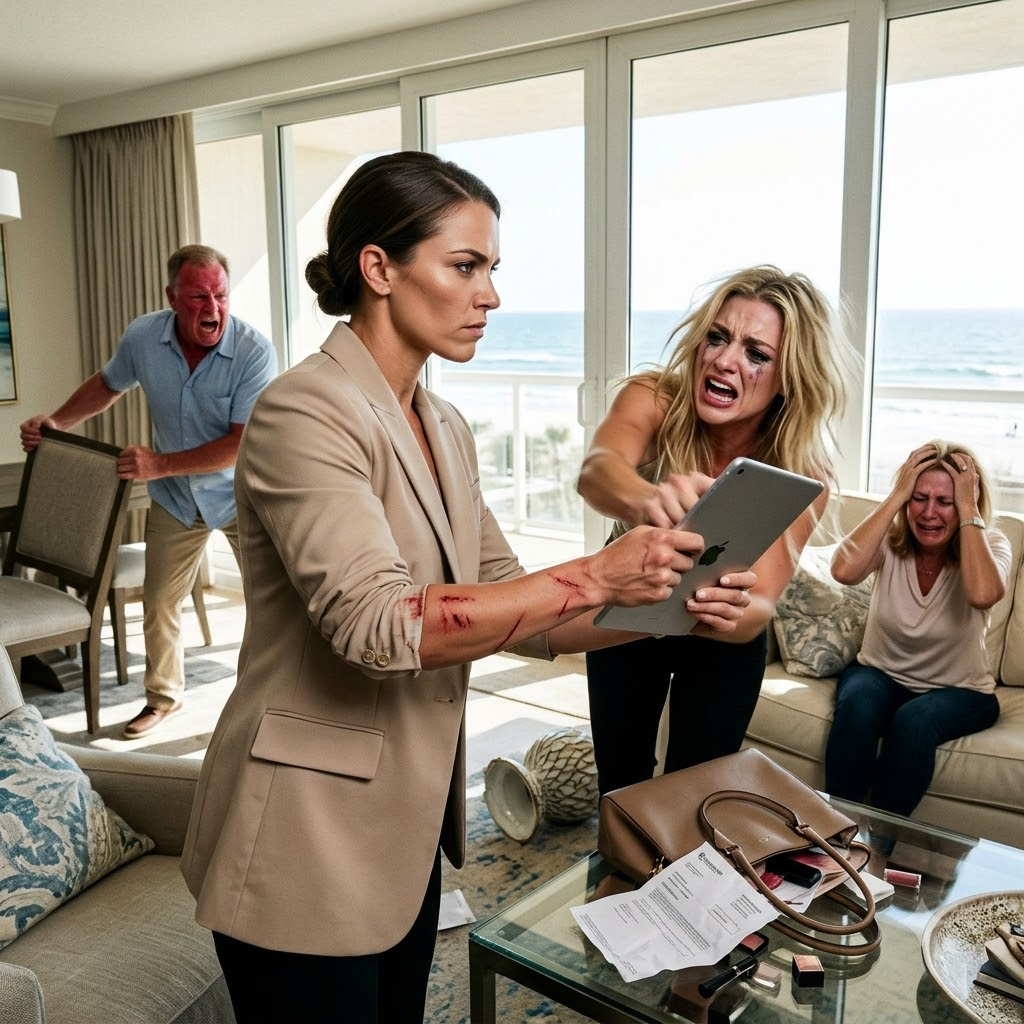
Daniel placed the second phone on the coffee table.
The video file was still open.
MAVE_THADDIUS_FINAL_AUTHORIZATION.mp4.
Nobody spoke.
I stared at the screen, then at Daniel.
"What is this?"
He swallowed.
"It's the recording from the night I went to the resort."
"Why does it have my name?"
"Because someone wanted to create proof that you authorized the financial agreement."
My father stepped forward.
"Play it."
Daniel shook his head.
"I think Mave should see it first."
I looked at him.
"Play it."
He pressed the screen.
The video began with a view of a hotel desk. A stack of documents lay beside an open laptop. The camera angle was slightly tilted, as though the phone had been placed casually against something.
Then a familiar voice filled the room.
Rebecca Shaw.
"Everything needs to be completed before midnight. The lender is expecting confirmation."
Another voice answered.
Edward Whitmore.
"The authorization is already prepared."
A third voice spoke.
My mother's.
"What if Mave discovers what we've done?"
Rebecca laughed quietly.
"She won't. By the time she sees the paperwork, the funds will have moved."
My stomach tightened.
The video continued.
Edward opened a folder and removed a document.
It was the same agreement I had been examining all evening.
Then Rebecca pointed to the signature.
"That should be sufficient."
My mother's voice became nervous.
"But she never agreed to this."
Edward answered without hesitation.
"Her previous authorization gives us the representation we need."
I looked at my mother.
She was crying silently.
On the recording, Rebecca continued.
"And the forty-five thousand?"
Edward closed the folder.
"That will be released through the new account tomorrow morning."
I leaned closer.
Then another person entered the camera's field of view.
Cresa.
She was carrying a black handbag.
She placed it on the desk and removed several documents.
"Did you get the watch back?" Rebecca asked.
Cresa shook her head.
"Not yet."
"Then make sure your father doesn't start asking questions."
Cresa nodded.
The video ended.
For several seconds, the apartment remained silent.
I felt strangely calm.
Not because I wasn't angry.
I was furious.
But the uncertainty was finally disappearing.
The people who had spent months creating explanations, excuses, and half-truths had now spoken clearly in their own voices.
I looked at Daniel.
"How did you get this?"
He took a breath.
"Rebecca asked me to bring the black case to the resort. She told me it contained documents that needed to be collected before the lender's representative arrived."
"And you recorded the room?"
"I had become suspicious. I wanted a record of what happened."
"Why didn't you tell me immediately?"
He lowered his eyes.
"Because Rebecca threatened me."
"With what?"
"She had copies of the original Northbridge investment agreement. She said she could make it look as though I had personally authorized every fraudulent transaction."
I stared at him.
"Did you?"
"No."
"Did you know about the plan to use my identity?"
"Not at first."
He paused.
"Later, I suspected something was happening. I should have told you. I should have gone to the authorities immediately."
I looked at him for a long moment.
"Yes. You should have."
He nodded.
"I know."
I didn't offer him immediate forgiveness.
He had made serious mistakes.
His silence had allowed the situation to grow.
But I also understood that his evidence might be the final piece needed to expose the entire operation.
Vanessa reached for her laptop.
"That recording changes everything."
My father sat down.
"Edward knew?"
I turned toward him.
"Yes, Dad."
He looked at the frozen image on the phone.
"My attorney."
I didn't answer.
For years, he had trusted Edward Whitmore with his financial affairs.
Now the same attorney appeared to have used that trust to connect my identity to a series of fraudulent transactions.
My mother covered her face.
"I didn't know it would become this."
I looked at her.
"You knew enough to know I hadn't agreed."
She began crying.
"You're right."
It was the first time she had said those words without adding an excuse.
The following morning, we met with independent legal counsel and representatives from the appropriate financial authorities.
Vanessa provided the documents she had collected.
Daniel surrendered the original digital records and gave a formal statement explaining his connection to Northbridge.
I supplied my business records, travel documentation, original signature samples, and the correspondence showing that I had never authorized the transactions.
The investigation moved quickly once the evidence was assembled.
The bank confirmed that the forty-five-thousand-dollar transfer had been stopped before funds were released.
The suspicious account associated with my firm was frozen.
My company's access credentials were secured, and an independent digital security team began reviewing every login and authorization.
Most importantly, the investigators obtained the original lending records.
Those records revealed the full structure.
Rebecca had used Northbridge as an intermediary between Meridian Asset Holdings and several private lending accounts.
Edward had prepared the legal documents and arranged the corporate filings.
Cresa had supplied personal information, business records, and access to the financial arrangement.
My mother had signed an acknowledgment she did not understand and had allowed documents containing my identity to be submitted without my permission.
My father had invested money in a property development without properly verifying its ownership or liabilities.
And Daniel had accepted an investment to establish Northbridge without conducting sufficient due diligence.
Each person had contributed something.
But the person who had orchestrated the arrangement was Rebecca.
The investigation established that she had diverted investment funds through related companies, used misleading financial documents to obtain additional financing, and created false authorizations to make the transactions appear legitimate.
Edward had assisted her by preparing agreements and submitting corporate documents that concealed the true beneficiaries.
The property development itself had been used as a financial cover.
My father's one-hundred-and-twenty-thousand-dollar contribution had not purchased the ownership share he had been promised.
It had been used as collateral for an existing obligation.
The missing Rolex was another part of the scheme.
Cresa had pawned it to obtain twelve thousand dollars.
Rebecca had convinced her that the watch would be recovered once the new financing was approved.
The eighteen-thousand-five-hundred-dollar resort demand had been fabricated to create urgency and pressure my family into obtaining immediate funds.
There had been no legitimate hotel demand for that amount.
The security footage, access logs, financial transfers, and messages contradicted the story of an ordinary burglary.
The watch was eventually located through the pawn transaction records.
It was returned to my father after the necessary legal procedures were completed.
The Rolex was scratched.
The bracelet needed repair.
But it was still his.
He held it in his hands for a long time when it was returned.
He didn't say anything.
Neither did I.
Some things could be recovered.
Others required a different kind of repair.
Three months later, I received the first official update.
Rebecca Shaw had been arrested following the investigation into the fraudulent financing operation.
Edward Whitmore was also facing serious legal consequences for his role in preparing and submitting the disputed documents.
The evidence included the resort recording, financial transfers, corporate filings, digital access logs, and the original agreements.
The investigation also established that my signature had been copied and used without my authorization.
The forty-five-thousand-dollar loan was invalidated.
My personal credit record was corrected.
The fraudulent company account was removed from the records associated with my firm.
My business was not held responsible for the unauthorized transfers.
Northbridge was placed under independent review, and Daniel cooperated with the investigation concerning its formation and administration.
He also stepped down from our firm.
That decision was difficult.
We had spent years building the company together.
But I couldn't continue a professional partnership with someone who had concealed a separate business, ignored suspicious activity, and allowed his silence to place my reputation at risk.
When we met for the last time in our old office, he looked exhausted.
"I know I don't deserve your forgiveness," he said.
I sat across from him.
"I don't think forgiveness is something you can demand."
He nodded.
"I understand."
"You helped create Northbridge without telling me. You accepted money without properly investigating the source. And when you realized something was wrong, you waited."
"I know."
"But you eventually brought me the evidence."
He looked up.
"I wanted to make that right."
"You helped."
I paused.
"But helping me expose the truth doesn't erase what happened."
He nodded again.
We shook hands.
Then he left.
I watched him walk through the glass doors.
It was strange how someone could be part of your everyday life for years and then become a stranger in a matter of minutes.
I didn't hate him.
But I no longer trusted him.
And I had finally learned that those were two very different things.
Cresa was the hardest person to deal with.
Not because she had the most complicated role in the scheme.
But because she had been my sister.
For several weeks after the investigation began, she refused to speak to me.
She blamed Rebecca.
Then she blamed Edward.
Then she blamed my father.
Eventually, she blamed me.
She said I had ruined her business by refusing to help.
She said my decision to involve investigators had destroyed the family's reputation.
She said I should have handled everything privately.
I listened.
Then I told her the truth.
"I didn't create this situation. I didn't forge the documents. I didn't pawn Dad's watch. And I didn't steal money."
She started crying.
"I know."
"Then why are you still blaming me?"
She looked away.
"I don't know how to fix everything."
For the first time, I believed her.
Her boutique had closed.
The landlord had taken legal action over unpaid rent, and several vendors had filed claims for outstanding invoices.
She had lost the expensive image she had worked so hard to maintain.
The designer handbag was eventually sold to help repay legitimate debts.
She moved into a smaller apartment and found work with a local fashion retailer.
It wasn't glamorous.
There were no expensive campaign photographs or luxury shopping trips.
But she was earning money honestly.
Several months later, she sent me a handwritten letter.
It was short.
She apologized for the restaurant confrontation.
She apologized for using my identity.
She apologized for hurting me in front of our parents.
Most importantly, she admitted that she had known I hadn't agreed to the loan.
I read the letter twice.
Then I put it in a drawer.
I wasn't ready to pretend everything was fine.
But I was willing to consider that people could change.
Eventually, we began speaking again.
Our conversations were awkward.
Sometimes they were uncomfortable.
But they were honest.
For the first time, I didn't pay her overdue bills.
I didn't repair her accounts.
I didn't offer to rescue her business.
I allowed her to take responsibility for her own life.
And surprisingly, that was when our relationship began to improve.
My mother came to see me one Sunday afternoon.
She brought no documents.
No financial questions.
No requests for money.
Just a small box of homemade cookies.
I opened the door and looked at her.
"Hi, Mom."
She smiled sadly.
"Can I come in?"
I stepped aside.
She sat on the sofa.
For several minutes, she looked around the apartment without speaking.
Then she began to cry.
"I'm sorry."
I sat opposite her.
She continued.
"I spent so many years trying to keep everyone happy that I stopped asking whether what I was doing was right."
I listened.
"I thought I was protecting Cresa. I thought I was protecting your father. I thought if I kept everything together, eventually things would work out."
She looked at me.
"But I wasn't protecting you."
I felt my eyes sting.
"No, you weren't."
She nodded.
"I know."
She took a breath.
"I should have called you before signing anything. I should have asked you before allowing anyone to use your information. And I should have defended you at that restaurant."
I remembered the evening clearly.
Cresa shouting.
My father looking away.
My mother calling me a dark cloud.
Eleven days of silence.
Forty-two missed calls.
A forged loan.
A stolen Rolex.
A family that had only remembered my number when it needed something.
I looked at her.
"Why didn't you defend me?"
She lowered her eyes.
"Because I was afraid of upsetting your father and your sister."
I nodded slowly.
"And you thought it was easier to hurt me."
She cried harder.
"Yes."
I didn't rush to comfort her.
I let the silence remain.
Finally, I said:
"I love you, Mom. But I can't keep being the person everyone hurts because they know I'll eventually fix things."
She nodded.
"I understand."
"I need honesty from now on."
"You'll have it."
"And I need you to respect my boundaries."
"I will."
I looked at her for a long moment.
Then I reached across the table and held her hand.
It wasn't a complete reconciliation.
Trust would take time.
But it was a beginning.
My father was the last to apologize.
He arrived at my apartment one evening without calling first.
I almost didn't open the door.
But when I saw him standing in the hallway, holding his old Rolex in a small repair box, I decided to hear him out.
He looked older.
His hair was grayer.
His shoulders weren't as straight as I remembered.
"Can I come in?"
I opened the door.
He walked toward the living room and placed the box on the table.
"The watch is repaired."
I nodded.
"That's good."
He sat down.
For a while, he stared at his hands.
Then he spoke.
"I was wrong."
I waited.
"I believed I could handle the investment myself. I trusted Edward because he had been my attorney for years. I trusted Rebecca because she seemed knowledgeable."
He looked at me.
"And when things started going wrong, I thought you would solve them."
I said nothing.
He continued.
"I knew you were good with financial records. I knew you would see through the problems. But instead of asking for your help honestly, I allowed people to use your name."
He swallowed.
"I also knew Cresa was in trouble. I kept giving her money because I didn't want to admit that her business was failing."
I looked at him.
"And the restaurant?"
His eyes dropped.
"I was ashamed."
"Of what?"
"Of the financial situation. Of losing money. Of being unable to control my own family."
I stared at him.
"So you blamed me."
He nodded.
"Yes."
His voice cracked.
"I told you to leave because I knew you were the only person who might ask questions I couldn't answer."
That confession hurt more than I expected.
For the first time, my father admitted that his anger had been a shield.
He hadn't been defending the family.
He had been protecting his pride.
"I'm sorry, Mave," he whispered.
I looked at him.
"I needed you to be my father that night."
He closed his eyes.
"I know."
"I didn't need you to agree with me. I needed you to stand beside me."
He nodded.
"I failed you."
I took a breath.
"Yes, you did."
He didn't argue.
He didn't raise his voice.
He didn't tell me everything he had done for me.
He simply sat there.
And for the first time in my life, my father allowed himself to be wrong without demanding that someone else make him feel better.
I wasn't ready to forget everything.
But I was ready to let him try again.
Six months after the night my family came to my apartment, my firm moved into a new office.
The space was brighter, larger, and more secure.
I had rebuilt the business with a smaller team and stricter procedures.
Every authorization required independent verification.
Every financial document was reviewed through a secure system.
No family member could request access to company records.
No outside consultant could make changes without documented approval.
I also established a new internal policy.
Personal relationships would never replace professional verification.
It was a lesson I had learned in the most painful way possible.
One afternoon, Vanessa visited the office.
She brought the final report concerning the fraudulent financial structure.
The report confirmed that the major unauthorized transactions connected to my identity had been addressed.
My company had been cleared of involvement in the fraudulent transfers.
The disputed loan had been cancelled.
The false ownership declaration had been corrected.
And the remaining legitimate debts were being handled through the appropriate legal processes.
I read the report slowly.
Then I closed it.
"Thank you," I said.
Vanessa smiled.
"You did most of the difficult work."
"I couldn't have done it without your help."
She shook her head.
"You had the evidence. You had the discipline. You refused to let anyone pressure you into signing something you didn't understand."
I looked out through the office windows.
Chicago stretched beneath us.
Cars moved along the streets.
People hurried between buildings.
Somewhere in that city, my family was learning to rebuild their lives.
And I was finally rebuilding mine.
On the anniversary of the Italian restaurant confrontation, I received a message from Cresa.
It contained a photograph.
She was standing outside a small fashion studio.
There was no expensive handbag.
No designer clothing.
No elaborate campaign.
Just a modest storefront with her name on the window.
Beneath the photograph, she had written:
I opened a new studio. It's small, and I'm doing everything myself. I know I still have a lot to make right, but I wanted you to see that I'm trying.
I looked at the photograph for a long time.
Then I replied:
I'm glad you're building something honest. Keep going.
A few minutes later, my mother sent another message.
She invited me to Sunday dinner.
This time, I agreed.
When I arrived, my father was setting the table.
My mother was preparing food.
Cresa was helping in the kitchen.
Nobody asked me to review a contract.
Nobody mentioned a loan.
Nobody asked me to transfer money.
We ate together.
The conversation was awkward at first.
Then my father told a story about the Rolex repairman accidentally setting the date incorrectly.
Cresa laughed.
My mother smiled.
And for the first time in a long while, I didn't feel like I was sitting at a table where everyone expected me to solve something.
I was simply there as their daughter and sister.
Before I left, my father walked me to the door.
He handed me a small envelope.
Inside was a check.
I looked at him.
"What's this?"
"Repayment for the money you spent helping us over the years."
I stared at the amount.
It wasn't everything.
But it was a sincere beginning.
"You don't have to do this all at once," I said.
"I know."
He paused.
"But I want to."
I folded the check and placed it inside my handbag.
Then I hugged him.
It was a quiet embrace.
No dramatic promises.
No sudden declaration that everything had been forgiven.
Just two people trying to do better.
A year after the night everything fell apart, my firm received its largest forensic accounting contract to date.
A national financial services company had hired us to investigate suspicious transfers involving several shell corporations.
The work was demanding.
The records were complicated.
But I loved it.
I was doing what I had always done best.
Finding the truth.
Following the money.
Separating facts from stories.
And refusing to let powerful people hide behind paperwork.
One evening, after finishing the final review of a major report, I stood beside the office windows.
My phone vibrated.
It was a message from my mother.
Sunday dinner next week? Your father wants to cook.
I smiled faintly.
Then another message arrived.
It was from Cresa.
I finally paid off my remaining vendor debt. I wanted you to know.
I read it twice.
Then I replied:
I'm proud of you.
I put my phone away.
For a long time, I had believed that being a good daughter meant making sacrifices until everyone else was comfortable.
I had confused loyalty with obedience.
I had confused love with unlimited financial responsibility.
And I had believed that if I worked hard enough, fixed enough problems, and forgave enough mistakes, my family would eventually treat me with the same care I gave them.
That wasn't how things worked.
The truth had cost me relationships, trust, and a great deal of emotional strength.
But it had also given me something I had never fully possessed.
The freedom to choose who had access to my life.
My family was still my family.
We were not perfect.
We still had difficult conversations.
We still had disagreements.
But we no longer pretended that love meant accepting dishonesty.
And I no longer carried responsibilities that belonged to other people.
I looked at the reflection of the city in the glass.
Then I turned off the office lights and picked up my coat.
Tomorrow would bring new investigations, new challenges, and new opportunities.
But none of them would require me to sign away my identity to prove that I belonged.
I had built my career with my own hands.
I had protected my name.
I had reclaimed my company.
And, most importantly, I had finally learned that I could love my family without allowing them to destroy me.
For the first time in years, I was going home without carrying anyone else's financial problems.
I was simply going home to my own life.






Comments 0