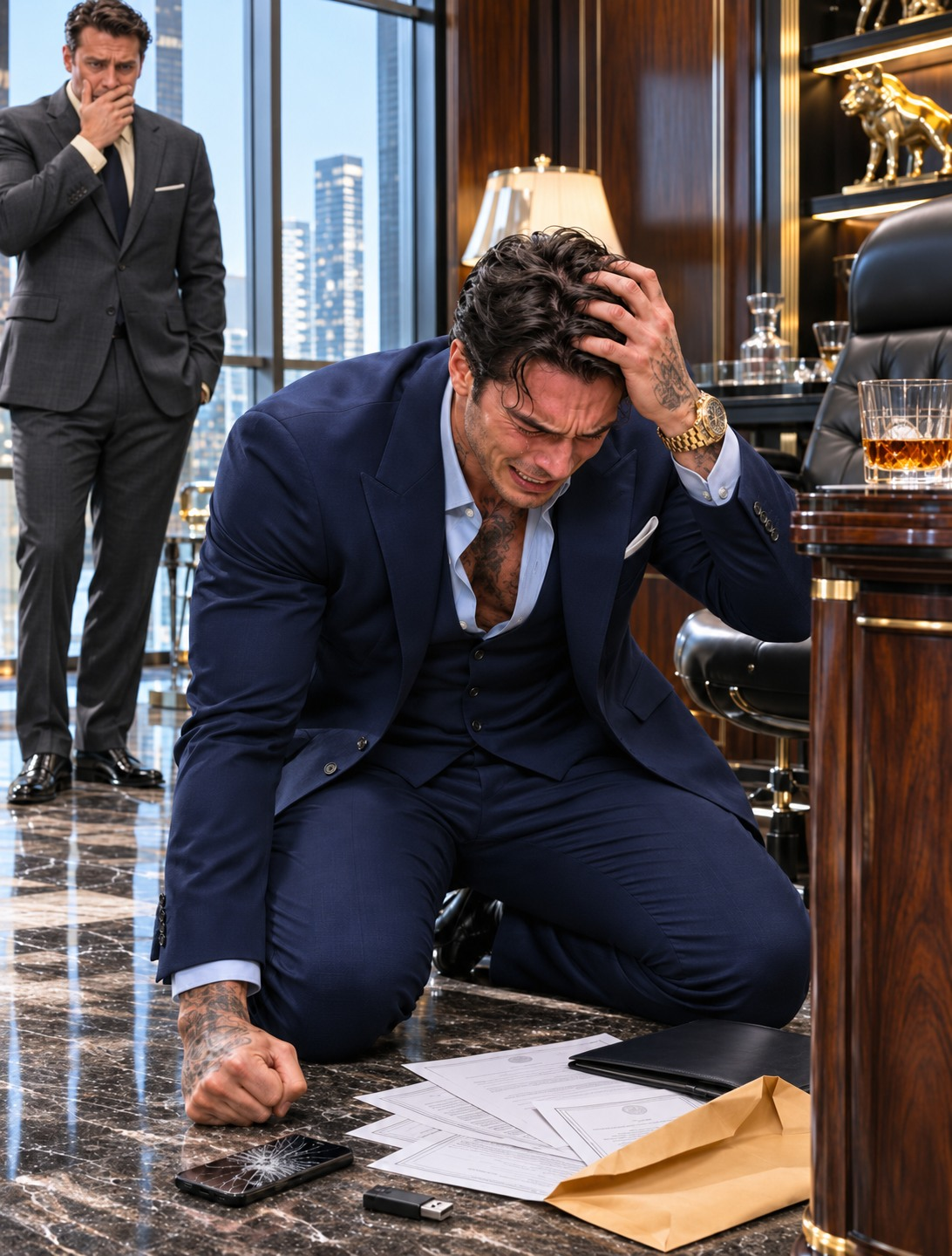
"I did."
Megan stood beside the hotel room door, holding the small black device.
For several seconds, I couldn't move.
The woman who had held me while I cried about my marriage had secretly placed a camera in the room where I slept.
The woman who had promised to protect me had watched me without my knowledge.
I stared at her.
"Why?"
Her eyes filled with tears.
"Because I was afraid Vincent was going to hurt you."
I shook my head.
"That's not an answer."
"I know."
"How long have you been watching me?"
"Since November."
My stomach tightened.
November fourteenth.
The date on the forged ownership agreement.
The date on the photograph Laura Whitcomb had sent me.
The date everything seemed to lead back to.
"You were in my study that night?"
Megan nodded.
"Yes."
"While I was sleeping?"
"Yes."
I felt something inside me go cold.
"Get away from the door."
She moved immediately.
I crossed the room and opened it.
The hallway was empty.
I stood there for a moment, breathing.
Then I turned back.
"You have five minutes to explain. After that, I'm calling the police."
Megan placed the device on the dresser.
"That's fair."
She sat down.
"Vincent came to me in October. He said you were having trouble sleeping. He said you were becoming suspicious and frightened."
I stared at her.
"He asked me to check on you."
"And you believed him?"
"At first."
I almost laughed.
Those two words had become the soundtrack of my marriage.
Megan continued.
"Then I visited you one afternoon. You showed me the folding bed. You told me Vincent had been entering the study when you weren't home."
I remembered.
I had complained that papers seemed to move.
That the computer sometimes felt warm even when I hadn't used it.
Megan had suggested I was exhausted.
"I bought the camera because I wanted to find out whether someone was coming into your room," she said.
"Why didn't you tell me?"
"Because Vincent convinced me that telling you would make your anxiety worse."
I closed my eyes.
"And the photographs?"
"I saved recordings when I saw something unusual. Vincent found out about the camera. He said he needed copies for a doctor."
My stomach dropped.
"You gave them to him."
Megan began crying.
"Yes."
I looked at the device.
"Did you sign the medical statement too?"
"Yes. He told me it would help you receive treatment."
I stepped backward.
She had believed she was helping.
Then she had helped him again.
And again.
Until the evidence gathered to protect me became evidence used against me.
I picked up my phone.
"I'm calling Laura."
Megan nodded.
"Please do."
Laura answered immediately.
I told her everything.
She listened carefully.
Then she asked Megan to preserve the device, its original files, and every message from Vincent.
"Do not delete or alter anything," Laura said. "The recordings may establish both what happened and how the images were misrepresented."
Megan agreed.
Laura continued.
"Claire, I want you to come to my office first thing tomorrow. Tonight, I recommend that you stay somewhere separate from anyone involved in gathering these materials."
I looked at Megan.
She lowered her eyes.
"I understand."
I moved to the other side of the room and asked the hotel for a separate room.
Megan didn't argue.
Before I left, she said, "Claire, there's one recording Vincent never received."
I stopped.
"What recording?"
"The one from November fourteenth."
My heart began pounding.
She pointed to the device.
"I kept the original because something about it frightened me."
"What?"
"Vincent came into your study while you were asleep."
I stared at her.
"He wasn't alone."
The recording was forty-three minutes long.
Laura arranged for me to provide a copy to Detective Aaron Cole that night. She advised me not to alter it or distribute it.
I watched the relevant portion with the detective on a secure video call.
At 11:17 p.m., Vincent entered my study.
He carried a folder.
Behind him came a woman wearing a dark coat.
Evelyn Hart.
I recognized her from the photograph Megan had shown me.
Vincent approached my folding bed.
I was asleep beneath the gray comforter.
Evelyn placed a small device near my pillow.
Then she opened the folder.
I watched her arrange papers on my desk.
She photographed them beside my sleeping body.
At one point, Vincent reached toward me.
Evelyn caught his wrist.
Her voice was faint but audible.
"Don't wake her. We only need the appearance of an evaluation."
My stomach turned.
Vincent stepped away.
Then Evelyn spoke again.
"Once the ownership transfer is recorded, the medical documentation will protect the restructuring."
Vincent looked toward the door.
"And if Claire finds out?"
Evelyn answered without hesitation.
"Then we proceed with guardianship."
I covered my mouth.
Detective Cole paused the recording.
"Mrs. Bennett, are you all right?"
I nodded.
But I wasn't.
The video had captured my husband standing beside my sleeping body while another woman prepared evidence intended to undermine my independence.
There was no argument.
No misunderstanding.
No way to explain it as concern.
He knew.
He had always known.
"Please keep playing," I whispered.
The detective resumed.
Near the end, Vincent said something that made my blood run cold.
"Richard promised this would end with the company."
Evelyn replied, "Richard doesn't control the arrangement anymore."
"Then who does?"
She looked directly toward the camera.
"The person who started it eleven years ago."
The next morning, Laura met me at eight.
She had already reviewed the video, the ownership records, the forged signatures, and the guardianship petition.
Her office was smaller than Rebecca's.
There were no expensive paintings.
No dramatic view.
Just shelves filled with legal books and a desk covered with carefully labeled folders.
I liked it immediately.
Laura looked at me.
"Claire, we have strong grounds to challenge the emergency petition. The recordings raise serious questions about the reliability of the supporting evidence."
I nodded.
"And Meridian?"
"We'll pursue that separately. The ownership documents and transfers need a full forensic examination."
At nine, we appeared before the judge.
Daniel Price's attorney informed the court that Daniel no longer supported the emergency request.
The medical report's authenticity was disputed.
The alleged examination had not been conducted as represented.
Laura presented the evidence necessary to challenge the request and asked that the disputed materials be preserved.
The judge denied the requested emergency guardianship and ordered further review of the circumstances surrounding the filing.
I remained legally in control of my own decisions.
No one was appointed to act for me.
When we stepped outside the courtroom, I started crying.
Laura stood beside me.
"You did well."
I shook my head.
"I barely said anything."
"You showed up. You challenged the allegations. That matters."
For the first time in months, I felt something other than fear.
Relief.
Not complete.
Not yet.
But real.
Over the following weeks, the investigation moved faster than I expected.
Daniel Price cooperated after recovering from his injuries.
He admitted signing the petition after being threatened with financial ruin and criminal exposure.
He had discovered that Meridian's records were being used to conceal losses from investors.
When he tried to withdraw, someone warned him that he would be blamed for the missing money.
Richard Halloway had prepared several of the original agreements.
Rebecca Shaw had reviewed an early proposal and withdrawn after objecting to provisions that could transfer control without my informed consent.
Her failure to disclose that prior involvement when she accepted my case was serious, but the investigation found no evidence that she had arranged the guardianship petition.
She provided her records to investigators and faced professional scrutiny.
Sophia was found alive two days after her car was discovered.
She had hidden with a relative after receiving threats.
She surrendered the second ownership schedule and agreed to cooperate.
The document identified the person who had actually controlled Meridian.
Evelyn Hart.
Not a licensed physician.
Not an independent guardian.
A financial consultant who had used medical credentials she did not possess.
She had directed the transfers through Northbridge Capital Services, a company she controlled through intermediaries.
The initials M.P. on one of the accounts stood for Managed Portfolio Holdings, an internal investment vehicle.
They had nothing to do with Megan.
Evelyn had used my identity as a convenient shield.
My forged signature made me appear responsible for the company.
The trust documents created a possible route for someone else to exercise control over the supposed ownership.
The psychiatric referral and guardianship petition were intended to strengthen that route.
The beneficiary schedule named the Bennett Family Protection Trust, whose proposed successor trustee was Evelyn's own management company.
If the plan had succeeded, she could have sought authority over the assets while leaving me associated with the liabilities.
The missing money had been routed through consulting accounts, property investments, and transfers to Northbridge.
The townhouse had been identified as potential collateral, but no enforceable mortgage based on my genuine authorization was established.
The proposed arbitration never proceeded against me as planned.
Once the forged records and disputed authority came to light, the investors pursued the people who had actually directed the transactions.
And Vincent?
Vincent had helped them.
He had signed declarations.
He had concealed documents.
He had provided samples of my signature.
He had allowed false medical allegations to be prepared.
He had watched the machinery being built around me and done nothing to stop it until he feared losing control of the consequences.
His affair with Sophia was real.
So were the tears he had cried over our marriage.
That was the hardest part to accept.
A person could feel love and still choose betrayal.
One did not erase the other.
My father's story took longer.
Detective Cole located the old partnership records after my mother gave investigators the folder marked 17-B.
Inside were bank statements, correspondence, and a handwritten account of a meeting my father had attended eleven years earlier.
The partnership had operated under a different name.
One of its organizers was a man called Robert Hale.
Robert Hale had later become Richard Halloway.
The identity change involved more than a professional name. Investigators found records indicating that Halloway had concealed his earlier business involvement when establishing his later practice.
My father had discovered that investor money was being diverted into accounts controlled by Hale and a younger associate.
That associate was Evelyn Hart.
She had been working under another surname.
My father planned to provide the evidence to investigators.
On the night he died, he was supposed to meet Vincent, who had been a junior employee connected to the partnership.
Vincent had promised to help him obtain additional records.
But Richard learned about the meeting.
He went to confront my father.
Evelyn accompanied him.
What happened next was reconstructed from the surviving records, recovered communications, and testimony obtained during the renewed investigation.
My father left the meeting frightened.
He drove away.
A vehicle associated with Evelyn followed him.
On the wet road outside Chicago, the pursuing driver attempted to force him to stop.
My father lost control.
His car crossed the shoulder and struck a tree.
The pursuing vehicle left the scene.
Evelyn later admitted, as part of a negotiated plea, that she had directed the pursuit and helped conceal the vehicle's involvement.
Richard admitted withholding evidence about the meeting and the events preceding the crash.
My father had not died in an ordinary traffic accident.
He had died because people wanted to prevent him from exposing their theft.
When Detective Cole told me, I didn't scream.
I didn't collapse.
I sat in a quiet interview room with my mother's hand in mine.
And I cried for the man who had tried to do the right thing.
The man who had left behind a folder because he understood that evidence could outlive fear.
The man who had warned me to read every document before signing it.
The man who had loved me enough to protect me even when he knew he might not be there.
My mother cried too.
For eleven years, she had carried questions she couldn't answer.
Now we finally had answers.
They were painful.
But they belonged to us.
The criminal cases took time.
Evelyn was convicted of financial crimes and offenses connected to the falsified medical records and the conspiracy against me. Her plea concerning my father's death resulted in an additional sentence.
Richard faced convictions arising from the financial conspiracy and obstruction related to the earlier investigation.
Vincent pleaded guilty to fraud-related charges and admitted his role in preparing and using documents bearing my forged signature.
Daniel received a reduced penalty after cooperating and providing records.
Sophia faced consequences for her involvement but received credit for producing evidence and assisting investigators.
Megan gave investigators the original recording and admitted everything she had done.
I didn't excuse her.
But I eventually understood the difference between someone who had been manipulated and someone who had designed the manipulation.
We didn't return immediately to the friendship we'd had.
Trust couldn't be restored by an apology.
It had to be rebuilt through time and honesty.
Months later, I agreed to meet her for coffee.
We talked about ordinary things first.
Work.
Her sister.
My mother's garden.
Then Megan looked at me.
"I'm sorry I didn't trust you enough to tell you about the camera."
I nodded.
"That's what hurt the most."
She wiped her eyes.
"I know."
I looked at her for a long moment.
"I don't know if things will ever be exactly the same."
"I understand."
"But I'd like to see whether we can build something honest."
She smiled through her tears.
"So would I."
My divorce was finalized the following spring.
The court recognized the disputed transfers for what they were.
The fraudulent ownership documents were set aside through the appropriate proceedings, and my legitimate interests were protected.
The townhouse was sold after the financial claims against it were resolved.
I didn't want to live there again.
I didn't want the black marble floors.
The expensive furniture.
The silent study.
I didn't want to spend another night in a home where my husband had photographed me while I slept.
Instead, I bought a smaller house near the lake.
It had white walls, wooden floors, and windows that opened onto a little garden.
There was no folding bed.
No locked study.
No hidden computer.
Just a bedroom with morning sunlight.
And a kitchen where I could drink coffee without wondering what someone was keeping from me.
I returned to work.
I rebuilt my savings.
I learned how to examine financial statements.
I asked questions without apologizing.
Sometimes I still woke in the night, frightened by a sound in the hallway.
Healing wasn't immediate.
But each month, those moments became less frequent.
I also began volunteering with an organization that helped people facing financial exploitation and coercive control.
I didn't tell them my story because I wanted sympathy.
I told it because I knew how easy it was to mistake control for protection.
How easy it was to believe that love required silence.
How easy it was to lose confidence in your own judgment when someone repeatedly insisted you were incapable of understanding.
I wanted other people to know they could ask questions.
They could demand records.
They could leave.
They could begin again.
On the first anniversary of the day I walked out of Rebecca Shaw's office, I visited my father's grave.
My mother came with me.
We brought white flowers.
Not roses.
Daisies.
His favorite.
We stood together beneath the trees.
For a while, neither of us spoke.
Then my mother placed her hand on the headstone.
"You would be proud of her," she whispered.
I looked away.
Tears filled my eyes.
I thought about the little girl I had been.
The young woman who believed she had lost her father to chance.
The wife who believed her husband's tears meant he couldn't possibly be deceiving her.
The frightened woman who slept alone for 183 nights because she knew something was wrong but couldn't prove it.
I wished I could tell that woman what I knew now.
That her questions mattered.
That her instincts deserved attention.
That she didn't have to solve everything alone.
And that the truth, however painful, could give her back the life she thought she'd lost.
I placed the daisies beside the stone.
"Thank you, Dad," I whispered.
My mother took my hand.
We stayed until the afternoon sun began to soften.
Then we walked back to the car.
That evening, I returned home and opened the windows.
A gentle breeze moved through the curtains.
The garden smelled of rain.
On the kitchen counter sat a letter from my attorney confirming that the last disputed financial claim had been resolved.
The final paperwork was complete.
There were no more hearings.
No more forged agreements waiting to be challenged.
No more hidden accounts requiring my name to explain them.
I placed the letter in a drawer.
Then I made dinner.
Something simple.
Pasta.
Fresh tomatoes.
A little basil from the garden.
I set one place at the table.
Not because I was lonely.
Because I was hungry.
And because, for the first time in years, I could sit down to a meal without waiting for someone else's mood to determine whether the evening would be peaceful.
Afterward, I carried a cup of tea into the living room.
My father's old wooden box sat on a shelf beside the window.
I had restored the brass clasp.
Inside were his photographs, his watch, and the original letter he had written to me.
I took it out.
This time, I had the entire page.
The final sentence no longer frightened me.
The person you know as Richard Halloway was once Robert Hale. Do not trust him with your future.
Beneath it, my father had written one more line.
Whatever happens, Claire, remember that your life belongs to you.
I read those words slowly.
Then I folded the letter and returned it to the box.
Outside, the last light of evening settled over the lake.
I thought about Vincent.
About the marriage I had mourned long before it officially ended.
I no longer needed to know whether every loving moment had been genuine.
Some probably were.
Some were not.
The difference no longer determined who I was.
I had loved him.
I had trusted him.
And when I discovered the truth, I had chosen myself.
That was enough.
I switched off the living room lamp and walked upstairs.
My bedroom door stood open.
The bed was neatly made.
The windows were unlocked to let in the cool night air.
There was no camera above the doorway.
No stranger waiting in the dark.
No reason to sleep somewhere else.
I changed into my pajamas, turned back the covers, and climbed into bed.
For a moment, I lay quietly, listening to the wind moving through the trees.
Then I smiled.
After 183 nights of sleeping apart from a husband who had made me afraid to trust my own mind, I finally understood what peace felt like.
It wasn't silence imposed by someone else.
It wasn't the absence of questions.
It was the freedom to know the truth and make my own choices.
I closed my eyes.
And in the home I had chosen, in the life I had reclaimed, I slept.






Comments 0