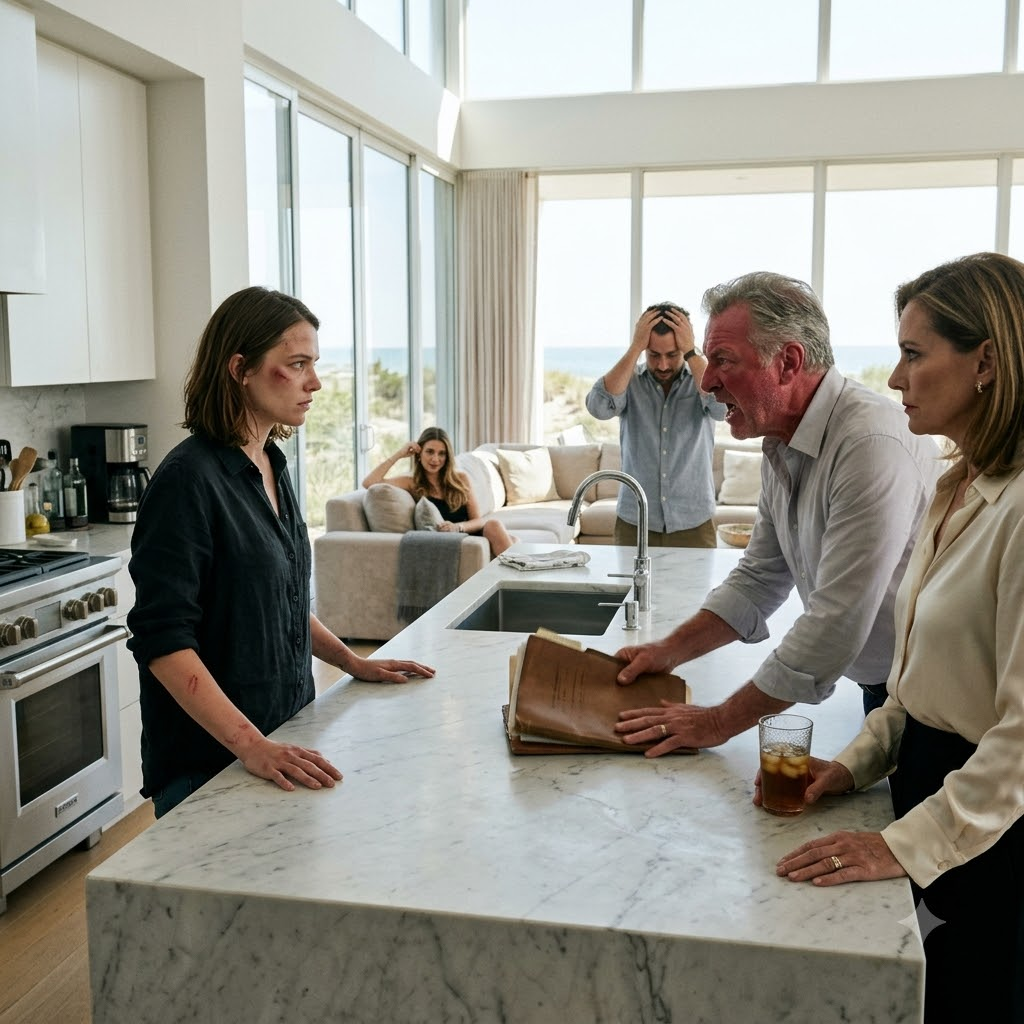
The man standing in the doorway was Richard Moore's former business partner.
His name was Charles Bennett.
For nearly five years, I had heard nothing about him.
My father had once described Charles as the closest thing he had to a brother in business. They had built their first investment company together, shared difficult negotiations, and celebrated their earliest successes side by side.
Then, shortly before my father's death, Charles disappeared from Manhattan's financial circles.
Some people said he had retired.
Others claimed he had suffered financial difficulties.
Nobody seemed to know the truth.
Now he was standing inside the Southampton estate, carrying a leather briefcase.
Patricia looked almost relieved to see him.
Leonard, however, appeared confused.
"Charles? What are you doing here?"
Charles ignored him.
He walked toward the dining table and placed the briefcase beside Patricia's folder.
Then he looked at me.
"Evelyn, I'm sorry it took so long."
I stood.
"Why are you here?"
"Because your father asked me to make sure you received the complete truth."
I glanced at the document Patricia had just presented.
"Is that your signature?"
Charles examined the page.
"No."
Patricia's face tightened.
"Charles, I don't think you understand the situation."
He turned toward her.
"Actually, Patricia, I understand it better than you think."
He opened his briefcase.
Inside were several original agreements, certified corporate records, and a sealed envelope bearing my father's handwriting.
I recognized the handwriting immediately.
Charles placed the envelope in front of me.
"Your father gave me these documents before he died. He instructed me to deliver them to you when the ownership structure could be verified independently."
I opened the envelope.
There was a letter.
It began with a sentence that made my eyes fill.
My dearest Evelyn, if Charles has finally placed this letter in your hands, then the people I worried about have forced you to discover what I tried so hard to resolve.
I took a breath and continued reading.
My father explained that he had originally entered the Northbridge arrangement in good faith.
He believed Leonard Wright was an honest businessman and that Patricia's involvement would provide administrative support.
However, he eventually discovered that the ownership structure was being manipulated.
Certain voting rights were being transferred without proper authorization.
Some financial transactions were being presented as legitimate investments despite lacking adequate documentation.
My father had withdrawn his approval.
He had also established the Moore Strategic Trust to preserve the legitimate ownership interests and prevent anyone from using his daughter's name without her consent.
The letter continued.
I never wanted you to inherit a battle. I wanted you to inherit the freedom to choose your own life. If the Wright family has used your marriage to create financial obligations, remember that love never requires you to surrender your identity.
I stopped reading.
For a moment, the room disappeared.
I could almost hear my father's voice.
I could almost see him sitting in his office, writing those words with the same careful handwriting he had used on my birthday cards.
Charles waited quietly.
When I finally looked up, he spoke.
"Your father knew Patricia might attempt to use the old authorization."
I placed the letter down.
"Why didn't you come forward earlier?"
"Because I was threatened."
"By whom?"
"Patricia's legal representatives. They warned me that if I released the documents, they would accuse me of participating in the unauthorized transfers."
I looked toward Margaret.
She was already examining the original agreements.
Charles continued.
"I should have fought harder. But I was afraid of losing everything your father and I had built."
I studied him.
"Did you know my father had named me as successor?"
"Yes. He told me personally."
"And the original ownership certificate?"
"I helped him prepare it."
Margaret looked up.
"Can you authenticate these documents?"
Charles nodded.
"I can provide the original correspondence, the registration history, and my sworn statement."
He turned toward Patricia.
"And I can explain why the document you just presented is misleading."
Patricia stood.
"That's enough."
Nobody moved.
Charles opened another folder.
"The authorization you're relying on was prepared after Richard had formally withdrawn his approval. The document was never validly executed."
Leonard stared at him.
"That's impossible."
Charles placed the withdrawal notice beside the agreement.
"It isn't."
Margaret examined both documents.
Then she looked at me.
"The dates are consistent with the records we already obtained."
Patricia reached for the papers.
"Those records were never intended to be made public."
I looked directly at her.
"Then you shouldn't have used my father's name without permission."
The room became increasingly tense.
Leonard paced beside the windows.
Daniel stood near the dining table, staring at the documents.
Patricia remained beside her chair, refusing to sit.
Margaret explained that the original agreements, the withdrawal notice, and the ownership certificate would need to be independently authenticated.
She also made it clear that the suspicious transactions would be referred to the appropriate authorities.
Leonard immediately objected.
"You cannot do this to the Wright Group."
I looked at him.
"I didn't move your money."
"You don't understand the consequences."
"I understand that money was transferred without proper authorization."
He pointed toward the documents.
"Your father was part of this arrangement."
"Initially, yes. Then he withdrew his approval."
"That doesn't erase the obligations."
"No. But neither does it give you permission to use his name."
Patricia finally spoke.
"You have no idea what we've had to do to keep this family standing."
I looked at her.
"Then perhaps you should explain why keeping your family standing required using mine."
She stared at me.
For the first time, I saw no attempt to hide her contempt.
"You think you're better than us because you inherited money?"
"No."
I placed my father's letter on the table.
"I think I deserved honesty."
Patricia laughed bitterly.
"Your father was no saint."
"I never said he was."
"He made mistakes."
"Then those mistakes should have been investigated. They should never have been covered up with false documents."
Leonard stepped forward.
"Evelyn, we can resolve this privately."
I looked at him.
"You had your opportunity."
He lowered his voice.
"Think about Daniel."
I turned toward my husband.
Daniel looked pale.
For the first time, he didn't ask me to sign anything.
He didn't ask me to forgive his father.
He simply stood there, listening.
I returned my attention to Leonard.
"I have thought about Daniel. That's why I'm not allowing you to make decisions on his behalf anymore."
Patricia looked furious.
"You're destroying our family."
I shook my head.
"No, Patricia. I'm refusing to let you use mine."
Margaret arranged for the original documents to be placed into secure legal custody.
Charles provided a signed statement confirming the history of the Northbridge structure.
Thomas Reed, who had been waiting outside with our legal team, was brought into the meeting.
He looked uncomfortable when he saw Charles.
Charles turned toward him.
"Thomas."
Thomas lowered his eyes.
"I know."
"You should have told her."
"I know."
I looked at Thomas.
"Did you knowingly approve transactions after my father withdrew his authorization?"
He nodded.
"Yes."
"Did Patricia threaten you?"
"She had evidence of my approvals. She told me she would make me responsible for everything if I cooperated with the investigation."
"Did you ever tell my father?"
Thomas shook his head.
"No."
I looked at him for several seconds.
"Why?"
"Because I was ashamed."
His answer was quiet.
I believed that he felt ashamed.
But that didn't erase what he had done.
I turned toward Margaret.
"Include his statement in the investigation."
She nodded.
Thomas looked at me.
"Evelyn, I don't expect forgiveness."
"Good. Because forgiveness isn't something you can request as payment for finally telling the truth."
He lowered his head.
I continued.
"You'll cooperate fully with the independent review. Your position at Moore Holdings remains suspended until the investigation is complete."
He nodded.
"Understood."
Charles then explained the remaining ownership structure.
The Moore Strategic Trust retained legitimate voting rights that had never been properly transferred.
The disputed transactions could be challenged through the appropriate legal process.
The Wright family's postnuptial agreement had no authority to transfer those rights.
Most importantly, I had never signed the document.
The signature Patricia had presented was not mine.
The independent examination would later confirm that the disputed signature had been reproduced from an earlier document.
Patricia had attempted to make it appear that I had acknowledged the financial arrangement.
But the original records established otherwise.
For the first time, the entire structure was visible.
And the people who had hidden behind it could no longer pretend that nothing had happened.
The investigation lasted several months.
It was not a glamorous process.
There were interviews, document examinations, financial audits, and long meetings with attorneys.
Several Wright Group subsidiaries were placed under independent review.
Transactions involving Northbridge were examined in detail.
The authorities received the relevant records.
The original ownership certificate was authenticated.
Charles's testimony confirmed my father's withdrawal of authorization.
Andrew Collins provided his preserved correspondence and explained the circumstances surrounding the false report of his death.
Thomas disclosed the transactions he had approved and cooperated with the investigation.
The findings were serious.
Patricia had controlled several financial entities through private holding structures.
Leonard had directed parts of the broader restructuring.
Daniel had acted as Northbridge's registered owner and had received payments connected to the arrangement.
Meline had helped coordinate the financial structure and had withheld information about transactions she knew were questionable.
Their responsibilities were examined individually.
Nobody was allowed to escape accountability simply because they belonged to a wealthy family.
Patricia and Leonard faced legal consequences arising from the evidence established by the investigation.
The Wright Group entered a court-supervised restructuring process.
Several assets were frozen while disputed claims were reviewed.
The money that could be traced to unauthorized transactions was recovered through the legal proceedings.
Other losses were addressed through settlements and the restructuring process.
Daniel cooperated with investigators.
He surrendered the records in his possession, disclosed the payments he had received, and accepted responsibility for his participation.
His cooperation did not erase his actions.
But it helped establish the full financial picture.
As for Meline, she provided additional records showing how the consulting arrangements had been structured.
She admitted that she had ignored warning signs because she believed the restructuring would protect her professional position.
She was not treated as an innocent bystander.
But her cooperation helped complete the investigation.
The most important result was that Moore Holdings remained protected.
My father's legitimate assets were preserved.
The Moore Strategic Trust was formally recognized.
And I became its confirmed successor.
Daniel and I met one final time in a quiet Manhattan café.
It was nearly six months after the Southampton confrontation.
He arrived before me.
When I entered, he stood.
He looked different.
His hair was shorter, and the expensive confidence he once wore so easily had disappeared.
He no longer seemed concerned about who might be watching.
I sat opposite him.
"Thank you for meeting me."
He nodded.
"I wasn't sure you would."
"I wanted to finish this properly."
He looked down at his coffee.
"I owe you an apology."
I waited.
He continued.
"I lied about knowing your family. I knew about the financial arrangement before we married. I allowed my father to use our relationship as part of a business strategy. And when you needed me to defend you, I chose my family's approval instead."
His voice became quieter.
"I was a coward."
I looked at him.
"Yes."
He nodded.
"I don't expect you to forgive me."
"That's good."
He gave a small, sad smile.
For a while, neither of us spoke.
Then he asked:
"Did you ever believe I loved you?"
I considered the question.
"I believed you loved me in the moments when loving me didn't cost you anything."
His eyes filled.
"And when it did?"
"You chose yourself."
He looked away.
I continued.
"Daniel, I don't hate you. But I can't build a life with someone whose promises disappear whenever another person demands something."
He nodded slowly.
"I understand."
We discussed the legal separation.
Neither of us wanted a public spectacle.
Our attorneys handled the formal arrangements, ensuring that my personal assets and the Moore family interests remained separate from the Wright Group's financial obligations.
Daniel agreed to the terms.
He surrendered any claims arising from the disputed financial arrangement.
The marriage ended without the dramatic courtroom confrontation Leonard had once threatened.
Before leaving, Daniel stood beside my chair.
"Evelyn."
I looked up.
"I really did love you."
I believed that he might have.
But love without honesty had not been enough.
"I hope you become someone you can respect," I told him.
He nodded.
Then he walked away.
I watched him disappear through the café entrance.
For the first time, I didn't feel abandoned.
I felt free.
One year later, Moore Holdings announced a new initiative.
It was called the Richard Moore Foundation.
The foundation supported women who had experienced financial coercion, deceptive marital agreements, and economic abuse.
I wanted it to provide practical assistance.
Not just encouraging speeches.
We funded independent legal advice, financial education programs, emergency support, and professional opportunities for women rebuilding their lives.
The first office opened in Manhattan.
At the opening ceremony, Charles Bennett stood beside me.
He had agreed to serve as an adviser.
Margaret became the foundation's legal director.
Andrew Collins assisted with the historical records and governance structure.
Thomas was not returned to his previous position at Moore Holdings, but after completing his cooperation with the investigation, he began working in a separate advisory role under strict oversight.
He understood that trust had to be rebuilt through consistent actions.
I no longer gave anyone authority simply because of history.
The foundation's first major project was a legal assistance program for women who had signed financial agreements without proper representation.
We wanted them to understand their rights before fear or family pressure took away their choices.
During the opening ceremony, I stood before a small audience.
I looked at the framed photograph of my father beside the entrance.
He was smiling.
I remembered his advice.
Never allow anyone to convince you that you need their permission to protect what belongs to you.
I finally understood what he had meant.
He hadn't been teaching me how to protect money.
He had been teaching me how to protect myself.
A few weeks later, I received an unexpected letter.
It came from Caroline Hayes, our former wedding coordinator.
She thanked me for not blaming her for the invoice arrangements and explained that she had provided additional evidence to the investigators.
She also included a copy of the original wedding photograph.
The one taken beneath the flower-covered arch.
I placed it on my desk.
For a long time, I looked at the woman in the picture.
She was smiling.
She believed that marriage meant partnership.
She believed that kindness would eventually be returned.
She believed that if she loved someone enough, they would stand beside her when things became difficult.
I didn't hate that woman.
She had been sincere.
She had simply trusted the wrong people.
I placed the photograph in a frame.
Not as a reminder of the marriage.
As a reminder of the woman who had survived it.
On the second anniversary of my father's death, I visited his grave.
I brought white lilies.
The afternoon was bright and quiet.
I knelt beside the stone and placed the flowers carefully.
"Hello, Dad."
I smiled faintly.
"I finally understand the notebook."
For a moment, I felt tears gathering.
But they were not the tears I had cried when the Wright family humiliated me.
These were different.
I told him about the foundation.
I told him that Moore Holdings was secure.
I told him that the people responsible had been held accountable.
And I told him that I was happy.
Not because I had defeated a wealthy family.
Not because I had recovered control of a company.
But because I had finally built a life in which nobody could demand that I become smaller to make them feel powerful.
Before leaving, I placed my hand against the gravestone.
"Thank you for believing I could handle the truth."
The wind moved gently through the trees.
I stood, brushed the dust from my coat, and walked back toward the car.
That evening, I hosted a small dinner at my Manhattan apartment.
There were no extravagant decorations.
No champagne towers.
No carefully arranged guest lists designed to impress influential families.
Just people I trusted.
Margaret was there.
Charles came with his wife.
Andrew joined us for dessert.
A few members of the foundation's legal team attended.
We talked about ordinary things.
Work.
Travel.
Books.
Future projects.
At one point, Margaret raised her glass.
"To new beginnings."
Everyone followed.
I looked around the table.
A year earlier, I had believed my entire life was collapsing.
My marriage had become a betrayal.
My father's legacy had been dragged into a financial scandal.
My husband's family had tried to use my identity against me.
And someone inside my own company had compromised my trust.
But I had not lost myself.
I had learned to distinguish loyalty from obedience.
Love from possession.
And wealth from power.
After dinner, I stepped onto the balcony.
Manhattan stretched before me, bright with thousands of windows.
My phone rested quietly in my hand.
There were no threatening messages.
No demands to sign documents.
No calls from Leonard.
No apologies from Patricia.
No desperate requests from Daniel.
There was only the city and the life I had chosen.
I thought about the woman who had walked into Leonard Wright's seventieth birthday celebration wearing a simple forty-dollar dress.
She had been judged for her appearance.
She had been sent away from the central table.
She had watched her husband remain silent while his family laughed.
They had mistaken her modest clothing for weakness.
They had mistaken her silence for submission.
And they had mistaken her kindness for permission.
They had been wrong.
I returned inside.
My father's photograph stood on the bookshelf beside the original red leather notebook.
I touched its worn cover.
The final page contained one sentence I had read many times since the investigation ended.
The greatest inheritance is not what you own. It is the freedom to decide who deserves a place in your life.
I closed the notebook.
Then I turned off the lights.
For the first time in years, there was nothing left to prove, nobody left to fear, and no one waiting to tell me what I was worth.
I was Evelyn Moore.
I had my father's legacy.
I had my own future.
And, finally, I had peace.






Comments 0