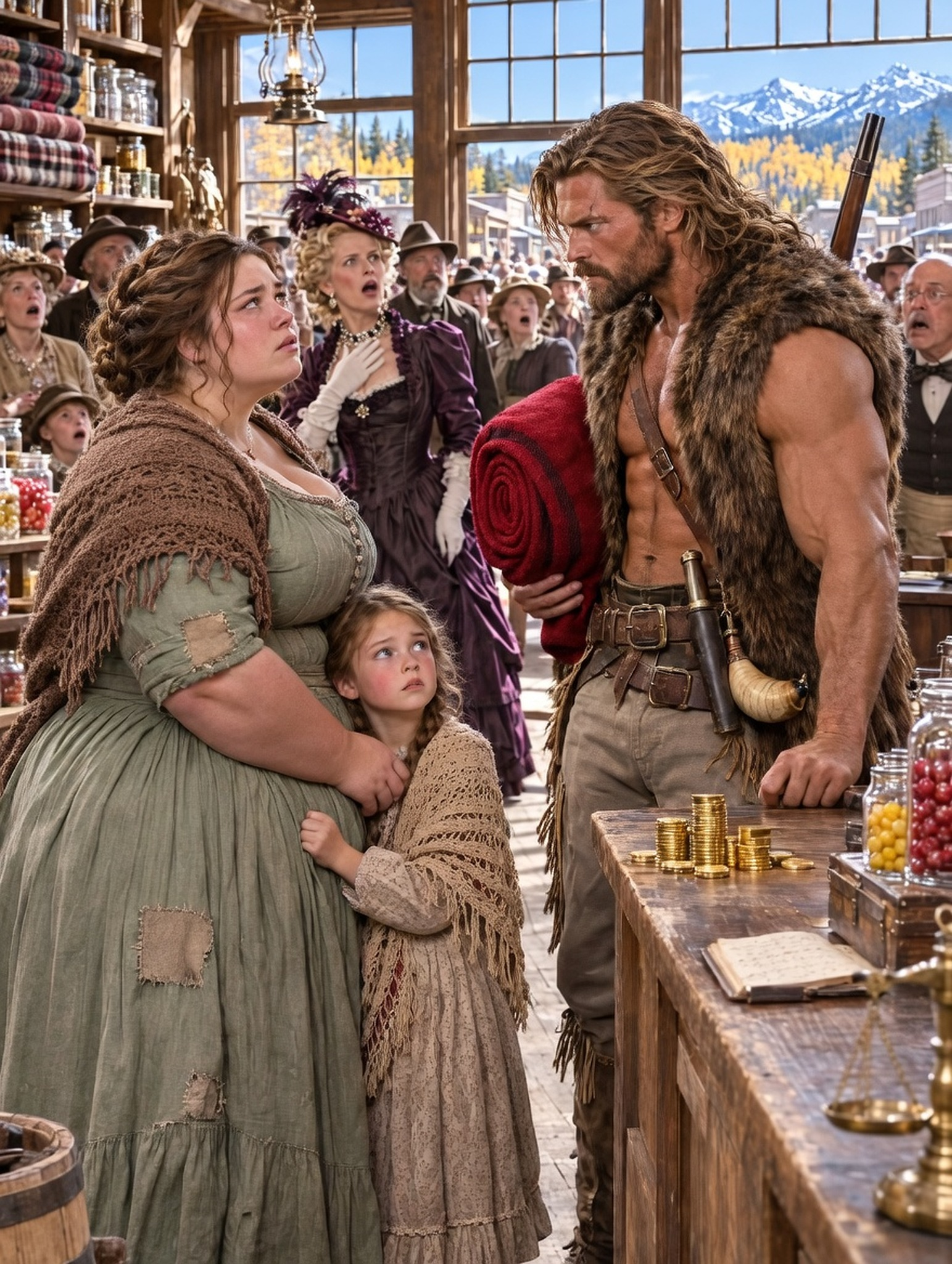
"Leave my mama alone!" Lila whispered, clutching Fiona Mercer's patched dress.
Across Chandler's General Store, a towering mountain man set down his coffee and approached the frightened widow.
He had noticed two tiny initials embroidered into the fabric near her elbow.
When he recognized them, his face went pale.
He knew something about that dress that Fiona did not.
"Would you let me look at that sleeve?"
The question was so unexpected that Fiona Mercer forgot, for one brief moment, the humiliation burning in her cheeks.
The stranger stood a few feet away, his broad shoulders covered by a heavy fur vest, his long dark hair falling against the collar of his weathered frontier shirt. A rifle rested across his back, and a hunting knife hung from his belt.
He looked like a man who had spent more nights beneath the stars than beneath a roof.
Yet his voice was gentle.
Fiona instinctively drew her daughter closer.
"I'm afraid I don't understand, sir."
"Your sleeve," he repeated. "The stitching near your elbow. May I see it?"
Behind Fiona, someone laughed.
"Well, now," Sienna Bennett said, her voice dripping with amusement. "Even the mountain men have started inspecting the poor widow's rags."
The doctor's wife covered her mouth with a gloved hand.
The livery owner's wife smiled.
Fiona felt the familiar sting of being made into entertainment for people who had never worried about where their next meal would come from.
But the stranger did not turn toward Sienna.
He simply waited.
His eyes remained on the faded embroidery.
Something in his expression made Fiona hesitate.
It wasn't pity.
She had learned to recognize pity during the two years since her husband's death. Pity came with lowered voices, uncomfortable smiles, and offers that vanished the moment accepting them became inconvenient.
This man looked troubled.
Deeply troubled.
As though he had discovered something he had spent years trying to find.
Slowly, Fiona extended her arm.
The stranger stepped closer.
His large, calloused fingers touched the edge of the fabric with surprising care.
Then he saw the initials.
H. P.
For several seconds, he did not move.
His breathing changed.
His jaw tightened.
And when he finally looked at Fiona, his expression was so stricken that she almost stepped backward.
"Who gave you this dress?"
The store fell silent.
Fiona stared at him.
"It belonged to my mother," she answered.
The stranger's hand dropped.
"Your mother?"
"Yes."
"What was her name?"
Fiona's heart began beating faster.
"Why?"
"Please."
There was something in that single word that unsettled her more than his size or the rifle on his back.
She glanced toward Lila.
The child was watching the stranger with wide eyes.
"My mother's name was Eleanor Prescott," Fiona said.
The man's face changed.
He looked as though someone had struck him.
"Eleanor," he repeated.
Then, almost too quietly to hear, he whispered, "Dear God."
Only twenty minutes earlier, Fiona had been standing outside Chandler's General Store, trying to decide whether she could afford a spool of thread.
It was the first Saturday of October, 1878.
Frost still clung to the wooden boardwalks of Alder Hollow, Wyoming Territory, and the morning air carried the sharp scent of pine from the mountains.
Fiona had driven six miles from her farm beside Ashford Creek.
Her elderly bay mare, Molly, stood patiently beside the hitching rail, her gray muzzle lowered toward the wooden trough.
The wagon had a cracked sideboard.
One wheel squeaked whenever the road turned.
Fiona had promised herself she would grease it before winter.
She had made the same promise three weeks earlier.
There were always more urgent things.
A broken fence.
A leaking roof.
A milk cow that needed tending.
A child whose winter coat no longer reached her wrists.
And the bank.
Always the bank.
At thirty-four, Fiona had learned that poverty was not one great disaster.
It was a hundred small ones.
It was a loose nail she could not afford to replace.
It was a pair of boots she repaired with scraps of leather.
It was waking before dawn to calculate whether the chickens might lay enough eggs to trade for flour.
It was smiling when her daughter asked for something she could not buy.
That morning, Lila had asked about candy.
"Could we stop by the jars, Mama?"
Fiona had looked down at the little girl.
Lila's blonde braids rested against a faded mustard-yellow dress. Her dark-green shawl had once belonged to Fiona, and her brown shoes were beginning to pinch.
"We can admire them," Fiona said. "Buying is another matter today."
Lila nodded.
She did not complain.
That was the part that hurt.
Children were supposed to beg for sweets and forget their disappointments before lunchtime.
Lila had already learned to measure her wishes against the contents of her mother's purse.
Fiona helped her down from the wagon.
"Stay close."
"I will."
"And remember your manners."
Lila gave her a solemn nod.
"Even if somebody forgets theirs?"
Fiona nearly smiled.
"Especially then."
They entered the store together.
Warmth rolled from the iron stove near the back wall.
The room smelled of coffee, leather, tobacco smoke, pickled vegetables, and freshly cut lumber.
Shelves rose nearly to the ceiling, crowded with glass jars, folded blankets, tin cookware, lamp oil, and bolts of cloth.
Men gathered around the stove, discussing cattle prices and the coming winter.
A farmer argued that the railroad would change everything.
Another insisted it would only make rich men richer.
Behind the counter, Wesley Chandler was sorting receipts.
He was a round-faced man nearing sixty, with spectacles that constantly slid down his nose.
"Morning, Mrs. Mercer."
"Good morning, Mr. Chandler."
His eyes briefly moved toward her dress.
Then toward the little basket on her arm.
"What can I get you?"
"Half a sack of oats, a tin of lard, and brown sewing thread, if this will stretch."
She placed her coins on the counter.
Wesley counted them.
Then counted again.
Fiona already knew the answer.
She had counted the money three times at home.
But some foolish part of her had hoped that perhaps she had overlooked a coin.
"The feed and lard are covered," Wesley said.
He hesitated.
"The thread needs another two cents."
Fiona kept her gaze on the counter.
Two cents.
Such a small amount.
Sienna Bennett would probably spend more than that on a ribbon she never wore.
Fiona had walked six miles behind an aging mare to discover that she could not afford a spool of thread.
"Leave the thread, then."
Wesley cleared his throat.
"I could perhaps—"
He stopped.
His eyes had shifted toward the fabric counter.
Fiona knew why.
Sienna Bennett stood there with two women whose approval seemed to govern half the town.
Sienna's husband, Nathan Wilder, was president of Alder Hollow Savings Bank.
The same bank that held the mortgage on Fiona's farm.
Wesley depended on Nathan's credit.
So did half the merchants in town.
A man could afford to be kind only when kindness did not threaten his business.
Wesley reached for the lard.
"Very well."
Fiona began placing her purchases into her basket.
Then she heard the doctor's wife.
"Isn't that the young widow?"
Fiona's shoulders stiffened.
Sienna turned.
"Still wearing that same dress, apparently."
Her eyes moved slowly over Fiona's repaired sleeves.
"Two years ought to be enough time to find something respectable."
The livery owner's wife gave a soft laugh.
Fiona said nothing.
She had been wearing the same dress because it was the last one she owned.
Her other clothes had been sold, traded, or cut apart to make garments for Lila.
The dusty-blue calico had belonged to her mother.
Fiona had altered it after her marriage, let out the seams during pregnancy, and taken them in again after Lila was born.
The patches had come later.
So had the careful repairs along the skirt.
It was not fashionable.
But it was clean.
And it was hers.
Sienna lifted a length of expensive crimson wool.
"Four dollars for one yard?"
"Shipped from Providence," Wesley answered.
"The finest flannel I've carried."
"Then naturally," Sienna said, glancing toward Fiona, "it isn't intended for everyone."
Fiona should have left.
She knew that.
But her grandfather had taught her that courtesy was not something other people could take away.
"The color is lovely," Fiona said quietly. "It should make you a handsome coat."
Sienna turned fully.
For a moment, her expression suggested that Fiona had committed some extraordinary offense simply by speaking.
"Expensive cloth can only do so much," Sienna replied. "A woman needs the upbringing to wear it properly."
Her gaze dropped toward Fiona's hands.
"All that field labor certainly hasn't helped you."
The doctor's wife laughed.
Fiona felt Lila move closer.
"Come along, sweetheart," she whispered.
But Sienna wasn't finished.
"Although I suppose once a woman dresses in scraps, she stops noticing how dreadful she looks."
She paused.
Then delivered the words that made the room erupt.
"A feed sack would be an improvement."
Laughter spread across the store.
The livery owner's wife bent her head.
One of the men near the stove nearly spilled his coffee.
Another laughed because everyone else was laughing.
Fiona stood still.
She had endured hunger.
She had endured the cold.
She had buried her husband.
She had watched creditors walk through her home and decide which possessions were worth taking.
But hearing grown people laugh while her daughter stood beside her was a different kind of cruelty.
Lila pressed her face against Fiona's skirt.
"Why are they laughing, Mama?"
Fiona rested a hand on her daughter's shoulder.
"Never mind."
"But your dress is pretty."
The words nearly broke her.
Fiona swallowed.
"Thank you, darling."
Sienna heard.
"Oh, how sweet. At least the child has imagination."
More laughter.
Then Sienna added something that made Fiona's fingers tighten around her basket.
"Imagine having a decorated officer for a grandfather and still bringing his family to this."
Colonel Holden Prescott.
Fiona had not heard his name spoken with such contempt in years.
Her grandfather had commanded territorial volunteers during the war.
He had helped build the church steeple.
He had donated the land for the schoolhouse.
When neighbors struggled, he had lent them money without demanding interest.
He had taught Fiona to read by lamplight and to ride before she could properly reach the stirrups.
And when he died, he had left behind more stories of generosity than money.
Fiona raised her chin.
"My grandfather was a good man."
Sienna smiled.
"I'm sure he was. How unfortunate that goodness doesn't pay a mortgage."
The words landed exactly where Sienna intended.
Fiona's farm.
Her husband's grave.
Her daughter's home.
All of it was tied to the bank controlled by Sienna's husband.
Fiona understood the warning.
She lowered her eyes.
Not in surrender.
In restraint.
Because she knew how much she stood to lose.
That was when the coffee cup struck the wooden table.
A small sound.
Almost nothing.
But the laughter near the stove stopped.
The mountain man rose.
His name, though Fiona did not yet know it, was Gabriel Thorne.
He had arrived in Alder Hollow the previous evening.
He had paid for a room above the livery stable, purchased feed for his horse, and asked Wesley Chandler whether any members of the Prescott family still lived nearby.
Wesley had told him that Colonel Holden Prescott was dead.
The stranger had asked whether the colonel had children.
Wesley said he believed there had been a daughter, but he knew little about her.
Gabriel had gone quiet.
He had spent the night awake.
By morning, he had decided to visit the store again before continuing his search.
He had not expected to hear the name Prescott spoken by Sienna Bennett.
And he certainly had not expected to see that embroidery.
Now he stood before Fiona, staring at the sleeve of a dress that had survived more than twenty years.
H. P.
Two small letters.
Nothing remarkable to anyone else.
But Gabriel knew the shape of the stitching.
He knew the way the second letter leaned slightly to the right.
He knew why the first letter had been embroidered with a double line.
And he remembered the hands that had made it.
"Your mother was Eleanor Prescott?" he asked again.
Fiona nodded.
"She died when I was young."
Gabriel looked toward the floor.
For a moment, he seemed unable to speak.
Then he asked, "Was your grandfather Colonel Holden Prescott?"
"Yes."
The stranger closed his eyes.
When he opened them, there was moisture in them.
Fiona had no idea what to make of it.
Sienna gave an impatient sigh.
"Really, must we turn the entire morning into a discussion of family history?"
Gabriel slowly turned his head.
He did not raise his voice.
"Ma'am, I believe you've said enough."
The room became still.
Sienna's cheeks colored.
"Do you know who my husband is?"
"No."
Gabriel looked back at Fiona.
"And at present, I don't much care."
One of the men near the stove lowered his eyes to hide a smile.
Sienna stiffened.
Nobody spoke to her that way.
Not in Alder Hollow.
Certainly not in front of an audience.
But Gabriel seemed to have forgotten she existed.
He was watching Fiona with an expression she could not understand.
"Mrs. Mercer," he said, "I need to ask you something."
Fiona tightened her hold on Lila.
"What is it?"
"Did your mother ever tell you where she got this dress?"
Fiona frowned.
"She made it."
"Are you certain?"
"Yes."
Gabriel swallowed.
"And the embroidery?"
"My grandfather's initials."
His expression changed again.
Fiona suddenly felt cold.
"Sir, what is this about?"
Gabriel glanced toward the people watching them.
Then toward the store's front windows.
He seemed to be weighing something.
At last, he spoke.
"My name is Gabriel Thorne."
Fiona waited.
The name meant nothing to her.
But Wesley Chandler, standing behind the counter, suddenly looked up.
"Thorne?" he repeated.
Gabriel did not answer him.
Instead, he reached inside his leather vest.
Fiona instinctively stepped back.
He stopped immediately.
"Forgive me. I mean no harm."
Slowly, he withdrew a small, weathered leather packet.
It was tied with a narrow strip of faded blue cloth.
He placed it on the counter.
Fiona stared at it.
Something about the cloth seemed familiar.
Not the color.
The stitching.
A tiny line of uneven white thread ran along one edge.
Gabriel rested his hand beside the packet.
"Your grandfather gave me this twenty-one years ago."
Fiona's mouth went dry.
"My grandfather?"
Gabriel nodded.
"He told me that if I ever found his family, I was to give it to the person who carried his mark."
Fiona looked down at her sleeve.
H. P.
She felt Lila's small fingers tighten around her hand.
Behind them, Sienna had gone completely silent.
Gabriel untied the blue strip.
Inside the packet lay a folded piece of paper, yellowed with age.
And beneath it was a small silver object.
Fiona leaned forward.
Her breath caught.
It was a military button.
The same kind her grandfather had kept in a wooden box beside his bed.
Gabriel unfolded the paper.
For a moment, he stared at the writing.
Then he turned it toward Fiona.
At the top, in unmistakable handwriting, were four words.
For Eleanor's eldest child.
Fiona gripped the counter.
Her mother had been dead for more than twenty years.
Her grandfather had been buried long before her marriage.
And yet a stranger had arrived carrying a message addressed to her.
"Where did you get that?" she whispered.
Gabriel did not answer immediately.
He was staring at something written beneath the first line.
His face tightened.
Then he looked toward Wesley Chandler.
"Who owns the bank in this town?"
Wesley blinked.
"Nathan Wilder."
Gabriel's expression hardened.
"Is he related to a man named Silas Wilder?"
The question seemed to drain the blood from Wesley's face.
Sienna stepped forward.
"Silas Wilder was my husband's father."
Gabriel looked at her.
For the first time, Fiona saw something dangerous beneath his restraint.
Not violence.
Recognition.
Gabriel turned the paper over.
There was a second message on the back.
He read it once.
Then again.
His hand began to tremble.
Fiona leaned closer.
"What does it say?"
Gabriel slowly raised his eyes.
"Mrs. Mercer, before your grandfather died, did anyone ever tell you what happened at Blackstone Pass?"
"No."
"Did anyone ever tell you why his military records disappeared?"
Fiona shook her head.
Gabriel looked toward Sienna.
Then back at the paper.
And in a voice barely above a whisper, he said, "Because the man who betrayed your grandfather left behind something that was never supposed to be found."
Fiona stared at him.
"What something?"
Gabriel reached beneath the folded letter.
His fingers closed around a second, smaller piece of paper.
It bore an old official seal.
He began unfolding it.
Then he stopped.
Across the store, the front door opened.
A man in an expensive black coat stood on the threshold.
Sienna's husband had arrived.
And when Nathan Wilder saw the silver button on the counter, he whispered one name.
"Thorne?"






Comments 0