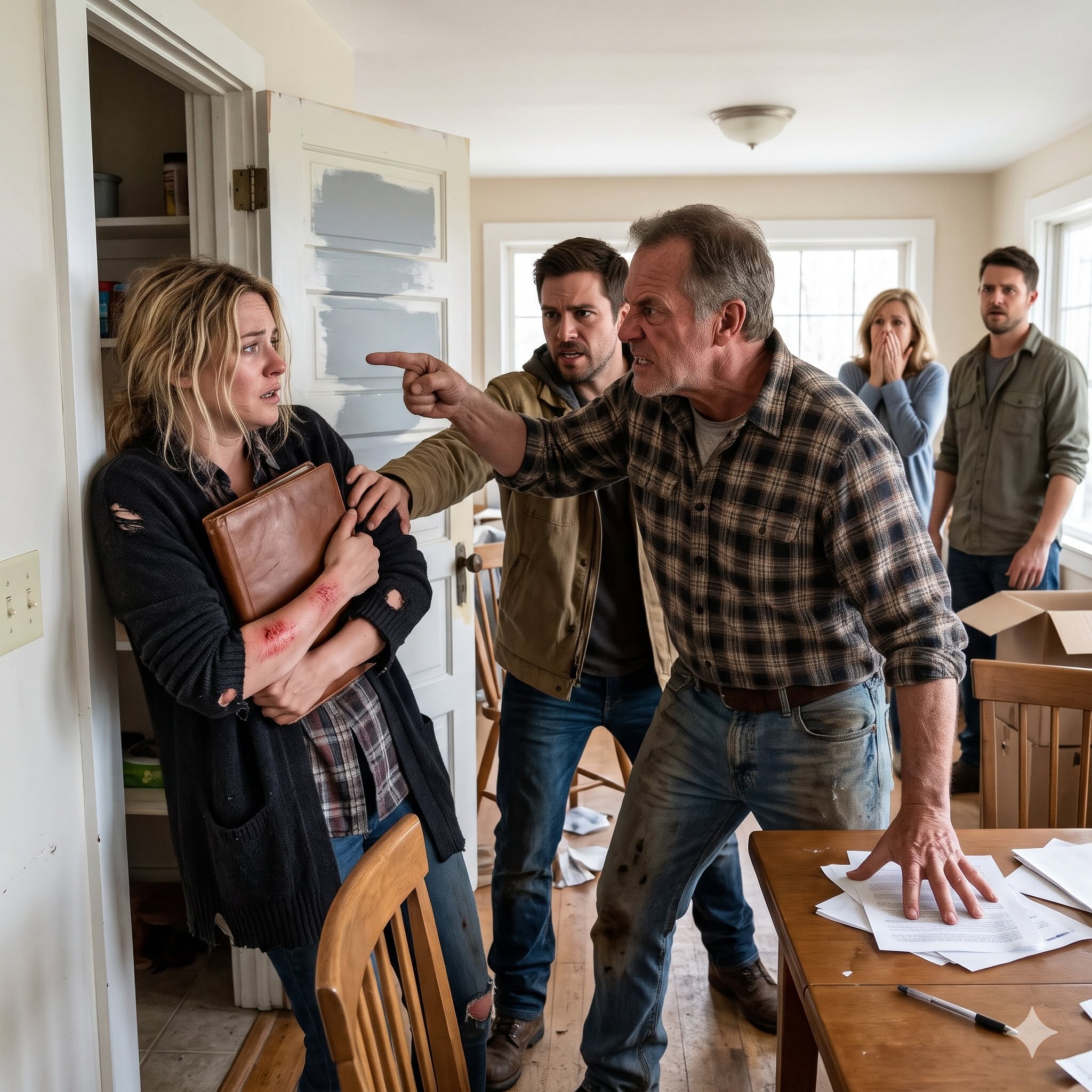
"Sign the house over to your brother!" my father shouted, grabbing my injured arm.
Gordon Lindquist stood inches from me, holding a black pen above a property deed.
Near the bottom of the document was a number I recognized.
It wasn't the number on my grandfather's original deed.
And that meant my father had made a mistake.
A very expensive mistake.
But to understand why my own father was threatening me three days before my wedding, I have to take you back to the moment he picked up a microphone and turned what should have been one of the happiest evenings of my life into a public execution.
My name is Ingrid Lindquist.
I was thirty years old, engaged to a man named Ethan, and living in New Hampshire when my father decided that my wedding rehearsal dinner would be the perfect opportunity to steal my house.
Not ask for it.
Not negotiate.
Steal it.
And he planned to do it with forty witnesses applauding.
The dinner was being held at an upscale rustic barn in Sanbornton, a beautiful place with exposed wooden beams, long farmhouse tables, and strings of warm lights hanging above arrangements of white roses and eucalyptus.
My mother had spent weeks worrying about the flowers.
Ethan's mother had worried about the seating chart.
I had worried about whether my father would find some way to make the evening about himself.
Looking back, I should have known that was the only thing worth worrying about.
I was wearing a deep emerald-green dress that evening, with my dark auburn hair falling over my shoulders. Ethan sat beside me in a gray jacket, his hand resting over mine beneath the table.
For the first time in months, I felt like I could breathe.
We had survived the wedding planning.
We had survived the arguments about the guest list.
We had survived my father's complaints about the venue, the menu, and the fact that Ethan's family wasn't wealthy enough to impress his business associates.
Three days.
That was all that stood between us and the beginning of our married life.
Then my father tapped his wineglass.
The sound was small.
The silence that followed was enormous.
"Ladies and gentlemen," he said, smiling into the microphone, "before we continue celebrating these two wonderful young people, I have a very special announcement."
I felt Ethan's fingers tighten around mine.
My father loved announcements.
Especially announcements that made him look generous.
Gordon Lindquist was sixty-seven, broad-shouldered, silver-haired, and capable of making complete strangers believe he was the kindest man in New Hampshire.
He volunteered at charity auctions.
He donated to local fundraisers.
He shook hands with bankers and town officials.
He remembered people's birthdays.
And behind closed doors, he could make his own daughter feel guilty for breathing too loudly.
"I've always believed," he continued, "that family comes before everything."
A few guests nodded approvingly.
My stomach tightened.
"That's why I'm so proud of Ingrid tonight."
I turned toward him.
He was looking directly at me.
Not with affection.
With expectation.
"Our generous daughter," he announced, "has decided to give her beautiful Lake Winnipesaukee house to her younger brother, Wade."
For one second, nobody moved.
Then someone gasped.
Another person whispered, "Oh, how wonderful."
And the barn erupted in applause.
I stared at my father.
I had not agreed to give Wade my house.
I had never even discussed it.
The house wasn't something my father had purchased for me.
It wasn't a family investment.
It wasn't a shared asset.
It belonged to me.
Exclusively.
My grandfather, Arnie Lindquist, had left it to me in his will.
He had made that decision deliberately.
And my father knew it.
Across the room, my brother Wade stood up.
He was twenty-five, with sandy-blond hair, a burgundy jacket, and the confident expression of someone who had spent his entire life receiving things he hadn't earned.
He laughed, raised his glass, and walked over to hug our father.
"Thanks, Dad," he said loudly.
Dad.
Not Ingrid.
Dad.
As though my father had just given him something that belonged to him.
The applause grew louder.
I felt forty pairs of eyes turning toward me.
People were smiling.
Some were wiping away tears.
A woman from Ethan's side of the family mouthed, "That's so sweet."
I wanted to stand up and scream.
Instead, I remained seated.
Because something about my father's expression told me this wasn't an impulsive stunt.
He had planned it.
And he had brought help.
Beside the podium stood Gus Bodri.
Gus was my father's oldest friend, a man who had been coming to our family barbecues for as long as I could remember.
He was also an active notary public.
I watched him open a polished leather binder.
Inside was a stack of neatly arranged papers.
He removed the top document and placed it on the podium.
Then he uncapped a black pen.
My pulse accelerated.
A speech was one thing.
A deed was another.
My father wasn't merely embarrassing me.
He was trying to create a legal transaction in front of an audience.
"Ingrid barely visits the lake anymore," Gordon continued cheerfully. "And Wade has always loved that place. He'll keep the family memories alive."
I nearly laughed.
Wade had spent most of the previous summer complaining that the dock was too small for the boat he wanted.
My grandfather had built that dock himself.
He had measured every board.
He had taught me to fish from its edge.
And when I was little, he would sit beside me in the early mornings, drinking coffee from a chipped blue mug while the mist lifted off the lake.
He had never cared whether the house impressed anyone.
He cared that it was ours.
Not in the legal sense.
In the sense that mattered to him.
It was a place where people could be themselves.
My father had never understood that.
Grandpa Arnie used to mark the spring thaw dates in pencil on the pantry door frame.
Forty-one years of tiny handwritten dates.
Some crooked.
Some faded.
Some accompanied by notes about unusually cold winters.
When Grandpa died, I couldn't bring myself to paint over them.
That door frame was worth more to me than the entire property.
And my father was trying to give it away between the salad course and dessert.
"Let's make it official," Gordon announced.
Gus lifted the deed.
Wade grinned.
The guests applauded again.
Ethan leaned toward me.
"Just play along for now, Ingrid," he whispered.
I turned to look at him.
His expression was tense.
He wasn't smiling.
He wasn't agreeing with my father.
But he was afraid of what would happen if I refused in front of everyone.
That frightened me almost as much as the deed.
Because Ethan knew my father.
He had seen the temper.
He had heard the shouting.
He knew Gordon could turn a simple disagreement into a three-hour interrogation about gratitude and respect.
But he had never seen what happened when my father believed he was losing control.
I had.
I had seen it since childhood.
When I was nine, I accidentally broke a decorative glass bowl in the kitchen.
My father made me stand beside the broken pieces for an hour while he explained how careless people destroyed everything good in their lives.
When I was sixteen, I received a scholarship to a summer writing program.
He told me I was selfish for wanting to leave home.
When I was twenty-two, I accepted a job without asking his permission.
He didn't speak to me for six weeks.
Every punishment came wrapped in the same explanation.
He was doing it because he loved me.
And every apology was expected to come from me.
But the house was different.
The house was the one thing he had never been able to control.
Grandpa had seen to that.
I slowly removed my hand from beneath Ethan's.
"Ingrid," he whispered.
I stood.
The applause softened.
I walked toward the podium.
My father watched me approach with the pleased expression of a man watching a chess piece move exactly where he wanted it.
"There's my girl," he said into the microphone.
I stopped beside him.
Gus slid the document toward me.
The paper was thick.
The printing was crisp.
My full legal name appeared near the top.
The property description referred to the Lake Winnipesaukee parcel.
And beneath it was a transfer provision naming Wade as the recipient.
My father offered me the pen.
"Go ahead, sweetheart."
I didn't take it immediately.
Instead, I studied the page.
I knew enough about property records to recognize what was wrong.
Not because I was a lawyer.
I wasn't.
But because two weeks earlier, I had spent nearly an entire afternoon in an attorney's office, reviewing documents that had made my hands shake.
Documents connected to my father's business.
Documents connected to Wade.
And documents connected to a bank that had no legitimate reason to believe my father controlled my lake house.
I had gone to that appointment after receiving a strange letter.
At first, I thought it was junk mail.
It mentioned a loan inquiry.
A property valuation.
A financial institution I had never contacted.
Then I noticed my grandfather's address.
And a reference to a proposed collateral arrangement.
I called the number on the letter.
The woman who answered asked whether I was calling about the Lindquist family financing package.
I told her I had no idea what she meant.
She became very quiet.
Then she asked me to verify my identity.
That conversation changed everything.
Because someone had been using information about my property to support a financial transaction.
And the person behind it appeared to be my father.
I didn't confront him.
I didn't tell Wade.
I didn't even tell Ethan everything immediately.
Instead, I found an attorney.
Her name was Rebecca Hale.
She was practical, direct, and completely unimpressed by the Lindquist family reputation.
After reviewing the documents I brought her, she asked me one question.
"Has your father ever had your written permission to pledge, transfer, or borrow against this property?"
"No."
"Are you certain?"
"Absolutely."
She placed her pen on the desk.
"Then we need to protect the title before anyone attempts to turn this into a completed transaction."
Over the following days, Rebecca helped me complete a lawful title-protection arrangement and record the necessary documents.
The property remained protected for my benefit.
My father's proposed transfer could not simply override those recorded interests.
And the suspicious financing activity had been flagged through the appropriate channels.
I didn't know how far his scheme had gone.
But I knew enough to understand that the deed Gus was offering me was not the harmless family gesture my father wanted everyone to believe.
Now, standing at the podium, I looked at the page again.
The property description was familiar.
The legal language was not.
And one reference number near the bottom matched a number from the suspicious banking correspondence.
I felt my stomach turn.
My father hadn't merely decided to give my house to Wade.
He had prepared paperwork connected to the very scheme Rebecca had warned me about.
"Ingrid?"
Gordon's voice brought me back.
He was still smiling.
But his eyes had hardened.
"Everyone's waiting."
I looked at the pen.
Then at Gus.
Then at my brother.
Wade was standing with his hands in his pockets, grinning like a boy who had just been handed the keys to a new car.
"Did you know about this?" I asked him.
The microphone caught my words.
A few guests shifted in their seats.
Wade laughed.
"Come on, Ingrid. Don't make it weird."
"Did you know Dad was announcing this tonight?"
He glanced at Gordon.
That glance told me everything.
My father reached for the microphone.
"She's overwhelmed," he told the room. "You know how emotional weddings can be."
A few people chuckled politely.
I didn't.
"Who prepared this deed?" I asked.
Gus cleared his throat.
"It's all standard paperwork."
"That wasn't my question."
My father's smile disappeared for half a second.
Then it returned.
"Sweetheart, this isn't the time for legal technicalities."
"Actually," I said, "it seems like exactly the time."
The room went quiet.
I could hear the faint hum of the sound system.
Someone set down a wineglass.
Ethan stood beside our table.
My mother was watching from the far side of the room, her face pale.
My father leaned closer.
His voice dropped low enough that only I could hear.
"Don't embarrass me."
There it was.
Not a request.
Not concern.
A warning.
I looked at him.
"I didn't agree to this."
His jaw tightened.
"You're going to sign."
"No."
For the first time that evening, his expression changed completely.
The warmth vanished.
The proud father disappeared.
And the man I had spent thirty years trying not to provoke stood directly in front of me.
He took the microphone away from his mouth.
"We're going to discuss this privately," he said.
Then he turned back toward the guests.
"Just a little family paperwork confusion. Enjoy your dessert."
He laughed.
Nobody else did.
Gus began gathering the documents.
Wade stepped toward us.
My father put a hand on my upper arm.
His grip was firm.
Too firm.
"Come with me."
I pulled away.
He tightened his fingers.
"Ingrid."
Ethan moved forward.
"Gordon, maybe we should all calm down."
My father looked at him.
"This is family business."
"I'm marrying your daughter."
"Then learn when to stay out of it."
The words landed hard.
Ethan stopped.
I could see the conflict in his face.
He wanted to protect me.
But he was still trying to find a way to do it without creating a scene.
My father had already created one.
He simply expected everyone else to pretend otherwise.
I turned toward the guests.
"I'm sorry," I said clearly. "There has been a misunderstanding. I'm not giving away my house."
The silence was immediate.
Then came the whispers.
Wade's face reddened.
Gus snapped his binder shut.
My father stared at me.
For one brief moment, I thought he might shout.
Instead, he smiled.
It was the most frightening smile I had seen in years.
"Of course," he said softly. "We'll sort it out."
He released my arm.
Then he leaned toward me.
"After dinner."
I knew what that meant.
The public performance was over.
The private punishment was coming.
And I knew exactly where he intended to deliver it.
Our family home.
The house where I had spent my childhood learning that my father's anger could fill every room.
The house with the narrow dining room, the wooden table, and the pantry door that never quite closed properly.
I had planned to avoid going there before the wedding.
Now I realized my father would not let the matter rest.
The next hour passed in a blur.
Guests avoided my eyes.
Some offered sympathetic smiles.
Others looked offended, as though refusing to surrender my inheritance had somehow ruined their evening.
Wade disappeared with Gus.
My mother tried to speak to me twice, but each time my father called her away.
Ethan stayed close.
When the last guests began leaving, he took my hand.
"We should go home," he said.
I nodded.
Then my phone vibrated.
A message from my mother.
Please come to the house before you leave town. Your father says he needs to apologize.
I stared at the screen.
An apology.
From Gordon Lindquist.
Without being forced.
Without an audience.
Without a demand attached.
It was almost funny.
Ethan read the message over my shoulder.
"Don't go," he said.
I should have listened.
But there was something I needed to know.
I needed to find out whether my mother had known about the deed.
And whether Wade understood what he was being drawn into.
So I agreed to stop by.
Only briefly.
Only with Ethan.
And only because I had something my father didn't know about.
The certified documents Rebecca had prepared were inside my brown leather folder.
I had brought them to the rehearsal dinner because I suspected my father might attempt something.
I had not expected him to do it in front of forty people.
As Ethan drove us toward the family home, my phone vibrated again.
This time, the message wasn't from my mother.
It was from Rebecca Hale.
Ingrid, I just received an urgent notification concerning the property. Do not sign anything tonight.
I immediately called her.
No answer.
I tried again.
Straight to voicemail.
Then another message appeared.
There is something you need to know about Wade's bank file.
I felt my chest tighten.
Before I could reply, a third message arrived.
It contained only six words.
Your father isn't the only signer.
I stared at the screen.
Ethan glanced over.
"What is it?"
I couldn't answer.
Because at that exact moment, another name appeared in Rebecca's next message.
And it was the last name I expected to see.






Comments 0