My mother was waiting outside the interview room with a document bearing my name.
For the first time in my life, I wasn't afraid of what she might say.
I was afraid of how much she had already done.
Genevieve sat beside her attorney, wearing a cream-colored suit and the diamond earrings my father had given her for their twentieth anniversary. Her hands were folded neatly in her lap.
She looked like a woman attending an important business meeting.
Not like a mother whose daughter had nearly lost her life at her wedding.
When I entered, she immediately looked at me.
"Rosalind."
I didn't respond.
Detective Mercer gestured toward the empty chair.
"Please sit down, Ms. Genevieve."
My mother placed a folder on the table.
"My daughter knew about the company," she announced. "She agreed to the arrangement months ago. I have documents proving it."
I looked at the folder.
"Then show them."
Her attorney opened it and removed several printed pages.
The first contained my name.
The second showed an authorization.
The third contained a signature that resembled mine.
My mother looked at Detective Mercer.
"She approved everything. Her father simply handled the administrative work."
I examined the document.
Then I noticed the date.
It was dated eleven months earlier.
The same period when I had been working in New York.
I looked at my mother.
"Where did you get this?"
"From the family records."
"Who gave it to you?"
"Your father."
"Did you watch me sign it?"
She hesitated.
"Your father told me you had signed."
I looked at Detective Mercer.
"That isn't the same thing."
"No," the detective replied. "It isn't."
My mother's attorney shifted in his chair.
Detective Mercer placed another document on the table.
It was the original authorization Marissa had preserved.
The witness signature was clearly visible.
Genevieve.
My mother looked at it.
Her expression changed.
"That's a different document."
"It's connected to the same company," Detective Mercer said.
My mother looked toward her attorney.
He leaned forward.
"Before my client answers further questions, I would like to review the documents."
Detective Mercer nodded.
Then she placed the final piece of evidence in front of them.
It was the email my mother had sent Evelyn Hart the night before my wedding.
If Rosalind refuses to sign tomorrow, Alistair has instructed us to proceed with the alternative arrangement. Cressida understands what she needs to do.
My mother stared at the page.
For several seconds, she didn't speak.
Then she looked at me.
"You don't understand."
I felt something inside me become very still.
"Then explain it."
She lowered her voice.
"Your father was trying to protect everyone."
"From what?"
She didn't answer.
"Why did you write that Cressida understood what she needed to do?"
Her eyes filled.
"She was supposed to convince you."
"How?"
My mother looked away.
"Your father thought she could persuade you to sign."
"By attacking me?"
"That wasn't supposed to happen."
I stared at her.
"Then what was supposed to happen?"
She began crying.
But I no longer felt compelled to comfort her.
For the first time, I understood that her tears didn't automatically mean I had done something wrong.
Detective Mercer asked her to clarify the statement.
My mother finally admitted that she had known about the planned transfer.
She had known the company was registered under my name.
She had witnessed the earlier authorization.
She had also known that the money was being moved through accounts connected to Cressida's business.
However, she denied knowing that my father had falsified my signature.
She claimed he had told her I had approved the arrangement electronically.
The investigator would need to verify that claim.
But there was something she couldn't explain.
The email.
The envelope.
And the instruction that Cressida understood what she needed to do.
My mother looked at me one final time.
"Rosalind, please. We can still fix this as a family."
I shook my head.
"No, Mom. You had years to fix it."
Then I stood.
And walked out.
The following weeks changed everything.
The investigation expanded beyond the wedding.
Financial investigators examined the company registration, bank accounts, authorization forms, and transfers.
The forensic examination of the signatures confirmed that several documents bearing my name had not been signed by me.
My travel records supported my statement that I had been outside Chicago when some of the documents were supposedly executed.
The photograph of the woman signing at my former office was also examined.
Investigators determined that it could not establish my identity as the person holding the pen.
The camera footage from the office helped establish who had accessed the room.
My father had been there.
The original security records from the wedding venue also confirmed that Alistair had accessed the equipment cabinet and removed a recording device.
The backup footage survived.
So did the call recording from Daniel Bennett.
The evidence became increasingly difficult to dismiss.
Marissa provided the original accounting files.
She also handed over emails showing that Daniel had prepared documents using information supplied by my father.
Several transfers were traced to Cressida Lane Creative.
The financial investigators established that approximately $350,000 had moved through the accounts under review.
They also identified outstanding obligations connected to the company.
The money had not simply disappeared.
Some had funded Cressida's proposed business.
Some had gone toward expenses connected to my parents.
Other payments had moved through third-party accounts.
Investigators followed the records.
They established the transactions that could be attributed to the scheme and identified the people who had benefited.
My father eventually stopped claiming that everything had been a misunderstanding.
Through his attorney, he acknowledged that he had arranged the company registration and controlled its financial accounts.
He claimed that he intended to transfer the business properly later.
But that explanation did not account for the forged authorizations, the misleading bank records, or the attempt to conceal the wedding footage.
Daniel Bennett also faced serious questions about his role in preparing and processing the documents.
The evidence established that he had knowingly handled paperwork that contained false representations about my authorization.
Evelyn Hart cooperated with investigators and provided her original files.
She admitted that she had prepared the final transfer documents without personally confirming my consent.
She also provided the correspondence between herself, my father, and my mother.
Lauren gave a statement explaining how the folder and envelopes had been moved through the venue.
The missing security device was recovered.
Its contents did not erase the other recordings, and its removal became another important part of the investigation.
Cressida's position was different.
She admitted receiving money through her company.
She admitted bringing the envelope to my wedding.
She also admitted that she had known my father wanted me to sign the final authorization.
But she maintained that the physical attack had been her own impulsive decision.
The police treated that admission seriously.
The witnesses, medical evidence, venue recordings, and statements established what had happened.
Cressida was formally charged in connection with the assault.
My father and Daniel faced separate financial and document-related proceedings.
My mother's involvement in the fraudulent paperwork was also examined.
She could no longer hide behind the phrase family matters.
Every signature had to be explained.
Every transfer had to be accounted for.
Every statement had to be compared with the evidence.
For the first time, my family was being asked to answer questions instead of expecting me to apologize.
My physical recovery took longer than I wanted.
The wound on my right forearm healed gradually.
I attended follow-up appointments and completed the rehabilitation recommended by my doctor.
There were days when my hand felt stiff.
There were mornings when the scar reminded me of the wedding.
But I regained its strength.
Aean never left me to manage the difficult days alone.
He helped with meals, drove me to appointments, and took over household responsibilities when my arm hurt.
He never treated me like I was fragile.
He treated me like someone recovering from something terrible.
That difference mattered.
One evening, several weeks after the wedding, I stood in front of the bathroom mirror.
My hair was loose around my shoulders.
The bandage was gone.
A pale scar remained along my forearm.
I touched it carefully.
Aean appeared behind me.
"How does it feel?"
I looked at my reflection.
"Different."
"Does it hurt?"
"Not much anymore."
He stood beside me.
For a moment, neither of us spoke.
Then I said, "I keep thinking about the wedding."
He looked at me.
"What part?"
"The cake. The guests. The music. Everything before it happened."
He gently took my hand.
"We can have another celebration."
I smiled faintly.
Not because the memories had disappeared.
Because I was beginning to understand that the wedding had not taken away our future.
It had only changed the way we would remember the beginning.
"I don't want another wedding," I said.
"That's fine."
"I want to celebrate our marriage. Not pretend that day didn't happen."
Aean nodded.
"Then we'll do it your way."
The financial investigation eventually produced a clear picture.
The company had been established using my personal information without my informed authorization.
My father had controlled its accounts.
Daniel had handled administrative paperwork.
Genevieve had witnessed documents and knew that money was being transferred.
Cressida had received funds through her company and was aware that the money was connected to the family arrangement.
The original $350,000 figure represented the funds investigators had identified moving through the accounts.
Additional obligations were examined separately.
The banks cooperated with the investigation.
The disputed company accounts remained restricted while the authorities and financial institutions completed their reviews.
With legal assistance, I formally disputed the false authorizations and provided evidence that I had not controlled the accounts.
The financial records were corrected where the institutions determined that the information had been improperly submitted.
I also obtained independent legal advice to protect my legitimate business.
My actual company, Rosalind Atelier Events, had nothing to do with the fraudulent arrangement.
Its accounts, contracts, and ownership records were separate.
That distinction became important.
For months, I had feared that my father's actions would destroy the business I had spent years building.
They didn't.
My clients continued working with me.
My staff supported me.
Several long-standing suppliers personally contacted me to express their confidence in my business.
One hotel manager sent a message that I kept.
Your work has always spoken for itself. We know the difference between your reputation and someone else's actions.
I read it several times.
For years, I had believed my family controlled the story of who I was.
Now other people were judging me by what I had actually done.
It was a relief I hadn't known I needed.
The legal proceedings took months.
There were hearings, interviews, financial reviews, and formal statements.
I didn't attend every meeting.
I didn't need to.
My attorneys handled the matters that concerned my business and financial identity.
I provided evidence when requested.
I also refused to participate in private negotiations that required me to accept responsibility for something I hadn't done.
My father attempted to contact me several times.
His messages changed over time.
At first, they were angry.
Then they became defensive.
Eventually, they turned apologetic.
One message read:
I made decisions under pressure. I never intended for you to suffer.
I read it once.
Then I put my phone down.
He never acknowledged the full damage.
He never directly addressed the smile at my wedding.
He never explained why he had watched me bleed while telling people I deserved it.
And I no longer needed him to.
The legal process established the financial wrongdoing and the false documentation.
The evidence also established Cressida's assault.
The proceedings resulted in consequences for those responsible.
My father faced criminal penalties for his financial misconduct and fraudulent documentation.
Daniel faced consequences for his participation in preparing and processing the false records.
Cressida was held accountable for the attack.
Her company lost access to the disputed funds, and the financial arrangements connected to it were unwound where legally possible.
My mother also faced consequences for her role in the documentation and her involvement in the scheme.
She eventually admitted that she had prioritized protecting the family arrangement over protecting me.
None of them could undo what had happened.
But they could no longer pretend it hadn't happened.
The most difficult conversation came from Cressida.
She wrote me a letter.
It arrived several months after the wedding.
The envelope contained no expensive stationery or dramatic decorations.
Just four pages of handwriting.
I almost threw it away.
Instead, I opened it.
She began by apologizing.
Not for embarrassing me.
Not for ruining the reception.
For stabbing me.
She admitted that she had been jealous for years.
She had watched me build my business and create an independent life while she continued relying on our parents.
She had believed that everything I achieved was somehow taken away from her.
My wedding had made those feelings worse.
She had arrived late, wearing white, determined to attract attention.
When nobody reacted the way she wanted, she became angry.
Then my father told her that I was refusing to cooperate with the family arrangement.
He promised that the final document would secure her business and help her escape her financial problems.
She admitted that she had been carrying the envelope containing the authorization.
She also admitted that she had wanted to confront me about it.
But when I continued the cake ceremony without paying attention to her, she lost control.
She picked up the knife.
She attacked me.
No one had forced her hand.
No one had made the decision for her.
She had done it.
The final paragraph was the shortest.
I don't expect you to forgive me. I only want you to know that I understand what I did, and I am ashamed that I became the person who hurt you.
I folded the letter.
I didn't call her.
I didn't promise forgiveness.
But I didn't destroy it either.
I placed it in a drawer.
For the first time, I allowed myself to accept that accountability and forgiveness were separate things.
Cressida had to face what she had done.
I had the right to decide what kind of relationship, if any, I wanted afterward.
My mother sent a letter too.
Hers was shorter.
She wrote that she had been afraid of losing the family.
She said my father had convinced her that the company was temporary and that the financial arrangement would eventually benefit everyone.
She admitted that she had known Cressida was supposed to persuade me to sign.
She also admitted that she had protected Cressida at the wedding because she believed the consequences of the attack would be worse for her younger daughter than for me.
I read that sentence several times.
She had calculated whose life was more important to protect.
And she had chosen.
I put the letter away.
I wasn't ready to speak with her.
Maybe I never would be.
But I no longer spent my evenings imagining what I could say to make her understand.
That responsibility wasn't mine anymore.
One year after the wedding, Aean and I decided to celebrate our anniversary quietly.
No enormous venue.
No two hundred guests.
No expensive decorations.
We booked a private dining room at a small restaurant overlooking the Chicago River.
There were flowers on the table.
A bottle of sparkling water.
A simple cake.
I wore a dark green dress with long sleeves.
My scar was almost invisible beneath the fabric.
Aean wore a charcoal suit.
When he reached across the table, I placed my hand in his.
"Happy anniversary," he said.
I smiled.
"Happy anniversary."
He looked at me for a moment.
"Do you ever wish we had done something differently that night?"
I thought about it.
The attack.
The ambulance.
The police.
The financial investigation.
The months of uncertainty.
Then I shook my head.
"No."
"Really?"
"I wish my sister hadn't stabbed me. I wish my parents hadn't betrayed me. I wish the wedding had been different."
He nodded.
"But I don't regret marrying you."
His expression softened.
"Neither do I."
I looked toward the river.
The city lights reflected across the water.
For the first time, I could think about our wedding without feeling that the entire day belonged to my family.
They had tried to turn it into a weapon.
They had tried to use my identity, my business, and my reputation.
They had tried to make me carry the consequences of their decisions.
But they hadn't taken my marriage.
They hadn't taken my work.
And they hadn't taken my future.
Aean lifted his glass.
"To us."
I lifted mine.
"To us."
Several months later, I organized a charity event for a Chicago hospital that had supported victims of domestic and family violence.
It was a project I had wanted to do for years.
This time, I didn't accept financial help from my parents.
I didn't involve their friends.
I didn't allow anyone to use the event as an opportunity to repair a reputation.
I built it with my own team.
The evening was successful.
Guests arrived.
The flowers were beautiful.
The lighting was warm.
The music played softly.
And when the final speaker finished, I stood near the back of the room and watched the guests applaud.
I felt proud.
Not because everything had been perfect.
Because I had created something good after something terrible.
Aean came up behind me.
"You did it."
I turned.
"We did it."
He smiled.
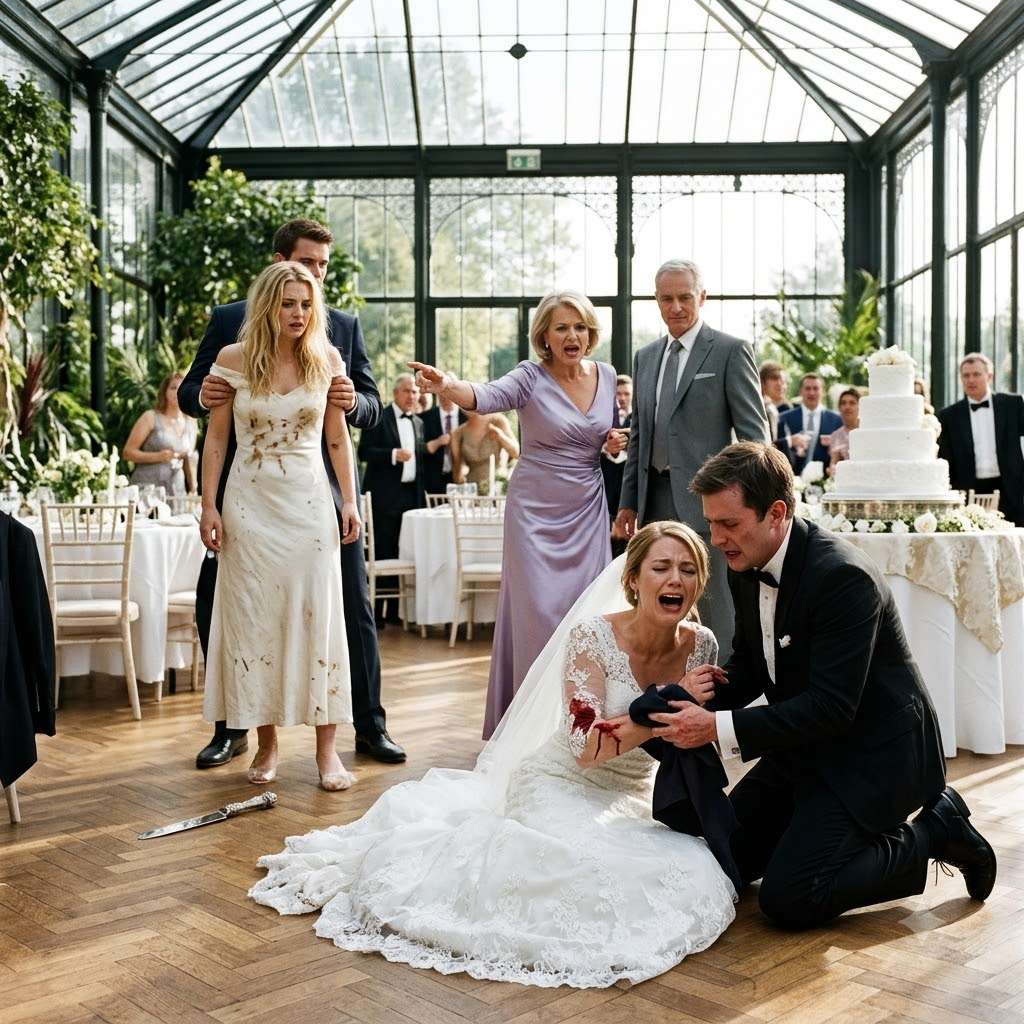
For a moment, I remembered the wedding cake.
The silver knife.
The blood on the floor.
Then I looked around at the people in the room.
My colleagues.
My friends.
The people who had supported me without demanding anything in return.
I understood that family wasn't simply a matter of sharing a surname.
It was the people who showed up when things became difficult.
The people who protected you without asking what they would gain.
The people who stayed when there was nothing to benefit from staying.
I had spent twenty-nine years trying to earn love from people who treated it like a reward.
I didn't need to do that anymore.
On the morning of our second anniversary, I opened a small box Aean had left on the kitchen counter.
Inside was a photograph.
It showed us standing together outside the hospital on the day I was discharged.
I looked exhausted.
My arm was bandaged.
Aean was holding my hand.
Neither of us was smiling.
But we were together.
Beneath the photograph was a handwritten note.
The day everything changed wasn't the day your family hurt you. It was the day you discovered you didn't have to live by their rules anymore. I'm proud of the life we're building.
I read it twice.
Then I placed the photograph on our living room shelf.
Beside it was another picture.
Our wedding portrait.
The one taken before the attack.
I had finally decided to display it.
I didn't display it because I wanted to pretend the evening had been perfect.
I displayed it because the photograph still contained something true.
Aean and I had loved each other.
We had chosen each other.
And nothing my family did could change that.
Later that afternoon, we went for a walk along the river.
The air was cool.
People moved past us, talking and laughing.
Aean held my hand.
I looked down at the pale scar on my forearm.
It was still there.
But it no longer controlled what I remembered.
I thought about the girl I had been before the wedding.
The daughter who believed that being useful would eventually make her parents love her.
The woman who had spent years apologizing for having boundaries.
The person who thought independence meant never needing anyone.
I wished I could tell her something.
That she didn't have to keep proving herself.
That she didn't have to rescue everyone.
That being loved should never require her to sacrifice her own safety.
And that the people who truly cared about her would never ask her to accept cruelty in the name of family.
I looked at Aean.
He squeezed my hand.
"Ready to go home?"
I smiled.
"Yes."
And this time, home was not a place where I had to earn my right to belong.
It was a life I had chosen.
A marriage built on honesty.
A business built on my own work.
And a future that belonged entirely to me.
My father had once believed he could control my name.
My mother had believed she could control my choices.
My sister had believed she could destroy my happiness because she couldn't bear to see me succeed.
They had all been wrong.
The truth had reached every door.
The people responsible had faced the consequences.
And I had finally found the peace I had spent my entire life searching for.
I wasn't the daughter who had been left bleeding on the floor anymore.
I was Rosalind.
A wife.
A businesswoman.
A survivor.
And, at last, a woman who was free.






Comments 0