The name beneath the forged authorization was mine.
Clara Sterling.
For several seconds, I stared at the screen without moving.
The document carried my full legal name, my corporate title, and what appeared to be my signature.
Underneath it was a date.
October 14.
Three weeks earlier.
I remembered that day perfectly.
I had spent the afternoon at a children's hospital reviewing a proposal to expand its pediatric cardiac unit. That evening, I had returned home to find Julian complaining that dinner was cold.
I had never attended a meeting about his financing request.
I had never authorized a two-hundred-and-forty-million-dollar commitment.
And I certainly had never signed this document.
"Daniel," I said quietly, "where did they get my signature?"
On the monitor, my chief operating officer leaned forward.
"We're investigating."
"That's not what I asked."
He removed his glasses.
"The signature appears to have been copied from an older Sterling Investment Group document."
"Which one?"
"We haven't identified the source yet."
I enlarged the signature.
The shape was convincing.
The first letter of my name had the same sharp upward stroke I had used since college. The final curve of Sterling looked almost identical to the one on my official correspondence.
Almost.
There was one problem.
I had changed my signature four years earlier.
After a failed acquisition exposed weaknesses in our document authentication procedures, our legal department had introduced a new signing system.
My handwritten signature was no longer sufficient to authorize major financial transactions.
Every binding commitment required a digital certificate, two executive approvals, and confirmation through our secure authorization platform.
The signature on Julian's document was old.
Someone had copied it from a document created before those changes.
"Daniel, check the authorization certificate."
"There isn't one."
"Executive approval records?"
"None."
"Board authorization?"
"No."
I leaned back.
"Then whoever prepared this didn't understand our procedures."
"Or assumed nobody would check."
That possibility was worse.
Julian had built his career around the belief that confidence could substitute for competence.
He knew how to charm investors.
He knew how to deliver a speech.
He knew how to make a struggling company appear successful long enough to secure another round of financing.
But he had never been particularly interested in the details that made legitimate businesses function.
Contracts.
Compliance.
Cash flow.
Risk.
He considered those things someone else's responsibility.
I used to be that someone.
Before we married, Julian had been ambitious but inexperienced. His first company had consisted of six employees, two rented offices, and a business plan that depended more on optimism than mathematics.
I had helped him build his first financial model.
I had introduced him to accountants.
I had explained why a growing company could collapse even while reporting impressive revenue.
At the time, he listened.
He asked questions.
He thanked me.
Then his business began attracting attention.
And somewhere along the way, he decided that accepting advice from his wife made him look weak.
Eventually, he stopped asking.
Then he stopped listening.
Finally, he started telling people I knew nothing about business.
I had allowed him to believe it.
That was a decision I was beginning to regret.
"Clara?"
Daniel's voice brought me back.
"I'm here."
"There's another issue."
"Go on."
"The presentation was submitted through an outside advisory firm. Their accompanying letter claims that Sterling's commitment has already been verbally confirmed."
"By whom?"
"An executive representative."
"Name?"
"Not provided."
I looked at the document again.
"Julian intends to announce this tonight?"
"According to the gala program, he's scheduled to deliver a presentation at nine fifteen."
I checked the clock.
7:42 p.m.
Less than ninety minutes.
"Has anyone from our team contacted him?"
"No. You instructed us to keep all communications centralized."
"Good."
Daniel hesitated.
"Should we cancel his presentation?"
I considered the question.
It would have been easy.
One telephone call to the event director.
One message from our legal department.
Julian would lose his speaking opportunity, his prospective investors would withdraw, and the evening would end in humiliation.
But I had learned something from years of negotiating difficult transactions.
A premature confrontation rarely revealed the entire truth.
And I wanted the entire truth.
Not because I needed revenge.
Because a forged financial commitment was not merely an insult to me.
It could mislead investors, employees, creditors, and anyone who relied on the supposed agreement.
If Julian was knowingly using a false document, I needed evidence.
If Victoria had prepared it without his knowledge, I needed to understand why.
And if someone inside Sterling had helped them, the problem was much larger than my marriage.
"Don't cancel anything," I said.
Daniel frowned.
"Clara—"
"Preserve the original submission, including the email headers, attachments, and metadata. Have legal document the chain of custody. Notify our compliance director."
"Already underway."
"And Daniel?"
"Yes?"
"Nobody confronts Julian or Victoria until we understand who created that signature."
He nodded.
"Understood."
I ended the call and opened the archived document database.
The system requested a second biometric confirmation.
I placed my thumb against the scanner.
A list of older agreements appeared.
I searched for my signature.
There were hundreds of results.
Property acquisitions.
Charitable donations.
Partnership agreements.
Investment authorizations.
Then I narrowed the search to documents created before the authentication changes.
Seventy-three results remained.
I studied the first several pages.
Nothing unusual.
Then I noticed a familiar company name.
Vance Meridian Holdings.
My husband's business.
The document was dated eight years earlier.
Three months before our wedding.
I opened it.
A capital contribution agreement appeared.
I knew the document immediately.
It was the agreement that had nearly destroyed our engagement.
Back then, Julian's company had been facing its first serious financial crisis.
A major client had canceled a contract.
His bank had refused to extend his credit line.
He had been forty-eight hours away from missing payroll.
I had offered to help.
He refused.
Not because he didn't need the money.
Because he didn't want anyone knowing his fiancée was helping him financially.
"I need to do this myself," he told me.
I remembered standing in his tiny office while he paced beside a desk covered with overdue invoices.
"Julian, accepting help doesn't make you a failure."
"It makes me look like one."
"To whom?"
"Everyone."
I had loved him enough to understand his pride.
Or perhaps I had been foolish enough to excuse it.
Two days later, an investment vehicle affiliated with my family office provided his company with emergency financing.
Julian never knew the money came from me.
The investment was structured through a holding company, with professional managers handling the transaction.
He believed an independent private investor had recognized his potential.
The financing saved his business.
And because the investment was legitimate, it came with normal contractual protections.
I had not given him a gift.
I had provided capital under terms his company could reasonably repay.
At the time, I told myself that protecting his pride was an act of love.
Looking back, I wondered whether it had been the first time I taught him that success could arrive without accountability.
I scrolled to the signature page.
There it was.
My old signature.
Exactly the same shape as the one on the forged authorization.
My stomach tightened.
The document had been stored in Sterling's archive for eight years.
But Julian's company also possessed a copy.
Someone with access to Vance Meridian's historical financing records could have found it.
I immediately called Daniel back.
He answered on the first ring.
"Clara?"
"I found the signature."
"Where?"
"An eight-year-old capital contribution agreement involving Vance Meridian."
He went silent.
"Daniel?"
"I'm here."
"Who has access to the original?"
"Your legal department, our archives, and the counterparty."
"Which means Julian's company."
"Yes."
I closed my eyes briefly.
"Victoria is head of public relations. Would she have access to historical financing documents?"
"Not ordinarily."
"But Julian could give her access."
"Certainly."
I looked at the clock.
7:58 p.m.
"Daniel, I want a forensic comparison. Don't assume the signature came from that agreement until we can establish it."
"I'll have the team examine both files."
"And one more thing."
"Yes?"
"Find out who first introduced Victoria Hale to Julian."
Daniel paused.
"Why?"
"Because I'm beginning to think she didn't enter his life by accident."
After the call ended, I remained at my desk.
I had never liked making decisions based on jealousy.
Jealousy distorted judgment.
It made people see patterns where none existed.
But Victoria's behavior had become increasingly strange.
Four months earlier, she had begun attending nearly every executive event with Julian.
Three months earlier, she had persuaded him to replace his longtime chief financial officer.
Two months earlier, several members of his accounting team had resigned.
And last month, Julian had stopped allowing me into his home office.
He said the documents were confidential.
At the time, I had almost laughed.
I had access to financial information concerning businesses worth billions.
Yet my husband believed his company's quarterly reports were beyond my understanding.
Now I wondered whether his secrecy had been designed to hide something more than an affair.
My phone vibrated again.
This time, it wasn't Daniel.
It was a message from Julian.
Make sure my mother gets her medication before bed. And don't forget the dishes.
I stared at the screen.
He was on his way to the most important financial event of his career.
His company was approaching collapse.
Someone had forged my authorization.
And he was reminding me to wash dishes.
A second message arrived.
Also, don't call me tonight. Victoria and I will be busy networking.
I set the phone down.
Then I opened a blank message.
For a moment, I considered telling him everything.
I could have written four words.
I own Sterling Investment Group.
Four words would have destroyed the illusion he had spent years constructing.
But they would also have warned him.
And I wasn't ready to warn him.
Instead, I typed:
Your mother has her medication. Enjoy your evening.
I pressed send.
Then I called the mansion's house manager.
"Margaret?"
"Yes, Mrs. Vance?"
"Would you please check that Eleanor's medication has been packed in her evening bag?"
"Of course."
"And Margaret?"
"Yes?"
"Please leave the kitchen exactly as it is."
There was a brief silence.
"Even the dishes?"
"Especially the dishes."
"Very well, ma'am."
I ended the call.
Margaret had worked in the mansion for six years.
She was one of the few people who knew I maintained an office downstairs, although she had never asked what I did there.
She had also witnessed enough of Julian's behavior to understand why I sometimes preferred silence.
Once, after he publicly criticized me during a dinner party, Margaret had approached me in the kitchen.
"You don't deserve to be spoken to like that," she said.
I had smiled and told her not to worry.
She hadn't smiled back.
"People who are treated badly often spend too much time explaining why it isn't so bad."
I remembered those words now.
I had spent eight years explaining.
Julian was stressed.
Julian had a difficult childhood.
Julian was under pressure.
Julian didn't mean what he said.
Julian loved me in his own way.
There had always been an explanation.
And every explanation had required me to surrender another small piece of myself.
I looked at the empty place on my finger.
For the first time, I wasn't searching for an explanation.
I was examining evidence.
At 8:11 p.m., a secure message appeared on my monitor.
It came from our compliance director, Rachel Bennett.
Preliminary findings: The unauthorized financing presentation was circulated to at least eleven external recipients.
I opened the attachment.
A distribution list appeared.
Private investors.
Financial advisers.
Two commercial banks.
A venture capital partner.
And an institutional investor based in Chicago.
My jaw tightened.
This was no longer a presentation prepared merely to impress gala guests.
Someone had been using Sterling's name to influence financial decisions.
I called Rachel.
She answered immediately.
"Ms. Sterling."
"How many recipients have acknowledged receiving the document?"
"Seven."
"Has anyone acted on it?"
"We're still checking. One lender appears to have accelerated its review of Vance Meridian's credit application after receiving the presentation."
"Any funds released?"
"Not that we've confirmed."
"Preserve everything and coordinate with legal. We may need to notify the recipients promptly."
"Understood."
I hesitated.
"Rachel, did the document include a statement about my personal participation?"
"Yes."
"What did it say?"
She looked down.
"It stated that Sterling's principal owner had personally reviewed the proposed financing and expressed strong confidence in Julian Vance's leadership."
I almost laughed.
Not because it was funny.
Because the statement was so absurd.
At the very moment Julian was telling me I knew nothing about business, someone was using my supposed confidence in him to obtain money.
"Rachel, that statement is false."
"I understand."
"Make sure our lawyers understand exactly how false."
"They do."
I ended the call.
A notification appeared from the gala's event management system.
Daniel had arranged for me to receive a secure feed from the ballroom.
I opened it.
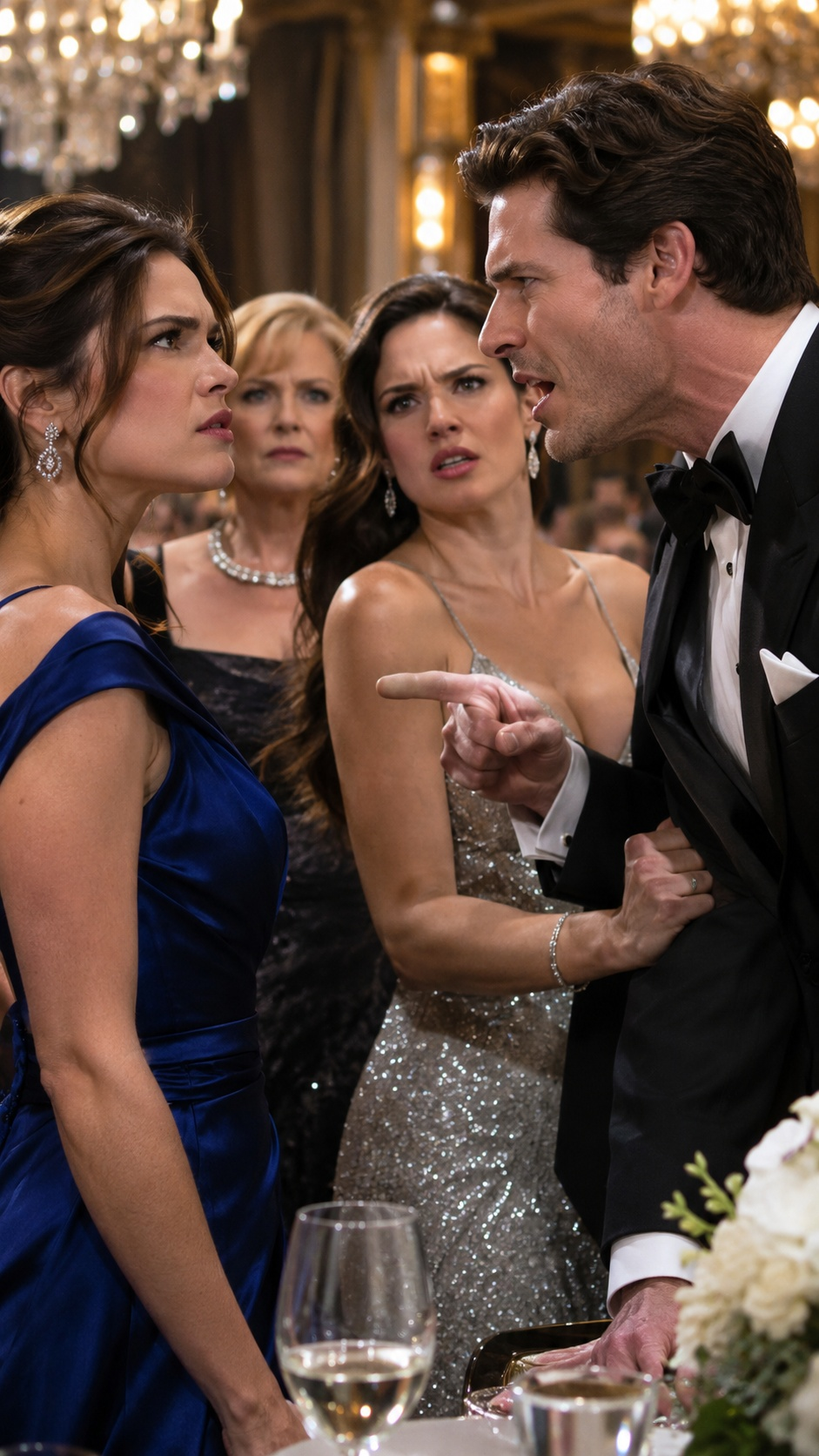
The Grand Aurelia Hotel's main ballroom appeared on the screen.
Hundreds of guests moved beneath enormous crystal chandeliers.
Waiters carried champagne.
A string quartet performed near the entrance.
Large floral arrangements decorated the tables.
Everything looked elegant.
Expensive.
Carefully arranged.
Then I saw Julian.
He stood near the center of the room, one hand resting against Victoria's lower back.
She was laughing at something he had said.
Eleanor stood beside them, speaking animatedly to an older gentleman.
Sabrina was taking photographs.
Julian looked completely at ease.
He had no idea that the woman he had ordered to stay home was watching him from a private financial command center beneath his own mansion.
I enlarged the image.
Victoria leaned close to Julian's ear.
He smiled.
Then she reached into her evening bag and handed him a slim black folder.
He opened it.
Even through the camera feed, I recognized the gold Sterling emblem.
My company's logo.
Julian glanced at the first page and nodded.
Victoria touched his arm.
He kissed her cheek.
I watched without moving.
Something inside me hurt.
Not the sharp pain I had expected.
Something quieter.
The grief of realizing that the man I once loved had become comfortable humiliating me.
I remembered our wedding day.
Julian had cried when he saw me walking down the aisle.
Actual tears.
He had whispered, "I can't believe you're choosing me."
I had answered, "I'll choose you every day."
I had meant it.
For years, I had kept choosing him.
Even when he forgot our anniversary.
Even when he dismissed my opinions.
Even when he began treating kindness as weakness.
But marriage was not supposed to be one person choosing while the other collected the benefits.
I closed the camera feed.
My secure telephone rang.
Daniel.
"Clara, we found something."
I answered immediately.
"What?"
"The original signature appears to match the eight-year-old agreement you identified."
"How confident are you?"
"The preliminary image comparison is strong. The forensic team is still validating the source."
"And Victoria?"
"We traced her employment history."
I waited.
"Before joining Vance Meridian, she worked for a boutique financial consulting firm called Ashcroft Advisory."
I frowned.
"I know the name."
"You should. They were involved in the failed acquisition attempt against one of our portfolio companies five years ago."
I remembered.
Ashcroft Advisory had represented a group of investors who attempted to acquire a distressed technology company at an artificially low valuation.
Our team had rejected the offer.
The negotiations had become hostile.
Eventually, the investors withdrew.
"What was Victoria's role?"
"Senior communications strategist."
"Did she work directly on the acquisition?"
"We're checking."
Daniel paused.
"There's another connection."
"Go on."
"One of Ashcroft's former managing partners is currently advising Julian."
I sat straighter.
"Who?"
"Richard Vale."
The name was familiar.
Very familiar.
Richard Vale had been present at a meeting five years earlier when a group of investors threatened legal action after Sterling refused to sell a valuable technology asset.
He had smiled throughout the negotiation.
Even when his clients were losing.
I remembered his final words.
Everyone has something they want badly enough to make a mistake.
I had dismissed him as an unpleasant negotiator.
Now his name appeared beside my husband's collapsing company.
"Daniel, does Richard know who owns Sterling?"
"No. He dealt with our legal representatives and investment committee."
"Then how did he become Julian's adviser?"
"According to the engagement letter, Victoria recommended him."
I looked toward the dark reflection in my monitor.
Victoria.
Richard.
The forged signature.
The unauthorized financing commitment.
Too many connections.
Not enough answers.
"Daniel, I want the complete Ashcroft file."
"I'll retrieve it."
"And make sure security knows I'm attending tonight."
"Of course."
I rose from my chair.
"One final instruction."
"Yes?"
"Don't announce my arrival."
Daniel's expression became serious.
"Understood, Ms. Sterling."
I ended the call.
Then I walked toward the wardrobe concealed behind the office's dark glass wall.
Inside were several formal gowns, tailored jackets, and accessories I kept for unexpected meetings.
I selected a long black cashmere coat to wear over my emerald-green dress.
I didn't need to change my appearance.
I didn't need diamonds.
I didn't need a new hairstyle.
I certainly didn't need to compete with Victoria.
I only needed to walk into that ballroom as myself.
As I fastened the coat, another notification appeared.
This one came from the mansion's security system.
UNRECOGNIZED ACCESS ATTEMPT — PRIVATE LOWER LEVEL.
I stopped.
The message was timestamped 8:24 p.m.
Twenty seconds earlier.
I opened the security panel.
A floor plan appeared.
The attempted access had not come from the wine cellar.
It had come from the service corridor connected to the mansion's eastern wing.
A corridor that was supposed to remain locked.
I pressed the intercom.
"Margaret?"
No answer.
I tried again.
"Margaret, are you there?"
Static.
Then a faint clicking sound.
I checked the camera feed.
The service corridor appeared empty.
One ceiling light flickered.
At the far end stood the reinforced door leading toward my underground office.
Its security indicator was red.
Locked.
I exhaled.
Then the indicator changed.
Yellow.
SECONDARY AUTHENTICATION REQUESTED.
Someone was trying to override the lock.
I reached for the emergency security control.
Before I could press it, a new message appeared on the monitor.
AUTHORIZED CREDENTIAL DETECTED.
My blood went cold.
Only three people possessed credentials for that corridor.
Daniel.
Margaret.
And me.
Daniel was at the hotel.
Margaret had not answered.
I enlarged the camera feed.
For several seconds, nothing moved.
Then a shadow crossed the floor.
A figure approached from outside the camera's field of view.
I couldn't see the person's face.
Only a hand reaching toward the security panel.
The hand held a black access card.
My screen flashed.
ACCESS GRANTED.
The reinforced door began to open.
And from the darkness beyond it, someone whispered my name.
"Clara?"






Comments 0