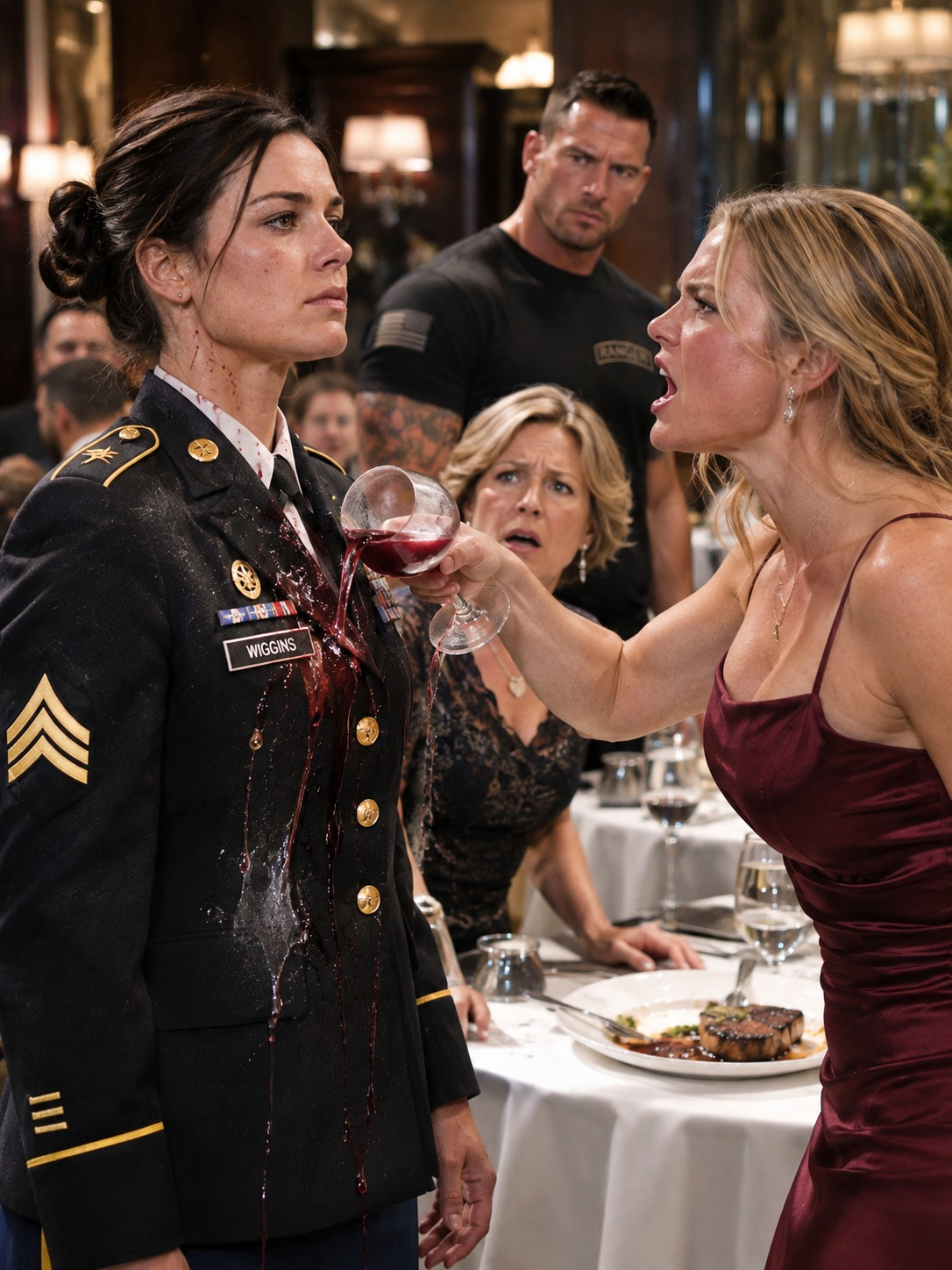
Maya Wiggins threw her wineglass across my Army dress uniform.
"You're just a secretary with fake medals!"
My mother immediately pointed toward the restaurant entrance.
"Get out, Amber. You're ruining your sister's engagement!"
I stood beside the expensive dinner table, red wine dripping from my ribbons, and looked at the three people who had just made it clear exactly where I stood in their family.
Then I reached for a napkin.
I didn't cry.
I didn't shout.
I simply wiped the wine from my cheek.
What happened next would change everything.
But at that moment, nobody at Ruth's Chris Steak House understood what they had just done.
My name was Amber Wiggins. I was thirty-four years old, a Staff Sergeant in the United States Army, and I had spent most of my adult life trying to earn something my family had never been willing to give me.
Their respect.
That Friday evening, I was exhausted.
I'd spent thirty-six hours working inside a secure intelligence facility at the Pentagon, analyzing surveillance reports and threat information connected to an overseas operation. My eyes burned, my shoulders ached, and I had consumed enough black coffee to make sleep feel like a distant luxury.
I wanted nothing more than a hot shower and eight uninterrupted hours in bed.
Instead, I was sitting in my old Toyota Camry, watching traffic crawl along I-95.
My younger sister was getting engaged.
Apparently, that meant the entire world had to stop for her.
My phone vibrated against the passenger seat.
A message from Mom.
Don't forget Maya's cake. The bakery closes at six.
Another message appeared.
Make sure you look presentable. Eric's family is very particular.
Then Maya sent one.
The restaurant says the deposit isn't showing. Can you handle it? My card is acting weird again.
I stared at the screen.
The restaurant deposit was supposed to have been paid two weeks earlier.
I had already reminded Maya about it three times.
I opened the payment link anyway.
Three thousand dollars.
I entered my credit card information and confirmed the transaction.
A moment later, the approval appeared.
Nobody thanked me.
Nobody asked whether I could afford it.
I put the phone down and returned to the traffic.
That was how things worked in my family.
If Maya needed something, everyone expected me to provide it.
If I needed something, I was reminded that I was strong enough to handle it myself.
When I was eighteen, I worked three jobs to save $1,500 for a used Ford Taurus. I remember standing in the driveway, holding the keys and feeling proud that I had bought my first car without asking anyone for help.
My father came outside, looked at it, and said Maya needed transportation more than I did.
I thought he was joking.
He wasn't.
"You're strong, Amber. You can take the bus."
Two weeks later, Maya drove the car into a telephone pole after drinking at a party.
She walked away without a scratch.
The car was totaled.
My mother somehow decided the accident was my fault because I had purchased an old vehicle with supposedly unreliable brakes.
I didn't argue.
I was already learning that arguing with my family rarely changed anything.
Years later, when I joined the Army, the pattern continued.
My letters home rarely contained questions about training or encouragement about my future.
They contained bills.
Requests for money.
Stories about Maya's latest problem.
I sent what I could because I convinced myself that family meant showing up, even when nobody showed up for you.
Last month, Maya called me at two in the morning.
She was crying.
Her wedding venue was threatening to cancel her reservation because her credit card had been frozen.
She told me Eric might reconsider the engagement if they couldn't secure the venue.
I listened to her cry for nearly twenty minutes.
Then I did something I would later spend many nights regretting.
I accessed my Thrift Savings Plan and requested a $10,000 hardship withdrawal.
I understood the financial consequences.
I knew I would lose money to taxes and penalties.
I also knew that those savings represented years of careful planning for my own future.
But Maya was my sister.
I sent her the money.
The next morning, she posted photographs of the wedding venue on Instagram.
The pictures showed elegant chandeliers, white flowers, polished floors, and a beautiful staircase.
Her caption read:
Everything is finally falling into place. So grateful for the blessings coming our way.
There was no mention of me.
Not even a private thank-you.
I told myself it didn't matter.
That was what I always told myself.
By the time I finally reached the restaurant, my back was stiff from driving and my eyes were struggling to stay open.
I hadn't changed out of my Army dress uniform.
I had considered stopping at home, but doing so would have meant arriving late, and Maya had already sent me four messages warning me not to embarrass her.
I parked, straightened my jacket, and checked the ribbons on my chest.
My uniform represented years of service.
It represented people I had lost.
It represented nights when I had been frightened but continued working because other people depended on me.
I looked at myself in the rearview mirror.
Then I got out.
Maya and Eric were standing near the restaurant entrance.
Maya wore a fitted burgundy evening gown, her blonde hair arranged in loose curls around her shoulders. She looked beautiful and knew it.
Eric stood beside her.
He was tall, broad-shouldered, and heavily built, with short dark hair and tattooed forearms. He wore a black tactical-style shirt and dark trousers.
He looked exactly like the kind of man my family had decided was impressive.
As I approached, I heard Maya speaking.
"That's my sister," she told Eric.
He glanced toward me.
"Army?"
Maya laughed.
"Technically. She's basically a secretary at the Pentagon."
Eric smiled.
"Somebody's got to make the coffee and file the reports."
They both laughed.
I stopped for half a second.
Then I continued walking.
There were things about my work I couldn't discuss with people outside authorized channels.
I couldn't explain every operation I had supported.
I couldn't describe the intelligence assessments I had worked on or the people whose lives had depended on accurate information.
I had also deployed to Afghanistan.
During one deployment, I lost Sergeant Davis, a mentor who had taught me more about courage than any military handbook ever could.
Our vehicle struck an explosive device.
I still remembered the sound.
I still remembered the silence afterward.
And I still remembered the way he had looked at me during our last conversation.
Some people never needed to prove they were soldiers.
They simply were.
I pushed those memories aside and entered the restaurant.
My mother was already seated.
She looked up, glanced at my uniform, and frowned.
"Amber, honestly?"
I stopped beside the table.
"What?"
"Couldn't you have worn something nicer?"
I looked down at my dress uniform.
"I came straight from work."
She shook her head.
"You look like a security guard who got lost on the way to the mall."
My father approached and pulled me aside before I could respond.
"Listen," he said quietly. "Eric's family has money. Don't start arguing about military things with him. Let him be the man."
I stared at him.
"I'm not going to lie about my job."
"Nobody asked you to lie. Just smile and enjoy the evening."
He returned to his seat.
I found my place at the far end of the table.
Maya and Eric occupied the center, surrounded by relatives and friends who seemed eager to congratulate them.
Across from me sat Eric's elderly great-aunt, Mildred.
She smiled politely.
"You're Amber, aren't you?"
"Yes, ma'am."
"I've heard a little about you."
I wondered what exactly she had heard.
Before I could ask, my mother began cutting Maya's steak into smaller pieces so her dress wouldn't get stained.
I watched her for a moment.
When I was nineteen, I broke my arm during training.
I called home because I needed someone to take me to the emergency room.
My mother refused.
Maya had a dance recital that evening.
She told me to take the bus.
Now she was worried about a little steak juice getting on Maya's expensive gown.
I looked down at my plate.
The food suddenly seemed difficult to swallow.
Dinner continued.
People toasted the engagement, complimented the ring, and discussed wedding arrangements.
Then Maya stood.
She lifted her wineglass.
"I just want to thank everyone for being here," she began.
She smiled at Eric.
"Especially my future husband. He's everything I ever wanted."
The table applauded.
Then she looked toward me.
"And of course, my older sister Amber, who actually found time away from her very important office work to join us tonight."
A few people laughed.
I kept my expression neutral.
Maya continued.
"She's always been busy with paperwork, but I guess even she knows when something important is happening."
Eric raised his glass.
"To Amber. Keeping the Army running one stapler at a time."
His friends laughed.
I placed my fork down.
"I'm an intelligence analyst," I said calmly.
Maya rolled her eyes.
"Here we go."
Eric leaned back.
"So, what does that actually mean?"
"It means I analyze intelligence information and support operational decisions."
"Do you ever actually go anywhere?"
"Yes."
"Ever carry a weapon?"
I looked at him.
"I'm an expert-qualified marksman."
His smile weakened slightly.
I continued eating.
Then I made the mistake of asking a question.
"When was your last weapons qualification?"
Eric stopped smiling.
Maya's chair scraped against the floor.
"Why do you always have to make everything about you?"
I looked up.
"I only answered his question."
"No. You always do this. You can't stand anyone else getting attention."
"Maya, I haven't said anything about you."
She laughed bitterly.
"You're jealous. That's what this is. You're thirty-four, unmarried, and you have nothing outside that uniform."
My mother looked uncomfortable, but she didn't intervene.
Maya stepped closer.
"You act like you're better than everyone because you wear those medals."
I remained seated.
She looked at my chest.
Then she grabbed her wineglass.
"You like that uniform so much?"
Her fingers tightened around the stem.
"Let me decorate it for you."
The next moment, red wine struck my chest.
It splashed across my ribbons and spread over the front of my jacket.
Several drops hit my face.
Someone gasped.
A fork fell against a plate.
I slowly stood.
Maya was breathing hard.
My mother looked at me as if I had caused the entire scene.
"Amber, go clean yourself up. Look what you've done. You've upset your sister."
I picked up a napkin.
I wiped my cheek.
Then I turned slightly toward the restaurant entrance.
I was finished.
I had paid for the dinner.
I had paid for the wedding venue.
I had spent years sending money, swallowing insults, and pretending that being useful was the same thing as being loved.
I wasn't going to do it anymore.
But as I reached for my jacket, the wine-soaked lapel shifted.
A small insignia beneath the fabric became visible.
I didn't notice it.
Eric did.
His expression changed.
He leaned forward.
The smile disappeared from his face.
He stared at the patch for several seconds, then looked back at my uniform.
Maya noticed him watching.
"What?" she asked impatiently.
Eric didn't answer.
He pushed his chair backward.
The legs scraped loudly against the restaurant floor.
Then he stood.
"Amber," he said.
His voice was completely different now.
He looked directly at me.
"Staff Sergeant Wiggins?"
And for the first time that evening, nobody at the table laughed.






Comments 0