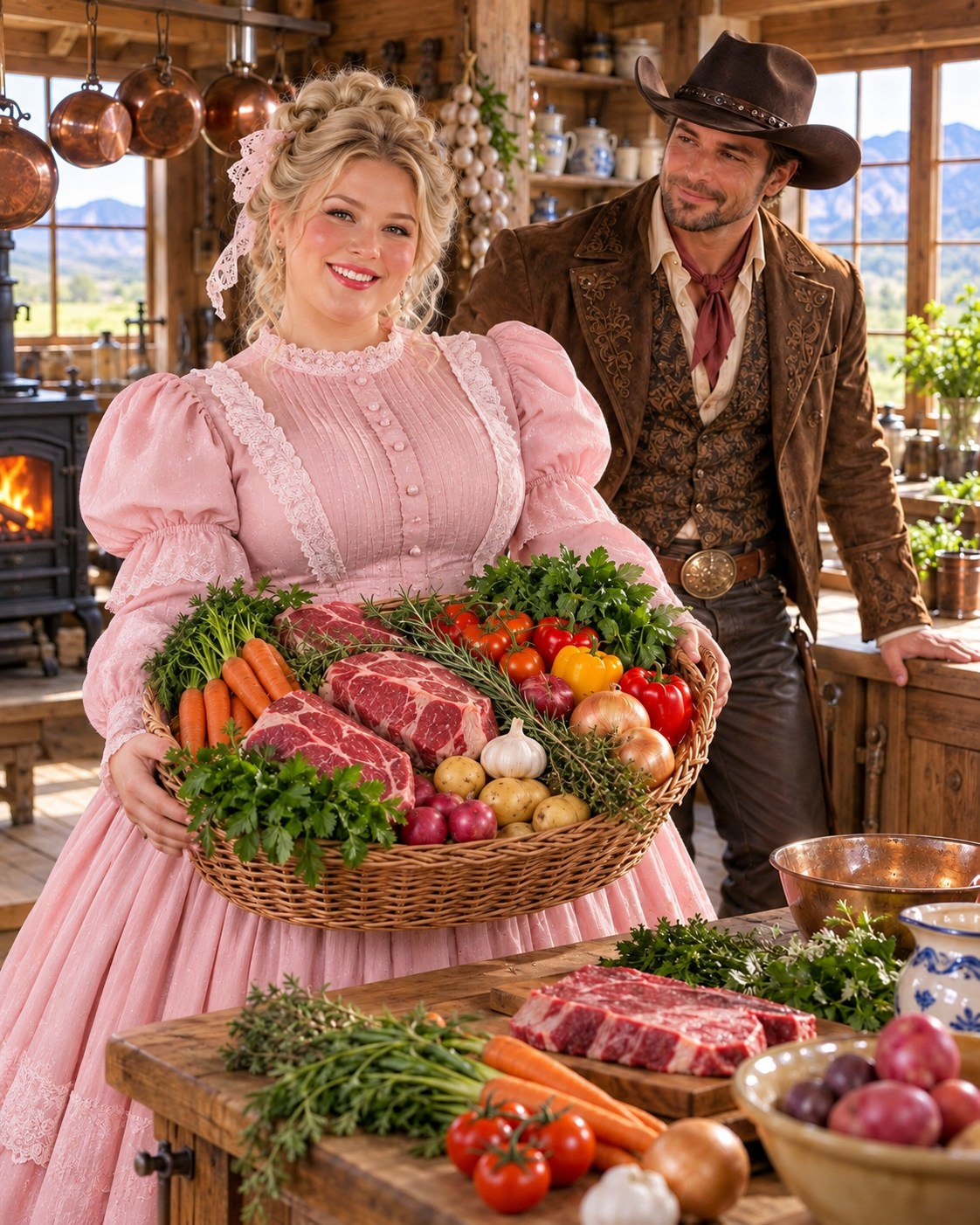
The ranch bell was ringing.
Three times.
Then three more.
I had heard that bell during blizzards, cattle stampedes, and the winter a young ranch hand nearly drowned beneath the ice at Willow Creek.
But I had never heard it ring while the sky above Cottonwood Ridge burned orange.
"Our home," I whispered.
Then I ran.
Owen Mercer caught me before I reached the horses.
"Clara, wait!"
I twisted away.
"Twenty men are up there!"
"I know."
"Thomas can barely use his arm. Frank can hardly stand. Billy—"
My voice broke.
Owen gripped my shoulders.
"Look at me."
I did.
His face was streaked with soot, and blood ran from a shallow cut near his temple.
"We're going together."
Behind us, Sheriff Briggs was shouting orders.
"Secure Pembroke! Get Cross into irons! Cole, take your men to the ranch!"
Silas Pembroke stood between two deputies, his face illuminated by the burning records office.
For the first time since I had known him, he looked small.
But when our eyes met, he smiled.
"You should have sold the cattle, Mercer."
Owen turned toward him.
"If one of my men dies tonight, Silas, you'll answer for him."
Pembroke's smile faded.
I stepped closer.
"Whatever you've done to Cottonwood Ridge, you haven't won."
He looked at me with cold amusement.
"You still don't know what your father buried beneath that land."
I glanced toward Matthew.
My father stood beside Eleanor, his face pale.
"Then tell me," I said.
Matthew took a breath.
"Not here. We have to save the ranch first."
I wanted to argue.
I wanted every secret dragged into the open before another person suffered.
But the bell was still ringing.
And somewhere beyond the hills, Billy Dawson was waiting for someone to come.
I mounted my horse.
Then we rode.
The road to Cottonwood Ridge was crowded with people carrying buckets, blankets, and tools.
Farmers who had lost livestock to Pembroke rode beside merchants who had once believed his lies.
Ruth and Henry Harlan followed in their wagon.
Daniel Price came with two railroad workers.
Even the blacksmith had abandoned his forge and joined us.
The closer we came, the stronger the smell of smoke became.
I could see flames beyond the cottonwoods.
My heart hammered.
Then we crested the final hill.
And I saw the ranch.
The main house was standing.
The bunkhouse was standing.
But the old storage barn near the north pasture had been torn apart.
Flames climbed its remaining timbers.
A wagon lay overturned beside the fence.
Men ran between the well and the burning structure, carrying buckets.
The emergency bell hung beside the kitchen porch.
Billy Dawson was pulling its rope.
He saw us first.
"MISS CLARA!"
I nearly fell from my horse.
"Billy!"
He ran toward me.
His face was blackened with soot.
But he was alive.
I caught him in my arms.
"Are you hurt?"
He shook his head.
"No, ma'am."
"Where's Frank?"
"Inside the kitchen."
"Thomas?"
"Helping with the horses."
I closed my eyes.
"Everyone else?"
Billy swallowed.
"All accounted for."
For one brief moment, my legs weakened.
Twenty men.
Alive.
Then Owen rode past us toward the burning barn.
"Get the horses away from that fence!"
Thomas appeared from the smoke, his wounded arm strapped against his chest.
"Already moving them!"
I stared at him.
"You should be resting!"
He gave me a crooked smile.
"Seems the barn disagreed."
I almost laughed.
Then another section of roof collapsed, sending sparks into the night.
Owen shouted for everyone to move back.
We formed a line from the well.
Buckets passed from hand to hand.
The fire fought us for nearly an hour.
By the time the last flames were smothered, the barn was gone.
But the house remained.
The bunkhouse remained.
And the three wagons of recovered provisions had been moved safely behind the stone wall.
I stood staring at them.
Flour.
Beans.
Salted beef.
Potatoes.
The food that had nearly cost us everything.
Still ours.
Still safe.
Billy came beside me.
"Miss Clara?"
I turned.
"Yes?"
"Does this mean we can finally have supper?"
I looked at his soot-covered face.
Then I laughed.
Not because anything was funny.
Because after all the fear, all the hunger, and all the terrible revelations, the boy was asking the only question that truly mattered.
"Yes, Billy."
My eyes filled.
"Tonight, everybody eats."
The explosion had not been an accident.
We learned that before midnight.
Thomas found pieces of a broken blasting-powder crate near the destroyed barn.
A wagon driver named Amos Bell admitted that Gideon Cross had paid him to deliver the crate, claiming it contained mining supplies.
Amos had left it beside the barn without knowing its contents.
Then another man had ridden in after sunset, cut the horses loose, and lit a fuse.
The man was caught trying to escape through the western fence.
He confessed before Deputy Cole had finished questioning him.
Pembroke had ordered the explosion.
Not to destroy the ranch house.
To destroy the old barn.
I looked at my father.
"Why that building?"
Matthew stood beside the burned foundation.
For a long moment, he said nothing.
Then he pointed toward the ground.
"Because the barn was built over the northern survey marker."
Owen stared.
"The old boundary stone?"
My father nodded.
"Yes."
I looked between them.
"What does that have to do with the railroad?"
Matthew knelt beside a patch of exposed earth.
"Twenty-five years ago, surveyors discovered a narrow seam of silver-bearing ore beneath the northern ridge."
I stared.
"Silver?"
"Not enough to make anyone rich by itself. But the survey also showed that the ridge was the only practical passage for the proposed railroad extension."
Owen looked toward the ruined barn.
"Pembroke wanted the mineral rights and the right-of-way."
My father nodded.
"He wanted both without paying the people who owned them."
I thought of the forty-thousand-dollar valuation.
The forged contracts.
The years of pressure.
"Then why did he keep trying to buy Cottonwood Ridge for almost nothing?"
"Because the railroad company had offered a substantial payment for a legal passage through the ridge," Matthew explained. "And a mining company had expressed interest in the silver seam."
I looked at the ground.
"So the land was worth far more than anyone knew."
"Yes."
My father stood.
"Margaret Mercer discovered the survey. She wanted the right-of-way payment placed in trust to compensate the families Pembroke had cheated, beginning with yours."
I swallowed.
"And the silver?"
"Under the original agreement, any proceeds from mineral rights would be divided between the lawful landowner and the compensation trust."
Owen looked at me.
"That was why Margaret insisted on the clause."
I stared toward the eastern rise, where his wife was buried beneath the cottonwood tree.
For years, Owen had mourned a woman whose final kindness had remained hidden.
Now her courage was standing before us in ink and paper.
"Did Margaret know about your involvement with Calvin Rusk?" I asked him.
Owen lowered his head.
"She learned the truth before she died."
"What did she say?"
His eyes filled.
"She told me that loving someone didn't excuse the harm I'd helped cause."
I felt those words settle inside me.
"She was right."
Owen nodded.
"I know."
We found the original survey marker beneath the collapsed barn floor.
It was a heavy stone slab with a brass plate set into its center.
The explosion had exposed it rather than destroyed it.
My father brushed away the dirt.
The plate bore a survey number matching the map recovered from Samuel's grave.
Daniel Price compared the numbers carefully.
Then he looked up.
"It's the same parcel."
Deputy Cole nodded.
"That establishes the location. The original documents establish the ownership and trust terms."
I looked toward the ruined barn.
"Pembroke destroyed the building trying to erase the proof."
"And uncovered the marker instead," Thomas said.
He shook his head.
"That man never did know when to stop digging."
For the first time that night, several men laughed.
But the laughter faded when Eleanor approached.
She carried her wooden box.
"Clara, there's something else you should see."
I turned.
She withdrew a final envelope.
It bore Margaret Mercer's handwriting.
Across the front were three words.
For Clara Witkim.
My throat tightened.
I looked at Owen.
He stared at the envelope.
"I've never seen that."
Eleanor nodded.
"Margaret gave it to me shortly before she died. She asked that it be delivered when the truth about the northern pasture became public."
I opened it carefully.
Inside was a short letter.
Dear Clara,
You have spent your life feeding people who might otherwise go hungry. I have watched you give away the best portion of a meal and pretend you were not hungry yourself.
I know what happened to Samuel. I know what was stolen from your family. I cannot undo that loss.
But I can help return something that should never have been taken.
If the railroad agreement is ever honored, I hope you will use your share to build a place where no child must wonder whether there will be bread tomorrow.
You deserve a life that is more than surviving.
With affection, Margaret.
I read the letter twice.
Then I folded it against my chest.
For years, I had believed my work was simply cooking.
Stretching supplies.
Counting potatoes.
Making certain twenty men had enough to eat.
Margaret had seen something larger.
She had seen the little girl who couldn't save Samuel.
And the woman who had spent the rest of her life trying to save everyone else.
I looked toward the kitchen.
Smoke rose from the chimney.
Billy was carrying wood inside.
Frank sat beside the doorway, wrapped in a blanket.
Thomas was arguing with one of the deputies about whether a wounded man could lift a sack of flour.
They were alive.
They were home.
And for the first time in nearly two weeks, there was enough food.
I wiped my eyes.
Then I turned toward Owen.
"Tomorrow, we rebuild the barn."
He nodded.
"Tomorrow."
"And tonight?"
He looked at me.
I smiled through my tears.
"Tonight, I'm making supper."
By midnight, the kitchen was crowded.
Every pot was on the stove.
Beans simmered with salted beef.
Potatoes roasted in iron pans.
Fresh bread browned in the oven.
Coffee filled the room with a smell I had nearly forgotten.
I had spent eleven days trying to make six potatoes feed twenty men.
Now I stood before shelves filled with food that belonged to us.
I should have felt triumphant.
Instead, I felt grateful.
And tired.
Terribly tired.
Billy appeared beside the stove.
"Can I help?"
I handed him a wooden spoon.
"Stir the beans."
He grinned.
"Yes, ma'am."
Frank sat at the table.
His color had returned.
Thomas lowered himself into a chair beside him.
"Smells like heaven."
I pointed at him.
"If you tear those stitches, you'll be eating broth for a month."
He raised his good hand.
"Understood."
My father entered quietly.
He stood in the doorway watching me work.
For a moment, I saw the old kitchen from my childhood.
The small stove.
The worn wooden table.
Samuel sitting beside the window, waiting for supper.
I felt my throat tighten.
Matthew approached.
"May I help?"
I looked at him.
"You still remember how to knead bread?"
He smiled.
"Your mother said I was better at building tables than using them."
I laughed softly.
Then handed him a bowl of dough.
"Let's find out whether she was right."
We worked side by side.
For the first time in seven years.
There were no explanations.
No accusations.
No secrets.
Only flour on our hands and the warmth of the stove.
At one point, my father looked toward me.
"Clara."
I stopped.
"Yes?"
"I know I can't give those years back."
I swallowed.
"No."
"But if you'll let me, I'd like to spend whatever years remain being your father."
I looked at his hands.
Older now.
Scarred.
Still steady.
The same hands that had taught me to count.
The same hands that had built Samuel's wooden horse.
I reached across the table.
And took one.
"I'd like that."
His eyes filled.
Then he pulled me into his arms.
I cried against his coat.
Not because the past had been repaired.
It hadn't.
Samuel was still gone.
My mother was still gone.
Seven years had still been stolen.
But my father was alive.
And this time, when I held him, he held me back.
The following weeks brought the justice our valley had waited years to see.
Deputy Marshal Cole escorted Pembroke, Gideon Cross, Dr. Harrison, and the men involved in the false burial and freight fraud to Helena.
The original contracts, payment books, freight records, and testimony from more than a dozen families were entered into evidence.
Sheriff Briggs surrendered his badge.
He confessed to altering records, suppressing complaints, and accepting improper favors from Pembroke.
His cooperation helped establish the full extent of the scheme, but it did not erase his responsibility.
He was removed from office and later sentenced for his part in the fraud.
Elias Ward testified about my father's imprisonment, Calvin Rusk's violence, and the forged documents.
He also admitted his own crimes.
The court considered his cooperation and the help he had given Matthew, but he was still required to answer for what he had done.
He accepted the judgment without protest.
Dr. Harrison's records established how my father had been drugged and falsely declared dead. Peter Larkin's death was formally investigated, and testimony from Ward and the surviving accomplices identified Rusk as the killer acting under Pembroke's direction.
Rusk had died years earlier, but Peter's family finally received the truth.
The false death certificate was corrected.
The man buried under my father's name was recognized as Peter Larkin.
His family gave him a proper grave.
My father's legal identity was restored.
And the letters that had been intercepted were recovered from Pembroke's private correspondence.
I read them beside the kitchen stove.
Three letters.
Three attempts to reach me.
In the first, my father had written that he was alive.
In the second, he had asked whether I was safe.
In the third, he had written only that he loved me and hoped one day I would understand.
I kept all three.
Not because they erased the years.
Because they proved he had tried.
Silas Pembroke was convicted of fraud, forgery, conspiracy, and crimes connected to the violence committed on his orders.
The evidence concerning Margaret Mercer's illness was examined separately. Investigators found proof that Harrison had concealed information about her treatment, but not enough to establish that she had been deliberately poisoned. I learned to accept the difference between suspicion and proof.
Pembroke's assets were seized to satisfy lawful judgments.
Families received compensation.
Fraudulent debts were canceled.
Property transfers obtained through falsified accounts were overturned wherever the evidence allowed.
Henry Harlan kept his farm.
Curtis Vale's mother's inflated debt was declared invalid.
Curtis testified about Pembroke's threats and the warehouse shooting. His own conduct was reviewed, but his cooperation and the coercion he had endured were taken into account.
He returned home to care for his mother.
And the man who had once controlled the valley through hunger could no longer decide who ate and who went without.
Spring came slowly to Cottonwood Ridge.
The snow retreated from the hills.
The creek broke free of its ice.
Green grass appeared around the fence posts.
The railroad company negotiated a new right-of-way agreement through the territorial court, using the genuine survey and the original trust provisions.
Owen retained ownership of the ranch.
The Witkim compensation trust received its lawful share of the payment.
The mineral rights remained subject to the original division, and any future development would require proper agreements rather than forged signatures.
The money was enough to repair the ranch, repay several families, and establish the project Margaret had imagined.
I called it Samuel's Table.
We opened it in the old boardinghouse near the center of town.
There was a kitchen.
A pantry.
A long wooden dining table my father built himself.
And a simple rule written above the doorway.
No hungry person turned away.
Ruth Harlan helped organize the supplies.
Frank Miller taught the younger workers how to preserve meat.
Thomas supervised deliveries, though he complained that everyone treated his healed arm as though it were made of glass.
Billy Dawson became our first apprentice.
He learned to bake bread.
He learned to keep accounts.
And he learned that a person's worth had nothing to do with how much money was in his pocket.
One afternoon, I watched him hand a warm loaf to a little girl whose family had lost their farm during the winter.
She looked up at him.
"How much?"
Billy smiled.
"Nothing."
The girl stared.
"Why?"
He glanced toward me.
Then said, "Because everybody deserves supper."
I turned away before he saw me cry.
Owen and I took longer to find our way back to each other.
There were things I could forgive.
And things I could never pretend had not happened.
He had paid Calvin Rusk.
He had witnessed a document he should have questioned.
He had remained silent when my father disappeared.
Those choices had consequences.
Owen testified fully and accepted responsibility for his role. He used his own money to compensate the people harmed by the land transactions in which he had participated.
He did not ask me to excuse him.
He did not tell me to forget.
Instead, he worked.
He rebuilt the barn.
He repaired fences.
He helped establish Samuel's Table.
And when the last of his obligations had been settled, he came to the kitchen one evening carrying a small wooden box.
I looked up from the bread dough.
"What's that?"
He placed it on the table.
"Something Margaret wanted you to have."
Inside was a silver measuring spoon.
Its handle was engraved with a small cottonwood tree.
I stared at it.
"She used this."
Owen nodded.
"Every Sunday."
I remembered.
Margaret had insisted that the best bread required patience.
She had taught me to measure carefully, then trust my hands.
I touched the spoon.
"Why give it to me?"
Owen looked toward the window.
"Because she loved you."
My throat tightened.
He continued.
"And because I think she'd be proud of what you've built."
I closed the box.
For a moment, we stood in silence.
Then I looked at him.
"I don't know what the future holds for us."
He nodded.
"I understand."
"But I'd like you to stay for supper."
His expression softened.
"I'd like that very much."
It wasn't a promise of everything.
It was a beginning.
And after the winter we'd survived, a beginning was enough.
On the first warm Sunday of May, my father and I visited Samuel's grave.
The snow was gone.
Wildflowers grew along the fence.
We carried fresh bread, a small wooden horse Matthew had carved, and a bouquet of yellow roses.
My father knelt beside the stone.
He placed the horse at its base.
Then he rested one hand against Samuel's name.
For a long time, he said nothing.
I stood beside him.
Finally, he whispered, "I'm sorry, son."
I knelt too.
I touched the carved letters.
For twenty-three years, I had come here carrying guilt.
I had imagined Samuel hungry.
Afraid.
Waiting for someone to save him.
But that morning, I remembered something else.
His laughter.
The way he had chased chickens through the yard.
The crooked wooden horse.
The stories he made up about thunder.
I smiled through my tears.
"You would have liked Billy," I whispered.
My father looked at me.
"He reminds me of Samuel sometimes."
I nodded.
"Me too."
We sat together beneath the spring sky.
Then I reached for my father's hand.
"Do you think Samuel knew we loved him?"
Matthew looked at the grave.
His voice was steady.
"Clara, I think that was the one thing he never doubted."
I closed my eyes.
For the first time, I believed it.
That evening, Cottonwood Ridge was filled with people.
The ranch hands gathered around the long dining table.
Ruth and Henry brought preserves.
Daniel Price arrived with fresh coffee.
Thomas carried a basket of bread despite my repeated instructions to leave the lifting to someone else.
Frank sat beside the stove, telling Billy a story that grew more ridiculous each time he repeated it.
My father stood near the window, watching the sunset.
Owen came in carrying a tray of roasted potatoes.
I looked at him.
"Careful. Those are hot."
He smiled.
"I've been told."
The room filled with laughter.
I stood beside the stove for a moment, watching everyone take their places.
Twenty men.
Friends.
Neighbors.
Family.
There was enough food.
Enough warmth.
Enough room at the table.
I looked toward the pantry.
The shelves were full.
Flour.
Beans.
Salt.
Coffee.
Potatoes.
Everything we had once feared losing.
Then Billy raised his cup.
"Miss Clara?"
I turned.
"Yes?"
He smiled.
"Would you say something before we eat?"
I looked around the table.
At Thomas's healed arm.
Frank's healthy face.
Ruth's gentle smile.
My father's familiar eyes.
Owen standing quietly beside me.
For a moment, I thought about all the speeches I might give.
About justice.
About courage.
About the danger of powerful men who believed other people's hunger was a price worth paying.
But those words belonged to another day.
Tonight, I wanted something simpler.
I lifted my cup.
"To everyone who came home."
The room fell quiet.
Then my father raised his cup.
"To those we carry with us."
Owen nodded.
"To Margaret."
I smiled.
"To Samuel."
The others raised their cups.
And for a moment, the room was filled with the names of people we had loved and lost.
Not forgotten.
Not erased.
Simply remembered.
Then I set down my cup.
"Now eat before everything gets cold."
Thomas reached for the potatoes.
Billy grabbed the bread.
Frank laughed.
And the room filled with the beautiful, ordinary sounds of people sharing a meal.
Later, when the dishes were cleared and the last guests had gone, I stood alone in the kitchen.
The fire burned low.
The table was empty.
But the house no longer felt lonely.
My father appeared in the doorway.
"Clara?"
I turned.
"Yes, Father?"
He smiled.
"Are you coming to sit with us?"
I looked at the clean dishes.
The full pantry.
The silver measuring spoon beside the stove.
Then I untied my apron.
"Yes."
I took his hand.
And together, we walked into the warm room where the people we loved were waiting.
For the first time in my life, I wasn't counting how much food remained.
I wasn't wondering who would go hungry tomorrow.
I wasn't carrying the weight of a little boy's death as though it had been my responsibility.
I was simply Clara Witkim.
A daughter.
A sister.
A woman who had survived a terrible winter and helped build something better from its ruins.
Outside, the cottonwood branches moved gently in the spring wind.
Inside, laughter rose around the fire.
And when my father pulled out a chair beside him, I sat down.
I was home.






Comments 0