My father's name glowed on the phone screen.
DAD.
For four years, that name had existed only in my memories, in old photographs, and in the contact list I had never been able to bring myself to delete.
Now it was calling me.
I stood in my mother's hallway, staring at the screen while two police officers waited on the porch.
My mother pressed a hand against her mouth.
Melissa whispered, "Dana, don't answer it."
But I already knew something.
Whatever was happening, my father wasn't calling.
My father was dead.
I had stood beside his hospital bed. I had held his hand. I had watched my mother kiss his forehead one final time.
No message, no recording, and no stolen telephone number could change that.
I looked at the officers.
"Someone is using my father's old number."
One officer stepped closer.
"May I see the screen?"
I showed him.
He studied the number, then nodded.
"Don't answer. Preserve the call information."
I let it ring until it stopped.
A message appeared immediately afterward.
You should have listened to Tyler.
I stared at those six words.
Then I looked at my mother.
And something inside me became very still.
For weeks, Tyler had used my love for my father to frighten me.
He had used his voice.
His photographs.
His records.
Now someone was using his telephone number.
But I wasn't frightened of ghosts.
I was frightened of living people who believed they could make me obey.
And those people had finally made enough mistakes to be caught.
Rachel Donovan arrived at my mother's house forty minutes later.
The officers had already explained that Tyler was alive and receiving medical treatment. They were investigating the reported theft of the external drive and the circumstances surrounding his collapse.
They had no evidence that my father had appeared at Tyler's apartment.
The name Tyler supposedly gave them was being treated as an unverified statement from a man who had been disoriented.
Rachel reviewed the messages.
Then she looked at me.
"Whoever sent these wants you at the hospital."
I nodded.
"Yes."
"And they want you to come alone."
I looked down at the final message.
Come before he tells them everything.
I swallowed.
"I'm not going."
Rachel nodded.
"Good."
She turned toward the officers.
"Can you preserve these messages as part of the investigation?"
They agreed.
Then Rachel asked a question that changed everything.
"Has anyone confirmed who currently controls the telephone number?"
The older officer shook his head.
"Not yet."
Rachel looked at me.
"Dana, do you remember when your father's account was closed?"
I turned toward my mother.
She frowned.
"About a month after the funeral."
I nodded.
"The number was disconnected."
Rachel leaned forward.
"Then whoever is calling may have obtained the number after it was reassigned, or may be manipulating the caller identification."
I stared at the phone.
For the first time, the impossible seemed ordinary.
Not supernatural.
Not mysterious.
Just another deception.
And deceptions could be investigated.
The following morning, I received a call from the detective assigned to Tyler's case.
His name was Detective Samuel Price.
He explained that Tyler was conscious and had been interviewed at the hospital.
The medical examination indicated that he had collapsed after combining alcohol with a prescribed medication. There was no evidence that someone had assaulted or poisoned him.
I closed my eyes.
For one terrible night, I had imagined another death.
Another unexplained tragedy.
Another set of records that would take years to understand.
But Tyler was alive.
And he was finally answering questions.
Detective Price continued.
"Mr. Bennett initially claimed someone stole a storage device from his apartment."
I swallowed.
"Did they?"
"That claim is under investigation. But he has since provided additional information."
I waited.
"He admitted he had arranged for someone to collect the drive."
My stomach tightened.
"Who?"
The detective paused.
"Michael Foster."
I stared at the wall.
Michael.
The family friend who had introduced me to Tyler.
The man who had signed a false statement about me.
The man who had stood beside Richard Voss at my mother's house.
Detective Price continued.
"Mr. Bennett says Mr. Foster came to retrieve the device on behalf of Richard Voss."
I swallowed.
"And Tyler agreed?"
"According to his account, yes. Then he became frightened that the device would be destroyed."
I stared at the kitchen table.
Tyler had told Denise the drive was stolen.
He had accused me.
Then he had admitted arranging its collection.
Another lie.
Another attempt to control the story.
I asked, "What about my father's name?"
The detective was quiet for a moment.
"Mr. Bennett says he didn't tell the officers your father entered his apartment."
I frowned.
"Then why did they say that?"
"He says he told the first responding officer that the dispute concerned Thomas Mitchell's records. His statements were confused, and the officer understood him to be identifying the person involved."
I closed my eyes.
The detective continued.
"We've clarified that with him."
I exhaled.
My father had never been there.
Of course he hadn't.
But hearing the explanation lifted a weight I hadn't realized I was still carrying.
Then I asked, "And the phone calls?"
"We've identified a prepaid telephone account associated with the number used to contact you. It was activated using information connected to Mr. Foster."
I went completely still.
"Michael?"
"Yes."
The detective continued.
"We also recovered the original drive from a storage unit he rented."
I sat upright.
"You found it?"
"Yes."
For several seconds, I couldn't speak.
The drive.
The one Tyler had kept for years.
The one Richard wanted.
The one Michael had tried to retrieve.
It was no longer hidden.
And neither was the truth.
Three weeks later, Rachel called me into her office.
I arrived wearing jeans, a navy sweater, and the old leather boots my father had bought me when I graduated from college.
Melissa came with me.
My mother waited in the reception area.
Rachel had several folders on her desk.
But this time, they weren't filled with accusations against me.
They contained findings.
Verified records.
Document comparisons.
Statements.
And evidence that had been preserved by investigators.
Rachel looked at me.
"Are you ready?"
I nodded.
"Yes."
She opened the first folder.
"The external drive contains original correspondence related to the Brangan Freight shipment approvals."
I leaned forward.
She continued.
"Those records support what your father and Daniel Mercer reported."
My throat tightened.
"The inspections?"
"Several shipments were cleared using inaccurate documentation."
I closed my eyes.
My father had been right.
Again.
Rachel continued.
"The records also show that Richard Voss approved the handling of those discrepancies and directed employees to characterize them as administrative corrections."
I looked at her.
"And Tyler?"
"Tyler helped maintain and distribute some of the revised documents."
I swallowed.
Rachel turned another page.
"His emails also show that he knew your father had challenged the discrepancies."
I stared.
"So he knew who I was when we met."
Rachel nodded.
"The correspondence strongly supports that."
I looked down.
For three years, I had believed Tyler and I met by chance.
But the emails showed something else.
Michael had told Tyler I would be at the birthday party.
Richard wanted the Mitchell family to stop asking questions.
And Tyler had agreed to get to know me.
I swallowed.
"Was I supposed to be part of the cover-up?"
Rachel considered her words.
"The records indicate Tyler was encouraged to maintain contact with your family. They don't establish that Richard specifically ordered him to pursue a romantic relationship."
I nodded.
That distinction mattered.
Because the truth was ugly enough without adding things we couldn't prove.
Tyler had known who I was.
He had concealed his connection to my father.
He had used our relationship to gather information.
And when I became harder to control, he had begun preparing documents to destroy my credibility.
Those facts were enough.
Rachel opened the second folder.
"The document supposedly signed by your father after his death was fabricated."
I stopped breathing.
She continued.
"Investigators recovered earlier versions without the signature. They also found correspondence discussing the addition of an acknowledgment after Thomas Mitchell had already died."
My hands tightened.
"Who added it?"
"The evidence points to Michael Foster preparing the altered version, with Richard Voss aware that the original had not been signed."
I stared at her.
"And my mother?"
Rachel's expression softened.
"The document she signed was different. She was presented with a release and acknowledgment while grieving, without a clear explanation of its significance."
I looked down.
"Can it be challenged?"
"Yes. Her attorney has already taken steps to dispute the circumstances under which it was obtained."
I nodded.
Rachel continued.
"More importantly, that document cannot change the underlying inspection records or make your father's concerns disappear."
My throat tightened.
For years, my mother had believed her signature had somehow betrayed him.
Now she knew what had happened.
Someone had taken advantage of her grief.
Someone had used complicated language to make a frightened widow sign papers she didn't understand.
And someone had later used a forged signature to create the appearance that my father had withdrawn his complaint.
But the original records remained.
My father's handwriting remained.
His letter remained.
And his integrity remained.
The third folder contained Tyler's campaign against me.
Rachel showed me the findings from the digital examination.
The audio recording sent to my employer had been assembled from existing recordings and artificially generated speech.
My father's voice came from the birthday video.
Melissa's voice came from an old voicemail Tyler had saved.
My supposed confession had been generated using samples from recordings Tyler had made inside our apartment.
I stared at the report.
"He really recorded me without telling me."
Rachel nodded.
"The examination found evidence of a concealed camera and microphone system in the apartment."
I felt cold.
She continued.
"The recordings were collected over several months."
I closed my eyes.
I remembered standing beneath the kitchen sink.
The argument.
The way Tyler had watched me.
He hadn't simply been angry.
He had been collecting material.
Rachel turned another page.
"The original files show that you never made the statements attributed to you in the complaint."
I opened my eyes.
"And my employer?"
"They've received the findings."
I swallowed.
Rachel smiled faintly.
"Your professional record has been cleared of the allegations."
For a moment, I couldn't speak.
Then I started crying.
Not loudly.
Not dramatically.
I simply sat there while tears ran down my face.
Because for weeks, I had been terrified that everything I worked for could be destroyed by someone who knew exactly how much my career meant to me.
I had studied for years.
Worked long hours.
Solved difficult problems.
Earned the respect of people whose opinions mattered.
And Tyler had tried to take it away because I wouldn't become the woman he wanted.
Melissa reached for my hand.
I held it tightly.
Rachel waited until I could speak.
Then I whispered, "Thank you."
She nodded.
"You're welcome."
The consequences didn't happen overnight.
There were investigations.
Interviews.
Document examinations.
Attorneys.
Hearings.
And months of waiting.
But the truth continued to hold.
Brangan Freight terminated Tyler's employment after its internal investigation substantiated serious misconduct, including the submission of false documents and misuse of company systems.
Richard Voss was removed from his position.
The company referred evidence concerning the historical shipment records to the appropriate authorities and began correcting its compliance procedures.
Michael Foster admitted that he had signed the false statement about me after being pressured by Tyler and Richard.
He also admitted helping recover the external drive and sending the messages from my father's old number.
He had wanted me frightened.
He had wanted me at the hospital.
He had wanted me to believe Tyler still controlled information I desperately needed.
But the messages became evidence against him instead.
Eventually, Tyler entered guilty pleas to charges arising from the forged financial authorization, unlawful recording, and falsified documents.
Richard and Michael also faced legal consequences for their roles in the document manipulation and related misconduct.
The proceedings took time.
There were no dramatic confessions in a crowded courtroom.
No sudden applause.
No perfect speech that made everything disappear.
There were simply records.
Dates.
Signatures.
Messages.
And people who finally had to answer for what they had done.
I didn't attend every hearing.
I didn't need to.
Rachel kept me informed.
And I learned that justice didn't require me to spend every waking moment watching the people who hurt me suffer.
It required the truth to be established.
And the consequences to follow.
Six months after the investigation began, I received a letter from Brangan Freight.
It was signed by Denise Harper.
The company formally acknowledged that my father's concerns had been legitimate and that its earlier handling of the matter had failed to meet appropriate standards.
The letter also recognized that Thomas Mitchell had attempted to raise safety issues in good faith.
I read it at my mother's kitchen table.
Then I handed it to her.
She read every word.
Slowly.
Carefully.
When she reached the final paragraph, she covered her mouth.
Then she began to cry.
I moved beside her.
She looked up.
"He would have wanted this."
I nodded.
"Yes."
She pressed the letter against her chest.
"For four years, I wondered whether he was wrong."
I shook my head.
"He wasn't."
She looked at me.
"And I wondered whether I failed him."
I took her hand.
"Mom, you loved him."
She closed her eyes.
"You were grieving. Someone took advantage of that."
She nodded slowly.
Then she looked toward the photograph on the wall.
My father stood beside his workbench, smiling with a wrench in his hand.
I followed her gaze.
For the first time since his death, I felt that the story of his final weeks had been given back to us.
Not changed.
Not rewritten.
Simply told truthfully.
My relationship with Tyler ended through attorneys.
I didn't meet him for one last conversation.
I didn't ask him why he had done it.
I didn't give him another opportunity to explain that everything was somehow my fault.
We separated our belongings.
Resolved the apartment lease.
Closed shared accounts.
And completed the remaining financial arrangements.
The attempted access to my bank account had been stopped before any money was transferred.
My credit remained protected.
The forged authorization was formally documented.
I changed my passwords, replaced compromised devices, and made sure Tyler no longer had access to my private information.
The pink curtains stayed with him.
So did the dresses he had purchased before telling me I needed to change.
I kept one photograph.
Not of Tyler.
Of myself.
It had been taken at the company barbecue.
I was wearing a pink sundress.
My hair was loose.
I was smiling.
For a while, I had hated that photograph because it reminded me of the woman Tyler wanted me to become.
Then I realized something.
I had chosen that dress.
I had liked the way it looked.
The problem had never been the color.
Or the clothes.
Or the makeup.
The problem was someone believing he had the right to decide who I was.
So I kept the photograph.
And I stopped apologizing for liking pretty things.
Rebecca and I became friends.
Real friends.
Not simply two women connected by the same man.
We met for coffee.
Talked about work.
Shared stories about our families.
Sometimes we laughed about things that had nothing to do with Tyler.
She told me about her architecture projects.
I told her about the machines I was designing.
One afternoon, she brought her husband to lunch.
He was kind.
Funny.
And completely comfortable listening to Rebecca explain a complicated structural problem without interrupting her.
I watched them together.
The easy way they spoke.
The way he asked questions.
The way she laughed.
And I realized I had spent years believing that love required one person to become smaller.
Rebecca's marriage showed me something different.
Two people could stand beside each other without competing for control.
I was glad she'd found that.
And for the first time, I believed I might find it too.
Someday.
When I was ready.
Jason apologized to me one evening.
We were sitting at a small restaurant near downtown Cedar Rapids.
He looked uncomfortable.
"I should have noticed sooner."
I shook my head.
"You noticed when it mattered."
He frowned.
"I laughed at some of Tyler's jokes."
I looked at him.
"I remember."
He lowered his eyes.
"I thought he was just being an idiot."
I smiled faintly.
"He was."
Jason laughed.
Then his expression became serious.
"But I didn't realize how much he was hurting you."
I took a sip of water.
"Neither did I, at first."
He nodded.
We sat quietly.
Then he said, "For what it's worth, I'm proud of you."
I looked at him.
"Thanks."
He smiled.
"And I'm never asking you to pretend you can't fix something again."
I laughed.
"Good."
He leaned back.
"Although if my car breaks down—"
"Call a mechanic."
He grinned.
"Fair enough."
Melissa stayed my closest friend.
We still worked together.
Still argued about design specifications.
Still complained about meetings that could have been emails.
And sometimes, when the day was difficult, we sat on her couch eating takeout and watching terrible television.
One evening, she looked at me.
"Can I ask you something?"
I smiled.
"Sure."
"Do you regret becoming Tyler's perfect girlfriend?"
I thought about it.
The pink dresses.
The soft voice.
The helplessness.
The way I'd stopped fixing things to show him how much work I'd always been doing.
Then I shook my head.
"No."
She looked surprised.
"Really?"
I smiled faintly.
"I regret how long I stayed."
She nodded.
"But pretending to be helpless showed me something I needed to understand."
"What?"
I looked at her.
"Tyler didn't want a feminine girlfriend."
Melissa waited.
"He wanted someone who wouldn't challenge him."
She nodded slowly.
"And the moment I stopped solving his problems, his life started falling apart."
Melissa smiled.
"That's true."
I laughed softly.
"But I don't want to spend the rest of my life proving a point to him."
She raised her glass.
"Good."
I raised mine.
"To never doing that again."
We clinked glasses.
The following spring, my mother and I finished the workshop.
It stood behind her house in Iowa City, where the old shed had been.
We replaced the roof.
Installed insulation.
Built sturdy shelves.
Ran new electrical wiring with the help of a licensed electrician.
And mounted my father's old tools above the workbench.
The brass key he had left me hung beside the door.
My mother painted the walls a warm cream color.
I installed bright overhead lights.
Melissa helped organize the storage drawers.
Jason assembled a cabinet, although he complained the entire time.
Rebecca designed a small worktable that folded against the wall.
Even Brett stopped by one Saturday with a box of spare hardware he'd found at a supplier.
He was doing well as district manager.
He had earned the position through years of work, and he never once treated Tyler's downfall as something to celebrate.
I respected him for that.
On the day we finished, my mother stood in the doorway.
She looked around.
Then smiled.
"Your father would have loved this."
I swallowed.
"Yeah."
She walked toward the workbench.
Touched the worn wooden surface.
Then looked at me.
"What are you going to build first?"
I smiled.
"I have an idea."
Three weeks later, I completed my first project.
It was a small mechanical display.
A series of brass gears mounted inside a wooden frame.
When a handle turned, the gears moved together, lifting a tiny metal bird into the air.
Nothing complicated.
Nothing expensive.
Just something beautiful that worked because every piece did its job.
I placed it on the workbench.
Then called my mother inside.
She watched me turn the handle.
The gears moved.
The bird rose.
She smiled.
"Oh, Dana."
I looked at her.
"What?"
She touched the frame.
"It's beautiful."
I swallowed.
"Thanks."
Then I pointed toward the small brass plate attached to the bottom.
She leaned closer.
The engraving read:
For Thomas Mitchell.
Who taught me that I could build anything.
My mother began to cry.
I hugged her.
And this time, the tears didn't feel like grief alone.
They felt like love.
Like gratitude.
Like the beginning of something we had thought we'd lost.
A year after I left Tyler, I stood in my own kitchen.
It was a small house.
Nothing luxurious.
Nothing designed to impress anyone.
There were bookshelves in the living room.
A comfortable couch.
A table by the window.
And a garage large enough for my tools.
I had bought it myself.
With money I had saved.
With decisions I had made.
And with no one telling me that being independent made me less desirable.
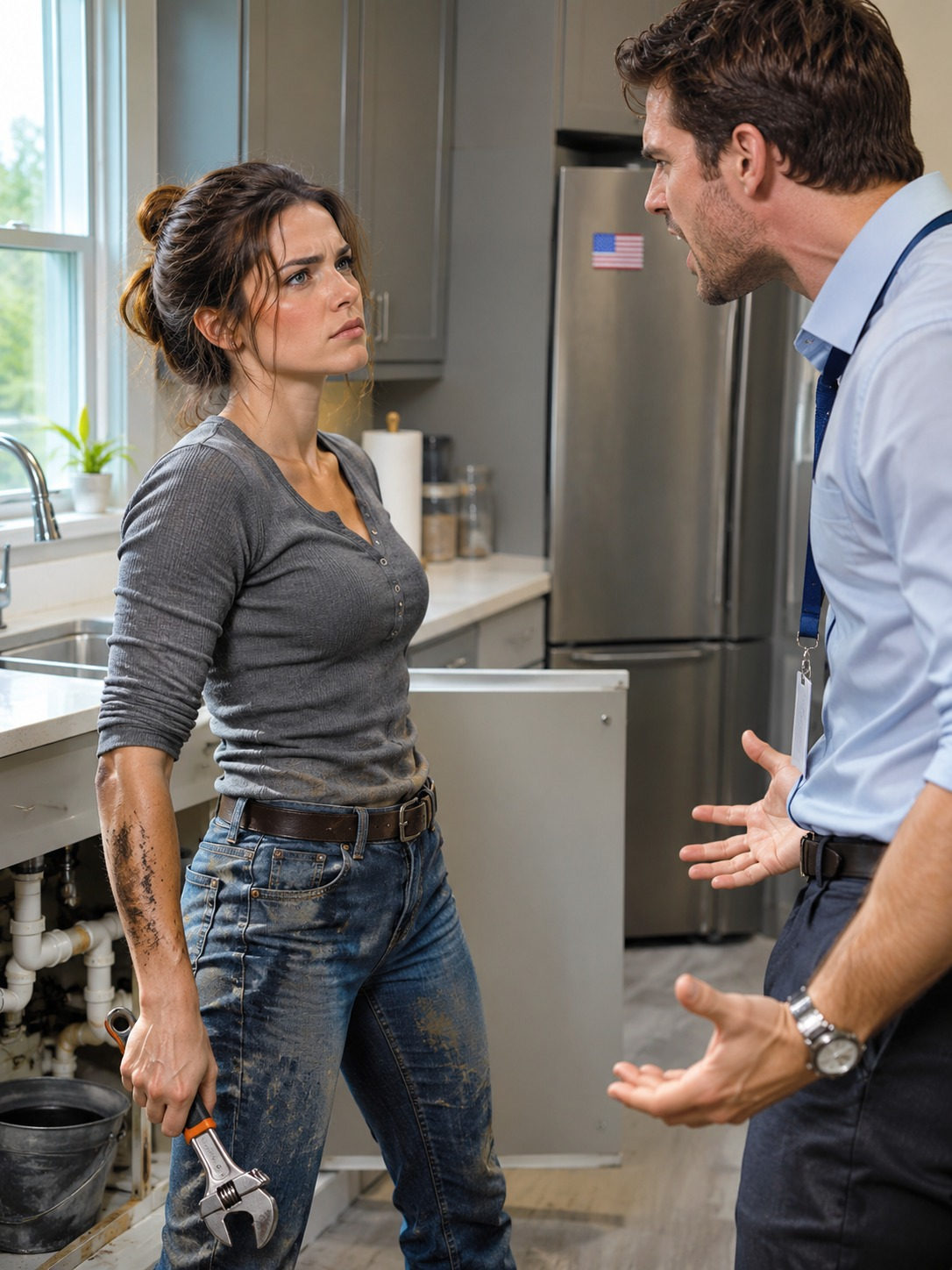
That Saturday morning, I was repairing the kitchen faucet.
I wore old jeans.
A gray T-shirt.
And my hair was tied back.
A wrench rested in my hand.
Water dripped slowly into a bucket.
I smiled.
Because I remembered another kitchen.
Another faucet.
Another man standing behind me, furious that I knew how to fix something he couldn't.
He had called me too masculine.
He had demanded a perfect girlfriend.
He had wanted me to become soft, obedient, helpless, and grateful.
So I had given him a glimpse of the woman he claimed to want.
And without my invisible labor holding his life together, everything he had built on appearances began to collapse.
But that wasn't the most important thing that happened.
The most important thing was that I stopped believing his definition of me.
I tightened the fitting.
Turned the water back on.
Checked for leaks.
Perfect.
Then my phone rang.
It was my mother.
"Hi, sweetheart."
"Hey, Mom."
"What are you doing?"
I looked down at the wrench.
"Fixing my sink."
She laughed.
"Of course you are."
I smiled.
"What's up?"
"Just wanted to remind you about dinner tonight."
"I'll be there."
"And Dana?"
"Yeah?"
There was a pause.
Then she said, "I'm proud of you."
I closed my eyes.
For a moment, I heard my father's voice.
Not the stolen recording.
Not the edited version.
The real memory.
That's my girl, Dana.
I smiled.
"Thanks, Mom."
We said goodbye.
I put down the phone.
Then I walked toward the window.
Outside, sunlight fell across the backyard.
My car sat in the driveway.
A pair of work boots rested beside the garage door.
And on the kitchen counter was a pink dress I had bought the week before.
I was wearing it to dinner.
Not because anyone demanded it.
Not because I needed to look smaller.
Not because I was trying to become someone's dream woman.
I had bought it because I liked it.
I looked at the dress.
Then at the wrench.
And laughed.
Because both belonged to me.
I could be feminine.
I could be strong.
I could be gentle.
I could be stubborn.
I could wear lipstick and steel-toed boots.
I could love someone deeply without surrendering myself.
And I could walk away from anyone who believed love meant control.
I turned off the kitchen light.
Picked up the dress.
And went upstairs to get ready.
That evening, my mother would be waiting.
Melissa would bring dessert.
Jason would probably arrive late.
Rebecca and her husband would join us.
There would be laughter.
Stories.
Good food.
And people who loved me without asking me to become someone else.
My father's photograph stood on the bookshelf beside the window.
I paused in front of it.
For a moment, I studied his familiar smile.
Then I whispered, "We did it, Dad."
The house was quiet.
The sunlight was warm.
And for the first time in years, I wasn't waiting for someone to tell me whether I was good enough.
I already knew.
I was Dana Mitchell.
An engineer.
A daughter.
A friend.
A woman who could build things, break things, repair things, and begin again.
And I was never going to apologize for being myself.






Comments 0