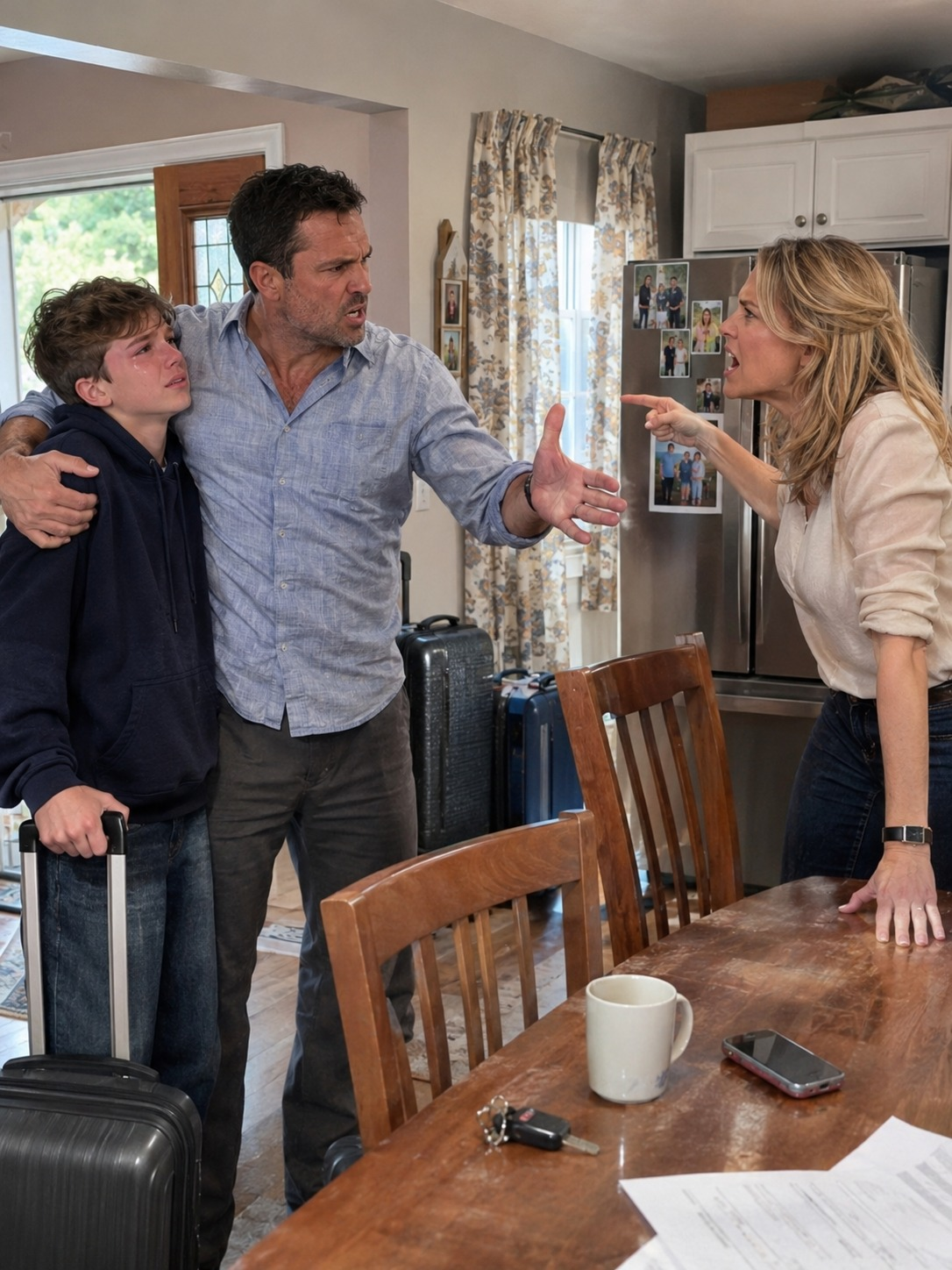
"Can I tell you something without Erica finding out?"
My twelve-year-old son stood in the kitchen doorway, barefoot and trembling slightly, while I sat at the dining table with my phone still in my hand.
I had heard Isaac ask for permission to do a hundred things.
Permission to stay up late.
Permission to visit a friend.
Permission to buy another video game.
But I had never heard him ask for permission to tell me the truth.
That frightened me more than I wanted to admit.
"Of course you can, buddy," I said quietly. "Come sit down."
He didn't move.
Instead, he glanced toward the staircase.
"Is she asleep?"
"I think so."
"Are you sure?"
I looked at the clock above the kitchen doorway. It was almost eleven.
Erica had gone upstairs nearly an hour earlier, complaining about a headache. The twins had been asleep since nine.
"She's upstairs," I said. "It's just us."
Isaac took two cautious steps into the kitchen.
Then he stopped again.
"You're not going to tell her I said anything?"
I felt something tighten inside my chest.
"Isaac, you can talk to me about anything."
"That's not what I asked."
His answer caught me off guard.
He wasn't being disrespectful.
He was being careful.
And there was something deeply unsettling about watching a child choose his words as though he were negotiating with someone who might use them against him.
I put my phone facedown on the table.
"Okay," I said. "I won't repeat what you tell me just to get you in trouble. If there's something important I need to deal with, we'll talk about how to handle it together."
He studied me.
For a moment, I thought he might finally sit down.
Instead, he rubbed his palms against his pajama pants.
"Never mind."
"Isaac—"
"It's stupid."
"Nothing you want to tell me is stupid."
He shook his head.
"I shouldn't have come downstairs."
Then he turned toward the hallway.
I wanted to stop him.
I wanted to demand an explanation.
I wanted to know why my own son looked frightened inside his own home.
But something in his expression told me that pushing him would only make him retreat further.
So I stayed seated.
"Buddy?"
He paused.
"I love you," I said. "And you don't have to earn that by keeping anybody happy."
He stood still for several seconds.
Then he nodded without turning around.
"Love you, Dad."
He went upstairs.
I remained at the table long after his footsteps disappeared.
My phone vibrated.
Another message from my friend, Mark.
Everything okay?
I stared at those words.
Then I typed:
I don't know anymore.
I didn't sleep much that night.
Erica lay beside me, breathing evenly, while I stared at the ceiling and replayed the conversation with Isaac.
The way he had checked the staircase.
The way he'd asked whether Erica would find out.
The way he'd said he shouldn't have come downstairs.
I kept searching for an innocent explanation.
Maybe he'd broken a rule.
Maybe he'd argued with the twins.
Maybe he was afraid Erica would be upset about the birthday plans.
Children sometimes exaggerated conflicts.
They sometimes worried about consequences that adults considered minor.
I knew all that.
But I also knew my son.
Isaac had never been particularly secretive with me.
When he was younger, he used to confess things before I even knew something had happened.
He once woke me at six in the morning to admit he'd accidentally broken a Christmas ornament.
Another time, he'd cried because he thought I'd be disappointed after getting a poor grade on a math test.
I had always told him the same thing.
Mistakes could be fixed.
Lies made things harder.
And telling me the truth would never make me stop loving him.
So why had he suddenly become afraid to speak?
At six the next morning, my alarm went off.
I got dressed quietly and went downstairs.
Erica was already in the kitchen making coffee.
She wore her work clothes and had her hair pulled back.
"Morning," she said.
"Morning."
She poured coffee into a travel mug.
"Did you talk to Isaac last night?"
I stopped reaching for a clean cup.
"What?"
"I heard someone downstairs."
My heart gave an uncomfortable thump.
"He couldn't sleep."
"What did he want?"
"Just to talk."
"About what?"
I looked at her.
"Why?"
She shrugged.
"Because he's been sulking about his birthday, and I'm tired of it."
I set my cup on the counter.
"He isn't sulking."
"Daniel, please."
"What?"
"He's been walking around acting like everyone owes him something."
I stared at her.
"He's excited about his birthday."
"He's being selfish."
The word came so easily that I almost missed its significance.
Selfish.
My son wanted an afternoon with two friends.
That was apparently selfish.
But asking him to abandon those plans so the twins could enjoy their favorite playground was supposed to be family loyalty.
"Erica, we've already discussed this."
"Apparently not enough."
I took a slow breath.
"I'm not canceling his birthday."
She turned toward me.
"And I'm not going to pretend it's fair."
"Fair to whom?"
"Emma and Ava."
"They'll have their own birthdays."
"You keep saying that."
"Because it's true."
She placed both hands on the counter.
"You know what your problem is?"
I didn't answer.
"You think that because Isaac doesn't have his mother around, you have to compensate for everything."
The words hit a nerve.
"That's not what this is about."
"Isn't it?"
"No."
"You spoil him because you feel guilty."
I stared at her.
There were things about Isaac's mother that Erica knew only because I'd trusted her enough to share them.
Things I rarely discussed.
Things that had hurt my son long before she entered our lives.
Hearing her use that history in an argument about an arcade made me feel as though something private had been dragged into the middle of the kitchen.
"Don't do that," I said.
"Do what?"
"Use his mother against him."
"I'm talking about your parenting."
"Then talk about my parenting."
She rolled her eyes.
"You're impossible when it comes to that boy."
That boy.
Not Isaac.
Not our son.
Not even your son.
That boy.
I looked toward the staircase.
The house was still quiet.
I lowered my voice.
"He's twelve years old, Erica."
"And old enough to understand that the world doesn't revolve around him."
I almost laughed.
Not because anything was funny.
Because the argument had become so distorted that I no longer recognized what we were supposedly discussing.
"He asked for pizza and a movie," I said.
"And I asked for one family afternoon."
"On his birthday."
"Yes, Daniel. On his birthday."
She said it as though I were being deliberately obtuse.
Then her expression softened.
It was a change I recognized.
The sharpness disappeared from her voice.
Her shoulders relaxed.
She looked almost wounded.
"I just don't understand why you keep making me feel like my daughters matter less."
There it was again.
The accusation.
Only this time, it came wrapped in sadness instead of anger.
I knew how that worked on me.
I knew because it had worked before.
Whenever I questioned something involving the children, the conversation somehow returned to whether I loved Emma and Ava enough.
If I asked why the twins had received new toys while Isaac was saving his allowance for something he wanted, I was accused of keeping score.
If I suggested that Isaac needed time alone instead of always entertaining his younger stepsisters, I was told he needed to learn responsibility.
If I said the girls should knock before entering his bedroom, Erica said I was encouraging him to shut them out.
Each disagreement seemed small when considered separately.
Together, they formed a pattern I had never properly examined.
And the worst part was that I had helped create it.
Every time Erica questioned my love for the twins, I tried harder to prove it.
I volunteered for another school event.
I bought something extra.
I rearranged my schedule.
I told myself I was protecting two little girls from feeling unwanted.
But I had never stopped to ask whether my efforts were costing Isaac something.
"Erica," I said carefully, "loving the girls doesn't mean Isaac has to give up everything he wants."
She stared at me.
"Nobody said everything."
"Then why are we still arguing about his birthday?"
"Because you refuse to compromise."
"Compromise would mean everyone gives something up. You're asking Isaac to give up his entire plan."
Her mouth tightened.
"You always have an answer."
"Because you're asking me to defend something that shouldn't need defending."
She grabbed her travel mug.
"Fine. Do whatever you want."
Then she walked past me.
At the doorway, she stopped.
"But don't expect me to explain to the girls why their brother gets special treatment."
I watched her leave.
For several seconds, I stood motionless in the kitchen.
Then I heard a faint sound behind me.
I turned.
Isaac was standing halfway down the stairs.
He was already dressed for school.
His backpack hung from one shoulder.
I had no idea how much he'd heard.
"Morning, buddy," I said.
"Morning."
He looked toward the front door.
"Is Erica mad?"
I hesitated.
"We disagreed about something."
"Was it my birthday?"
I didn't want to lie.
"Yes."
He nodded.
Then he said something that made my stomach sink.
"We can just go to the play place."
I stared at him.
"What?"
"It's fine. We can go there."
"Isaac, you don't have to—"
"I don't care that much."
But he did.
I knew he did.
He'd spent weeks planning that afternoon.
He'd talked about it every day.
He'd printed the movie schedule and written my promise beneath it.
Now he was standing in front of me pretending none of it mattered.
"Buddy, look at me."
He reluctantly raised his eyes.
"Do you want to go to the play center?"
He hesitated.
"Emma and Ava like it."
"That's not what I asked."
He looked down.
"No."
"Then we're not going."
He swallowed.
"Okay."
I stepped closer.
"Your birthday is your birthday. You don't need to apologize for wanting to enjoy it."
He nodded.
But instead of smiling, he asked, "Can you tell Erica that?"
I felt my throat tighten.
"Yes."
"Before you go to work?"
The question stayed with me.
"Why before work?"
He shrugged.
"Just because."
I wanted to ask more.
But Erica's car was already pulling out of the driveway, and the twins would be downstairs any minute.
So I placed a hand on his shoulder.
"I'll handle it."
He looked at me for a long moment.
Then he said, "Okay, Dad."
I drove to work feeling uneasy.
My job usually gave me enough problems to occupy my mind for an entire day.
Delayed shipments.
Staffing shortages.
Drivers calling in sick.
Customers demanding explanations for things beyond my control.
Normally, I could lose myself in those responsibilities.
That morning, I couldn't concentrate.
At ten fifteen, Mark called.
I stepped outside the warehouse and answered.
"Hey."
"You sound terrible," he said.
"Thanks."
"I'm serious. Did you talk to Isaac?"
"Sort of."
"What does that mean?"
I leaned against the wall.
"He came downstairs last night and asked if he could tell me something without Erica finding out."
Mark went quiet.
Then he said, "Daniel, that's not normal."
"I know."
"Did he tell you?"
"No. He changed his mind."
"Why?"
"I don't know."
Mark exhaled.
"Listen, I'm not saying your wife is doing something terrible. I don't know her well enough to make that judgment."
"I understand."
"But your kid is afraid to talk to you. That part you know."
I looked across the parking lot.
A delivery truck backed toward the loading dock.
Its warning signal echoed between the buildings.
"I've been working a lot," I admitted.
"Most parents work a lot."
"Erica handles the afternoons. She's with the kids until I get home."
"Then you need to find out what those afternoons are like."
I rubbed my forehead.
"He's probably just worried about getting her in trouble."
"Maybe."
Mark paused.
"Or maybe somebody told him he'd be the one in trouble."
I didn't answer.
Because I had been thinking the same thing.
After the call, I returned to my office and opened my calendar.
Isaac had a day off school coming up.
Teacher preparation day.
The twins would still have classes.
Erica would be working.
I stared at the date.
For the first time in months, I considered taking a day off for something that wasn't an appointment, an emergency, or a family obligation.
Just a day with my son.
No Erica.
No twins.
No interruptions.
I submitted the request.
My supervisor approved it within twenty minutes.
I should have felt relieved.
Instead, I felt strangely nervous.
That evening, I came home earlier than usual.
The twins were in the living room watching television.
Erica was folding laundry.
Isaac was at the dining table with his homework.
I greeted everyone and asked about their day.
Emma told me she'd earned a sticker at school.
Ava showed me a drawing.
Isaac said his day had been fine.
Then Erica asked him to put away the girls' toys.
He stood immediately.
I glanced at the floor.
The twins had left dolls, plastic animals, and building blocks scattered across the rug.
"Girls," I said, "why don't you help Isaac clean up?"
Emma looked surprised.
"But Mommy said Isaac had to."
Erica stopped folding a towel.
I looked at her.
"Why?"
"Because he was supposed to be watching them."
I glanced at Isaac.
"Watching them?"
Erica gave an impatient sigh.
"Daniel, don't start."
"I'm asking a question."
"He was home. I needed to finish some errands."
I turned back to Isaac.
"How long were you watching them?"
He opened his mouth.
Then closed it.
Erica answered for him.
"Not long."
I looked directly at my son.
"Isaac?"
He stared at the floor.
"Just a while."
Something cold settled in my stomach.
I wanted to ask how long.
I wanted to ask whether Erica had left him alone.
I wanted to ask why a twelve-year-old boy was being held responsible for two seven-year-olds while their mother ran errands.
But I could see his discomfort growing.
So I said, "Okay. Girls, help clean up your toys."
Erica shot me a look.
The twins reluctantly joined Isaac.
I went into the kitchen.
A few minutes later, Erica followed.
"Are you seriously going to undermine me in front of the children?"
"I'm not undermining you."
"You just contradicted me."
"I asked the girls to pick up their own toys."
"Isaac was responsible for them."
"He's their brother, Erica. Not their babysitter."
Her face hardened.
"He's old enough to help."
"Helping is one thing."
"And what exactly are you implying?"
I looked at her.
I could have argued.
I could have demanded answers.
But I remembered Isaac standing in the kitchen doorway the night before.
Can I tell you something without Erica finding out?
I needed to hear from him before turning this into another confrontation.
So I said, "I'm not implying anything. I just think we need to talk about expectations."
She stared at me suspiciously.
Then she shook her head.
"You're making a problem out of nothing."
Maybe she believed that.
Maybe she had convinced herself that everything she demanded was reasonable.
Or maybe she knew exactly what she was doing.
I couldn't tell.
Not yet.
Later that night, after dinner, I went upstairs to tell Isaac about my day off.
His bedroom door was partly open.
I knocked.
"Come in."
He was sitting at his desk.
"Hey, buddy. I've got some good news."
He turned.
"What?"
"I'm taking Friday off."
His eyebrows lifted.
"Why?"
"Because you've got no school, and I thought we could spend the day together."
He stared at me.
"Just us?"
"Just us."
For the first time in days, I saw a real smile.
"Seriously?"
"Seriously. We can get lunch, maybe stop by the bookstore, whatever you want."
"That sounds awesome."
I smiled.
"Good."
Then his expression changed.
"Does Erica know?"
"Not yet."
He looked toward the hallway.
"Can we keep it that way until Friday?"
I felt my smile disappear.
"Why?"
He hesitated.
Then he reached into his desk drawer and pulled out a folded piece of paper.
It wasn't the movie schedule.
It was a sheet torn from a school notebook.
He held it for a moment, staring at the creases.
"She told me I wasn't supposed to show you this."
My heart began pounding.
"What is it?"
He extended the paper toward me.
I took it.
Across the top, in Erica's handwriting, were the words:
Isaac's Responsibilities.
Beneath them was a numbered list.
I recognized the first few items.
Homework.
Cleaning his room.
Helping with dishes.
Then I reached the fourth line.
My fingers stopped moving.
Isaac watched my face.
"Dad," he whispered, "please don't get mad."
I unfolded the bottom half of the page.
There was another section.
It had been written in darker ink.
And beside the final rule, Erica had written my name.
I started reading.
The first sentence was bad enough.
Then I saw what she'd written underneath it.






Comments 0