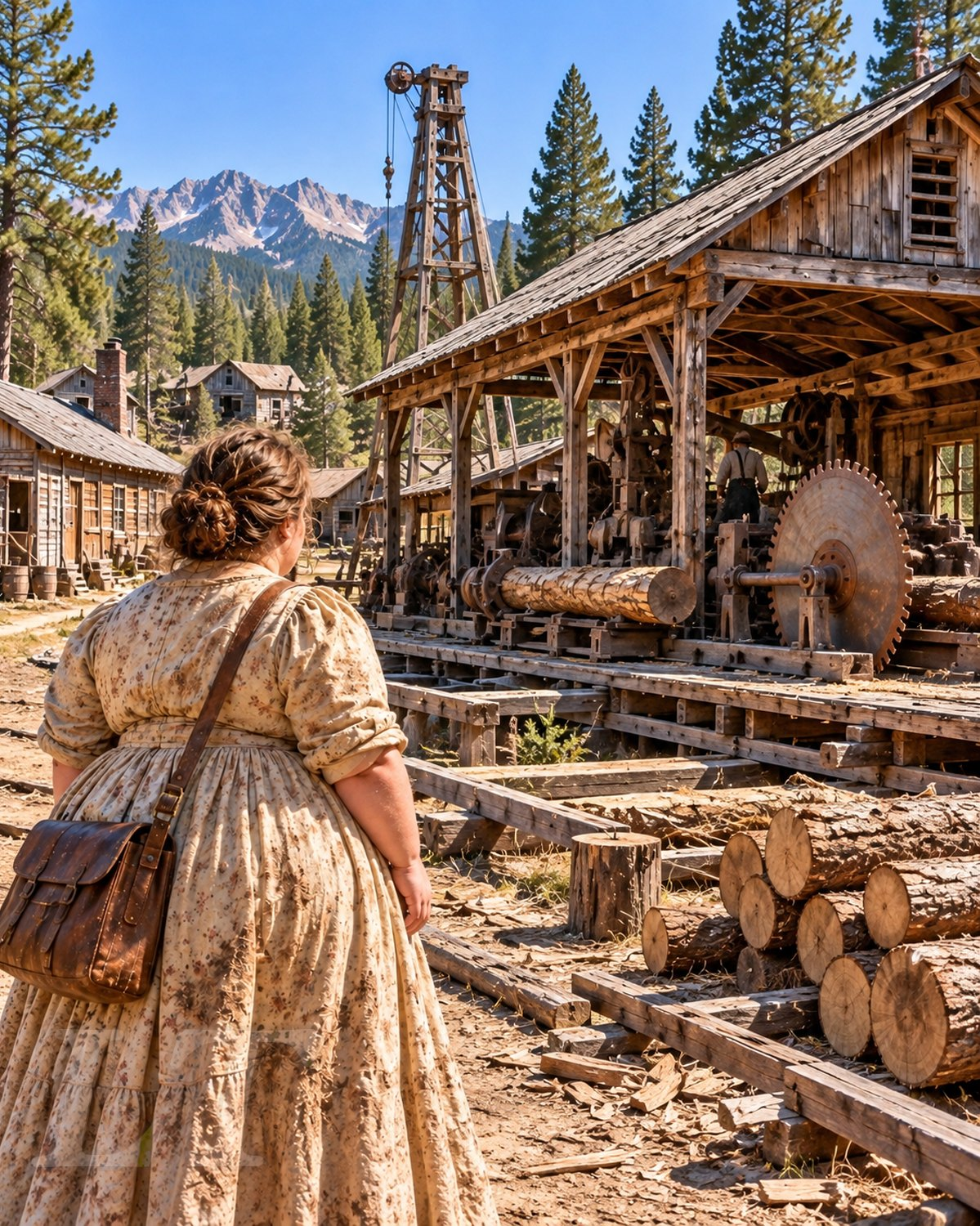
Delphine Whitam grabbed the lantern and stepped away from the bedroll.
The knocking came again.
Three slow strikes.
Then silence.
She stood in the middle of the cabin, listening so carefully that she could hear the fire settling inside the iron stove.
The sound had come from beneath the eastern side of the floor.
She was certain of it.
"Who's there?" she whispered.
No answer.
Delphine lowered the lantern and examined the floorboards. They were old pine, darkened by years of dirt and moisture. Some had warped upward at the edges. Others were held down by square-headed iron nails.
She crouched and placed her palm against the boards.
Nothing.
Then she heard it again.
Knock.
Knock.
Knock.
This time, the sound seemed to travel beneath her hand.
She pulled away.
For several seconds, she considered going outside and hitching Old Sam to the wagon. There was no shame in leaving a place where twenty-nine men had disappeared. Especially when something beneath the floor appeared capable of answering her.
But she had spent seven dollars reaching Alder Hollow.
She had spent four more silver dollars claiming Widow's Hollow.
And she had come too far to turn around because an abandoned building made strange noises at midnight.
Delphine took a small iron poker from beside the stove and began examining the floor.
She tapped each board.
Most produced a solid wooden sound.
One, near the eastern wall, answered with a hollow thud.
She tapped it again.
The same sound.
She pressed against the edge with the poker.
The board did not move.
Whatever lay underneath was either part of the original construction or had been deliberately concealed.
Delphine leaned closer.
A thin line of dust had gathered between two boards. She brushed it aside with her fingertips and noticed something unusual.
There was a narrow gap between the wood and the wall.
Someone had recently disturbed it.
She brought the lantern closer.
A tiny piece of dark fabric was caught between the boards.
Delphine pulled it free.
It was a thread of wool.
Dark brown.
She rubbed it between her fingers.
It was not the same color as the clothing she had brought with her.
Someone had been kneeling here.
Recently enough to leave fibers behind.
Her stomach tightened.
The knocking did not return.
She remained awake until dawn.
Morning arrived slowly over Widow's Hollow.
Sunlight filtered through the pine branches, illuminating the abandoned settlement one building at a time.
Delphine stepped outside with her coat buttoned and her hair tied back.
Old Sam was still where she had left him.
The mule lifted his head when she approached.
"Good morning."
He made a low sound.
She checked his water, examined the wagon harness, and placed a little hay near his feeding bucket.
Everything appeared normal.
Then she noticed something beside the cabin.
A narrow line had been drawn through the dirt.
It began near the back wall and continued toward the trees.
Delphine crouched.
The mark was too straight to have been made by an animal.
It looked like something heavy had been dragged across the ground.
She followed it for several feet.
Then she stopped.
The trail ended beside a large pine tree.
A small patch of earth beneath its roots had been disturbed.
She used the heel of her boot to move aside some loose dirt.
A rusted iron nail appeared.
Then another.
She looked around.
The forest was quiet.
Too quiet.
Delphine returned to the cabin and retrieved her crowbar.
She did not know what she expected to find beneath the pine tree.
Perhaps an old tool.
Perhaps a piece of machinery.
Perhaps nothing at all.
But before she could begin digging, she heard a sound from the sawmill.
A metallic clang.
She turned sharply.
The enormous wooden structure stood in the morning sunlight.
The circular saw blade was motionless.
The pulley tower cast a long shadow across the ground.
There was nobody visible.
Delphine watched the entrance for several seconds.
Then she remembered Hester's words.
The men had not abandoned the camp.
She returned the crowbar to the wagon.
The cookhouse was her priority.
The cookhouse stood beside the main sawmill.
Its roof had partially collapsed near the western corner, but the eastern wall remained intact.
Delphine entered through the main door.
Dust covered the long wooden table.
A rusted iron stove stood against the far wall.
Several cooking utensils remained hanging from hooks.
A cracked plate sat upside down beside an old tin cup.
The place looked as though its occupants had stepped outside and forgotten to return.
She placed the lantern on the table.
Then she walked toward the eastern wall.
Her father's drawing had been clear.
EAST WALL. BELOW THE OLD FOUNDATION.
Delphine removed the folded paper from her coat and compared it with the room.
The rough sketch showed a rectangular building.
A small mark appeared near the eastern corner.
She counted the floorboards.
One.
Two.
Three.
The fourth board was wider than the others.
She crouched and pressed against it.
The wood shifted slightly.
Her pulse quickened.
She reached for the crowbar.
The first attempt barely moved the board.
The second loosened one nail.
On the third attempt, the wood lifted with a loud crack.
Dust rose into the air.
Delphine coughed and turned her face away.
Beneath the floor was a narrow compartment.
She lowered the lantern.
The compartment was empty.
But its wooden interior was covered with deep scratches.
Something heavy had been dragged out.
She examined the marks.
There were several parallel grooves, all running toward the western side of the compartment.
The wood around them had been scraped down to a lighter color.
Someone had removed an iron-bound object.
And they had done so with considerable force.
Delphine leaned closer.
Near the bottom was a small fragment of black leather.
She reached inside and carefully pulled it free.
It was a piece of an old leather strap.
The edge had been cut cleanly.
She turned it over.
A faint impression had been stamped into the material.
Two letters.
T.R.
Delphine stared at them.
Thomas Reed.
The foreman from the photograph.
She remembered Gideon pointing him out.
The man responsible for keeping the payroll records.
She placed the leather fragment inside her satchel.
Then she noticed something else.
A small rectangular mark had been pressed into the dust at the bottom of the compartment.
It looked like the outline of a metal box.
The box had been there for a long time.
But it had been removed recently.
Delphine ran her fingertips along the edge.
Someone had beaten her to the discovery.
Someone had known where to look.
And someone had known enough to remove whatever Edward Whitam had spent years trying to find.
She sat back on her heels.
For the first time, she felt the full weight of the situation.
She had not simply purchased a ruined logging camp.
She had inherited an unfinished investigation.
And someone was determined to keep it unfinished.
By midday, Delphine had searched the cookhouse from one end to the other.
She examined the stove, the pantry shelves, the cupboards, and the wooden beams above the ceiling.
She found an old ledger with several pages torn out.
She found three empty bottles.
She found a cracked wooden spoon with a name carved into the handle.
SAMUEL.
But she found no payroll records.
No letters.
No explanation for the missing men.
She was preparing to leave when she noticed a narrow shelf behind the stove.
It was almost hidden by a hanging piece of canvas.
She pulled the canvas aside.
A small wooden box sat on the shelf.
It was covered in dust.
Delphine lifted it.
The lid opened easily.
Inside were several folded sheets of paper, a brass button, and an old photograph.
She unfolded the first sheet.
It was a kitchen inventory.
Flour.
Coffee.
Salt.
Dried beans.
Meat.
The handwriting was different from her father's.
The second sheet contained a list of names.
Twenty-nine names.
The same twenty-nine men from the photograph.
Beside each name was a number.
At the bottom, someone had written:
BALANCE OWED: $4,350.
Delphine felt her throat tighten.
That was an enormous amount of money.
Enough to change the lives of the workers and their families.
She checked the back of the page.
There was a second handwritten note.
VALE CONFIRMED PAYMENT. REED REFUSED TO SIGN.
Delphine read it twice.
Thomas Reed had refused to sign something.
What?
A payroll receipt?
A release of claims?
A statement confirming that the men had received their wages?
She folded the paper and placed it in her satchel.
The brass button was marked with a small circular emblem.
She recognized it from the photograph.
Several workers had worn identical buttons on their jackets.
The final object was the most interesting.
It was a photograph of a woman standing outside the cookhouse.
Her face was partially obscured by sunlight.
But Delphine recognized the building behind her.
She turned the photograph over.
There were five words written in faded pencil.
ASK THE WOMAN WHO COOKED.
Delphine slowly lowered the photograph.
Hester.
Her heart began to beat faster.
The old woman had known about the missing payroll.
She had known Orson Vale was involved.
She had kept her father's document.
But there was something she had not told Delphine.
Something about the cookhouse.
Something about the woman in the photograph.
Delphine looked at the image again.
The woman appeared younger than Hester.
Perhaps fifty.
Her hair was dark.
Her posture was familiar.
She studied the photograph carefully.
Then she noticed a small scar above the woman's left eyebrow.
Delphine remembered seeing the same scar on Hester's face.
The old woman had been the woman in the photograph.
But there was something written beneath the five words.
A date.
And a name.
OCTOBER 14 — ELEANOR BELLAMY.
Delphine froze.
Hester's surname was Bellamy.
But her first name was not Eleanor.
At least, she had introduced herself as Hester.
Why?
The road back to Alder Hollow seemed longer than it had the previous day.
Delphine drove the wagon carefully, keeping the old mule at a steady pace.
The documents were tucked securely inside her satchel.
She had decided not to tell Gideon about the photograph until she understood what it meant.
She needed to speak to Hester.
And this time, she intended to ask questions that could not be answered with a simple warning.
When she reached town, the sun was already beginning to lower.
She tied Old Sam at the stable and walked directly toward Hester's house.
The door was closed.
That was unusual.
Every time Delphine had passed the house, the old woman had kept it open.
She knocked.
No answer.
She knocked again.
A chair moved inside.
Then footsteps.
The door opened.
Hester stood in the doorway.
Her white hair was pinned neatly behind her head.
She looked at Delphine's face.
Then at the satchel.
"You went up there."
"Yes."
"Did you find it?"
Delphine did not answer immediately.
Instead, she removed the photograph and held it up.
Hester's expression changed.
The color drained from her face.
"Where did you get that?"
"Inside the cookhouse."
Hester stared at the photograph.
Her fingers began to tremble.
"Put it away."
"Why?"
"Not here."
Delphine stepped inside.
Hester closed the door quickly and locked it.
For a moment, the old woman remained with her hand against the latch.
Then she turned.
"How much did you find?"
"A list of twenty-nine men. A payroll balance. A note saying Orson Vale confirmed payment, but Thomas Reed refused to sign."
Hester lowered herself into her chair.
Delphine placed the photograph on the table.
"Who was Eleanor Bellamy?"
The old woman closed her eyes.
Nobody spoke.
Then Hester opened a small wooden drawer and removed a handkerchief.
She held it tightly.
"Eleanor was my sister."
Delphine looked at her.
"Your sister?"
"Yes."
"Why is her photograph inside the cookhouse?"
Hester looked down.
"Because she was there the night the men disappeared."
Delphine felt the room become very still.
"She worked at the camp?"
"She helped me in the kitchen. She was younger than me. Stronger, too. She could carry two sacks of flour without complaining."
"What happened to her?"
Hester's fingers tightened around the handkerchief.
"She went with the men."
Delphine stood motionless.
"She went north?"
"Yes."
"Why?"
"Because she believed they deserved their wages. She had heard Vale promise them their money. She knew the men were frightened of losing everything they had worked for."
"Was she supposed to return?"
"She said she would be back by morning."
Hester's voice broke slightly.
"But she never came."
Delphine sat opposite her.
"Why didn't you tell me?"
The old woman looked up.
"Because I spent seven years trying to convince myself she was dead."
"Did you search for her?"
"Everywhere."
"Did you contact the authorities?"
Hester gave a bitter laugh.
"The authorities worked for Vale."
Delphine thought about the town.
The men at the stove.
The clerk in the land office.
The way everyone had laughed when she purchased Widow's Hollow.
Perhaps they were not laughing because the property was worthless.
Perhaps they were laughing because they knew exactly what had happened there.
"Did Eleanor know where the payroll was?"
Hester looked at the photograph.
"I believe she did."
"Did she tell you?"
"She left something with me before she went north."
Delphine leaned forward.
"What?"
Hester rose and walked to the cabinet.
She opened the bottom drawer and removed a small wooden sewing box.
The box was old, with a broken hinge.
Inside were several needles, a spool of dark thread, and a tiny brass key.
Hester held it out.
"Eleanor told me to keep this safe."
Delphine examined the key.
It was unusually small.
There was a number engraved into its handle.
29.
"What's it for?"
"I don't know."
"Have you ever tried it?"
"No."
"Why not?"
Hester looked toward the window.
"Because I was afraid of what it might open."
Delphine turned the key over in her fingers.
Then she noticed something scratched along its side.
A single letter.
R.
Thomas Reed.
She looked up.
"Mrs. Bellamy, I think this key belonged to the foreman."
Hester nodded slowly.
"Perhaps."
"Did Eleanor ever mention a metal box?"
The old woman became very still.
"Yes."
Delphine waited.
"She told me Thomas had a box. He kept it away from the payroll office. He said it contained records that could destroy a powerful man."
"Orson Vale?"
Hester nodded.
"She said the box was hidden somewhere nobody would think to look."
Delphine placed the key on the table.
"Then we need to find it."
Hester shook her head.
"No."
"Why?"
"Because you don't understand what happened to the men who went looking for it."
Delphine looked directly at her.
"Did someone threaten you?"
Hester did not answer.
"Did Vale?"
The old woman rose abruptly.
"Enough."
Delphine remained seated.
"Mrs. Bellamy—"
"I said enough!"
The sudden outburst startled them both.
Hester took a breath.
Then she lowered her voice.
"Seven years ago, a man came to this house. He wore a brown coat and carried a silver-handled walking stick. He asked me where Eleanor had hidden the records."
"Who was he?"
"I didn't know his name."
"What did he look like?"
"Thin. Tall. Dark hair. A scar near his mouth."
Delphine thought of Silas Mercer.
"Did he threaten you?"
"He told me that if I ever spoke about the missing men again, I would join them."
The room fell silent.
Delphine slowly stood.
"Was that man Silas Mercer?"
Hester's eyes widened.
"Yes."
Delphine felt cold.
The same man who had visited her at Hester's house.
The same man who had offered to buy Widow's Hollow.
The same man who worked for Orson Vale.
He had been searching for the missing records for seven years.
And now he knew Delphine had purchased the camp.
"Why didn't you tell me his name earlier?"
"Because I wanted you to leave town before he noticed you."
Delphine looked at the little brass key.
Then at the photograph.
Then at the old woman.
"Where is Eleanor's other photograph?"
Hester frowned.
"What other photograph?"
"The one she kept for herself. The one she carried when she left."
Hester slowly shook her head.
"I don't have it."
"Did she leave anything else?"
The old woman thought for a moment.
Then she walked to the bedroom.
Delphine followed.
Hester opened a wooden trunk at the foot of her bed.
Inside were several folded dresses, old blankets, and a pair of worn leather boots.
She lifted the blankets.
Beneath them lay a small envelope.
Her hands trembled as she opened it.
Inside was a single piece of paper.
The handwriting was faint.
But the message was clear.
Hester, if anything happens to us, tell Edward Whitam to look behind the twenty-ninth bed. The truth is not in the ground. It is inside the walls.
Delphine read the message again.
Her father had known.
He had known that something was hidden in the walls.
She looked at Hester.
"Why didn't you give him this?"
The old woman began to cry silently.
"Because I never received it until after he died."
Delphine felt her chest tighten.
"Who brought it?"
Hester looked toward the window.
"A man."
"Who?"
"I never saw his face."
"When?"
"Three days before Edward died."
Delphine took a step closer.
"Did he say anything?"
Hester nodded.
"He told me to keep it until his daughter came."
Delphine looked down at the paper.
Her father had been closer to the truth than she had imagined.
And someone had been guiding her toward Widow's Hollow long before she purchased it.
She folded the letter carefully.
Then she heard a horse outside.
A single horse.
Its hooves stopped directly in front of Hester's house.
The old woman turned pale.
Delphine moved toward the window.
A dark brown horse stood beside the fence.
Its rider wore a long charcoal coat.
A silver-handled walking stick rested across the saddle.
Hester whispered.
"That's him."
Delphine slowly lowered the curtain.
The rider dismounted.
He approached the front door.
Then he raised his hand.
Three deliberate knocks.
A pause.
And finally, a voice spoke from the other side.
"Miss Whitam, I know you've found Eleanor's key."
The door handle began to turn.






Comments 0