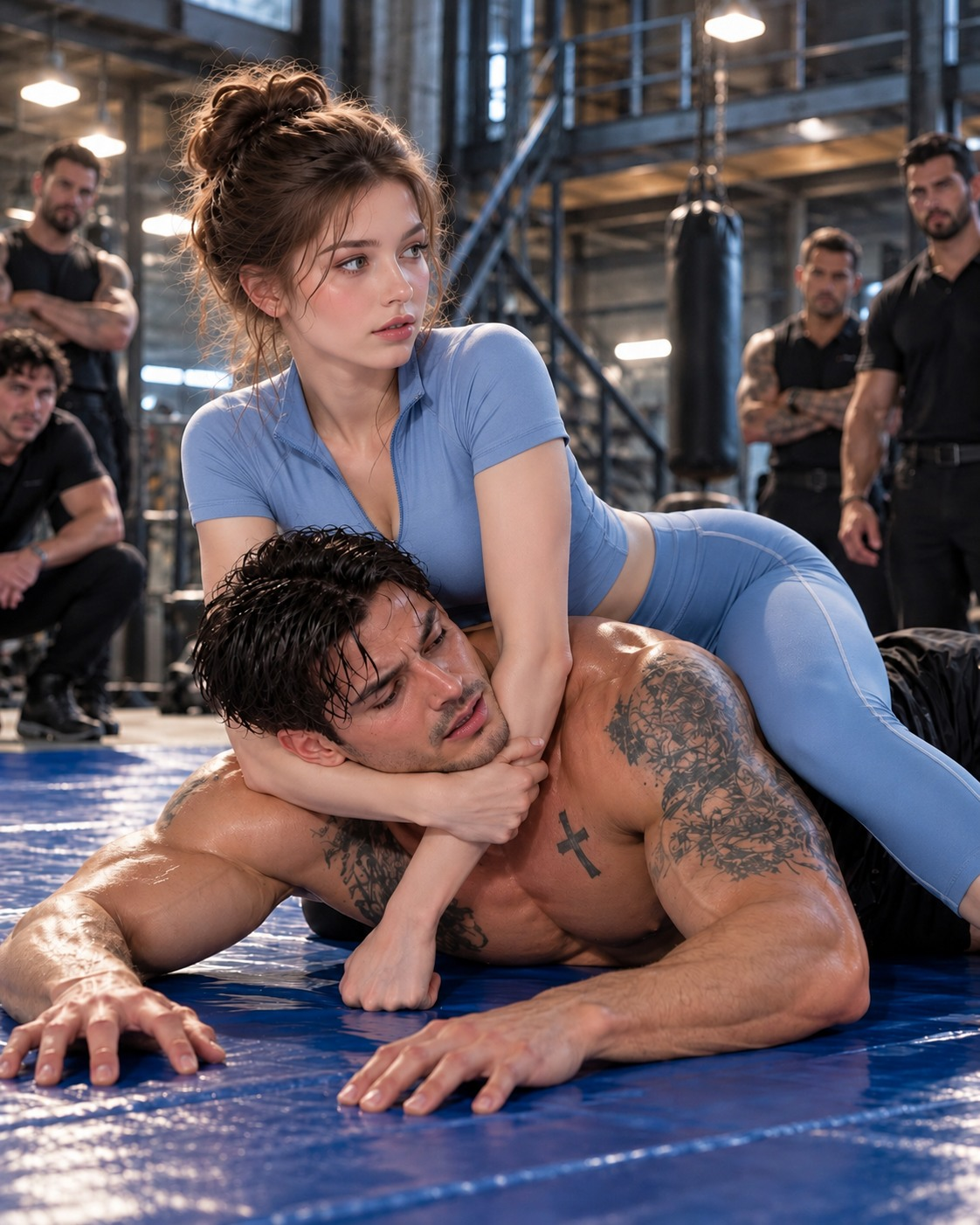
"Get your hands off me!" Mateo Moretti growled as I pressed his shoulder against the blue wrestling mat.
Chicago's most feared mafia boss had just been taken down by a woman half his size.
Beside his discarded leather shoes lay a black medical identification card that had slipped from his pocket.
On the back, beneath a faded hospital stamp, someone had written three words:
"LEFT SIDE. 2014."
I knew this wasn't an ordinary wrestling injury.
Three minutes earlier, I had been trying to convince his fourteen-year-old son that size wasn't everything.
Now I was kneeling beside a man whose name made police officers hesitate, whose business associates never interrupted him, and whose four armed guards were staring at me as though I had just committed a crime.
My name is Gia Moretti.
I was twenty-eight years old, five-foot-five, and considerably less interested in intimidating people than in teaching them how to move their bodies correctly.
That distinction had never seemed particularly important until I accepted a private coaching job inside a warehouse on Chicago's West Side.
The money was excellent.
The circumstances were strange.
And the family name was an unfortunate coincidence.
When the employment agency first called, I almost laughed.
"You're telling me a man named Moretti wants to hire a wrestling instructor named Moretti?"
"That's correct," the woman answered.
"Are we related?"
"I sincerely hope not."
She hadn't laughed.
That should have been my first warning.
But I had rent to pay, a struggling youth wrestling program to support, and a professional reputation that had taken fifteen years to build.
I wasn't in a position to turn down good money simply because the client had a dangerous last name.
Besides, the job description sounded straightforward.
A wealthy father wanted private grappling lessons for his teenage son.
No competitions.
No public appearances.
No photographs.
Absolute discretion.
I had worked with professional athletes, frightened children, recovering competitors, and executives who believed they could purchase athletic ability by the hour.
I figured I could handle one more difficult family.
Then I met the bodyguards.
"You're the wrestling coach?"
The man asking the question stood beside the warehouse entrance with his arms crossed.
He had thick forearms, a shaved head, and a black shirt stretched tightly across his chest.
A pistol rested in a holster at his waist.
I looked at him.
"Unless you've hired another Gia Moretti."
His eyes traveled from my face to my athletic shoes.
Then he laughed.
"You're kidding."
"No."
"You're about five feet tall."
"Five-five."
"That's supposed to make a difference?"
"Usually when somebody measures something, yes."
Behind him, another guard chuckled.
The first man stopped smiling.
"Name's Enzo."
"Congratulations."
His expression hardened.
I could have apologized.
I probably should have.
But I had spent too many years dealing with men who mistook politeness for weakness.
Enzo stepped aside reluctantly.
"Boss's kid is waiting."
I entered the warehouse.
Four armed guards occupied different positions around the room.
A large black punching bag hung from the ceiling.
Industrial lights illuminated a broad blue wrestling mat.
Metal stairs led to a mezzanine overlooking the training area.
And standing near the center of the mat was a teenage boy who looked as though he wanted to disappear.
He was tall for fourteen, with sandy-blond hair and a nervous habit of rubbing his palms against his shorts.
"Leo?" I asked.
He nodded.
"I'm Gia."
"I know."
"Good. That saves us both an introduction."
He almost smiled.
Almost.
Then Enzo spoke from behind me.
"Careful, kid. Don't break your little teacher."
The other guards laughed.
Leo's expression collapsed.
I pretended not to hear.
"Have you wrestled before?" I asked.
"A little."
"School team?"
"No."
"Any injuries?"
He shook his head.
"Good. Show me your stance."
He bent his knees, lowered his shoulders, and raised his hands.
Not terrible.
Not particularly good, either.
"Who taught you that?"
"Videos."
"That explains the elbows."
He looked down.
"What's wrong with them?"
"Nothing that can't be fixed."
I adjusted his arm position and stepped backward.
"Now try to take me down."
He hesitated.
"Seriously?"
"Seriously."
"But you're—"
"Smaller?"
He flushed.
I nodded toward the mat.
"That's what makes this educational."
Leo moved forward cautiously.
Then, encouraged by Enzo's laughter, he charged.
I shifted my hips, redirected his momentum, and guided him into a controlled takedown.
He landed safely on his back.
For several seconds, he simply stared at the ceiling.
Then he looked at me.
"How did you do that?"
"Physics."
"That's it?"
"Mostly. The rest is practice."
I offered my hand.
He accepted it.
This time, when he stood, he was smiling.
"Again?"
"Absolutely."
We repeated the movement.
Then again.
Each time, I explained what had happened.
Where his weight had gone.
Why his shoulders had moved ahead of his hips.
How strength became useless when applied in the wrong direction.
Leo listened carefully.
He was a good student.
More importantly, he was beginning to forget that four armed men were watching him.
Then Enzo decided to interfere.
"Those are cute tricks," he announced.
I ignored him.
"But they wouldn't work on a real man."
Leo glanced toward him.
I saw the familiar embarrassment return.
That bothered me more than the insult.
"Leo," I said, "what's the first rule we discussed?"
He thought for a moment.
"Control your balance?"
"Before that."
He frowned.
Then he remembered.
"Don't let somebody else decide what you can do."
"Exactly."
Enzo snorted.
"Sounds like something you put on a motivational poster."
I turned toward him.
"Would you like a lesson?"
The warehouse became quiet.
Enzo uncrossed his arms.
"You offering?"
"I'm working."
He took one step forward.
Then a voice came from the metal staircase.
"Enough."
One word.
That was all.
Every guard straightened.
Leo immediately lowered his eyes.
I turned.
A tall man was descending the staircase, one hand resting against the railing.
He wore an expensive dark shirt and tailored trousers.
His silver-gray hair was neatly combed back.
His expression was cold enough to make the room feel smaller.
I recognized him from newspaper photographs.
Mateo Moretti.
Forty-two years old.
Owner of legitimate businesses worth millions.
Suspected leader of a criminal organization whose influence extended across Chicago.
A man who had survived investigations, betrayals, and violent attempts against his life.
But I noticed something the newspapers never mentioned.
His left foot dragged.
Only slightly.
Almost invisibly.
Most people wouldn't have seen it.
I did.
Because watching people move was my profession.
And Mateo Moretti was moving like a man who had spent years hiding pain.
"You're the instructor?"
His voice was deep and controlled.
"Gia Moretti."
He studied me.
"Interesting name."
"Apparently."
"Any relation?"
"Not that I'm aware of."
For the first time, something resembling amusement crossed his face.
Then he looked toward Leo.
"How is he doing?"
"He's learning quickly."
"Is he strong?"
"Yes."
"Then why was he on the floor?"
"Because strength isn't the same thing as control."
Mateo looked back at me.
"And you have control?"
"I teach it."
He stepped closer.
The guards watched us carefully.
"Show me."
I gestured toward Leo.
"We've been working on—"
"Not with my son."
His eyes remained fixed on mine.
"With me."
Leo's face changed.
"Dad—"
Mateo raised one hand.
Leo fell silent.
I studied the man standing before me.
Up close, his physical limitations were even more obvious.
His shoulders were unusually rigid.
His left hip remained slightly flexed.
And when he shifted his weight, the muscles around his jaw tightened for a fraction of a second.
He was in pain.
Significant pain.
The kind that changes how someone lives.
"Are you currently injured?" I asked.
Enzo made a disapproving sound.
Mateo ignored him.
"No."
"Any restrictions?"
"No."
"Previous surgeries?"
His expression darkened.
"Are you a wrestling instructor or a doctor?"
"Wrestling instructor."
"Then wrestle."
I considered refusing.
There were plenty of reasons.
He was my client's father.
He was substantially larger than me.
He was obviously concealing a physical problem.
And judging by the expressions around us, embarrassing him could have consequences that extended far beyond losing a job.
But I also understood something about powerful men.
Sometimes the only way to make them listen was to demonstrate that their assumptions were wrong.
"Take off your shoes," I said.
Nobody moved.
Mateo stared at me.
"What?"
"Leather soles damage wrestling mats."
Enzo stepped forward.
"Lady, you don't tell him—"
Mateo raised one finger.
Enzo stopped.
Then, without another word, Mateo removed his shoes.
Leo looked astonished.
I stepped onto the mat.
"One condition."
Mateo lifted an eyebrow.
"You have conditions?"
"Everyone who trains with me does."
"Go on."
"If I tell you to stop, you stop."
He gave a humorless smile.
"You think you can make me?"
"No," I answered. "I think you're intelligent enough to understand why I might need to."
Something changed in his expression.
Not respect.
Not yet.
But curiosity.
He stepped forward.
"Fine."
The first thing Mateo did was attempt to overpower me.
It was predictable.
Men with considerable physical strength often made the same mistake.
They assumed that being able to move something meant being able to control it.
Mateo reached for my upper body.
I shifted sideways.
He adjusted.
I moved again.
He frowned.
"Stop dancing."
"Stop chasing."
Behind us, someone laughed.
It wasn't Enzo.
It was Leo.
The sound seemed to surprise everyone, including the boy himself.
Mateo's jaw tightened.
He stepped forward more aggressively.
This time, I allowed him to establish contact.
Then I redirected his forward pressure, changed my angle, and used his momentum to guide him into a controlled takedown.
He landed on the mat with a heavy thud.
The warehouse fell silent.
For a moment, Mateo looked genuinely confused.
Then anger flashed across his face.
He tried to rise.
I stabilized his shoulder and upper torso.
"Don't force it," I warned.
He attempted to twist.
His right side responded normally.
His left didn't.
Instead, his entire body tightened.
A sharp breath escaped him.
I felt it immediately.
The involuntary muscular guarding.
The sudden resistance.
The way his body anticipated pain before the movement had even happened.
I released the hold.
"Stop."
Mateo glared at me.
"What?"
"Don't move yet."
He looked ready to argue.
Then he saw my expression.
I wasn't celebrating.
I wasn't mocking him.
I was studying him.
"Your left hip," I said.
His eyes narrowed.
"What about it?"
"How long has it been restricted?"
"Get off the mat."
"How long?"
Enzo started toward us.
"That's enough."
Mateo held up his hand.
The guard stopped.
I shifted backward, giving Mateo room to sit.
He pushed himself upright carefully.
Too carefully.
He used his right arm to support most of his weight.
His left knee remained bent.
And when he attempted to straighten his back, a small tremor passed through his abdomen.
I had seen that pattern before.
Not exactly.
But close enough to concern me.
"Do you mind if I check something?" I asked.
He stared at me.
"What?"
"The muscles along your back. I won't manipulate anything."
He hesitated.
Then nodded once.
I moved behind him and placed my hands lightly against his upper back.
The muscles were rigid.
Not ordinary tension.
Not the stiffness of someone who had worked too hard.
This felt like a body that had forgotten how to stop protecting itself.
I moved my hands slightly lower, staying away from his spine.
His breathing changed.
Immediately.
I withdrew my hands.
"Does lying flat make it worse?"
Mateo turned his head.
"What did you say?"
"Your pain."
He didn't answer.
I continued carefully.
"When you're standing, you keep your left hip slightly bent. When you sit, your back relaxes a little. But when you try to straighten completely, your body braces."
His expression had become unreadable.
I knew I was entering territory that required caution.
A movement assessment couldn't establish a medical diagnosis.
But sometimes it could reveal questions nobody had thought to ask.
"Do you sleep with your knees elevated?" I asked.
Silence.
"Or do you avoid lying down altogether?"
Leo looked toward his father.
"Dad?"
Mateo didn't acknowledge him.
His eyes remained fixed on me.
I lowered my voice.
"You don't sleep in a bed, do you?"
The change was immediate.
His face lost color.
Enzo stopped moving.
The other guards exchanged glances.
Leo stared at me.
Mateo's lips parted slightly.
For the first time since entering the warehouse, he looked like a man who had encountered something he couldn't control.
"Who told you?" he asked.
"Nobody."
His voice became dangerously quiet.
"Who told you about the chair?"
Nobody spoke.
Even the humming industrial lights seemed suddenly loud.
I kept my hands visible.
"I noticed how you move."
"That's impossible."
"No. It's an observation. I could be wrong."
He stared at me for several seconds.
Then he looked toward Enzo.
"Everyone out."
Enzo hesitated.
"Boss—"
"Now."
The four guards moved toward the warehouse entrance.
One by one, they disappeared through the heavy metal doors.
Leo remained.
Mateo looked at him.
"You too."
"No."
The word surprised all three of us.
Leo's face was pale.
But he didn't move.
"Dad, if you're hurt—"
"I'm fine."
"No, you're not."
Mateo's expression changed.
Not anger this time.
Something closer to exhaustion.
I looked away to give them a moment.
Then Mateo spoke.
"Stay, Leo."
The boy swallowed.
Mateo turned back to me.
"Twelve years."
I waited.
"I haven't slept in a bed for twelve years."
His voice was almost flat.
"I sleep in a chair. Sometimes I manage three hours. Sometimes less."
Leo looked stunned.
"You told me you liked sleeping in your office."
Mateo closed his eyes briefly.
"I know."
I felt something tighten in my chest.
Not pity.
Recognition.
Chronic pain had a way of shrinking even the largest life.
And this man, who could apparently command everyone around him, had spent twelve years unable to command his own body to rest.
"Have you seen specialists?" I asked.
He gave a bitter laugh.
"Chicago. New York. Switzerland. Germany."
"What did they find?"
"Different things. Nothing that lasted."
"Do you have your records?"
"Boxes of them."
"Then you need someone qualified to review them together."
He studied me.
"You think you know what's wrong?"
"No."
The answer clearly surprised him.
"I think your left hip deserves a closer look, and I think the original injury matters. But I can't diagnose the cause from watching you wrestle."
He leaned forward.
"What original injury?"
I looked directly at him.
"The one that happened about twelve years ago."
He became completely still.
For several seconds, he said nothing.
Then he whispered, "How did you know there was an injury?"
"Because something seems to have changed the way you move. Did you fall? Were you hit? Did something happen to your left side?"
Mateo looked down at the mat.
Leo stepped closer.
"Dad?"
His father didn't answer immediately.
When he finally spoke, his voice sounded different.
Older.
More tired.
"I fell."
I waited.
"At a loading platform. Concrete. Twelve years ago."
"Did you land on your left side?"
He nodded.
"Hard."
"Were you evaluated afterward?"
"Of course."
"What did they tell you?"
"Nothing important was broken."
"And the pain?"
"It never stopped."
I glanced at the black identification card lying beside his shoes.
The faded date.
The handwritten words.
LEFT SIDE. 2014.
Something about it bothered me.
"Was that card from the hospital where they treated you?"
Mateo followed my gaze.
His expression tightened.
"Yes."
"Can I see it?"
He hesitated.
Then nodded.
I retrieved the card and examined it.
The hospital name was partially faded.
The date matched his story.
But beneath the handwritten note was another marking.
A small sequence of numbers.
And a set of initials.
I turned the card toward him.
"Do you recognize these?"
Mateo leaned closer.
His expression changed.
He reached for the card.
Then stopped.
"Where did you find that?"
"It fell from your pocket."
He took it carefully.
For a long moment, he stared at the handwriting.
Leo moved beside him.
"Dad, what is it?"
Mateo didn't answer.
Instead, he slowly turned toward the metal staircase.
His eyes narrowed.
"That handwriting," he whispered.
A faint metallic sound came from the mezzanine above us.
I looked up.
Someone was standing behind the railing.
Mateo rose too quickly, caught himself against the mat, and stared at the shadowed figure.
Then a voice came from above.
"Put the card down, Mateo."
The voice belonged to someone he recognized.
And the moment Mateo heard it, his face went white.






Comments 0