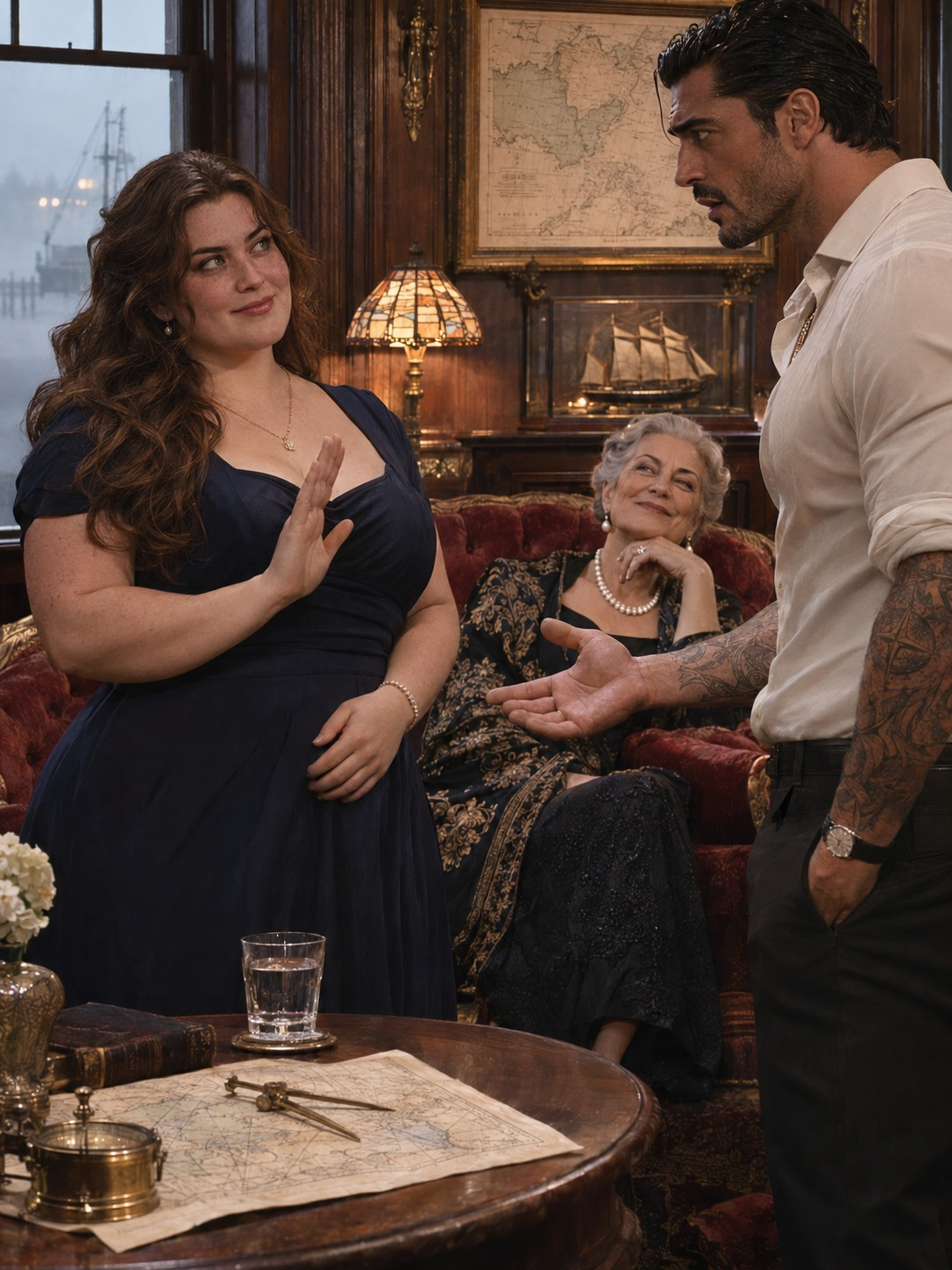
A woman dropped her champagne glass when a wealthy creditor whispered something into her ear.
"Marry me, or your father loses everything."
Cecily Marlowe calmly placed the glass on the nearest table.
Across the ballroom, mafia boss Dario Vianelli watched her walk away.
He had no idea that the woman who had just refused another man's marriage proposal would soon become the only person capable of challenging his entire world.
The music continued, but Cecily barely heard it.
She stood beside a marble column near the edge of the ballroom, her fingers resting against the cool surface. Her emerald-green evening gown fell gracefully around her full figure. A few strands of auburn hair had escaped the careful arrangement at the back of her head, and her diamond earrings caught the golden light whenever she turned.
She had spent the evening pretending everything was fine.
She had smiled at strangers, accepted compliments she didn't particularly believe, and listened politely to conversations about expensive houses, private investments, and people whose names appeared regularly in financial magazines.
But she wasn't there because she enjoyed galas.
She was there because her father had insisted that attending might help her meet someone who could introduce her to potential investors.
Their workshop needed money.
And the situation was becoming desperate.
"You're making this unnecessarily difficult, Cecily."
Blaine Rusk stood beside her.
He was fifty-one, impeccably dressed, and possessed the kind of smile that made people believe he was generous before they discovered how carefully he calculated every favor.
His dark navy suit probably cost more than several months of her father's business expenses.
A diamond pin decorated his lapel.
He held a glass of champagne in one hand and looked at her as though the conversation had already reached its conclusion.
"I've already told you my answer," Cecily replied.
Blaine leaned closer.
"Then perhaps you haven't understood what I'm offering."
"I understand perfectly."
"Two hundred eighteen thousand dollars."
She looked directly at him.
"I know how much the debt is."
"Your father's workshop is collateral. So is the house."
"I know that too."
"Then why are we having this conversation?"
Cecily took a quiet breath.
Because she had spent the past six months hearing the same threat in different words.
Her father, Arthur Marlowe, had owned a small marine instrument restoration business for nearly thirty years. He repaired antique navigational equipment, restored precision compasses, and calibrated specialized instruments used by commercial shipping companies.
His workshop wasn't particularly large.
It wasn't fashionable.
But it was respected.
Arthur had built it from almost nothing.
Four years earlier, a violent coastal storm had flooded the lower part of the building. Water damaged expensive equipment, destroyed several unfinished restoration projects, and forced him to borrow money to keep the business alive.
The original lender had been reasonable.
Blaine Rusk had not been.
After purchasing the outstanding debt, he began changing the repayment terms, adding fees, and threatening enforcement whenever Arthur requested additional time.
Cecily had examined every statement.
She knew the numbers.
She knew which charges were questionable.
And she knew that her father was too proud to admit how frightened he had become.
Blaine glanced toward the ballroom.
"Your father is a decent man. I would hate to see him lose everything at his age."
"Then stop threatening him."
His smile disappeared.
"Careful."
Cecily straightened.
"I am being careful."
"You think a woman like you can simply walk away from a man like me?"
She felt the familiar sting of his judgment.
He looked at her body before he looked at her face. His gaze traveled over her waist and hips with the same dismissive calculation he used when evaluating damaged property.
"You're thirty-one years old," he continued. "You aren't exactly surrounded by opportunities."
Cecily's fingers tightened around her clutch.
"I have a career."
"A career that doesn't pay your father's debt."
"It also doesn't require me to marry someone I despise."
Blaine's jaw shifted.
For a moment, she thought he might grab her.
Instead, he smiled again.
It was worse than the anger.
"You'll change your mind."
"No."
"Your father may not survive watching that business disappear."
Cecily stared at him.
Then she turned away.
She refused to let him see how deeply the threat had affected her.
She had learned something important during the years she spent working in industries dominated by men.
Some people mistook politeness for weakness.
Others mistook silence for agreement.
And men like Blaine Rusk believed that money gave them permission to decide what other people deserved.
Cecily walked toward the corridor.
She needed air.
She needed somewhere quiet.
Most importantly, she needed to stop herself from crying in a ballroom full of people who would probably interpret her tears as entertainment.
The private sitting room was almost empty.
Cecily had barely stepped inside when she noticed an elderly woman sitting on a red velvet sofa.
The woman was elegantly dressed in black and gold, with a pearl necklace resting against her collarbone. Her short silver hair framed a face that looked both delicate and remarkably alert.
A crystal glass stood in her hand.
She was gripping the edge of the sofa with her other hand.
Cecily immediately noticed the slight tremor in her fingers.
"Excuse me. Are you feeling all right?"
The woman lifted her chin.
"I'm perfectly capable of looking after myself."
"Of course."
Cecily glanced at the glass.
"Would you mind demonstrating that impressive ability while sitting somewhere more comfortable?"
The elderly woman stared at her.
Then she laughed.
It was a surprisingly warm laugh.
"You're rather bold."
"Only when necessary."
Cecily approached and offered her arm.
The woman accepted it after a moment.
"I'm Amelia."
"Cecily."
"Are you working at the gala?"
"No. I'm attending."
"Then you must be one of the few people here who isn't trying to sell something."
Cecily smiled faintly.
"I wouldn't be so certain."
Amelia looked at her more carefully.
"Something happened."
It wasn't a question.
Cecily hesitated.
She didn't usually discuss personal problems with strangers.
But there was something reassuring about the older woman's manner. She didn't seem interested in gossip or social advantage.
"He wants me to marry him."
Amelia's expression changed.
"Does he?"
"Yes."
"Do you love him?"
Cecily almost laughed.
"No."
"Then I hope you told him so."
"I did."
"Good."
Amelia placed her glass on the table.
"Money can make a difficult man dangerous. But it cannot turn him into a decent one."
Cecily looked at her.
The words struck closer to home than she expected.
"My father owes him money."
"Ah."
"It's complicated."
"Most things involving powerful men and money are."
Cecily sat beside her.
For several minutes, they talked about the hotel, the gala, and the antique maritime objects displayed throughout the sitting room.
Amelia seemed particularly interested when Cecily mentioned her work.
"Marine instruments?"
"Among other precision equipment. I specialize in industrial-scale calibration systems, but I grew up around my father's restoration business. He taught me how to recognize when a measurement looks correct but isn't."
Amelia smiled.
"That sounds like a useful talent."
"It is. Especially when someone insists that a machine is working perfectly and the numbers say otherwise."
"Do people listen?"
"Not always."
"Then you must have a difficult job."
Cecily laughed.
Before Amelia could respond, footsteps approached the doorway.
A tall man appeared.
He wore a charcoal-gray shirt with the sleeves rolled to his forearms. His dark trousers were perfectly tailored, and an expensive silver watch rested against his wrist.
He had short silver-black hair, a strong jaw, and an expression that seemed naturally serious.
His eyes moved immediately toward Amelia.
"Aunt Amelia?"
"I'm fine, Dario."
He stepped into the room.
"Someone told me you weren't feeling well."
"Someone worries too much."
His gaze shifted toward Cecily.
"Who is this?"
"Cecily Marlowe. She rescued me from a room full of people who apparently believe speaking loudly makes them interesting."
Dario looked at Cecily.
"Thank you for helping her."
"She only needed a little water and somewhere to sit."
"You didn't have to stay."
"I know."
Something in his expression changed.
He was accustomed to people explaining themselves.
Cecily hadn't.
Dario glanced toward Amelia.
"Are you feeling better?"
"Much."
He nodded, then looked again at Cecily.
"Have we met?"
"I don't think so."
"Then I should introduce myself."
He extended his hand.
"Dario."
Cecily accepted it briefly.
"Cecily."
She didn't ask for his surname.
She didn't recognize the expensive watch.
And she certainly didn't understand why a man standing in a private sitting room seemed to command the attention of everyone who passed the doorway.
Dario noticed her glance toward the antique wall clock.
"What is it?"
"That fitting."
He turned.
"What fitting?"
"The lower fastening beneath the clock cabinet. It's loose."
He approached the cabinet.
Cecily pointed toward a small brass attachment.
"If someone keeps opening and closing that door, the mechanism might shift. The clock could lose its calibration."
Dario looked at the fitting.
Then at her.
"You noticed that from across the room?"
"It's what I do."
"What do you do?"
"I inspect equipment. Measure things. Find mistakes people wish weren't there."
For the first time that evening, the corner of his mouth lifted.
"That sounds useful."
"It is, provided people listen."
Amelia watched them.
Her expression grew increasingly amused.
Dario Vianelli was thirty-nine years old and had spent most of his adult life surrounded by people who wanted something from him.
Men wanted contracts.
Politicians wanted support.
Business owners wanted protection.
Women wanted his attention.
And those who knew his real identity generally preferred to keep a safe distance.
His family controlled a network of legitimate businesses, shipping interests, private security operations, and criminal enterprises that stretched along California's northern coast.
Dario had inherited leadership after his father died.
He had also inherited enemies.
He rarely attended public events without knowing who was present, who had entered, and who might be watching him.
Yet Cecily Marlowe had walked into his sitting room, noticed a loose clock fitting, and treated him like an ordinary man.
He found that unexpectedly refreshing.
"Are you enjoying the gala?" he asked.
Cecily looked toward the doorway.
"Not particularly."
"Why?"
"Too many people trying to impress one another."
Dario glanced at Amelia.
His aunt lowered her eyes to hide a smile.
"An honest observation," he said.
"I try."
He studied her for another moment.
Then he extended his hand.
"Would you honor me with a dance?"
Cecily looked at his hand.
Then at his face.
"No, thank you."
Amelia nearly choked on her water.
Dario went completely still.
Cecily didn't notice the full significance of her refusal.
She simply studied his tense shoulders and the way his eyes kept drifting toward the corridor.
"You don't look as though you enjoy dancing," she added.
His gray eyes narrowed slightly.
"Is that so?"
"You keep watching the doorway. You haven't relaxed your shoulders once. And I suspect you'd rather be somewhere quiet."
She nodded toward the corridor.
"There's a Maritime Chart Room down the hall. You might prefer that."
For the first time in years, Dario Vianelli found himself without an immediate response.
He slowly lowered his hand.
"Perhaps you're right."
"I think you'll enjoy it."
Cecily turned toward Amelia.
"It was lovely meeting you."
"And you, dear."
Dario watched her walk away.
He didn't follow.
He simply stood there, staring at the empty doorway.
Amelia folded her hands in her lap.
"Well?"
He looked at her.
"What?"
"She refused you."
"I noticed."
"And then she recommended a room where you could be alone."
Dario said nothing.
Amelia's smile widened.
"I haven't seen anyone do that in years."
He looked toward the corridor again.
Then, unexpectedly, he laughed.
It was quiet and brief.
But Amelia heard it.
"Dario Vianelli," she murmured. "I may live long enough to witness a miracle."
Cecily returned to the ballroom several minutes later.
She was searching for her handbag when her phone vibrated.
A message from her father appeared.
Are you coming home soon? We need to talk about the bank.
Her stomach tightened.
She typed a quick reply.
Leaving now. I'll be home in twenty minutes.
She found her handbag beside the registration desk and headed toward the hotel entrance.
Behind her, Blaine Rusk stood near the ballroom doors.
He had been watching her.
His expression was no longer friendly.
He approached a man standing beside a decorative column and spoke quietly.
"Did you find out who she was talking to?"
The man nodded.
"An older woman and a tall gentleman."
"Name?"
"Dario."
Blaine's expression changed.
He glanced toward the private sitting room.
For the first time that evening, something resembling uncertainty crossed his face.
Dario remained in the sitting room after Cecily left.
Amelia was examining the small card attached to her handbag when she noticed his attention drifting toward the doorway again.
"You like her."
"I've known her for ten minutes."
"That wasn't my question."
He gave her a look.
Amelia ignored it.
"She has a good heart."
"She also notices loose clock fittings."
"Perhaps that's why she noticed you."
Dario looked at his aunt.
"What does that mean?"
"It means she saw a man who looked uncomfortable. Not a powerful man. Not a wealthy man. Just someone who needed somewhere quiet."
He didn't answer.
Amelia reached for her handbag.
Inside was a cream-colored invitation card bearing the hotel crest.
She turned it over and began writing something on the back.
Dario noticed.
"What are you doing?"
"Something you should have done yourself."
He glanced at the card.
Amelia carefully wrote a name.
CECILY MARLOWE.
Then she placed the card inside her handbag.
Dario's eyes narrowed.
"Why do you have her name?"
Amelia looked up.
"Because, dear nephew, I have a feeling she will need help."
Before he could respond, his phone vibrated.
A message from his head of security appeared.
We identified the man who approached Miss Marlowe in the ballroom. Blaine Rusk. He has recently acquired several distressed commercial loans along the coast. One of them belongs to Arthur Marlowe.
Dario read the message twice.
His expression hardened.
He looked toward the doorway through which Cecily had disappeared.
Then he typed a single reply.
Find out everything about the loan. Quietly.
He put his phone away.
Amelia watched him.
"Dario?"
He turned.
"What?"
She held up the cream invitation card.
"I think you should be very careful with this one."
He looked at the name written on the back.
For reasons he couldn't explain, he felt that the woman who had refused his dance had just become the most interesting person in his world.
But neither he nor Amelia knew what Cecily would discover when she reached home.
Because waiting on her father's kitchen table was a black envelope bearing Blaine Rusk's signature.
And inside it was a document that could take away everything the Marlowe family owned.
The story is structured as a 12-chapter complete series. The remaining chapters will preserve the original characters, the debt and marriage conflict, Dario's concealed identity, Amelia's involvement, and the eventual happy ending. Each chapter will follow the cliffhanger rule, with Chapter 12 resolving the entire story and ending with THE END.






Comments 0