Harper slammed the ledger shut.
"Someone has been stealing from this ranch."
Rhett Callahan stared at the financial book sitting between them on the kitchen table.
One payment carried the signature of his wife, who had been dead for two years.
But Harper had found something even more disturbing.
The final withdrawal had been sent to someone Rhett knew.
And that person was still living on the ranch.
Three weeks earlier, Harper Whitmore had stepped off a train in Harlan Creek, Kansas, carrying one battered suitcase, a wool worker's contract, and enough determination to make a roomful of strangers uncomfortable.
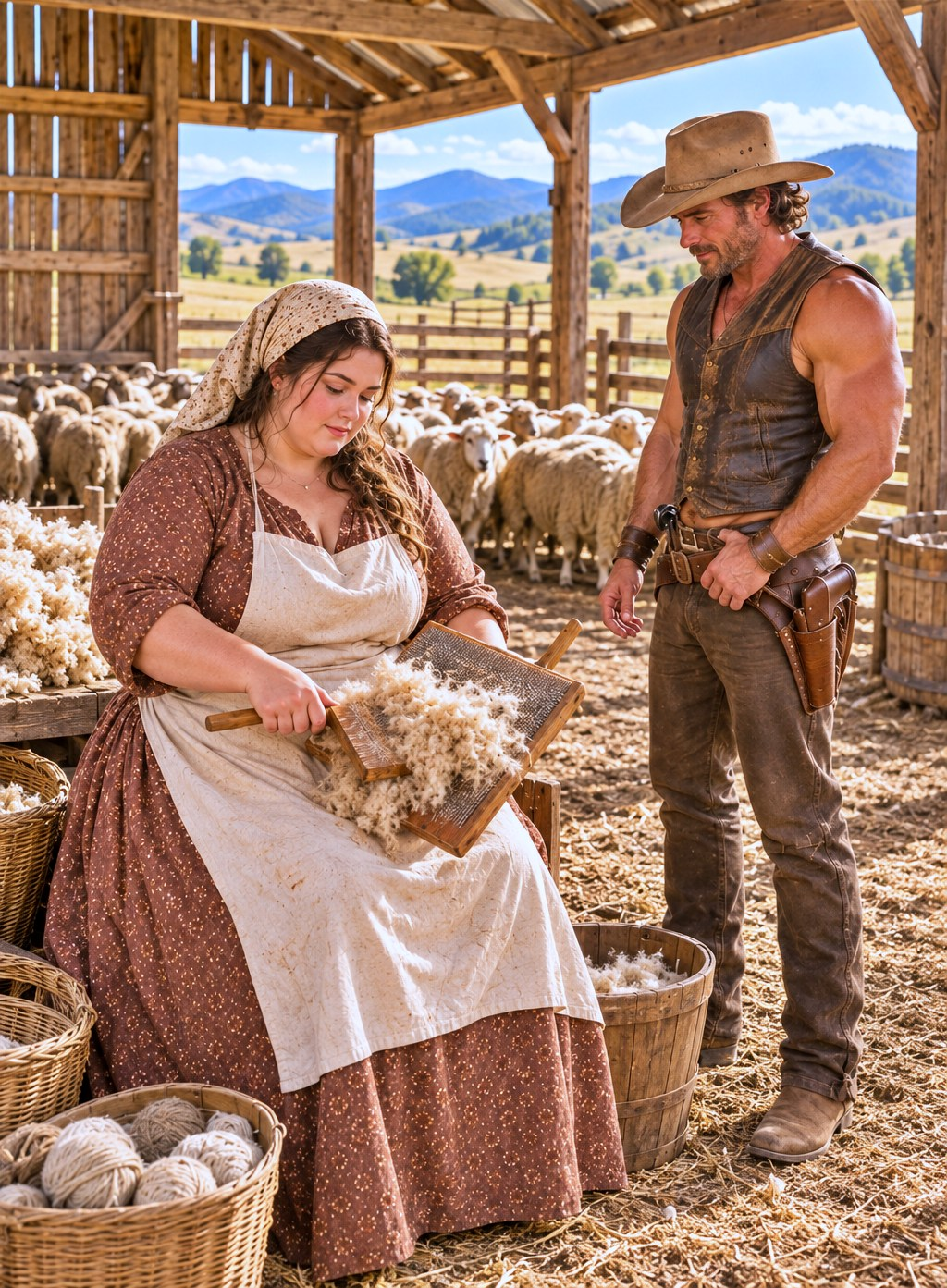
She was thirty-four years old, broad-shouldered and full-figured, with dark brown hair pinned beneath a cream-colored scarf. Her brown eyes were steady, her hands strong from fifteen years of working with wool, and her brown traveling jacket had seen more winters than she cared to count.
She had spent most of her adult life learning things that could not be taught in a classroom.
How to recognize disease before an animal showed obvious symptoms.
How to identify poor-quality fleece by touch.
How to calculate wool yield, manage shearing crews, and recognize when an entire flock was being damaged by mistakes that began long before the animals became sick.
She also knew bookkeeping.
That last skill had saved her from more than one dishonest employer.
It was not listed as prominently in her contract, but Harper considered it just as important as her ability to work with sheep.
A ranch could survive a bad season.
It could survive a broken fence, a failed shipment, or even a year of poor wool prices.
What it could not survive indefinitely was money disappearing without explanation.
Harper set her suitcase down on the dusty station platform and looked toward the small town.
Three men stood near the water tower. Two women waited outside the general store.
Their conversations slowed when they noticed her.
One woman whispered something to the other.
Harper recognized the look.
She had seen it in Denver, in agricultural offices, at supply depots, and in places where people decided what a person was worth before hearing a single sentence.
Her size often became the first thing strangers noticed.
Her experience usually became the last thing they bothered to ask about.
She reached into her jacket and removed a folded envelope.
Inside was her employment contract, signed and notarized in Denver.
The agreement was straightforward. She would receive room, board, and a monthly salary in exchange for managing the wool operation at Callahan Ranch.
The ranch owner had specifically requested someone experienced.
The agency had described the position as difficult but promising.
Harper had read between the lines.
A struggling rancher needed help.
She needed steady work.
It seemed fair enough.
A tall man approached from the far end of the platform.
He walked with the heavy, unhurried stride of someone accustomed to crossing fields rather than city sidewalks.
He wore a weathered tan cowboy hat, a dark brown leather vest, and work trousers marked with years of use. His short brown hair curled slightly beneath the hat. A rough beard covered his jaw.
His eyes were gray.
Not the friendly gray of a spring morning.
The flat gray of a winter sky.
He stopped in front of Harper.
"You're the wool worker?"
"Harper Whitmore. From Denver."
"Rhett Callahan."
He did not offer his hand.
His eyes moved briefly over her traveling clothes and settled on her face.
"The agency said you had experience."
"Fifteen years."
"Doing what?"
"Grading, shearing management, disease detection, fleece assessment, yield analysis, and wool accounting."
Rhett nodded once.
Then he hesitated.
"They didn't mention..."
Harper waited.
"They didn't mention you were quite so..."
He stopped again.
"Quite so what?" she asked.
He looked uncomfortable.
"Heavier than I expected."
Harper studied him for a moment.
She had a choice.
She could pretend not to understand what he meant, or she could make certain he understood the terms of their agreement before either of them wasted another minute.
She chose the second.
She held out the contract.
"This says you'll evaluate me on the quality of my work, Mr. Callahan. Not the quantity of me."
His jaw tightened.
"I signed that contract."
"So did I."
He took the envelope.
For several seconds, neither spoke.
Then Harper asked, "Would you like to discuss my appearance, or would you prefer to take me to the ranch so I can start earning the salary you're paying me?"
Something almost resembling amusement crossed his face.
It disappeared quickly.
"Your bag."
He picked it up and headed toward the wagon.
Harper followed.
Behind them, one of the women outside the general store spoke loudly enough to be heard.
"Lord have mercy. What is Rhett Callahan thinking bringing that woman out to his place?"
Harper kept walking.
She had not traveled across Colorado and Kansas to win the approval of strangers.
She had come to work.
The drive to Callahan Ranch took nearly an hour.
Rhett handled the reins while Harper sat beside him, watching the countryside.
She noticed things other people might have overlooked.
The grass was thin in several sections.
Some fence posts leaned dangerously.
A water trough near the road looked almost dry.
There were patches of soil where the grazing land should have been greener.
She filed each observation away.
A ranch was a living system. Everything depended on something else.
Poor pasture management affected the sheep.
Poor nutrition affected the fleece.
Poor fleece quality affected the sales.
Lower sales affected the money available for feed.
And eventually, the entire operation began collapsing.
"How long has the ranch been struggling?" she asked.
Rhett looked ahead.
"Long enough."
"One bad season?"
"More than one."
"Have you changed feed suppliers?"
"Twice."
"Pasture rotation?"
"Last spring."
"Any unusual animal losses?"
His hands shifted slightly on the reins.
"Some."
Harper turned toward him.
"That's not a very encouraging answer."
"It's the only one I have."
She decided not to push.
After a few minutes, she asked another question.
"How long since your wife passed?"
The reins tightened.
"Two years."
"I'm sorry."
"You don't need to be."
"I know. I am anyway."
He said nothing.
Harper looked toward the open fields.
The agency had mentioned his daughter.
"Maisie is eight, isn't she?"
Rhett's expression changed.
Not dramatically.
But enough.
"Yes."
"Does she live at the ranch?"
"She does."
"Will I be sharing the house with her?"
"There's a spare room. You'll have your own space."
"Good."
He glanced at her.
"She hasn't taken well to strangers since her mother died."
"I won't force her to like me."
"Most people say that."
"Then most people should learn to mean it."
For the first time, Rhett looked at her with something other than suspicion.
He did not smile.
But he stopped treating her like a problem he had been forced to collect from the train station.
The ranch appeared over the final rise.
Harper immediately understood why the agency had struggled to find someone willing to take the position.
The main barn needed repairs.
The western wall had several damaged boards.
The shearing floor was cluttered, and the fencing around the nearest paddock had begun to sag.
Twelve sheep stood in the closest enclosure.
Harper counted them without thinking.
Twelve.
Their coats were uneven, and several looked thinner than they should have.
She studied their posture and movement.
Something was wrong.
She would need to examine them more closely.
Rhett pulled the wagon beside the farmhouse.
Before he could reach for her suitcase, the front door opened.
A little girl stood on the porch.
She had dark brown hair, a pale face, and serious eyes that seemed too old for eight years.
"That's her?" the girl asked.
"That's Ms. Whitmore," Rhett replied.
"I know why she's here."
Maisie looked directly at Harper.
"Are you going to stay?"
Harper lowered herself from the wagon.
"I have a contract."
"That's not what I asked."
Harper paused.
There was something familiar in the girl's expression.
The guarded eyes.
The careful questions.
The way she seemed to be measuring every answer against something she already knew.
"I stay until the work is done," Harper said.
Maisie considered that.
Then she turned and went inside.
The door closed.
Rhett picked up Harper's suitcase.
"She's been through a lot."
"I can see that."
"She doesn't trust people."
"Then I won't give her a reason to."
He looked at Harper for a moment.
Then he carried her bag inside.
Her room was small but clean.
It was located at the back of the farmhouse, with a window overlooking the eastern pasture.
There was a narrow bed, a wooden dresser, a washbasin, and a small chair beside the window.
Harper unpacked her clothes and placed her working tools in a neat row.
She had learned that a person did not need much to begin again.
A clean bed.
A place to work.
A chance to be useful.
That evening, she ate dinner with Rhett and Maisie.
Rhett had prepared eggs, potatoes, and bread.
He was not a particularly gifted cook, but he placed the food on the table without complaint.
Maisie read a book while eating.
Harper noticed that the girl barely looked at her father.
She also noticed that Rhett kept glancing toward his daughter whenever he thought nobody was watching.
Grief had settled into the farmhouse like another member of the household.
Nobody spoke about it.
But everyone made room for it.
"Do you read?" Maisie suddenly asked.
Harper looked up.
"I do."
"What?"
"Agricultural manuals. History books. Sometimes poetry."
Maisie frowned.
"Poetry?"
"Is that surprising?"
"You work with sheep."
Harper smiled faintly.
"Sheep don't care what I read."
Maisie looked down at her book.
The corner of her mouth moved.
It was not quite a smile.
But Harper considered it a beginning.
The following morning, Harper woke before sunrise.
She pulled on her working dress, tied her apron, secured her hair beneath her scarf, and walked toward the paddock.
The sheep were quiet.
She approached slowly, allowing them to become accustomed to her presence.
She examined their fleece, checked their hooves, studied their eyes, and observed how they moved.
Within an hour, she had identified three animals showing early signs of foot rot.
Another problem appeared when she examined the flock's general condition.
Several animals showed signs consistent with nutritional deficiency.
Harper stood and brushed the dirt from her hands.
The problems were manageable.
But they had not appeared overnight.
Someone had allowed them to develop.
Rhett found her near the fence at half past six.
"You're already working."
"Three sheep have early-stage foot rot."
His expression changed.
"How serious?"
"Manageable if treated now. Another two weeks, and you could lose them."
She walked toward the next animal.
"Your flock also needs a nutritional assessment. Their fleece quality is suffering, and their general condition isn't where it should be."
Rhett stared at the sheep.
"How do you know the wool quality has been falling?"
"Because the animals are telling me."
Harper turned toward him.
"But I'd like to see your financial records."
His face became still.
"Why?"
"Because when a ranch looks like this and the animals are in this condition, I want to understand the whole operation."
She paused.
"Sometimes the problem is management. Sometimes it's money."
Rhett looked toward the farmhouse.
Then back at her.
"After breakfast."
Harper nodded.
Breakfast was quiet.
Maisie sat with her book.
Rhett poured coffee.
Harper ate everything on her plate and complimented the coffee.
He seemed surprised.
After the meal, Rhett disappeared into his office.
When he returned, he carried a large leather-bound ledger.
It was heavy, worn at the corners, and filled with years of handwritten transactions.
He placed it on the kitchen table.
"These are the ranch accounts," he said. "Wool sales, feed purchases, repairs, supplier payments. Everything."
Harper pulled out a chair.
"How many years?"
"Five."
"Good. I'll need to compare the recent transactions with the earlier records."
Rhett sat opposite her.
His hands wrapped around his coffee cup.
Harper opened the book.
She started with the previous year.
At first, the entries appeared ordinary.
Feed purchases.
Equipment repairs.
Payments to seasonal workers.
Wool shipments.
Then she noticed something strange.
A supplier had been paid twice for the same delivery.
She turned back several pages.
The same supplier appeared again.
Another payment.
Another amount.
She wrote down the dates.
Then she noticed a series of withdrawals that did not appear to correspond with any ranch expenses.
The amounts were small enough to escape immediate attention.
But they appeared regularly.
Harper added them together.
Her pencil stopped.
She checked the calculation again.
Thousands of dollars.
She turned another page.
Then another.
A familiar name appeared in the authorization column.
She stared at it.
The signature was old-fashioned, slightly slanted, and unmistakably repeated.
It belonged to someone who should never have been signing anything again.
Harper slowly lifted her eyes toward Rhett.
"Mr. Callahan..."
He looked up.
"What?"
She turned the ledger around.
"Who authorized these payments?"
Rhett leaned forward.
His coffee cup remained untouched.
When he saw the signature, the color seemed to drain from his face.
And before Harper could ask another question, someone knocked three times on the kitchen door.
It was a knock Rhett recognized immediately.
Comments 0