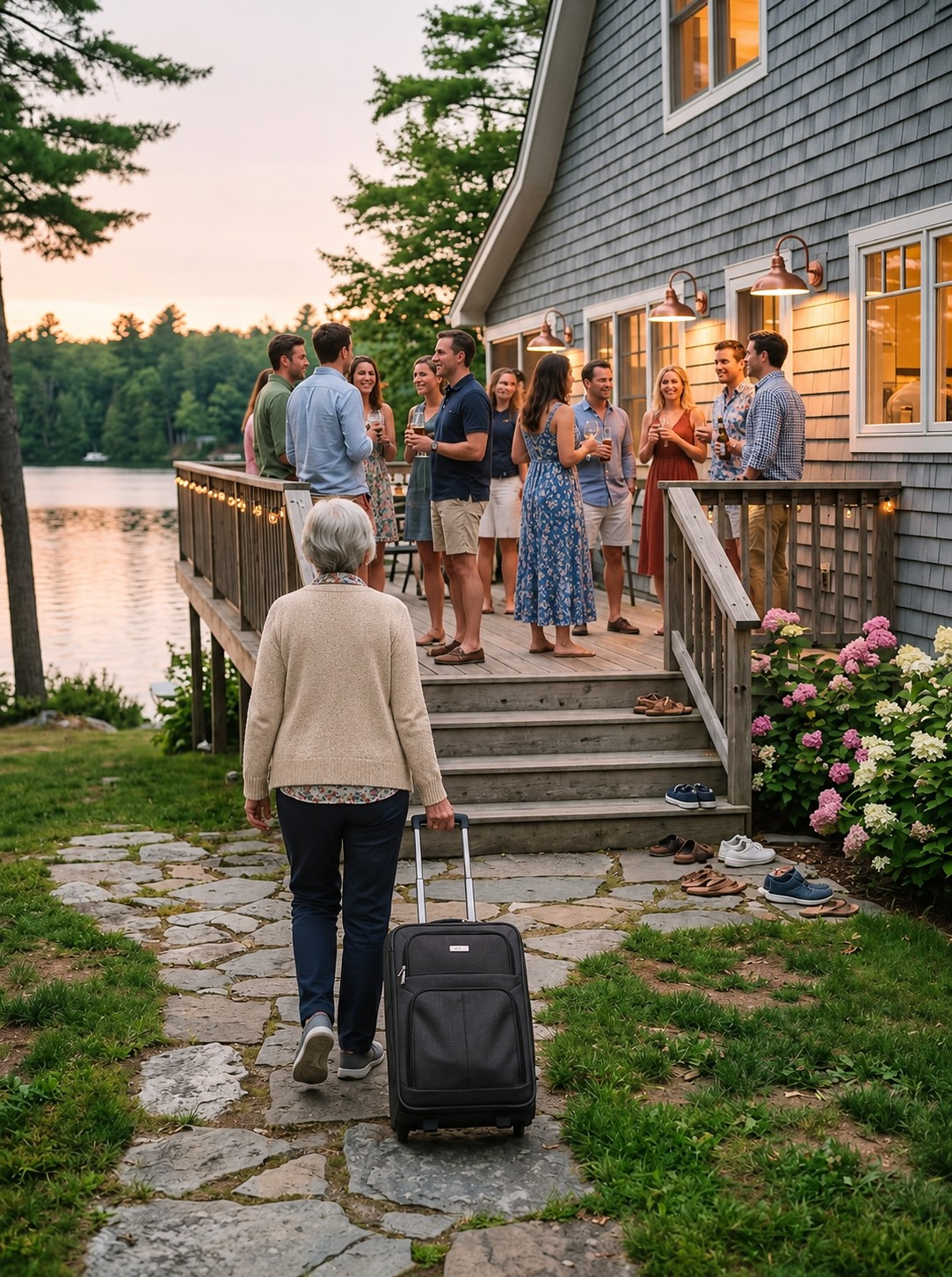
"Why is she here? There's no room for her!" Megan shouted from my deck.
I stopped beside my suitcase as my daughter-in-law raised her glass and laughed.
Then I noticed the small brass key hanging from her wrist.
A faded blue ribbon was tied around it.
My husband had tied that ribbon himself.
And Megan had no idea what that key opened.
I was seventy years old when I learned that being unwanted in your own home could hurt more than being alone in it.
It happened on a Friday afternoon, just before sunset, when I drove up to the lake house I had bought with forty years of hard work.
I had been looking forward to that weekend for nearly a month.
Nothing extravagant. Nothing anyone else would have considered exciting.
I wanted to sit on my porch with a cup of tea, watch the lake turn silver in the evening light, and listen to the wind move through the pine trees.
At my age, peace was no longer something I took for granted.
It was something I protected.
My name is Eleanor Whitmore.
For most of my adult life, I worked as a seamstress.
I hemmed dresses, altered wedding gowns, repaired winter coats, and rescued expensive suits from people who had waited until the last possible moment to remember they needed them.
I raised my son, Robert, while my husband, Thomas, worked long hours as a mechanic.
We never had much money.
But we had enough to keep the lights on, food on the table, and our boy in decent shoes.
Then Thomas died.
And the world I had spent thirty-eight years building suddenly became a place I barely recognized.
For a long time afterward, I couldn't sleep without the television playing quietly in the background.
The silence was too much.
I would wake in the middle of the night and reach across the mattress, forgetting for one terrible second that nobody was there.
People told me time would make things easier.
They were partly right.
Time didn't make me miss him less.
It simply taught me how to carry the missing.
A few years after his death, I bought the lake house.
It was the first property I had ever purchased entirely on my own.
No mortgage.
No borrowed money.
No one else's name on the deed.
Just mine.
I remember sitting across from the closing attorney, holding the pen so tightly my fingers ached.
When he slid the papers toward me, I cried.
Not because I was sad.
Because for the first time in my life, I owned something that nobody could take away simply because they had decided they deserved it more.
Or so I believed.
That Friday, I had packed my favorite chipped blue mug, a paperback novel, a small tin of Earl Grey tea, and the quilt I had sewn from scraps of fabric left over from forty years of wedding dresses.
I stopped at a roadside market and bought fresh peaches.
I even picked up a little bunch of yellow daisies.
Thomas used to bring me daisies when we were young.
He always said roses were too serious for a woman who laughed as much as I did.
I don't laugh as easily anymore.
But I still buy the flowers.
The drive took a little over two hours.
As I turned onto the narrow road leading toward the lake, I felt the familiar sense of relief settle over me.
The trees grew taller.
The houses grew farther apart.
The air changed.
Then I rounded the final bend.
And saw the cars.
At first, I thought someone was having a party at a neighboring property.
There were at least six vehicles crowded along my driveway.
A silver SUV was parked partly on the grass.
A red sedan had its rear tires dangerously close to my hydrangeas.
Someone had pulled a large black pickup truck onto the sandy patch beside the garden.
My garden.
The one I had spent three springs bringing back to life after a late frost nearly destroyed everything.
I slowed my car.
For a moment, I wondered whether there had been an emergency.
Perhaps Robert had come to check on the house.
Perhaps something had happened.
Then I heard the music.
It was loud enough to reach me through my closed car windows.
Bass thumped across the lawn.
People were shouting over one another.
A child ran between two parked cars carrying a bright orange plastic water gun.
Another child chased him, laughing.
Neither looked familiar.
I parked as close to the stone pathway as I could.
For several seconds, I simply sat there with my hands resting on the steering wheel.
I remember looking at the yellow daisies on the passenger seat.
One flower had fallen loose from the paper wrapping.
Its stem lay across my purse.
Such a small thing.
And yet I remember it more clearly than almost anything else about that afternoon.
Because I was still trying to believe there was an innocent explanation.
I switched off the engine.
Opened the door.
And stepped out.
The smell hit me first.
Charcoal smoke.
Grilled meat.
Sunscreen.
And something unpleasant drifting from the direction of my kitchen.
Something burning.
I opened the trunk and took out my navy suitcase.
Then I began walking toward the house.
My stone pathway was littered with muddy footprints.
A crushed paper cup lay beside the lavender bushes.
Someone had dropped a hamburger bun near the front steps.
The string lights along the deck railing were already switched on, although the sun had not yet set.
And there, standing in the middle of my deck as though she were hosting a party at a resort, was Megan.
My daughter-in-law.
She was wearing an emerald-green blouse, cream-colored pants, and a white apron with tiny embroidered flowers.
My apron.
The one Thomas had bought me at a little country store during our last vacation together.
She held a glass in one hand.
Her platinum-blonde hair moved slightly in the breeze.
When she saw me, she didn't look surprised.
She looked annoyed.
That was my first warning.
Not embarrassment.
Not confusion.
Annoyance.
As though I had arrived somewhere I wasn't supposed to be.
Then she turned toward the people gathered around her.
"Why is she here?" she called out. "There's no room for her!"
A few people laughed.
I stopped walking.
For one strange second, I thought she must be talking about somebody else.
Then Megan looked directly at me.
"Seriously, Eleanor. You should've called."
I stared at her.
I had known Megan for nearly seven years.
She and Robert had been married for five.
Our relationship had never been particularly warm, but I had tried.
I remembered birthdays.
I sent flowers when she received a promotion.
I invited them to dinner.
When she complained that my house was too far away for regular visits, I stopped asking so often.
When she said my cooking was old-fashioned, I learned new recipes.
When she told Robert that I made her uncomfortable by asking too many questions, I learned to ask fewer.
I had spent years making myself smaller around that woman.
And now she was standing in my home, wearing my apron, telling me I should have called before arriving.
"Megan," I said, "what's going on?"
She took a sip of her drink.
"We're having a family weekend."
I looked around.
Her mother, Diane, was stretched out in my favorite outdoor chair.
Her sister, Vanessa, had her feet propped on a chair beside the dining table.
Several people I had never met stood near the railing, laughing and holding drinks.
A teenage boy was leaning against the post where Thomas had once hung a bird feeder.
Two younger children were running through the flower beds.
Someone had placed a cooler directly against the hydrangeas.
I recognized a few faces from Megan's side of the family.
Others were complete strangers.
"Family weekend?" I repeated.
Megan gave a little sigh.
The kind of sigh people use when they want an audience to know how unreasonable someone else is being.
"Yes, Eleanor. Family weekend."
I looked past her toward the open door.
Through the window, I could see bags piled near the sofa.
A beach towel hung over the back of my grandmother's rocking chair.
Someone had moved the small side table that held Thomas's seashell lamp.
I felt something tighten in my chest.
"Where's Robert?"
"At work."
"Does he know all these people are here?"
Megan rolled her eyes.
"Of course he knows."
I waited.
She lifted her chin.
"He said we could use the house."
The words seemed to hang between us.
I looked at the deck.
The cars.
The strangers.
Then back at my daughter-in-law.
"Robert doesn't own this house."
The music continued playing.
A man near the grill laughed at something another guest said.
Megan's expression hardened.
"Oh, please. He's your son."
"Yes," I said. "He is."
"So what's the problem?"
I could hardly believe the question.
"The problem," I answered carefully, "is that nobody asked me."
Megan laughed.
Not because anything was funny.
Because she wanted the people around her to laugh too.
And several of them did.
"You're hardly ever here," she said.
I glanced toward the lake.
That wasn't true.
I came whenever I could.
Sometimes twice a month.
Sometimes more.
But even if I visited only once a year, what difference would it make?
It was my home.
I had paid for it.
I maintained it.
I paid the taxes, the insurance, the utilities, and the man who came every spring to check the roof.
I was not a guest.
Yet everyone on that deck was looking at me as though I were causing a scene.
"I came to spend the weekend," I said.
Megan spread her arms.
"Well, as you can see, we're already here."
I waited for her to offer a solution.
Perhaps she would say they could make room.
Perhaps she would apologize for the misunderstanding.
Perhaps she would ask whether I wanted something to drink.
Instead, she said, "Every bedroom is taken."
I looked at her.
"Every bedroom?"
"Yes."
"There are four bedrooms."
"And we have a lot of people."
My fingers tightened around the suitcase handle.
The metal felt cold against my palm.
"Megan, I don't need a guest room. I have my own bedroom."
She gave me a thin smile.
"Vanessa and her husband are using that one."
For the first time, I felt genuine anger.
Not because someone had slept in my bed.
Because Megan had given away my bedroom as though it belonged to her.
The room where I kept Thomas's photograph.
The room where his old watch still sat inside the top drawer.
The room where I sometimes slept with the windows open because the sound of the lake reminded me of the vacations we had taken when Robert was little.
"You put someone in my room?"
Megan shrugged.
"They needed the bigger bed."
Behind her, Vanessa glanced up.
She looked briefly uncomfortable.
Then Megan continued.
"Honestly, Eleanor, you're making this awkward."
I almost laughed.
I was making it awkward.
Not the strangers occupying my home.
Not the cars crushing my lawn.
Not the people drinking on my deck.
Me.
A teenage boy standing nearby muttered, "Why doesn't she just get a hotel?"
Someone chuckled.
Megan didn't correct him.
She smiled.
And something inside me changed.
It wasn't dramatic.
There was no sudden rush of courage.
No trembling speech.
No grand declaration.
It was quieter than that.
I remembered a winter many years earlier, when Robert was nine.
Thomas had been injured at work.
We had almost no savings.
I spent six weeks sewing until my hands cramped so badly I could barely hold a needle.
One evening, a customer complained that I had taken too long to finish her daughter's dress.
I apologized.
Then I stayed up until three in the morning making sure every stitch was perfect.
The next day, I delivered the dress.
Collected my payment.
And bought groceries.
I had survived that winter.
I had survived losing Thomas.
I had survived years of loneliness.
And now a woman who had never paid a dollar toward my lake house was trying to embarrass me into leaving it.
I looked at Megan.
Really looked at her.
She stood above me on the deck, surrounded by people who seemed eager to agree with her.
She was confident.
Comfortable.
Certain.
She thought she knew exactly how I would respond.
She expected me to cry.
Or plead.
Or call Robert and beg him to explain.
She expected me to make a scene that she could later describe as another example of her difficult mother-in-law.
I realized that any argument I started would become a story she could control.
So I stopped arguing.
I let go of the suitcase handle.
Straightened my cardigan.
And smiled.
Just a little.
"I understand," I said.
Megan blinked.
Then her expression brightened.
"Good."
I nodded.
"Enjoy your weekend."
She gave a satisfied little laugh.
"Thanks."
I turned toward the driveway.
Behind me, the conversation resumed almost immediately.
Someone asked whether there was more ice.
A child shouted.
The music grew louder.
I walked slowly along the stone pathway, pulling my suitcase behind me.
I didn't hurry.
I didn't look back.
But as I passed the hydrangeas, I noticed something that made me stop.
One of the pale blue flowerpots had been knocked over.
Its soil had spilled onto the stones.
A small white ceramic bird lay broken beside it.
Thomas had bought that bird at a flea market.
He'd insisted it looked exactly like the one that used to sit outside his mother's kitchen window.
I had kept it for more than twenty years.
Now one wing was missing.
I bent down.
Picked up the broken bird.
And held it in my palm.
For a moment, the years seemed to fold together.
I could hear Thomas laughing.
Could see him standing in the sunshine with that ridiculous little bird in his hand.
"Every respectable house needs a guardian," he'd told me.
I swallowed.
Then I carefully placed the broken piece inside my cardigan pocket.
I continued toward the car.
At the edge of the driveway, I glanced toward the deck one final time.
Megan had turned away from me.
She was laughing with her sister.
And the brass key with the faded blue ribbon still hung from her wrist.
I recognized it immediately.
It was the spare key Thomas had once used for the old cedar storage cabinet.
After he died, I had moved the cabinet into the little utility room beside the kitchen.
I kept important papers there.
Old photographs.
Insurance documents.
Receipts.
And a small metal box containing the records from the purchase of the house.
I had never told Megan about that cabinet.
I wondered how she had found the key.
Then I remembered something Robert had said several months earlier.
He had called to ask whether I still kept important documents at the lake house.
At the time, I thought he was simply being thoughtful.
He said he worried about fire.
About flooding.
About whether I had everything organized in case something happened to me.
I told him I did.
And that my attorney had copies of anything important.
He had sounded disappointed.
Only slightly.
I hadn't thought much of it.
Now, standing beside my car, I remembered the exact tone of his voice.
I opened the trunk and placed my suitcase inside.
Then I sat behind the wheel.
For several minutes, I did nothing.
I looked at the house.
At the people on the deck.
At the woman wearing my apron.
My son had told her she could use the property.
Perhaps he believed he had the right.
Perhaps he had simply been careless.
Or perhaps there was something else going on.
I didn't know.
And I wasn't going to make accusations until I did.
But I knew one thing with absolute certainty.
The house belonged to me.
And nobody had my permission to turn it into a private resort.
I took out my phone.
Scrolled through my contacts.
And found the number I wanted.
Arthur Bennett.
My attorney.
Arthur had handled the purchase of the lake house.
He had also helped me update my will after Thomas died.
He was a patient man with a quiet voice and a habit of explaining complicated matters in plain English.
We hadn't spoken in several months.
I pressed Call.
He answered on the fourth ring.
"Eleanor?"
"Hello, Arthur."
"Well, this is a surprise. Everything all right?"
I looked toward the deck.
Megan was raising her glass in a toast.
"No," I said. "Not exactly."
His voice changed.
"What's happened?"
I explained.
I told him about the cars.
The guests.
The bedrooms.
The conversation with Megan.
I told him that Robert had apparently given permission without asking me.
Arthur listened without interrupting.
When I finished, there was a brief silence.
Then he asked, "Are you somewhere safe?"
"Yes. I'm in my car."
"Good."
I waited.
"Eleanor, I need you to answer something carefully."
"All right."
"Have you signed anything concerning that property in the last year?"
I frowned.
"No."
"Nothing authorizing Robert to manage it?"
"No."
"Nothing giving anyone permission to rent it, transfer it, or use it for business purposes?"
"Absolutely not."
Another silence.
Then Arthur asked a question that made my stomach tighten.
"Has Robert recently asked you about the deed?"
I stared through the windshield.
"Yes."
"When?"
"A few months ago."
"What did he say?"
I told him.
About the documents.
The cabinet.
The concern over whether my papers were organized.
Arthur exhaled slowly.
"Eleanor, I don't want to alarm you."
"Then don't," I said.
He paused.
And despite everything, I heard a faint smile in his voice.
"Fair enough."
Then he became serious again.
"I need to review something before I advise you further."
"What something?"
"A document that came across my desk earlier this week."
My grip tightened around the phone.
"What document?"
"I haven't confirmed its authenticity yet. That's why I didn't contact you immediately."
I looked back at the house.
Megan was still laughing.
Arthur continued.
"Can you come to my office?"
"Today?"
"Yes."
"It's Friday afternoon."
"I know."
"Arthur, what is going on?"
He didn't answer immediately.
When he finally spoke, his voice was lower.
"Just come in. And Eleanor?"
"Yes?"
"Don't confront Robert or Megan about the property documents until we've spoken."
A cold sensation moved through me.
"Why?"
"Because I need to establish exactly what they believe they have."
I sat very still.
For the first time that afternoon, I felt something other than humiliation.
Fear.
Not of Megan.
Not of the strangers.
But of the possibility that my own son had done something I couldn't yet understand.
I started the car.
As I pulled away, I glanced into the rearview mirror.
The lake house grew smaller behind me.
The deck lights glowed.
People continued laughing.
Megan stood near the railing, holding her glass like a woman who had just won a contest.
She didn't know I had called Arthur.
She didn't know he had already seen a document.
And she certainly didn't know what I was about to discover.
Twenty minutes later, as I drove toward town, my phone rang.
Arthur again.
I answered through the car's hands-free system.
"Eleanor," he said, "I've located the paperwork."
I slowed down.
"All right."
His next words came carefully.
"There's a signature on it."
My heart began to pound.
"Whose?"
He hesitated.
Then said, "It's supposed to be yours."
I pulled into the nearest parking lot.
Because I had not signed anything.
Not for Robert.
Not for Megan.
Not for anyone.
Arthur's voice returned.
"And there's something else. The document lists a second person as an authorized party."
I gripped the steering wheel.
"Who?"
Arthur took a breath.
Then he said the name.
And I realized the strangers on my deck might be the smallest part of my problem.






Comments 0