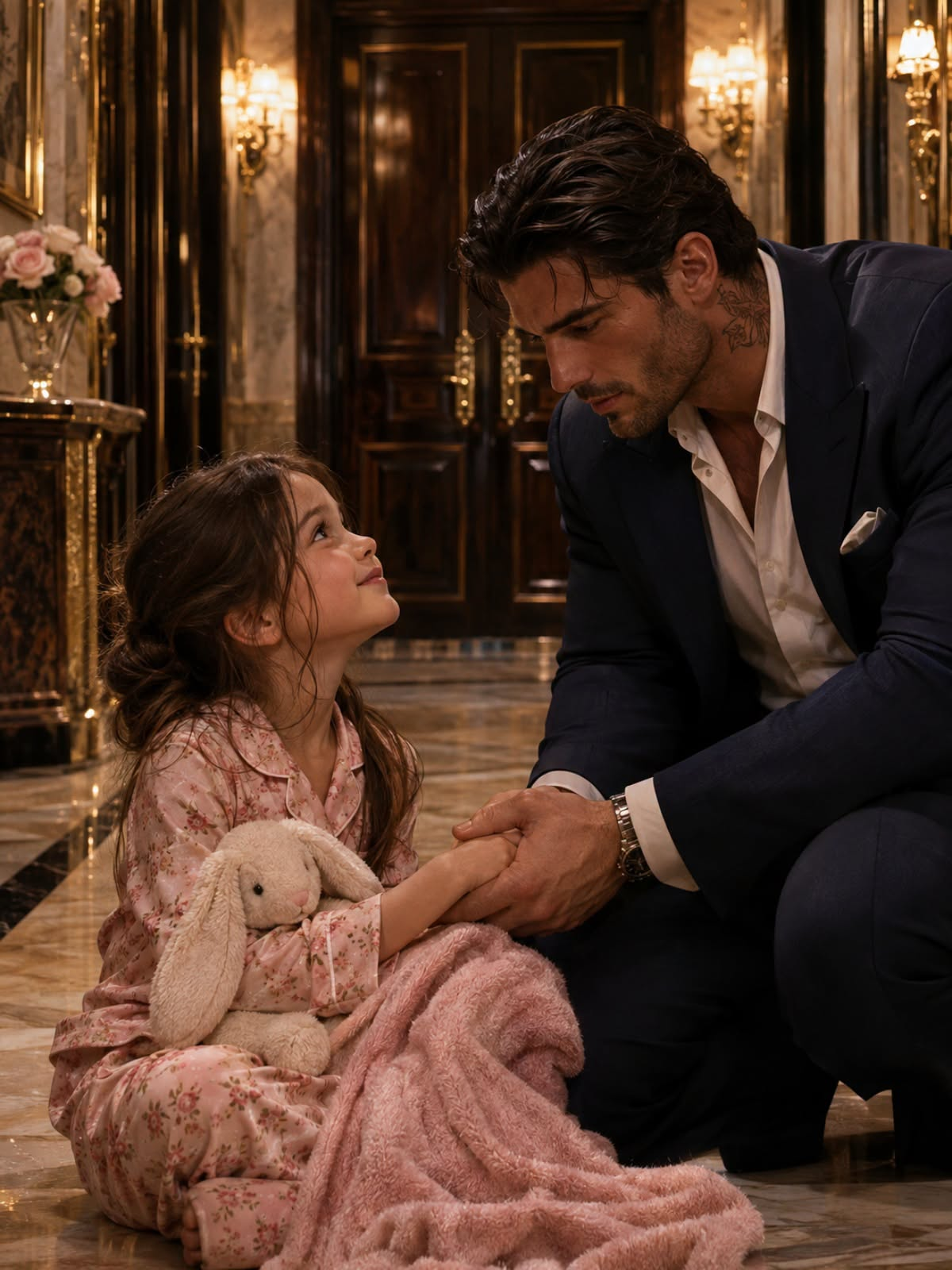
A little boy dropped his glass and began gasping for air.
"Leo, breathe!" Lorenzo Moretti shouted.
Then a waitress stepped between Chicago's most feared businessman and his terrified son.
She had no idea what she was about to awaken.
The crystal glass shattered against the marble floor.
Water splashed across Lorenzo Moretti's polished Italian shoes, and every conversation in the restaurant stopped.
But nobody looked at the broken glass for long.
They were watching the little boy.
Leo Moretti was six years old. His small hands were wrapped around a red toy car, and his eyes were wide with terror. His chest rose and fell too quickly. His lips trembled as he tried desperately to make a sound.
Nothing came out.
His father reached for his shoulders.
"Leonardo! Look at me!"
The boy recoiled.
"Leo, I said look at me!"
That was when I dropped my tray.
I had been working at Le Bernadin for almost eight months. In that time, I had learned three important things.
First, wealthy customers rarely remembered the names of the people serving them.
Second, the restaurant manager, Monsieur Sterling, believed that a waitress should be seen only when something needed to be delivered.
And third, Lorenzo Moretti was a man nobody wanted to disappoint.
He was thirty-two, handsome in a way that made people uncomfortable, and powerful enough that even the restaurant's owner personally checked his reservations.
People whispered about his family.
Some said his money came from legitimate investments. Others claimed that his influence reached places where ordinary businessmen would never dare to go.
I didn't know which stories were true.
I only knew that when Sterling had assigned me to his table that evening, he had looked me directly in the eyes.
"Don't stare at him. Don't ask unnecessary questions. And whatever happens, don't create a scene."
Unfortunately, the scene had already started.
I watched Leo's fingers tighten around his toy car.
His father was trying to help him, but every command seemed to make the boy more frightened.
I recognized that expression.
I had seen it during my university clinical placements at Northwestern.
It wasn't ordinary shyness.
It was fear that had become so overwhelming that communication itself felt impossible.
I had studied speech pathology for three years, specializing in childhood trauma and selective mutism. I had spent countless hours observing children who struggled to express themselves.
Some communicated through gestures.
Some used pictures.
Others needed patience, rhythm, and a safe environment before they could even attempt a sound.
I had once believed that knowledge would lead me into a career helping those children.
Then my mother died, the medical bills arrived, and my life changed.
Now I was serving expensive dinners to people who wouldn't have recognized my degree if I had printed it on my apron.
But Leo needed help.
And I couldn't stand there pretending I hadn't noticed.
I abandoned my tray and hurried toward the booth.
"Let him go."
Lorenzo turned his head.
For one terrible second, I thought he might have me escorted out of the building.
"What did you say?"
"Take your hands off his shoulders. You're frightening him."
The restaurant manager appeared behind me.
"Miss Jenkins!" Sterling hissed. "Step away from the table immediately."
I ignored him.
Lorenzo's eyes narrowed.
"Do you know who you're speaking to?"
"Right now, I'm speaking to a father whose son can't breathe properly."
His jaw tightened.
I knew I had crossed a line.
But I also knew that a frightened child didn't need another adult demanding that he behave.
He needed someone who wasn't going to make him feel trapped.
Lorenzo slowly removed his hands.
I lowered myself onto my knees beside Leo.
A small piece of broken glass pressed into the fabric of my trousers, but I barely noticed.
"Hi, Leo."
He didn't look at me.
I didn't touch him.
Instead, I placed my fingertips against the edge of the wooden table and began tapping.
One.
Two.
Three.
Four.
Then I repeated the pattern.
The boy's eyes moved toward my hand.
Good.
I kept my voice low.
"That's water, sweetheart. Just water."
His breathing was still uneven.
I continued tapping.
One.
Two.
Three.
Four.
Then I hummed a gentle note.
It was a simple sound, nothing extraordinary. I wasn't trying to force words out of him. I was offering him a rhythm he could follow.
For several seconds, nothing happened.
Lorenzo stood behind us.
I could feel his attention on every movement.
"What are you doing to my son?" he demanded.
"Please be quiet."
The words escaped before I could reconsider them.
Sterling looked ready to faint.
Nobody spoke to Lorenzo Moretti like that.
But Leo's eyes had finally settled on my face.
I hummed again.
He swallowed.
A tiny sound escaped his throat.
It was barely audible.
A trembling imitation of my note.
I smiled.
"That's wonderful, Leo."
He looked confused.
I pointed toward the overturned glass.
"Wet."
I sang the word gently, allowing the sound to rise and fall with the rhythm of my tapping.
Then I waited.
I didn't repeat it immediately.
I gave him time.
His small fingers loosened around the toy car.
His lips moved.
"W-wet."
Everything stopped.
My fingers froze against the table.
Behind me, I heard Lorenzo take a sharp breath.
I turned slightly.
His expression had changed completely.
The powerful businessman who had frightened an entire restaurant into silence was staring at his son as though the world had suddenly shifted beneath his feet.
"What?" he whispered.
Leo looked at the spilled water.
"Wet."
Lorenzo moved closer.
"Leo?"
The boy turned toward him.
For the first time in two years, he had responded with a recognizable spoken word.
Lorenzo's eyes became glassy.
He lowered himself beside the booth, but he didn't touch his son this time.
He simply watched.
I knew that moment was bigger than anything I could explain.
I also knew better than to assume one word meant that Leo's difficulties were over.
Trauma wasn't something that disappeared because a child managed to speak once.
But something had changed.
And the little boy knew it.
I picked up his red toy car.
"Is your car wet?"
Leo examined it carefully.
Then he shook his head.
"No."
I smiled.
"That's right."
I glanced toward Lorenzo's shoes.
"Is Daddy wet?"
For a moment, Leo said nothing.
Then the corners of his mouth lifted.
"Yes."
A tiny smile.
A single word.
But Lorenzo looked as if someone had handed him back the most precious thing he had ever lost.
He reached toward his son, stopped halfway, and waited.
Leo moved closer on his own.
His father gently took his little hand.
I looked away, suddenly aware that my own eyes were burning.
For two years, Lorenzo had paid specialists, traveled internationally, purchased expensive treatments, and consulted doctors whose names appeared in medical journals.
And here he was, kneeling on the floor of a restaurant, holding his son's hand because a waitress had helped him say two simple words.
I slowly stood.
That was when the pain in my knees caught up with me.
A small red stain had appeared on the fabric of my trousers. A fragment of glass had scratched my skin.
I pressed my hand against the injured area.
Lorenzo noticed immediately.
"You're bleeding."
"It's nothing, sir."
He looked toward Sterling.
"First-aid kit. Now."
"Of course, Mr. Moretti."
"And bring a bottle of the 1982 Château Margaux."
Sterling hurried away.
I looked at the floor.
"Mr. Moretti, I'm sorry about the glass."
He stared at me.
"You're apologizing?"
"It happened at your table."
"My son was terrified, and you helped him. You're worried about a glass?"
I didn't know what to say.
He examined the small name badge attached to my uniform.
"Imelda."
"Yes, sir."
"How did you know what to do?"
I hesitated.
"I studied speech pathology at Northwestern. I completed clinical training with children who experienced communication difficulties. Sometimes rhythm and gentle melodic techniques can help a frightened child participate in communication."
"You're a speech therapist?"
"Not currently."
"Why not?"
I looked down at my uniform.
It wasn't a question I enjoyed answering.
"My mother became seriously ill. I had to work. After she passed away, I inherited some medical debts. I never managed to return to my original career."
Lorenzo remained silent.
I didn't want his sympathy.
I had learned that sympathy from wealthy people often came with expectations.
Instead, I wanted to make sure Leo was comfortable.
The little boy was now sitting quietly, moving his toy car along the tablecloth.
Every few seconds, he looked toward me.
"Car," he whispered.
I smiled.
"Yes. That's your car."
Lorenzo followed his son's gaze.
"Would you like to sit?"
I glanced at the chair opposite him.
"Employees aren't allowed to sit with customers."
Lorenzo looked toward Sterling, who had just returned with the first-aid kit.
"Is that a rule?"
Sterling immediately straightened.
"Not when Mr. Moretti makes a request."
"Then bring another chair."
I sat.
For nearly an hour, Lorenzo asked me about my education, my clinical experience, and the techniques I had used.
He wanted to understand every detail.
I explained that Leo's silence might have been connected to the traumatic event he had witnessed when his mother died in a car explosion two years earlier.
I emphasized that a proper assessment would be necessary.
"I can't promise that he will start speaking regularly tomorrow," I told him. "What happened tonight is important, but he needs patience, professional evaluation, and a safe environment."
Lorenzo studied me.
"How much would it cost to have you work with him?"
I shook my head.
"That's not something I can decide over dinner."
"Why?"
"Because Leo isn't a business transaction."
His expression changed slightly.
For the first time, I thought I saw something resembling respect in his eyes.
He looked toward his son.
Leo was carefully eating his dinner.
Every now and then, he whispered a small word.
Not many.
But enough to make his father stop whatever he was doing and listen.
When the evening finally ended, Lorenzo stood and lifted Leo into his arms.
The boy turned toward me.
He raised one small hand and waved.
I waved back.
"Good night, Leo."
He hesitated.
Then he whispered something I almost missed.
"Bye, Mel."
I smiled.
"Good night, sweetheart."
Lorenzo looked at me.
"Mel?"
"Apparently, that's my new name."
For a moment, the corner of his mouth lifted.
Then he reached inside his jacket and removed a black business card.
It was simple, expensive, and carried only his name and a private telephone number.
"Call me tomorrow."
I accepted it.
"I have two shifts tomorrow."
"Not anymore."
I frowned.
"Excuse me?"
He held Leo closer.
"I'll see you tomorrow, Imelda."
Then he walked away.
I remained beside the table, holding the black card.
Sterling approached cautiously.
"Do you understand what just happened?"
"Not entirely."
He looked toward the restaurant entrance.
"Mr. Moretti doesn't usually make promises to people."
I slipped the card into my apron.
"Maybe he was just being grateful."
Sterling gave me a look that suggested he didn't believe that for a second.
I finished my shift, changed out of my uniform, and caught the bus home.
My apartment in Humboldt Park was small, old, and constantly noisy. The heating system had a habit of stopping whenever the temperature dropped, and the landlord had been leaving increasingly unpleasant messages about my overdue rent.
I placed Lorenzo's card on the kitchen counter.
Then I opened the drawer where I kept my mother's medical bills.
There were still too many.
The following morning, I woke with a headache and an aching knee.
I checked the time.
10:00 a.m.
My shift at Jim's Diner had started fifteen minutes earlier.
"Perfect," I muttered.
I hurried toward the bedroom to change.
Then someone knocked on my apartment door.
Three heavy knocks.
I assumed it was Mr. Kowalski, my landlord.
I opened the door wearing my robe, expecting another lecture about rent.
Instead, a massive man in a dark suit stood in the hallway.
He had a noticeable scar crossing one eyebrow and carried a black leather briefcase.
His expression was unreadable.
"Imelda Jenkins?"
"Yes. Who are you?"
"My name is Dante. Mr. Moretti sent me."
My stomach tightened.
I instinctively reached for the door.
Dante placed one hand against it before I could close it.
"Mr. Moretti would like you to accompany me."
I stared at him.
"I have to work. I'm already late."
He glanced at his watch.
"Mr. Moretti knows."
"Then he can call me himself."
Dante looked down the hallway.
For the first time, his expression seemed slightly uncomfortable.
"Miss Jenkins, there's something you need to understand."
"What?"
He opened his briefcase.
Inside was a photograph of Leo.
And beneath it was a document bearing my full name.
Then Dante said five words that made my blood run cold.
"Your mother knew Mr. Moretti."
Make every chapter reach 2,000 words Preserve the waitress’s original intervention






Comments 0