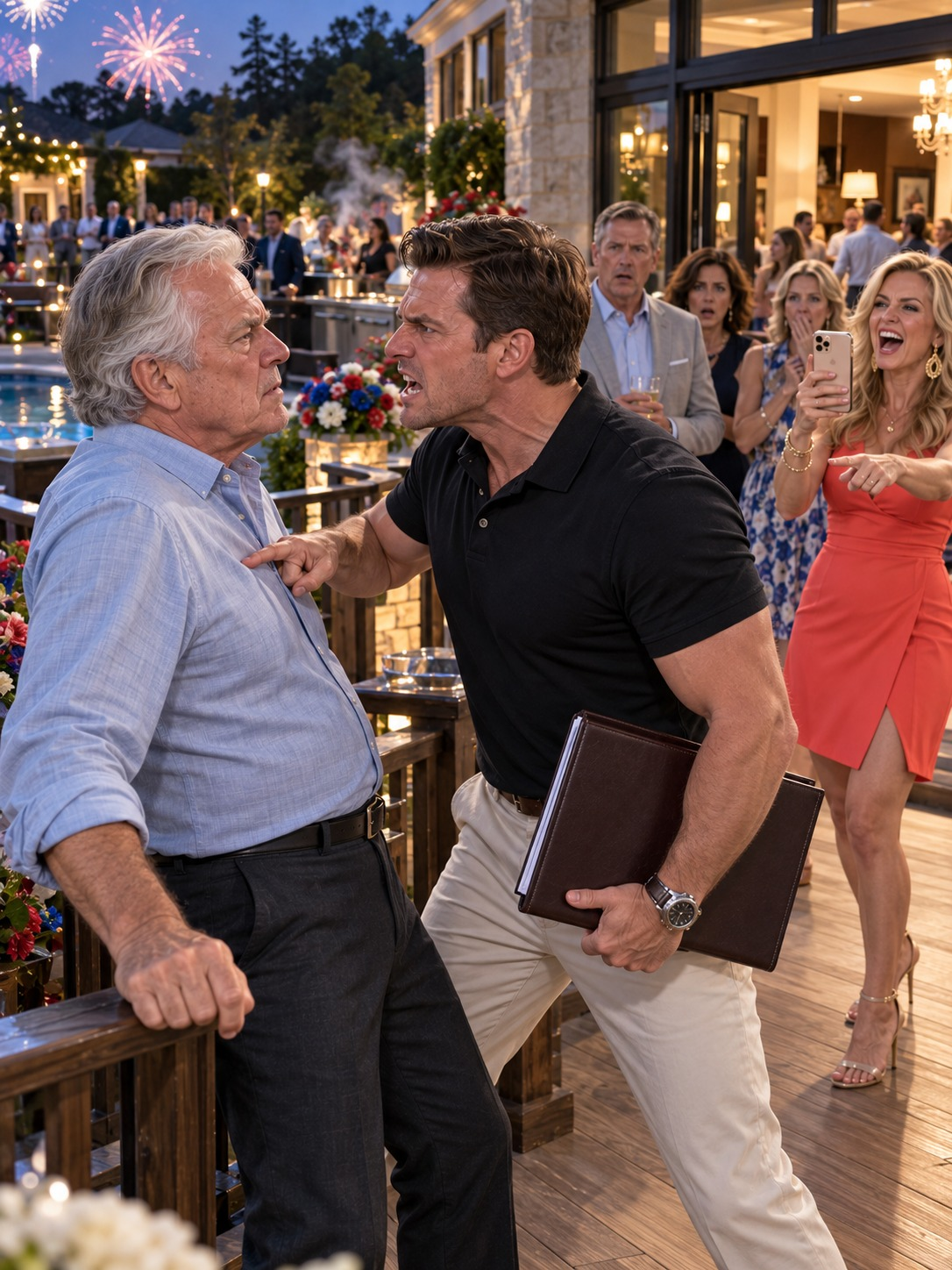
"You're nothing without my money!" my son screamed as he drove his finger into my chest for the thirteenth time.
I stood against the cedar railing, holding the unsigned trust documents he had brought to the party.
On the first page, beside the requested distribution, was a number: $300,000.
My son wasn't asking for help anymore.
He was demanding ownership.
The strangest part was that the house behind him belonged to me.
Not metaphorically. Not because I had helped with a down payment or made a few mortgage payments when times were tough. I owned it through a limited liability company I had established years earlier. The deed was in the company's name. The property taxes came out of its account. The insurance policy named it as the insured owner.
Sterling knew all of that.
He had simply spent so many years pretending otherwise that the truth had become inconvenient.
My name is Garrick Hale. I was sixty-five years old that summer, a retired commercial real estate investor from outside Columbus, Ohio, and a widower who had made the mistake of confusing financial generosity with fatherhood.
The Fourth of July was supposed to be a family celebration.
Sterling and his wife, Amberly, had turned it into something closer to a luxury product launch.
There were nearly forty guests in the backyard. Three barbecue grills sent smoke drifting over the swimming pool. Red, white, and blue flowers decorated every table. The outdoor speakers played patriotic music while children ran through sprinklers on the far side of the lawn.
Everything looked expensive.
Everything was expensive.
And, as I would soon be forced to admit, I had paid for far too much of it.
Sterling stood inches from my face in a fitted black polo shirt and beige trousers. His expensive silver watch flashed beneath the porch lights whenever he raised his hand.
He was thirty-nine years old, broad-shouldered, handsome, and accustomed to entering rooms as though everyone inside owed him attention.
I remembered when that same hand had been small enough to disappear inside mine.
I remembered teaching him to throw a baseball.
I remembered holding him after his mother died.
And now I was watching that hand repeatedly strike my chest because I would not give him three hundred thousand dollars.
"You're embarrassing me," Sterling snapped.
I looked past him toward the pool.
A few guests had stopped talking.
"Then lower your voice," I said.
His jaw tightened.
"You always do this."
"Do what?"
"Act like I'm some idiot who can't make a decision."
I glanced at the leather folder tucked beneath his arm.
"You're asking me to move trust money into a business that can't explain its own liquidity."
He laughed bitterly.
"There it is. The lecture."
"Sterling—"
"No. You listen to me."
He pressed his finger into my chest again.
I moved backward until the railing stopped me.
"Do not touch me again."
That should have ended it.
Instead, he smiled.
Not the smile he used in family photographs. Not the boyish grin that once persuaded his mother to forgive a broken window.
This was the tight, contemptuous smile of a man who believed he had finally found an audience for a private resentment.
"You're old, Dad. You don't understand how money works anymore."
I had spent forty years in commercial real estate finance.
I had reviewed thousands of balance sheets, negotiated acquisitions, survived recessions, and watched supposedly brilliant men lose fortunes because they mistook leverage for wealth.
But I said nothing.
Sterling took my silence as permission.
"North Arc is going to be worth millions."
"Then it shouldn't need the trust."
His expression changed.
For a second, the anger dropped away and I saw something more revealing.
Fear.
He recovered quickly.
"You don't know what you're talking about."
"I know you asked for two hundred thousand in June."
"Things changed."
"And now you need three hundred."
"That's how business works."
"No," I said. "That's how a cash shortage works."
His face reddened.
Behind him, Amberly appeared in the open patio doorway.
She wore a coral-red cocktail dress, gold earrings, and the same bright smile she used in photographs of restaurants and resorts.
At first, I was relieved to see her.
I thought she might calm him down.
Instead, she raised her phone.
"Go ahead, Sterling," she said. "Tell him."
I frowned.
"Amberly, put that away."
She laughed.
"Why? It's a family moment."
The phone remained pointed at us.
Sterling stepped closer.
"Tell me something, Dad. When were you planning to stop controlling my life?"
"I haven't controlled your life."
"You control the money."
"The trust has terms."
"It's Mom's money."
I felt something tighten behind my ribs.
Elaine had been dead for seventeen years.
Her name was not something I used casually, especially during an argument.
Sterling knew that.
He had learned long ago that invoking his mother could make me hesitate.
"The insurance proceeds were placed into a trust," I said. "You're a beneficiary under its terms. That doesn't make the principal yours to spend."
His eyes narrowed.
"I'm her son."
"Yes."
"Her only son."
"Yes."
"Then stop acting like I'm some stranger begging for a handout."
I looked at him carefully.
"You're asking me to risk money your mother wanted protected."
That was when he began jabbing me in earnest.
One sharp finger against my sternum.
Then another.
Each jab punctuated an accusation.
"Cheap."
Another jab.
"Controlling."
Another.
"Selfish."
His voice grew louder.
Amberly laughed behind the phone.
"This is gold," she said.
I could hear people moving closer.
A man near the outdoor kitchen stopped pouring a drink.
A woman in a blue floral dress covered her mouth.
Someone called Sterling's name, but he ignored it.
He was too busy performing.
"You've spent your whole life making people feel small," he shouted.
I had no idea where that accusation came from.
Perhaps he believed it.
Perhaps he needed to believe it.
I had certainly made mistakes as a father. More than I cared to count. But I had never wanted my son to feel small.
I had wanted him to stand on his own.
Unfortunately, every time he stumbled, I had rushed forward with a checkbook.
And now he seemed to believe that standing on his own meant standing on me.
By the tenth jab, my chest hurt.
By the twelfth, I was no longer listening to the words.
I was watching my son.
Really watching him.
His anger was genuine.
So was his conviction.
He believed I was withholding something that belonged to him.
Then came the thirteenth jab.
Hard enough to make me grip the railing.
"You're nothing without my money!"
For a moment, nobody moved.
Even Amberly's laughter seemed to stop.
The sentence hung between us.
I looked at Sterling.
Then I looked at Amberly's phone.
Then I looked through the glass doors into the house.
I could see the chandelier I had paid to install.
The custom kitchen cabinets.
The stone flooring.
The furniture they had purchased after telling me they were temporarily short on rent.
I could see a life my son had constructed out of other people's resources.
Mostly mine.
And suddenly, I understood something I should have understood years earlier.
Sterling didn't think of my financial support as help.
He thought of it as an obligation.
An obligation that would continue until I died.
Maybe beyond that.
I could have humiliated him right there.
I could have told everyone that the house was mine.
I could have explained that the SUV Amberly drove belonged to one of my companies, that Sterling's business credit card was an authorized-user arrangement, and that I had been quietly absorbing their expenses for years.
I could have opened my banking app and shown the guests exactly how successful Sterling really was.
But there were children in the yard.
There were people who had come expecting a celebration.
And somewhere beneath my anger, there was still a father who did not want to destroy his son in public.
So I did something Sterling clearly hadn't expected.
I straightened my shirt.
I looked him directly in the eyes.
And I stepped away.
"Where are you going?" he demanded.
I didn't answer.
"Dad!"
I walked toward the driveway.
Behind me, Sterling said something about cowardice.
Amberly laughed again, although it sounded less certain this time.
I kept walking.
My car was parked near the end of the driveway, beneath a maple tree that had been planted during the property's landscaping renovation.
I remembered approving the invoice for that tree.
The memory almost made me laugh.
I had paid for the ground beneath my son's feet while he accused me of living off his money.
I got into the car and sat for several seconds without starting the engine.
My hands were steady.
That surprised me.
I had expected rage.
Instead, I felt an exhaustion so complete that even anger seemed like too much work.
I drove home without turning on the radio.
My apartment was twenty minutes away, in a quiet building near the city. I had moved there after deciding the old family house was too large for one person.
Elaine would have hated the apartment's modern kitchen.
She would have loved the windows.
I sometimes imagined her standing beside them, telling me that I had spent too much money on a view.
That night, I wished she were there.
I wished she could tell me whether I had failed our son.
I wished she could tell me what to do next.
Instead, I poured a glass of water and sat in my office.
My chest was beginning to bruise.
I unbuttoned my shirt and examined the marks.
They were small.
Almost ridiculous.
Thirteen painful reminders of a much larger injury.
I photographed them with my phone.
I wasn't sure why.
Perhaps some part of me had already begun thinking like the financial professional I used to be.
Document the facts.
Preserve the evidence.
Don't rely on memory when records are available.
At 12:43 a.m., my phone vibrated.
It was a message from Daniel Reeve, a man I knew casually through local business circles.
Daniel had attended the party.
His message contained a screen recording.
Garrick, I thought you should have this before it disappears.
I pressed play.
There was Sterling, towering over me.
There was Amberly's laughter.
There was my son jabbing my chest.
But something was missing.
The recording began after I had already told Sterling not to touch me.
The clip made it appear that I had been standing silently while he demanded an explanation.
Amberly had added laughing captions.
One suggested that Sterling was finally standing up to his controlling father.
Another mocked my age.
I watched the video twice.
Then I noticed the view count.
People had already seen it.
People who knew my son.
People who knew me.
People who had no idea what had happened before the recording began.
I set the phone down.
Until that moment, I had believed the confrontation was an ugly family incident.
Something private that had unfortunately occurred in public.
The edited video changed that.
Amberly hadn't simply witnessed my humiliation.
She had packaged it.
I opened a drawer and removed a yellow legal pad.
At the top, I wrote:
Sterling — Financial Relationships.
Below it, I began listing everything.
The house.
The vehicle.
The credit card.
The insurance reimbursements.
The phone plan.
The unpaid rent.
The subscriptions.
The business guarantees.
I kept writing until the page was full.
Then I turned to another.
At 1:26 a.m., I stopped.
I had not yet calculated the total, but I knew it would be substantial.
I also knew that I could no longer solve this with another conversation.
Sterling had stopped hearing me years ago.
Maybe he had never heard me at all.
I opened my contacts and found the number for Nadine Foster, my longtime attorney.
It was too late to call.
I scheduled a reminder for eight the next morning.
Then I placed the leather-bound folder containing my estate documents on the desk.
For years, I had assumed that whatever I owned would eventually pass to Sterling.
I had treated that as a natural conclusion rather than a decision that required thought.
Now, for the first time, I questioned it.
Not because I wanted revenge.
Because my son had made it clear that he already considered my assets his property.
And I had begun to wonder what he might do if he believed I was standing between him and the money.
I was closing the folder when my phone vibrated again.
This time, the message came from an unfamiliar number.
There was no greeting.
No name.
Only a photograph of the trust-distribution document Sterling had brought to the barbecue.
Someone had circled the signature line in red.
Beneath it was a message:
"Mr. Hale, before you sign anything, you need to know what North Arc has already promised its investors."
A second message appeared.
"Your son has been using your name."
Then a third notification arrived.
It was an attachment.
And the filename contained a word I had never expected to see beside my late wife's trust.
GUARANTEE.






Comments 0