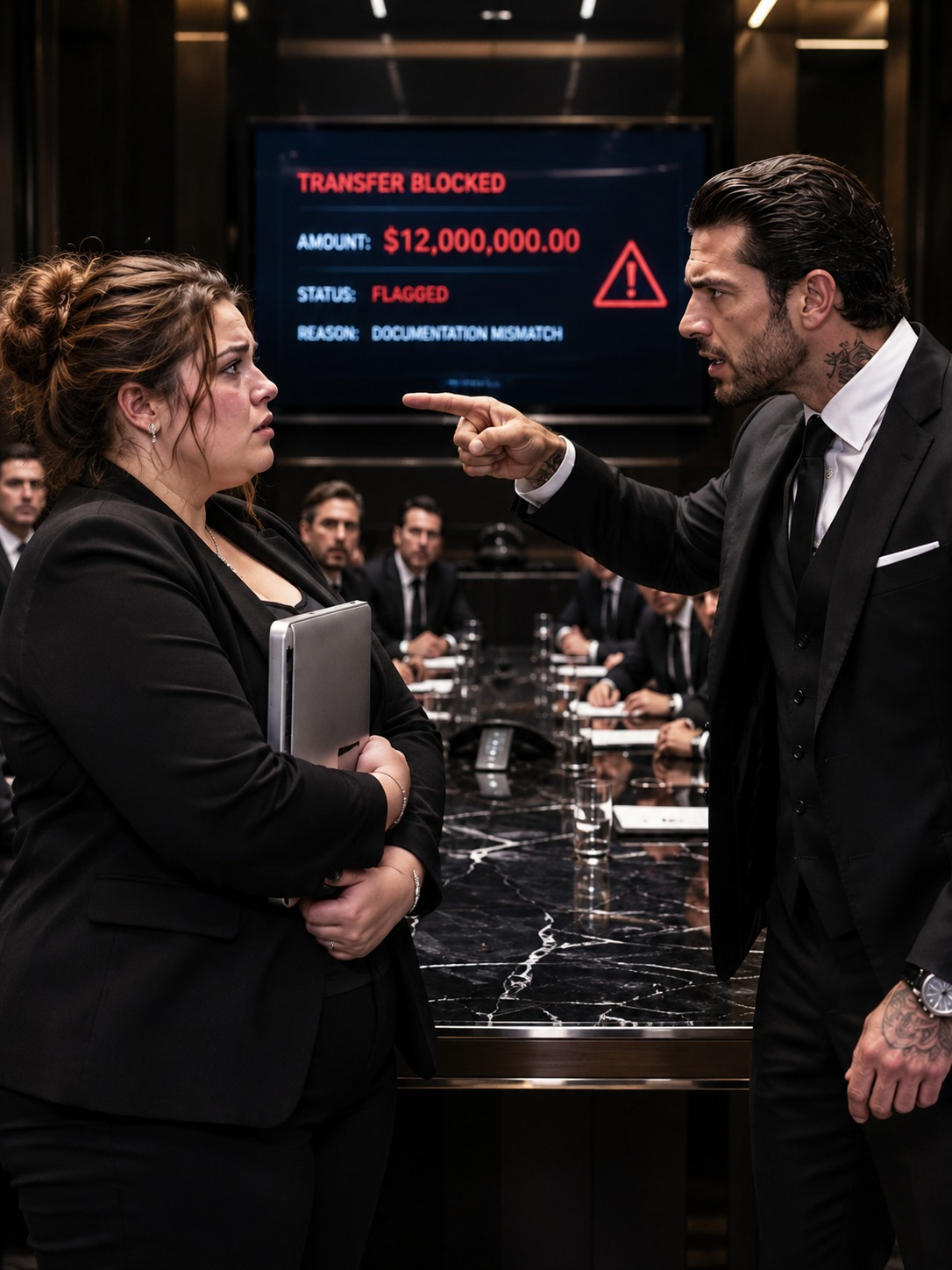
"Lock down the building."
Marco Bellini's voice came through the security radio.
Karl looked toward the monitor.
"Mr. Bellini, we have an unauthorized access alert on the financial archive."
"Nobody leaves the building until we know what happened."
Rachel stood beside the revolving doors, her phone still displaying the anonymous message.
YOU SHOULD HAVE LEFT THE REPORT WITH HIM.
NOW THEY KNOW YOU HAVE THE ORIGINALS.
She read the words again.
Her first instinct was to call the police.
Her second was to call Marco.
She did neither.
For three months, someone had been watching her investigate the financial records. Calling Marco now, without knowing who was listening to his communications, could be exactly what that person wanted.
She slipped her phone into her bag.
"Karl, can you tell me whether the archive is still accessible?"
He looked uncomfortable.
"That's above my clearance."
"I know. But if someone is trying to delete financial records, you need to preserve the security logs."
Karl studied her.
"You think this is connected to the transfer?"
"I think it's connected to everything."
Before he could answer, his radio crackled.
"Security supervisor to the executive floor. Immediately."
Karl looked at Rachel.
"Stay here."
She nodded.
He walked toward the private elevators.
Rachel watched him disappear.
Then she turned toward the glass doors.
Outside, rain fell across the Chicago sidewalk. Cars moved through the intersection, their headlights reflecting on the wet pavement.
She opened her umbrella and stepped outside.
She had barely reached the curb when a black SUV pulled away from the opposite side of the street.
It moved slowly.
Too slowly.
Rachel looked at its windshield.
She couldn't see the driver.
Her phone vibrated again.
This time, there was no message.
It was an incoming call.
Unknown number.
She declined it.
The SUV accelerated and disappeared into traffic.
Rachel stood beneath her umbrella.
For the first time that morning, she wondered whether leaving Bellini headquarters had been a mistake.
Thirty-one minutes earlier, Marco Bellini had still believed he was in control.
He stood at the head of the conference table while the executives gradually returned to their conversations.
Adrian poured himself a glass of water.
"Well," he said, "that was unnecessary."
Marco didn't answer.
"She was becoming difficult. Honestly, we should have replaced her months ago."
Marco looked at him.
"Why?"
Adrian paused.
"Why what?"
"Why should we have replaced her?"
"Because she kept questioning routine decisions."
"Questioning twelve million dollars is routine?"
Adrian placed his glass down.
"You know what I mean."
Marco picked up the white envelope.
It was sealed.
Rachel had written his name across the front in neat black handwriting.
MARCO BELLINI — CONFIDENTIAL.
Below it, in smaller letters:
DO NOT AUTHORIZE THE TRANSFER.
He turned it over.
There was no return address.
No additional note.
"Have you read the original beneficiary packet?" Marco asked.
Adrian sighed.
"We have discussed this."
"I asked a question."
"Of course I have."
"Who verified it?"
"Finance."
"Which department?"
Adrian looked toward the other executives.
"Why are we interrogating each other? The transaction is legitimate."
Marco's expression hardened.
"Then you won't mind waiting for independent confirmation."
Adrian's fingers tightened around his glass.
"That could delay the acquisition."
"Then it can be delayed."
The room fell silent again.
Marco returned to his chair.
He placed the envelope beside his laptop.
"Meeting dismissed."
The executives began collecting their belongings.
Adrian remained seated.
"Marco, a word."
"Not now."
"This is about the family."
Marco looked up.
"Everything is about the family. That's why I need to understand what happened."
Adrian's face became unreadable.
For a moment, the cousins stared at each other.
Then Adrian stood.
"You're making a mistake."
Marco didn't respond.
Adrian walked out.
Only after the conference room had emptied did Marco reach for the envelope again.
He examined the seal.
Then he opened it.
The first page contained a summary of suspicious financial transactions.
Thirty-eight thousand dollars.
Seventy-one thousand dollars.
One hundred and forty-two thousand dollars.
Nine separate transfers.
Four shell suppliers.
Three modified authorization records.
Marco read the first page twice.
He had seen financial irregularities before.
He understood that large organizations sometimes experienced administrative errors.
But Rachel's report was different.
She had connected transactions across departments that were supposedly independent.
Each payment appeared ordinary when examined alone.
Together, they formed a carefully designed system.
Money entered through legitimate subsidiaries.
It moved through consulting accounts.
Then it disappeared into offshore institutions.
Marco turned the page.
A list of dates and authorization codes followed.
He recognized one of the names.
His own chief financial officer.
Another name belonged to a senior executive who had been with the organization for fourteen years.
Then he saw Adrian Bellini.
Marco stopped reading.
He looked toward the conference room doors.
He turned another page.
A note had been attached.
The beneficiary change requested today is not an isolated incident. It is the final stage of a diversion operation that has been active for at least ninety days.
Below it:
The $12 million transfer appears designed to conceal the previous withdrawals by replacing the original beneficiary with an institution controlled by an undisclosed intermediary.
Marco's face became still.
He reached for his phone.
"Get me Thomas."
Thomas Reed was his head of internal security, a former federal investigator who had joined the organization years earlier.
He answered on the second ring.
"Boss."
"Come to the conference room."
"What's happened?"
"Now."
Three minutes later, Thomas entered.
Marco pushed the report across the table.
"Read this."
Thomas began scanning the pages.
His expression changed.
"Where did you get this?"
"Rachel."
"The accountant?"
"Yes."
Thomas looked at the transaction summary.
"She's been investigating this?"
"For three months."
Thomas continued reading.
Then he reached the final section.
His eyes narrowed.
"Boss, you need to see the last page."
Marco turned it over.
There was a photograph.
A photograph of a storage facility outside Chicago.
Beneath it was a list of dates, vehicle registration numbers, and names.
One name appeared more frequently than the others.
Adrian Bellini.
Marco slowly leaned back.
"How certain is this?"
Thomas studied the supporting documents.
"She has included the original transaction references. These can be independently verified."
"Then verify them."
Thomas nodded.
But he didn't move.
"There's something else."
"What?"
"These access codes."
He pointed to a column of numbers.
"They belong to the executive financial archive."
Marco looked at him.
"Meaning?"
"Someone has been accessing the archive using credentials with administrative privileges."
"Whose credentials?"
Thomas hesitated.
"Yours."
Silence.
Marco stared at the page.
His own authorization credentials had been used to approve transactions he had never seen.
Someone had been impersonating him inside his own organization.
He stood.
"Find Rachel."
Thomas picked up his phone.
"Do you want her brought back here?"
"No."
Marco's voice became sharper.
"I want her found before whoever did this gets to her."
Thomas immediately contacted security.
Marco looked at the report again.
There was one final page.
Rachel had written a handwritten note at the bottom.
I didn't tell you everything because I wasn't sure who I could trust. I'm sorry.
Marco read it several times.
He remembered the way she had looked at him when he fired her.
He remembered her refusing to release the money.
And he remembered something else.
Three weeks earlier, Rachel had asked him whether anyone in the organization could access his private authorization records.
He had dismissed the question.
He had told her that the system was secure.
Now he understood why she had looked so disappointed.
She had been trying to warn him.
And he had chosen to humiliate her in front of thirty people.
At 1:47 p.m., Rachel reached her apartment.
She lived in a modest building several blocks from Lake Michigan.
It wasn't luxurious.
The kitchen was small, the furniture was secondhand, and the heating system made strange noises whenever the temperature dropped.
But it was hers.
For two years, she had saved a portion of every paycheck.
She wanted to buy a small house someday.
A place with a garden.
A kitchen with enough room for a proper dining table.
A life where nobody called her at midnight because a financial report had disappeared.
She locked the apartment door.
Then she checked the windows.
Everything appeared normal.
She placed her laptop on the kitchen counter and removed a small encrypted storage device from her bag.
The original financial records were backed up there.
She had made three copies.
One was stored in a secure cloud account.
One was with an attorney.
The third was hidden in a location she had not told anyone about.
Rachel connected the device.
A password screen appeared.
She entered the code.
The folder opened.
Inside were hundreds of documents.
She located the original beneficiary approval packet and compared it with the altered version from that morning.
The differences were obvious.
Someone had replaced the receiving institution.
But there was something she had not understood before.
The new beneficiary wasn't simply an offshore account.
It belonged to a company registered under a different name.
Rachel opened the corporate registration.
Then she searched the director's information.
Her stomach tightened.
The company had been established seven years earlier.
Its listed director was a retired businessman.
But its registered contact information led to a private law office in Chicago.
An office Rachel recognized.
She had seen its name on Bellini legal correspondence.
It was the office responsible for managing several of Marco's private business holdings.
Rachel leaned closer to the screen.
This wasn't simply an external fraud operation.
Someone had built a financial doorway inside the Bellini organization.
And the person who controlled it had access to the family's legal structure.
Her phone rang.
She looked at the screen.
Unknown number.
This time, she answered.
"Hello?"
A man's voice came through.
"Miss Foster."
Rachel froze.
"Who is this?"
"You left something important behind."
Her fingers tightened around the phone.
"Who are you?"
A short pause.
Then:
"Someone who knows you have the originals."
Rachel stood.
"How did you get this number?"
"That's not important."
"Then what do you want?"
"Stop investigating the twelve million dollars."
Rachel looked at the encrypted storage device.
"I've already resigned."
The man laughed quietly.
"Resignation doesn't erase what you've seen."
The call ended.
Rachel remained still.
She slowly walked toward the window.
Across the street, a black sedan was parked beneath a tree.
Its headlights were off.
Someone was sitting inside.
Rachel stepped away from the glass.
Her phone vibrated.
A message from a number she recognized.
Karl.
Miss Foster, please don't go outside. Something happened upstairs.
Before she could respond, another message arrived.
This one was from Marco Bellini.
Rachel. I read your report. Please answer.
She stared at the screen.
A third message appeared.
You were right. Someone inside my family is involved.
Rachel began typing.
Then she stopped.
Because at that exact moment, her laptop screen went black.
A new notification appeared.
REMOTE ACCESS REQUEST — AUTHORIZED ADMINISTRATOR.
And beneath it was the name of the person requesting access.
MARCO BELLINI.






Comments 0