"Your wife didn't die the way you were told, Richard."
Linda Whitmore stood in the hallway holding a blue folder against her chest.
Behind her, Mark smiled.
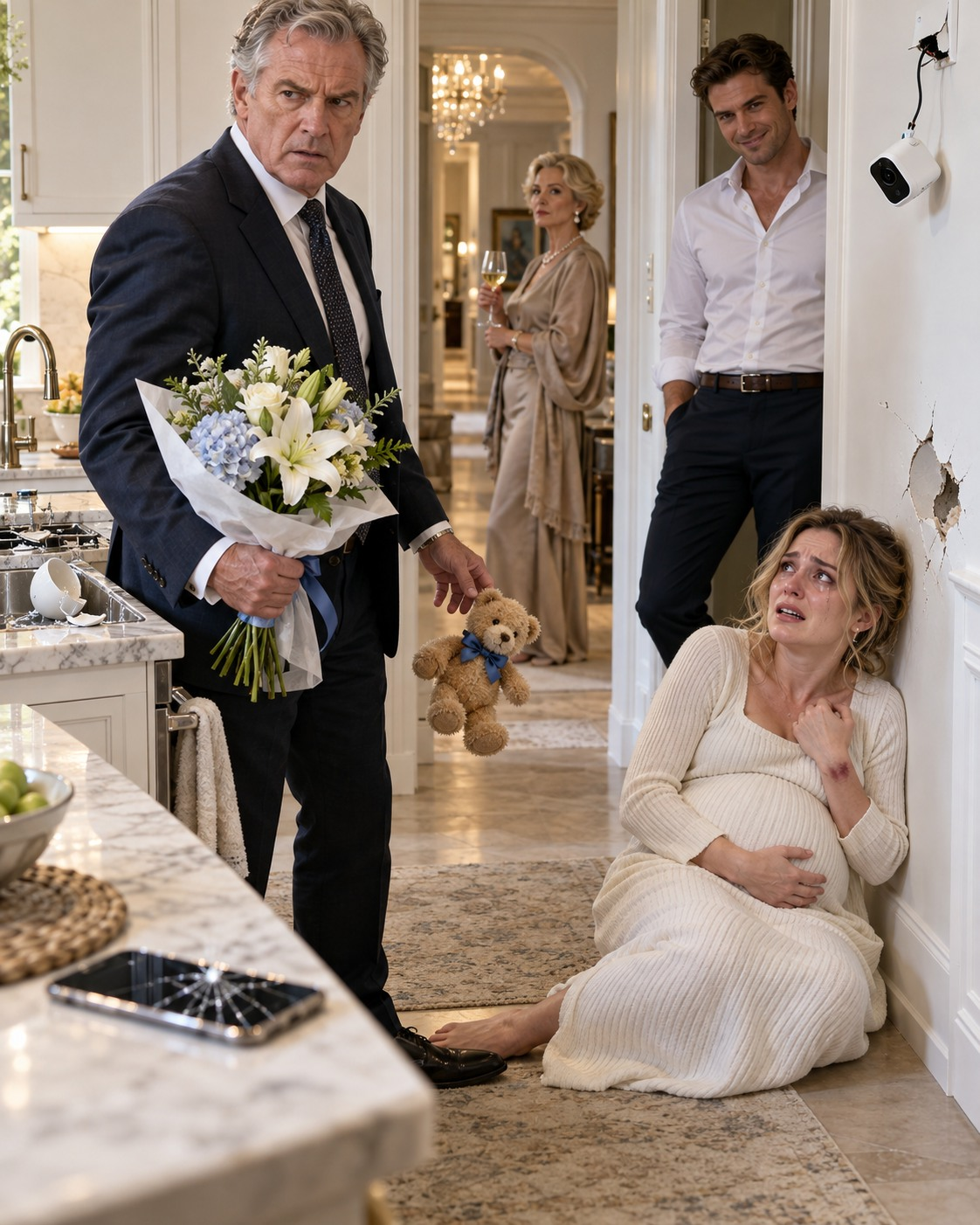
My daughter was sitting on the kitchen floor, eight months pregnant, trembling so badly she could barely hold the little teddy bear I'd brought for her unborn son.
And somehow, in the middle of that nightmare, Linda had found the one subject capable of making me forget how to breathe.
My wife.
Margaret Bennett.
Dead for eleven years.
The woman I had loved since I was twenty-four.
I stared at Linda.
"Be very careful what you say next."
She smiled.
"There's the Richard Bennett I remember."
I felt something cold settle in my stomach.
"Remember?"
"Oh, Richard." She tilted her head. "You really don't recognize me?"
I studied her face.
The silver-white hair.
The expensive jewelry.
The carefully controlled expression.
There was something familiar about her eyes.
Something I had seen before.
But eleven years can change a person.
Especially someone who has spent those years becoming wealthy enough to reinvent herself.
"Who are you?" I asked.
Linda's smile widened.
"That's a much better question."
Behind me, Emily made a frightened sound.
"Dad, please."
I turned immediately.
She was trying to stand.
One hand pressed against the wall while the other protected her stomach.
"Sweetheart, stay seated."
"I don't want to be here."
"I know."
"Please, Dad. I need to leave."
I looked toward the front door.
Still locked.
Then at Mark.
Still standing between us and the hallway.
Then at Linda.
Still holding that blue folder.
Whatever game they were playing, my daughter was running out of time.
I stepped toward Linda.
"Unlock the door."
She didn't move.
"Richard, don't you want to know what happened to Margaret?"
"I want my daughter in a hospital."
"And afterward?"
I stared at her.
"Afterward, you can tell your story to the police."
Mark laughed.
"Still threatening us with the police?"
I looked at him.
"No, Mark. I'm telling you what happens next."
His smile disappeared.
Linda raised one hand.
"Enough, both of you."
Then she opened the folder.
Inside were several documents, an old photograph, and a yellowed envelope.
She removed the photograph first.
I recognized the location immediately.
The county courthouse.
Eleven years earlier.
Margaret stood beside me on the courthouse steps.
She was wearing a pale blue dress.
Her hair was pulled back.
She was smiling.
I remembered that day.
I remembered the lunch we'd eaten afterward.
I remembered how she teased me for forgetting our anniversary the previous week.
But there was someone else in the photograph.
A woman standing several feet behind us.
Dark hair.
Black sunglasses.
A beige coat.
Linda tapped the woman's face.
"Look familiar?"
I stared.
The woman in the photograph was younger.
Her hair was darker.
But the shape of her face—
The eyes—
My mouth went dry.
"That was you."
Linda nodded.
"Very good."
"What were you doing there?"
"Watching."
"Watching what?"
"You."
I felt my pulse quicken.
"Why?"
She slipped the photograph back into the folder.
"Because eleven years ago, you helped destroy my husband's life."
Mark folded his arms.
"There it is."
I turned toward him.
"What?"
"The reason Mom never liked you."
I looked back at Linda.
"Your husband?"
She smiled without warmth.
"Charles Whitmore."
The name hit me like a physical blow.
Charles Whitmore.
I hadn't heard it spoken aloud in years.
But I remembered him.
Of course I remembered him.
He had been a prominent property developer.
A man with political connections, expensive lawyers, and a talent for making witnesses disappear before trial.
Eleven years earlier, our office investigated a construction fraud operation involving falsified safety inspections, illegal payments, and a deadly structural collapse at a residential development.
Three workers died.
A fourth suffered permanent injuries.
Charles Whitmore had been the company's controlling executive.
I helped build the case.
He was eventually convicted of fraud, obstruction, and conspiracy.
He died in prison four years later.
I looked at Linda.
"Charles was your husband?"
"Yes."
"Then why didn't you tell me when Emily introduced us?"
She laughed softly.
"Would you have welcomed my son into your family if you'd known?"
I didn't answer.
Because the answer was obvious.
Mark stepped forward.
"My father was innocent."
I looked at him.
"Your father was convicted by a jury."
"Because of you!"
"Because of evidence."
"You manipulated that evidence!"
My jaw tightened.
"No."
Mark pointed at me.
"You ruined our family."
I looked at Emily.
She was staring at her husband.
Her expression had changed.
The fear was still there.
But beneath it was something else.
Confusion.
"Mark," she whispered, "you told me your father died in a car accident."
He froze.
Linda's face tightened.
For the first time, neither of them had an immediate answer.
Emily stared at him.
"You said he died when you were in college."
Mark looked away.
"Emily, this isn't the time."
"You lied to me?"
"Don't start."
"You told me your father was a businessman who died in an accident."
He stepped toward her.
I moved between them.
"Stay where you are."
Mark glared at me.
"Get out of my way."
"No."
Linda sighed.
"Richard, you really do enjoy making everything difficult."
I turned toward her.
"You let my daughter marry your son without telling her who your husband was."
"Families have complicated histories."
"You concealed a criminal conviction."
"Charles was a good man."
"Three workers died because his company ignored safety reports."
Linda's eyes flashed.
"Don't you dare lecture me about death."
I went still.
She saw it.
And smiled.
"Ah," she whispered. "Now we're getting somewhere."
I felt the old anger rising.
Not the hot, careless kind.
Something quieter.
Something I had spent thirty-one years learning to control.
"Tell me what you know about Margaret."
Linda studied me.
Then she placed the folder on the kitchen island.
"Your wife died in a traffic collision on November seventeenth, didn't she?"
I swallowed.
"Yes."
"On Route 46."
"Yes."
"At approximately 8:40 in the evening."
I stared at her.
"How do you know that?"
She didn't answer.
Instead, she removed a second document.
A photocopy of a police report.
I recognized the format.
The county seal.
The case number.
The official language.
But something was wrong.
A handwritten notation appeared across the bottom.
Three words.
SECOND VEHICLE UNIDENTIFIED.
I frowned.
"Where did you get that?"
Linda smiled.
"From someone who knew more than you did."
I took one step closer.
"That notation wasn't in the report I received."
"No."
"Why not?"
"Perhaps you should ask the people you trusted."
I looked at the page again.
Margaret's accident had been investigated by state police.
The conclusion was straightforward.
Her car had left the road after an apparent tire failure.
She struck a concrete barrier.
The vehicle caught fire.
By the time emergency responders arrived, she was gone.
I had spent months questioning every detail.
I requested photographs.
Mechanical inspections.
Witness statements.
I read the accident reconstruction report so many times that I could recite portions from memory.
And now Linda was standing in my daughter's kitchen, holding a document I'd never seen.
"Is that authentic?" I asked.
She shrugged.
"You spent thirty-one years examining evidence. You tell me."
I looked at the photocopy.
The notation was handwritten.
No initials.
No date.
No reference to the person who added it.
It could have been genuine.
It could have been fabricated yesterday.
I wasn't going to let my grief make that decision for me.
"An unverified photocopy proves nothing," I said.
Linda's smile faded slightly.
"Still the investigator."
"Always."
She leaned closer.
"Then investigate."
Behind me, Emily suddenly gasped.
I turned.
She had both hands against her stomach.
"Emily?"
She squeezed her eyes shut.
"Something hurts."
I was beside her immediately.
"Where?"
"Low. In my stomach."
"Is it constant?"
She shook her head.
"It comes and goes."
My heart began pounding.
I looked at my watch.
Then at her face.
"How long has this been happening?"
"Since this morning."
"How often?"
"I don't know."
I placed a hand gently against her shoulder.
"Listen to me. We're going to get you medical attention."
Mark approached.
"She's exaggerating."
I stood so quickly he stopped.
"Say that again."
He blinked.
"What?"
"Look at your wife."
He glanced toward Emily.
"She's fine."
"Look at her."
His expression hardened.
"Don't tell me what to do."
I stepped closer.
"She's carrying your child."
He said nothing.
"She's in pain."
"Pregnant women have pain."
"Then you shouldn't object to a doctor examining her."
Mark looked toward Linda.
That was interesting.
A grown man.
Thirty-seven years old.
Successful businessman.
Standing in his own house.
And when faced with a simple decision about his pregnant wife's health, he looked to his mother.
Linda gave a small nod.
"Emily can see her doctor tomorrow."
I stared at her.
"No."
"Richard—"
"Not tomorrow."
My voice remained quiet.
"Now."
Linda's eyes narrowed.
"You're not in a position to make demands."
I looked toward the front entrance.
"Then open the door and let her make the decision."
Neither of them moved.
Emily began crying again.
"Dad, please."
I knelt beside her.
"Sweetheart, look at me."
She tried.
Her eyes were wet.
"I need you to breathe slowly."
She nodded.
"In through your nose. Out through your mouth."
She followed my instructions.
I took my phone from my pocket.
Still no signal.
I looked toward the kitchen windows.
There was enough daylight outside to remind me how ordinary the rest of the world probably looked.
People were driving to grocery stores.
Children were playing.
Neighbors were walking dogs.
And inside this beautiful house, my daughter couldn't leave.
I turned toward Mark.
"What's blocking the cellular signal?"
He frowned.
"What are you talking about?"
"My phone worked when I arrived."
"Maybe your carrier is terrible."
"Maybe."
I held his gaze.
"Or maybe someone doesn't want calls leaving this house."
Linda laughed.
"Now you're becoming paranoid."
I ignored her.
Instead, I looked toward the kitchen's wall-mounted control panel.
The house had an integrated security system.
Electronic locks.
Cameras.
Smart lighting.
Possibly a hardwired connection to an alarm monitoring company.
If I could access the panel, I might be able to trigger an emergency response.
But Mark was watching me closely.
Too closely.
I needed him distracted.
I looked back at the blue folder.
"Tell me about the second vehicle."
Linda seemed pleased.
"I thought you'd never ask."
"Who was driving it?"
She hesitated.
"Someone you knew."
"Name."
"Not so fast."
I stared at her.
"What do you want?"
She smiled.
"An apology."
I almost laughed.
"For what?"
"For what you did to Charles."
I looked at her for a long moment.
Then I said, "Your husband was responsible for a conspiracy that contributed to three deaths."
Linda's expression went cold.
"He was protecting his company."
"He falsified safety documents."
"He was protecting his employees."
"Three of them died."
She slammed the folder shut.
"YOU DON'T KNOW WHAT HAPPENED!"
The shout echoed through the kitchen.
Emily flinched.
Mark looked startled.
And Linda—
Linda seemed surprised by her own outburst.
She took a breath.
Smoothed her blouse.
Recovered her composure.
"I'm sorry," she said softly.
I watched her.
There was more here than revenge.
Something about the old case still frightened her.
I remembered Charles Whitmore's trial.
The missing financial records.
The anonymous witness who vanished before testifying.
The unexplained transfer of nearly two million dollars shortly before his arrest.
And one detail that had bothered me for years.
Charles had repeatedly insisted he wasn't the person in charge.
He claimed someone else controlled the decisions.
Someone whose name he refused to reveal.
At the time, we believed he was trying to shift blame.
Now I wondered whether he'd been telling part of the truth.
I looked at Linda.
"Charles said he wasn't acting alone."
Her face changed.
Only for a second.
But I saw it.
"Did he?" she asked.
"Yes."
"Criminals say all sorts of things."
I nodded.
"They do."
I let the silence stretch.
Then I asked, "Were you the person he was protecting?"
Mark turned toward his mother.
"What?"
Linda stared at me.
"That's ridiculous."
"Is it?"
"Charles loved me."
"I didn't ask whether he loved you."
Her jaw tightened.
I continued.
"He refused to identify the person who authorized the payments. The records disappeared. And the investigation never established where the missing money went."
Mark looked between us.
"Mom?"
Linda ignored him.
I took another step toward the island.
"Was it you?"
She picked up the blue folder.
"You're making accusations without evidence."
I smiled faintly.
"Funny. That's exactly what you were doing about Margaret's death."
For the first time, Linda had nothing to say.
Behind me, Emily whispered, "Dad."
I turned.
She was watching Mark.
Her expression was strange.
Not just frightened.
Almost desperate.
She shook her head very slightly.
I understood.
She didn't want me pushing them further.
Not while we were trapped.
She was right.
I had let the past distract me from the immediate danger.
I took a slow breath.
Then I stepped away from Linda.
"All right."
Mark frowned.
"All right what?"
"I'm done arguing."
He looked suspicious.
I held up my hands.
"No more accusations. No more questions about your father."
Linda watched me carefully.
"What are you proposing?"
"Emily needs medical care. Let me take her to the hospital. Afterward, we can discuss whatever you want."
Mark laughed.
"You expect us to believe that?"
"I expect you to recognize that an emergency involving your unborn child isn't good for anyone."
He looked toward Emily.
Then at Linda.
She hesitated.
For one brief moment, I thought she might agree.
Then she shook her head.
"Not until we settle the matter of the recording."
I felt my stomach tighten.
"There it is."
Linda extended her hand.
"Give me Emily's phone."
"No."
"Richard."
"No."
She smiled.
"Then we're at an impasse."
I looked at the phone inside my jacket.
The recording had already uploaded.
That was important.
Destroying the device wouldn't necessarily destroy the evidence.
But I didn't know where the recording had gone.
Or whether it was still accessible.
And I wasn't going to surrender the only physical proof Emily had managed to preserve.
"Why are you so worried about the recording?" I asked.
Linda's smile disappeared.
"Because private conversations can be misunderstood."
"Then a full recording should clear everything up."
Mark swore under his breath.
Linda looked at him sharply.
Something passed between them.
A silent warning.
Then she turned back to me.
"Richard, I'm going to give you one final opportunity to be reasonable."
I glanced at Emily.
She was holding her stomach again.
Her face was pale.
I had no intention of negotiating any longer.
But I needed a way to get her out.
I looked toward the kitchen sink.
A narrow window above it overlooked the side yard.
Too small for Emily.
Too high.
The patio doors were farther away, beyond the dining area.
I couldn't see whether they were electronically secured.
Then I noticed something else.
The wall-mounted security panel near the pantry had a small green indicator light.
Connected.
Active.
The house might have been blocking ordinary calls, but the alarm system was still communicating with something.
I remembered what Emily had said.
"I set something up."
The camera.
The recording.
The upload.
She had planned ahead.
My daughter had been fighting back long before I arrived.
I looked at her.
She met my eyes.
Then she glanced toward the security panel.
A tiny movement.
Barely noticeable.
But unmistakable.
She wanted me to see it.
I kept my expression neutral.
Linda was still speaking.
"All we need is your cooperation."
I nodded slowly.
"Of course."
Mark looked surprised.
"Seriously?"
I looked at him.
"You're right about one thing."
He raised an eyebrow.
"What's that?"
"There's no point making a scene."
Linda relaxed slightly.
"Finally."
I reached into my jacket.
Mark's eyes followed my hand.
I took out Emily's phone.
The screen was dark.
"Before I give you this," I said, "I want to check one thing."
Linda frowned.
"What?"
"Whether Emily needs an ambulance."
Mark rolled his eyes.
"Again with the hospital?"
I ignored him.
I stepped toward the security panel.
"Does this system have an emergency function?"
Mark moved quickly.
"Don't touch that."
I stopped.
"Why?"
"Because it's my security system."
I looked at the panel.
Then at him.
"You're afraid I'll call for help."
He said nothing.
Linda's expression hardened.
"Richard, step away."
I smiled.
Not because I was amused.
Because I'd finally found something they didn't want me near.
And when people guard something that closely, there's usually a reason.
I took one step toward the panel.
Mark grabbed my arm.
I turned.
"Let go."
He tightened his grip.
"You're not touching anything."
I looked down at his hand.
Then back at his face.
"Mark, you've already made several very poor decisions today."
He leaned closer.
"Then maybe I should make one more."
I didn't move.
Behind him, Linda said sharply, "Mark, don't."
But he wasn't listening.
His face was flushed.
His breathing was heavy.
He wanted control.
He wanted me frightened.
He wanted the old man who had walked into his house carrying flowers to beg.
Instead, I looked directly into his eyes.
"Take your hand off me."
He shoved me backward.
My shoulder struck the pantry door.
Emily cried out.
"DAD!"
I regained my balance.
Mark stepped forward again.
Then something unexpected happened.
A soft electronic beep sounded from the security panel.
Everyone froze.
The green light blinked twice.
Then turned blue.
A woman's recorded voice spoke from the small speaker.
"Remote access established."
Mark stared at the panel.
"What the hell?"
Linda went pale.
The voice continued.
"Encrypted archive synchronization complete."
I looked at Emily.
She was staring at the panel with tears running down her face.
But this time, she wasn't crying from fear.
She was crying from relief.
"Emily," I whispered, "what did you do?"
She looked at me.
Then at Mark.
Then back at me.
Her voice trembled.
"I did what you taught me, Dad."
I stared at her.
"What?"
She swallowed.
"When I was little, you said that if someone was lying, I should always keep proof."
I felt my chest tighten.
She continued.
"So I kept proof."
Mark spun toward her.
"What proof?"
Emily didn't answer.
Linda stepped toward the panel.
"Turn it off."
The blue light blinked again.
A new message appeared on the display.
ARCHIVED FOOTAGE AVAILABLE.
I looked at the unplugged camera above the refrigerator.
Then at the panel.
And suddenly I understood.
The camera Mark had disconnected wasn't the only recording device in the house.
Emily had found another way.
Linda reached for the screen.
Before her fingers touched it, a second message appeared.
REMOTE VIEWER CONNECTED.
Mark grabbed the panel.
"WHO IS WATCHING?"
The speaker crackled.
A man's voice came through.
Calm.
Professional.
And painfully familiar.
"Richard Bennett?"
I went completely still.
I knew that voice.
I hadn't heard it in eleven years.
Not since the investigation into Margaret's death.
The man on the other end spoke again.
"Richard, don't say anything. Don't let them know you recognize me."
My mouth went dry.
Then the security panel displayed a name.
DETECTIVE THOMAS REED — STATE POLICE, RETIRED.
The same detective who had signed my wife's accident report.
The same man who had told me there was no evidence of another vehicle.
The same man who had assured me Margaret's death was an accident.
Linda stared at the screen.
Her face had gone completely white.
Then Reed spoke one final sentence.
"Richard, I need you to look at the security camera above the refrigerator. There's something inside it that Margaret left for you."
I slowly raised my eyes.
The camera was still hanging crookedly from the wall.
Its disconnected cord swayed slightly.
And just as I reached toward it, someone on the other side of the pantry door began knocking.
Three slow knocks.
Then a woman's voice whispered my dead wife's name.






Comments 0