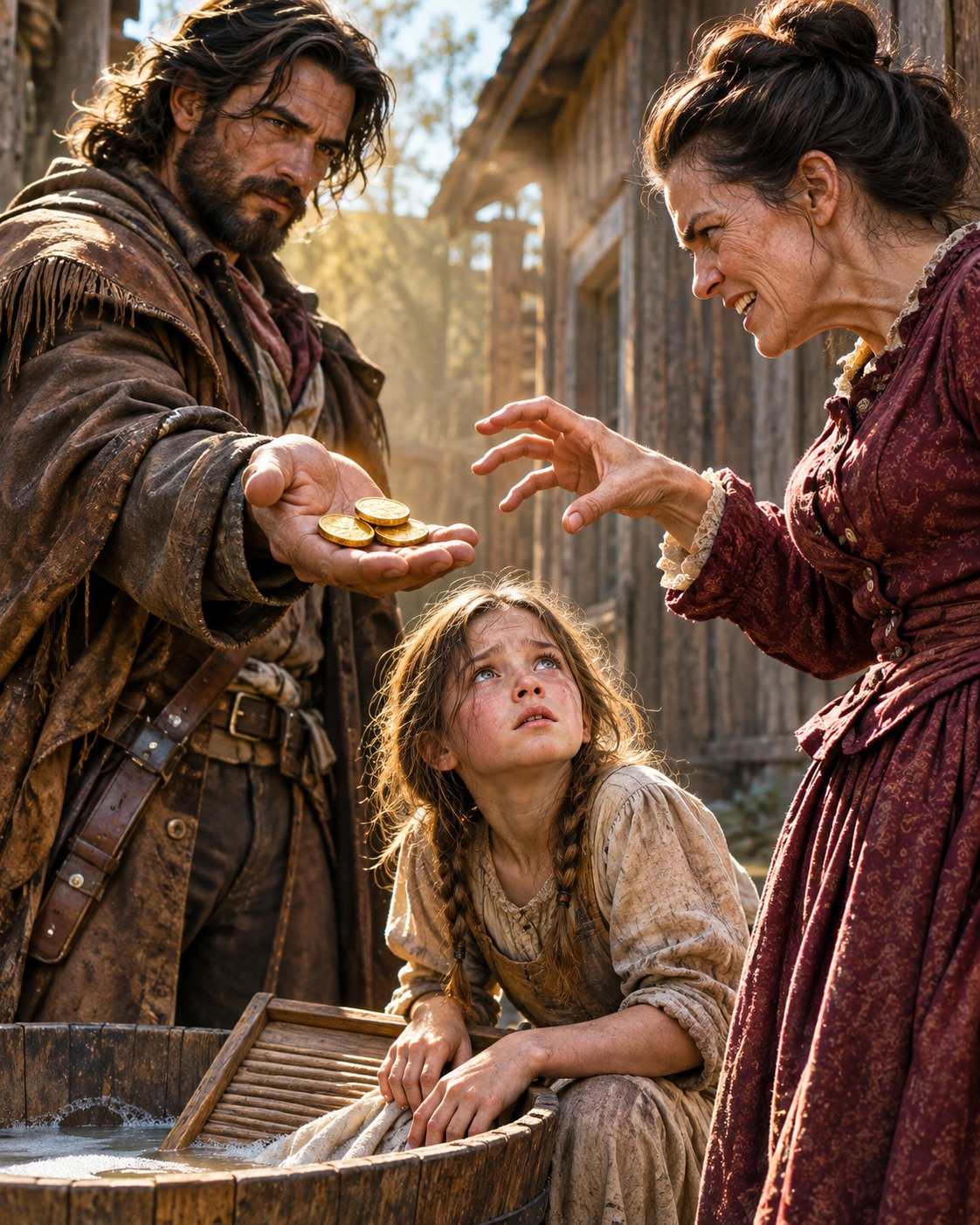
"Please, Ma! I'll wash it again!"
Abigail grabbed the edge of the wooden washtub as her mother raised the paddle.
A towering stranger stepped into the alley, holding three gold coins and staring at a small silver locket hanging from the girl's neck.
Two letters were scratched into the back of the locket.
E. W.
The stranger recognized them.
And suddenly, the three gold coins were no longer an offer.
They were a warning.
Abigail Whitmore was nine years old when her mother decided she was worth exactly three gold coins.
Not four.
Not five.
Three.
And if the stranger had offered two, Martha Whitmore probably would have accepted those instead.
Abigail would remember that afternoon for the rest of her life, although not for the reasons anyone in the little frontier town of Mercy Creek might have imagined.
She would remember the smell of dirty laundry.
The burning pain in her hands.
The sunlight falling across a stranger's enormous shoulders.
And the terrible smile that spread across her mother's face when she realized someone was willing to pay money for the daughter she had spent years convincing was worthless.
But the memory that would remain sharpest was something much smaller.
A single moment.
A single glance.
The instant the stranger noticed the silver locket around Abigail's neck.
Because for the first time in her short life, Abigail saw a grown man look at Martha Whitmore without fear, politeness, or submission.
He looked at her as though he knew something she desperately wanted buried.
And Martha, who had never been afraid of anyone in Abigail's presence, suddenly stopped smiling.
"Get that grease out!"
The wooden paddle struck the side of the washtub.
Abigail flinched so violently that the wet petticoat slipped from her fingers.
"I'm trying, Ma."
"Trying?"
Martha stepped closer.
"You've been trying for an hour."
Abigail stared at the stubborn yellow stain.
It was still there.
No matter how hard she scrubbed, the grease refused to disappear.
The woman who owned the petticoat had spilled cooking fat across it the previous evening. Abigail had overheard her laughing about it while drinking tea in the boarding house.
But Martha didn't care how the stain had gotten there.
She cared only that it remained.
"I'll use more soap," Abigail whispered.
"Soap costs money."
"I can rinse it again."
"Water costs work."
Abigail swallowed.
There was no right answer.
There never was.
Martha stood over her daughter with the wooden paddle hanging loosely from one hand.
She was a large woman with hard eyes and a mouth that seemed permanently dissatisfied.
To the customers who rented rooms in her boarding house, Martha Whitmore was respectable.
She kept clean beds.
She served hot meals.
She attended Sunday services whenever the traveling preacher passed through town.
And she always had a pleasant word for men who arrived carrying money.
People called her hardworking.
Some called her generous.
A few even said she deserved admiration for raising a daughter without a husband.
None of those people knew what happened behind the boarding house.
Or perhaps some did.
Abigail had begun to suspect that grown-ups could see more than they admitted.
They simply preferred not to become involved.
"Look at me."
Abigail lifted her eyes.
Martha's expression tightened.
"Do you know what Mrs. Bellamy pays me to wash her clothes?"
"No, Ma."
"Enough to keep food on this table."
Abigail glanced toward the kitchen window.
She hadn't eaten since the previous evening.
"Yes, Ma."
"And do you know what happens when you ruin her laundry?"
Abigail shook her head.
"She takes her business elsewhere."
Martha leaned forward.
"And then what happens?"
Abigail knew the answer.
She had heard it many times.
"We go hungry."
Martha smiled without warmth.
"Exactly."
Abigail lowered her eyes.
She wanted to say that they were already hungry.
At least she was.
Martha had eaten eggs and biscuits that morning while Abigail carried water from the pump.
She had watched through the kitchen doorway as her mother spread blackberry preserves across a warm biscuit.
For one foolish moment, Abigail had hoped Martha might leave her something.
Instead, Martha had scraped the remaining food into a bucket for the pigs.
Abigail had said nothing.
She always said nothing.
Silence was the closest thing to safety she understood.
"Well?"
Martha tapped the paddle against her palm.
"Are you going to sit there daydreaming?"
"No, Ma."
Abigail grabbed the petticoat.
She pressed it against the washboard and scrubbed.
Back and forth.
Back and forth.
The rough fabric scraped against the cracked skin of her fingers.
A sharp sting traveled through her knuckles.
She saw a thin red line appear in the cloudy water.
Blood.
She quickly submerged her hands.
If Martha noticed, she might accuse Abigail of ruining the laundry.
"Harder."
Abigail scrubbed harder.
"You're barely touching it."
Her shoulders trembled.
"Yes, Ma."
"Stop saying that!"
The paddle came down.
Abigail barely saw it move.
Pain burst across her shoulder, and her body pitched forward.
Her face struck the rim of the washtub before slipping into the water.
For one terrifying second, everything became gray and muffled.
She couldn't breathe.
Her hands scrambled against the wooden sides.
Then she pushed herself upright, coughing as dirty water streamed down her face.
Her lungs burned.
Her tongue tasted of blood.
But she didn't cry.
Not one tear.
Martha stood behind her.
"Look at the mess you've made."
Abigail blinked water from her eyes.
"I'm sorry."
"Sorry doesn't earn money."
"I know."
"Sorry doesn't put food on the table."
"Yes, Ma."
"And sorry certainly doesn't make you worth keeping."
Those words hurt more than the paddle.
Abigail stared at the ground.
She had heard them before.
But hearing something many times didn't always make it easier.
Sometimes it only made the words feel more permanent.
Martha raised the paddle again.
Abigail squeezed her eyes shut.
Then something unexpected happened.
The blow never came.
A shadow crossed the alley.
It stretched from the entrance all the way to the washtub.
Abigail opened her eyes.
At first, she saw only boots.
Large, worn leather boots covered in pale mountain dust.
Then dark trousers.
A heavy coat.
A broad chest.
And finally, the face of a man so enormous that Abigail wondered whether he could possibly fit through an ordinary doorway.
He stood at the alley entrance without moving.
His short, ash-blond hair looked as though it had been cut with a hunting knife.
A sandy beard covered his jaw.
His face was deeply weathered, with a thin scar near one eyebrow.
But his eyes were what Abigail noticed most.
Gray.
Steady.
Unusually quiet.
He looked at her.
Not at Martha.
Not at the laundry.
At her.
Abigail immediately lowered her head.
Strangers usually meant trouble.
Some complained that she washed too slowly.
Others laughed when Martha called her clumsy.
A traveling salesman had once offered Abigail a penny to sing for him, then snatched it away when she finished.
"Little beggars ought to learn their place," he had said.
Abigail had learned not to expect kindness from people she didn't know.
Martha lowered the paddle.
"Good afternoon, mister."
Her voice changed so quickly that Abigail almost looked up again.
It became sweet.
Respectful.
The voice Martha used when speaking to paying customers.
"Can I help you with something?"
The man said nothing.
His eyes moved toward the paddle.
Then toward Abigail's hands.
Abigail instinctively hid her fingers beneath the wet petticoat.
Martha noticed.
"Don't mind the girl," she said with a small laugh. "She's been difficult today."
The stranger didn't smile.
"Children need discipline," Martha continued. "Especially this one."
Still nothing.
Martha shifted her weight.
"Are you looking for a room?"
The man remained silent.
"Because I've got a perfectly respectable establishment here. Clean sheets. Hot supper. Reasonable rates."
He slowly reached toward his belt.
Abigail tensed.
For one frightening moment, she thought he might be reaching for a weapon.
Instead, he opened a worn leather pouch.
Something metallic caught the sunlight.
Gold.
Three coins rested in his enormous palm.
Martha stopped speaking.
Abigail watched her mother's face change.
It was almost frightening how quickly it happened.
The irritation vanished.
Her eyes widened.
Her lips parted.
And then came the smile.
The smile Abigail feared more than the paddle.
"Well," Martha whispered. "Now, that's something."
The stranger extended his hand.
Martha took a step forward.
"Are you paying for a room?"
He shook his head.
"Supplies?"
Another shake.
Martha frowned.
"What, then?"
The man raised his free hand.
And pointed directly at Abigail.
For several seconds, nobody moved.
Then Martha laughed.
It was a short, disbelieving sound.
"The girl?"
The stranger nodded.
Martha looked at Abigail.
Then at the coins.
Then back at Abigail.
"You want to take her?"
Another nod.
Abigail felt the world shift beneath her.
She didn't understand.
Not completely.
She knew people bought horses.
They bought cattle.
They bought furniture and land.
Sometimes they paid for workers to help with harvesting.
But children?
Could someone buy a child?
Could a mother simply decide she no longer wanted her daughter?
Abigail looked at Martha.
Surely she would refuse.
Surely there were some things even Martha wouldn't do.
Her mother held out her hand.
"Three coins?"
The stranger remained still.
Martha's smile widened.
"She's yours."
Abigail stopped breathing.
"Take her away," Martha continued. "She's never been worth the food I fed her."
The words fell into the alley like stones.
Abigail stared at her mother.
She waited for Martha to laugh.
To say it was a joke.
To tell the stranger that no amount of gold could purchase her daughter.
But Martha only stared at the money.
"Go on," she said impatiently. "Hand them over."
The stranger didn't move.
His attention had shifted.
Abigail followed his gaze.
He was looking at her neck.
At the small silver locket resting against the collar of her faded green dress.
The locket was the only beautiful thing Abigail owned.
It was small and oval, with a delicate floral pattern engraved across the front.
The silver had darkened with age.
Its clasp was bent.
A thin chain held it around her neck.
Abigail didn't remember receiving it.
She had simply always had it.
Martha hated the necklace.
Whenever she noticed it, she told Abigail to hide it beneath her dress.
"That thing's worthless," she would say.
But she had never taken it away.
Abigail didn't understand why.
The stranger slowly lowered his hand.
The three coins disappeared into his pouch.
Martha's smile vanished.
"Now, hold on."
The man stepped forward.
Abigail instinctively recoiled.
He stopped immediately.
For a moment, he simply looked at her.
Then he crouched.
Even kneeling, he seemed enormous.
But he didn't reach for her.
He held out his hand, palm upward.
Abigail stared at it.
His fingers were thick and scarred.
His knuckles looked as though they had been broken more than once.
He pointed gently toward the locket.
Abigail's hand flew to her throat.
"No," she whispered.
The stranger froze.
Martha stepped closer.
"Give him the necklace, girl."
Abigail shook her head.
It was the first time she had openly refused an order in months.
Martha's face darkened.
"Abigail."
The girl tightened her grip.
"Please, Ma."
"Do as you're told."
The stranger raised one hand.
Not toward Abigail.
Toward Martha.
A simple gesture.
Stop.
Martha looked offended.
"Now, see here—"
The man turned his head.
His gray eyes settled on her face.
Martha fell silent.
Abigail had never seen anyone quiet her mother so easily.
The stranger looked back at the girl.
He pointed toward the locket again.
Then he touched his own chest.
A question.
Abigail swallowed.
"You want to see it?"
He nodded.
She hesitated.
Every instinct told her to protect the little necklace.
It was hers.
The only thing in the world that belonged entirely to her.
But something about the man's patience confused her.
He wasn't grabbing.
He wasn't shouting.
He wasn't threatening to punish her.
He was waiting.
Slowly, Abigail lifted the chain over her head.
Her fingers shook.
She placed the locket in his open palm.
The stranger studied it.
Then he turned it over.
His entire body went still.
Abigail noticed the change immediately.
It wasn't dramatic.
He didn't gasp.
He didn't speak.
But something in his face tightened.
His thumb moved across the back of the locket.
Across two tiny letters scratched into the silver.
E. W.
Abigail had asked Martha about those letters once.
She had been six years old.
"What's E. W. mean, Ma?"
Martha had slapped her so hard that she fell from her chair.
"Stop asking stupid questions."
Abigail had never asked again.
Now the stranger stared at those same letters.
His breathing changed.
He closed his fingers around the necklace.
For a moment, Abigail thought he might never give it back.
Then he looked directly at Martha.
The expression in his eyes frightened her.
Not because it was cruel.
Because it was certain.
As though a question he had carried for years had finally received an answer.
Martha took a step backward.
"Where did you get that?" she demanded.
The stranger didn't answer.
"I asked you a question."
He slowly opened his hand.
The locket lay against his palm.
Martha's face lost its color.
"That's just some old trinket."
The man watched her.
"Not worth a penny," Martha added.
Silence.
"Belonged to her grandmother, I think."
The stranger's jaw tightened.
Abigail looked between them.
Something was wrong.
Martha was lying.
Abigail knew her mother's lies.
She recognized the hurried words.
The nervous way Martha smoothed her apron.
The sudden insistence that something unimportant was very important indeed.
The stranger reached into his coat.
Martha stiffened.
But he withdrew only a small leather notebook.
He opened it.
Several pages were filled with careful handwriting.
Abigail couldn't read much of it from where she sat.
The man turned to a page near the middle.
Then he held the notebook beside the locket.
Abigail saw a drawing.
An oval necklace.
A floral pattern.
Two letters.
E. W.
It was the same locket.
Exactly the same.
Martha saw it too.
Her mouth opened.
Then closed.
"Who are you?" she whispered.
The stranger didn't answer.
He turned the notebook toward Abigail.
Beneath the drawing was a name.
The letters were large enough for her to recognize.
ELIZABETH WHITMORE.
Abigail stared.
Whitmore.
Her own last name.
She looked at the stranger.
"Who is Elizabeth?"
The man closed his eyes.
Only for a moment.
When he opened them, his expression had changed.
There was something behind the stillness now.
Something Abigail couldn't understand.
Pain, perhaps.
Or grief.
Martha suddenly lunged forward.
"Give me that!"
She reached for the notebook.
The stranger stood.
Martha stopped so abruptly that she nearly stumbled.
He towered above her.
His face remained calm.
But his hand closed firmly around the notebook.
Martha stepped back.
"That necklace belongs to my daughter."
The stranger looked at Abigail.
Then at Martha.
He shook his head.
Martha's voice sharpened.
"What do you mean, no?"
He opened the notebook again.
This time he turned to the final page.
A folded piece of paper rested inside.
Yellowed.
Worn.
Carefully preserved.
The stranger removed it.
Martha stared at the paper.
Abigail saw fear flash across her mother's face.
Real fear.
Not irritation.
Not embarrassment.
Fear.
"Where did you get that?" Martha whispered.
The man unfolded the paper.
Abigail could see writing.
A signature.
And a dark circular mark near the bottom.
Martha backed toward the boarding-house door.
"That doesn't prove anything."
The stranger held the paper steady.
"You hear me?" Martha snapped. "It doesn't prove a thing!"
Abigail looked at the man.
"Please," she whispered. "What's happening?"
He lowered his eyes toward her.
For the first time, his expression softened.
Only slightly.
But enough that Abigail noticed.
He carefully returned the locket to her.
She held it against her chest.
Then he reached into his pouch again.
The three gold coins reappeared.
Martha watched them with desperate attention.
The stranger placed them on the rough wooden worktable.
One.
Two.
Three.
Each coin made a small metallic sound.
Martha stared.
"Well, finally."
She reached toward the money.
The stranger placed his large hand over the coins.
Martha froze.
He pointed toward Abigail.
Then toward the alley entrance.
Martha understood.
"You want her to go with you first?"
He nodded.
Martha hesitated.
Her eyes moved toward the paper in his other hand.
Then toward the gold.
Greed won.
It always did.
"Fine."
She turned toward Abigail.
"Get up."
Abigail's legs felt weak.
"Ma?"
"You heard me."
"Where am I going?"
"With him."
Abigail stared.
"But—"
"Don't argue."
The little girl slowly rose from her knees.
Her wet dress clung to her legs.
Her shoulder throbbed.
Her hands burned.
She looked toward the boarding-house door.
For nine years, that building had been the center of her world.
She knew every creaking floorboard.
Every broken window latch.
Every hiding place where she could escape Martha's temper for a few precious minutes.
She had dreamed of leaving.
Of walking down the road and never returning.
But now that the moment had arrived, terror overwhelmed her.
She didn't know the stranger's name.
She didn't know where he lived.
She didn't know whether he was kind.
She didn't know what he wanted.
And the worst part was that nobody seemed to care.
"Can I take my blanket?" she whispered.
Martha rolled her eyes.
"What blanket?"
"The one under my bed."
"You don't need it."
"It's cold at night."
"Then work harder wherever you're going and earn yourself another."
Abigail lowered her head.
The stranger watched.
Then he removed his heavy coat.
He crouched beside her and held it open.
Abigail hesitated.
He waited.
Slowly, she stepped closer.
He draped the coat around her shoulders.
It was enormous.
The sleeves hung far beyond her hands.
It smelled of pine smoke, leather, and mountain air.
For one strange moment, Abigail felt warm.
Not because of the summer heat.
Because someone had noticed she was cold.
The stranger rose.
Martha reached for the coins again.
This time he allowed her to take them.
She snatched all three and closed her fist.
"Pleasure doing business with you," she said.
The stranger looked at her.
There was no pleasure in his expression.
He turned toward the alley entrance.
Abigail followed.
She took three steps.
Then stopped.
"Ma?"
Martha sighed.
"What now?"
Abigail's throat tightened.
She had promised herself she wouldn't ask.
She knew the answer would hurt.
But some small, stubborn part of her still needed to know.
"Will you miss me?"
Martha stared at her.
Then she laughed.
"Miss the extra mouth to feed?"
Abigail felt something inside her go very quiet.
"No, girl."
Martha tucked the coins into her apron.
"I don't reckon I will."
Abigail nodded.
Just once.
Then she turned away.
She didn't cry.
She wouldn't give Martha that satisfaction.
The stranger stood waiting at the alley entrance.
When Abigail reached him, he moved aside so she could pass first.
It was such a small gesture.
So ordinary.
Yet Abigail had never experienced it.
Adults always went first.
Children followed.
Especially unwanted children.
She stepped into the sunlight.
The stranger followed.
Behind them, Martha called out.
"Wait!"
Abigail froze.
For one impossible heartbeat, hope rushed through her.
Maybe Martha had changed her mind.
Maybe she couldn't bear to watch her daughter disappear.
Maybe—
"Don't forget," Martha shouted. "No refunds!"
Abigail kept walking.
The stranger's horse stood near the boarding house.
It was a massive dark bay animal with a thick mane and a worn leather saddle.
Abigail had never ridden a horse.
She approached cautiously.
The animal lowered its head and sniffed her sleeve.
She stepped back.
The stranger placed one broad hand against the horse's neck.
The animal settled immediately.
Then he looked at Abigail.
He pointed toward the saddle.
She swallowed.
"Am I supposed to climb up?"
He nodded.
"I don't know how."
The man crouched beside her.
He held out both hands.
Abigail stared at him.
She had spent her entire life learning to avoid grown-ups' hands.
Hands meant chores.
Hands meant punishment.
Hands meant being grabbed by the arm and dragged somewhere she didn't want to go.
But this man waited.
Again.
Always waiting.
Finally, Abigail stepped forward.
He lifted her carefully onto the saddle.
His movements were so gentle that she barely felt herself leave the ground.
Then he mounted behind her.
The horse began walking.
Abigail clutched the saddle horn.
They passed the general store.
The blacksmith's shop.
The little white church.
Several townspeople glanced at them.
Nobody stopped the stranger.
Nobody asked why a little girl in a dirty dress was riding away with a man they didn't recognize.
Abigail watched Mercy Creek disappear behind them.
She wondered whether she would ever see it again.
After several minutes, she gathered enough courage to speak.
"Mister?"
The stranger looked down.
"Do you have a name?"
He said nothing.
"Can you talk?"
Still nothing.
Abigail hesitated.
"Are you angry with me?"
The man shook his head.
She considered that.
"Did I do something wrong?"
Another shake.
Abigail stared at her hands.
"Then why did you buy me?"
The stranger didn't answer.
He reached into his coat and withdrew the little notebook.
Keeping one hand on the reins, he opened it to a blank page.
He wrote something.
Then turned it toward her.
Abigail sounded out the words slowly.
YOU ARE SAFE.
She read them twice.
Then looked up.
"How do you know?"
The stranger's expression changed.
Only slightly.
He closed the notebook.
For a long time, they rode in silence.
The town disappeared.
The road narrowed.
Tall pines rose ahead of them.
Abigail held the locket beneath the stranger's coat.
She thought about the drawing in his notebook.
About the name written beneath it.
Elizabeth Whitmore.
And about the way Martha had looked when she saw the folded paper.
Finally, Abigail spoke again.
"Mister?"
He glanced down.
"Who was Elizabeth?"
The stranger's hands tightened around the reins.
The horse slowed.
For several seconds, he didn't move.
Then he reached toward his coat.
He took out the folded paper Martha had feared.
Abigail watched as he opened it.
She saw the same signature.
The same dark circular mark.
But this time, the stranger turned the paper over.
There was writing on the back.
Only one sentence.
Abigail leaned closer.
She could read most of the words.
If anything happens to me, find my daughter.
Below the sentence was a name.
Elizabeth Whitmore.
Abigail's heart began pounding.
"Was she my grandmother?"
The stranger shook his head.
Abigail stared at him.
"Then who was she?"
He looked toward the mountains.
His face had gone pale beneath the sunburn.
Slowly, he opened the notebook again.
He wrote four words.
Then he turned the page toward Abigail.
The little girl stared at the writing.
Her lips moved as she sounded out each word.
And just as she began to understand, the stranger reached beneath his shirt and pulled out a second silver locket.
It was identical to hers.
Except this one had been broken in half.
Inside was a tiny portrait of a young woman holding a newborn baby.
Abigail leaned forward.
The woman in the portrait had Abigail's eyes.
And beneath the picture, written in faded ink, were the words:
My darling Abigail.
The horse stopped.
The stranger looked down at the little girl.
For the first time, tears filled his gray eyes.
Then he turned the notebook toward her.
Abigail read the four words he had written.
SHE WAS YOUR MOTHER.
Behind them, somewhere along the empty road, a horse suddenly whinnied.
The stranger's head snapped around.
A rider had appeared between the trees.
And the rider was carrying Martha Whitmore's wooden paddle.






Comments 0