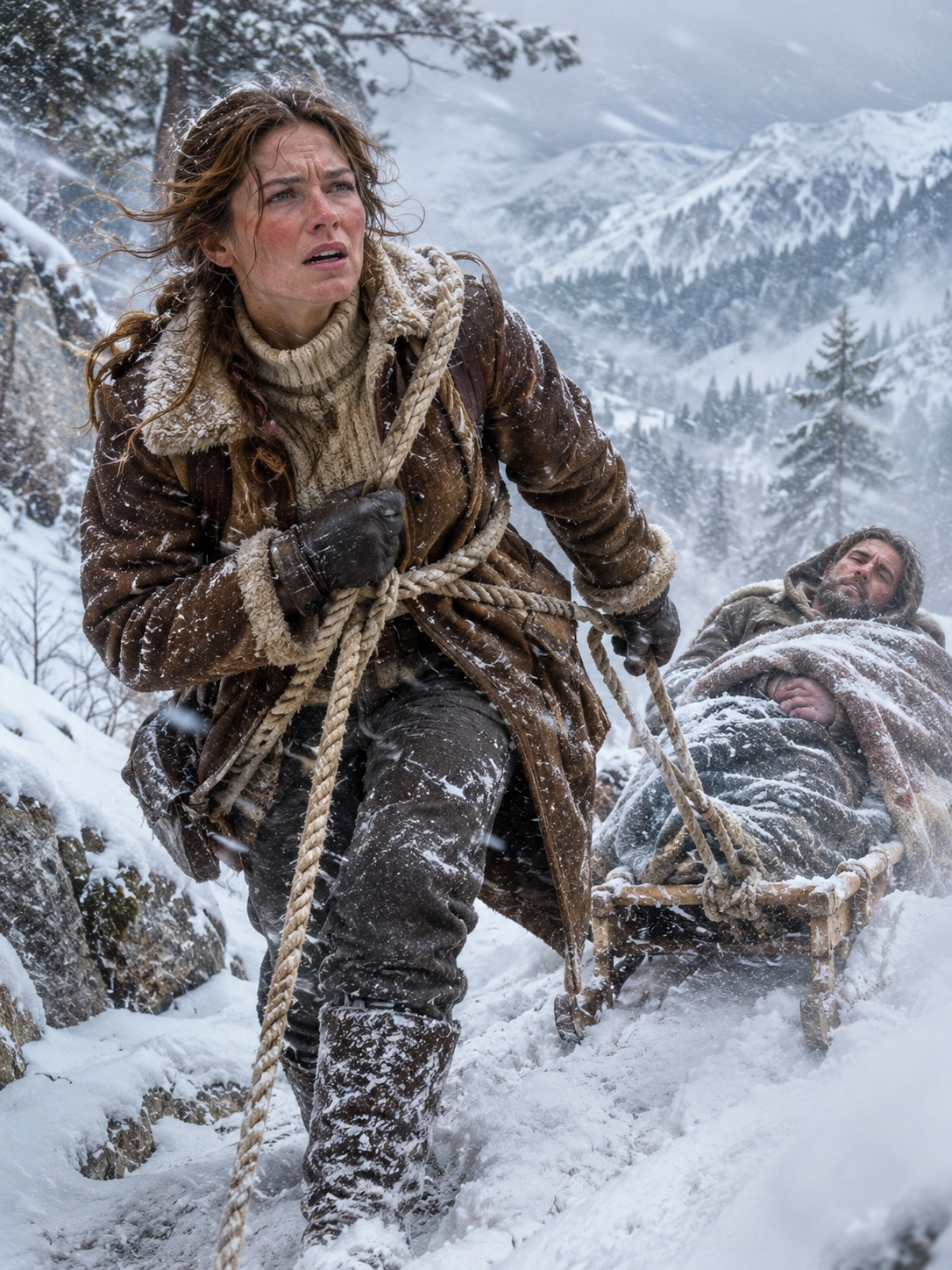
"Calvin! If that's you, answer me!"
Henrietta threw open the cabin door and found a wooden supply crate buried in the snow.
A strip of red wool was tied around its handle.
Three dark stitches marked one end.
Her husband had sewn those stitches himself.
And suddenly, Henrietta knew the knocking hadn't been an ordinary visitor.
Five days.
That was how long Calvin Mercer had been missing.
Five days since he had kissed the top of their old chestnut mare's head, tightened his saddle straps, and ridden toward the mining settlement beyond North Ridge.
Five days since Henrietta had watched him disappear between the pine trees without calling him back.
And five days since she had said the words she now wished she could tear out of the past.
"Maybe you'd be happier if you never came home."
She hadn't meant them.
Not really.
But grief had a way of turning ordinary arguments into wounds that refused to close.
Now, standing in the doorway of their isolated Wyoming cabin, with the December wind tearing at her nightdress beneath her wool shawl, Henrietta would have given anything to hear Calvin's boots crossing the floor.
Instead, she found a crate.
A torn scarf.
And the terrible possibility that someone had come to tell her she was already a widow.
"Hello?" she called into the darkness.
The wind answered.
Snow swept across the narrow porch, erasing the faint tracks that led away from the cabin.
Henrietta leaned forward, shielding her face with one hand.
"Who's there?"
Nothing.
The storm swallowed her voice.
She looked toward the barn.
Its roof was barely visible beneath the snow.
Beyond it stood the dark shapes of the pine trees.
And farther still, hidden beneath the mountains, lay the trail Calvin had promised to travel before the first heavy snowfall.
A promise he had broken.
Or perhaps one he had died trying to keep.
Henrietta bent down and grabbed the crate.
It was heavier than she expected.
She dragged it inside, kicked the door shut, and set it beside the fireplace.
The cabin suddenly seemed too quiet.
For three days, the wind had screamed through the valley, rattling the shutters and forcing snow through every crack in the walls.
But now Henrietta heard something else.
The ticking of the clock above the mantel.
The popping of the fire.
The soft scrape of her own breathing.
And the silence where Calvin's voice should have been.
She knelt beside the crate.
The red wool was unmistakable.
Calvin's scarf had been a Christmas gift from her four winters earlier.
She remembered sitting beside the fireplace, struggling to knit the uneven stitches while he pretended not to notice.
When she finally gave it to him, he had wrapped it around his neck and announced that no man in Wyoming had ever received a finer scarf.
She had laughed.
He had kissed her.
And for one brief winter, before everything changed, they had been happy.
Henrietta touched the three dark stitches.
Calvin had repaired a tear in the scarf himself after catching it on a fence nail.
He had made a terrible job of it.
She used to tease him about those crooked stitches.
Now they felt like the last remaining proof that he had once belonged to her.
She untied the wool.
The knot was stiff with ice.
Inside the crate lay a broken silver pocket watch and a folded piece of paper.
Henrietta recognized the watch immediately.
It had belonged to Calvin's father.
Calvin carried it everywhere.
He had once told her that as long as the watch kept ticking, he would always know when it was time to come home.
Now its glass was shattered.
Its hands had stopped at 4:17.
Henrietta picked it up carefully.
A dark stain marked the edge of the case.
She couldn't tell whether it was rust or dried blood.
Her stomach tightened.
"Calvin," she whispered.
Then she unfolded the paper.
The handwriting was uneven.
Some letters slanted sharply downward.
Others were barely legible.
But she knew his writing.
She had read it in the notes he left beside her breakfast plate, on grocery lists, and on the backs of envelopes when he wanted to tell her something without speaking.
This message contained only eleven words.
"North Ridge. Horse gone. Leg hurt. Can't reach home."
Henrietta read it once.
Then again.
She lowered herself onto the floor.
North Ridge.
Twelve miles.
Perhaps more, depending on where Calvin had become stranded.
Twelve miles through mountain country where a single wrong step could send a person tumbling into a ravine.
Twelve miles of snow-covered rock, frozen streams, and narrow trails that disappeared beneath winter storms.
And Calvin was injured.
Alone.
Without his horse.
She pressed the paper against her chest.
For five days, she had imagined him angry.
She had imagined him deciding to stay in the settlement until their argument cooled.
She had imagined him sitting beside a stove somewhere, drinking coffee with other ranchers and complaining about his stubborn wife.
She had even imagined him choosing not to return.
That possibility had frightened her more than she wanted to admit.
But she had never allowed herself to imagine him lying helpless in the snow.
Now she could see nothing else.
His hands turning blue.
His breathing growing shallow.
His voice calling for someone who couldn't hear him.
Henrietta rose unsteadily.
She looked toward the kitchen table.
Two plates sat beneath a clean cloth.
Two cups waited beside the coffeepot.
She had prepared supper for both of them every evening since Calvin disappeared.
At first, she told herself it was habit.
Then she claimed it was practicality.
If he returned hungry, he would need something warm.
But the truth was simpler.
As long as she set his place at the table, she could pretend he was coming home.
She crossed the room and touched the back of his chair.
The wood was smooth beneath her fingers.
Calvin had built that chair during their first winter together.
He had built almost everything in the cabin.
The table.
The shelves.
The bedframe.
Even the small wooden cradle they had placed beside the fireplace.
Henrietta's eyes moved toward the corner.
The cradle was gone now.
They had carried it into the storage shed two years earlier.
Neither of them had spoken while doing it.
Neither had cried.
That silence had been the beginning of everything that followed.
Their daughter, Rose, had lived only seven months.
Seven months of tiny fingers curling around Henrietta's thumb.
Seven months of sleepless nights, soft lullabies, and Calvin walking the floor with their baby against his chest.
Then came the fever.
The doctor had been delayed by a flooded crossing.
By the time he arrived, Rose was already gone.
Henrietta remembered every terrible minute.
She remembered Calvin kneeling beside the bed.
She remembered him pressing his forehead against their daughter's blanket.
And she remembered the way he had whispered, "I'm sorry, little bird."
Afterward, they buried Rose beneath a young pine tree overlooking the valley.
Calvin carved her name into a wooden marker.
Henrietta planted wildflowers around the grave when spring arrived.
For months, they visited together.
Then Calvin began going alone.
Later, he stopped going altogether.
Henrietta had mistaken that for forgetting.
Calvin had mistaken her refusal to leave the mountain for an unwillingness to live.
And somewhere between those misunderstandings, they had stopped reaching for each other.
Three months earlier, Calvin had suggested selling the ranch.
He wanted to move east.
Somewhere with neighbors.
A doctor within reach.
Winters that didn't threaten to bury them alive.
"We could start over," he had told her.
Henrietta had stared at him.
"Start over?"
"Henrietta—"
"With what? Another house? Another piece of land? Another child?"
He had flinched.
She remembered that now.
The way his expression had changed.
But she had been too angry to care.
"Rose is here," she had said. "Our daughter is here."
"I know where our daughter is buried."
"Then how can you ask me to leave her?"
Calvin had looked exhausted.
"Because I don't know how to keep watching you die beside her grave."
Those words had stayed between them for months.
Neither apologized.
Neither explained.
They continued sharing meals, doing chores, and sleeping beneath the same quilt.
But the warmth between them had faded.
Until five days earlier.
Until their final argument.
Henrietta closed her eyes.
She could still see Calvin standing beside the door, his red scarf hanging loose around his neck.
"I'll be back before the storm," he had said.
She hadn't looked up from the table.
"Do whatever you want."
"Henrietta, please."
"You're always talking about leaving. Maybe you'd be happier if you never came home."
Silence.
Then the quiet sound of the door closing.
She hadn't watched him ride away.
She hadn't even said goodbye.
Now the memory struck harder than the winter wind.
Henrietta opened her eyes.
"No," she whispered.
She wasn't going to let those be the last words he ever heard from her.
She hurried toward the bedroom.
Her winter clothing hung from wooden pegs beside the bed.
She pulled on heavy wool trousers, a thick knitted sweater, and her forest-green frontier coat.
The coat had belonged to her mother.
Its sleeves were slightly too long, but its heavy lining had protected her through countless winters.
She wrapped a burgundy scarf around her neck.
Pulled a dark wool bonnet over her short ash-blonde hair.
Then fastened her leather boots.
Her hands trembled as she worked.
Not from cold.
From fear.
She knew what waited outside.
The storm had already buried the fence line.
The path to the barn had disappeared.
Even the nearest trees were difficult to distinguish through the blowing snow.
No sensible person would attempt North Ridge tonight.
But Calvin was out there.
And sensible decisions had never brought anyone back from the dead.
Henrietta stopped.
She looked toward the fireplace.
For one terrible moment, she considered waiting until morning.
Perhaps the storm would weaken.
Perhaps someone from the settlement would come.
Perhaps Calvin had found shelter.
Perhaps he could survive another night.
Then she remembered the broken watch.
The torn scarf.
The trembling handwriting.
"Leg hurt. Can't reach home."
He had used the little strength he possessed to send her those words.
He hadn't written goodbye.
He had written where to find him.
Henrietta took a deep breath.
"All right," she whispered. "I'm coming."
She crossed to the storage cupboard.
Inside were supplies Calvin had prepared for winter emergencies.
A small oil lantern.
A tin of matches.
A folded canvas tarp.
A hunting knife.
A length of sturdy rope.
She took them all.
Then she added dried beef, hard biscuits, a small flask of water, and a wool blanket.
She filled a second flask with hot coffee.
She packed everything into a canvas satchel.
Near the door stood Calvin's old wooden walking staff.
He had carved it from a fallen ash branch during their first year on the mountain.
Henrietta picked it up.
The wood felt familiar.
Solid.
Reliable.
She needed something reliable tonight.
Outside, the wind struck the cabin so hard that the shutters rattled.
Henrietta moved to the window.
Beyond the glass, the world had disappeared beneath a wall of white.
She could barely see the porch railing.
A sudden fear tightened around her chest.
What if she became lost before reaching the lower trail?
What if she fell?
What if Calvin was already dead?
She pressed her palm against the cold glass.
For a moment, she imagined him standing behind her.
His hand resting gently on her shoulder.
His voice telling her not to be foolish.
Telling her to stay inside.
Telling her he could manage.
But Calvin had spent their entire marriage trying to carry every burden alone.
And she had spent the last two years pretending she didn't need him.
Neither of them had been right.
Henrietta turned away from the window.
She returned to the crate.
The broken watch lay beside the fireplace.
She picked it up and slipped it into her coat pocket.
Then she examined the note again.
Something about the paper troubled her.
It was thick and rough, the kind used for wrapping supplies at the mining settlement.
One corner had been torn away.
The message contained no explanation of how it had reached the cabin.
No name.
No instructions.
Only Calvin's words.
Henrietta looked toward the door.
Someone had carried the crate through the storm.
Someone had climbed the mountain.
Someone had knocked three times and disappeared.
Why?
If they had found Calvin, why hadn't they brought him home?
If they knew where he was, why hadn't they stayed to help?
She unfolded the paper completely.
On the reverse side, beneath a smear of moisture, she noticed a faint mark.
A straight line.
Then another.
She moved closer to the lantern.
The marks appeared to be part of a symbol.
Perhaps a mining-company stamp.
Perhaps nothing.
She had no time to study it.
She tucked the paper into her pocket beside the watch.
Then she opened the door.
The wind hit her like a physical blow.
Snow rushed into the cabin.
The lantern flame flickered.
Henrietta stepped onto the porch and immediately sank to her ankles.
She pulled the door shut behind her.
For a moment, she stood perfectly still.
The cold was worse than she expected.
It cut through her scarf and burned her cheeks.
She could hear the wind moving through the pine trees, a low, terrible sound like something alive.
She secured one end of the rope around the sturdy porch post.
Then she measured out enough length to reach the first large pine tree beside the trail.
She couldn't carry twelve miles of rope.
She knew that.
But she could use it to navigate the first dangerous stretch beyond the cabin.
After that, she would rely on the trees, the shape of the land, and the memories of every journey she had made with Calvin.
She tightened the strap of her satchel.
Gripped the walking staff.
And stepped off the porch.
The snow reached nearly to her knees.
Each movement required effort.
She planted the staff ahead of her, testing the ground before shifting her weight.
The wind pushed against her shoulder.
She leaned forward.
One step.
Then another.
Behind her, the cabin's windows glowed warmly through the storm.
She refused to look back.
After several minutes, she reached the pine tree.
She secured the rope around its trunk and paused to catch her breath.
The cabin was already barely visible.
She could still return.
She could crawl into bed.
Pull the quilt over her shoulders.
Wait for morning.
Instead, she untied the rope and coiled it carefully.
Then she moved deeper into the storm.
The trail descended toward a frozen creek before climbing sharply toward North Ridge.
Henrietta knew the route.
She had traveled it in spring when the mountain flowers bloomed.
In summer when the creek ran clear.
In autumn when the trees turned gold.
But winter had transformed everything.
The familiar rocks were buried.
The creek had vanished beneath ice.
Even the trees seemed to lean differently beneath the weight of snow.
She counted her steps.
Twenty.
Forty.
Sixty.
Then stopped to listen.
Nothing.
Only wind.
She moved forward again.
A sudden gust tore at her bonnet.
She grabbed it before it disappeared.
Her fingers were already growing stiff inside her mittens.
She flexed them.
Kept walking.
She thought of Calvin.
Of the way he always warmed her hands between his own after she came inside from feeding the animals.
Of the ridiculous songs he sang while chopping firewood.
Of the morning he had carried Rose outside to show her the first snowfall.
Their daughter had laughed.
A small, delighted sound.
Calvin had laughed with her.
Henrietta stumbled.
Her staff sank unexpectedly deep.
She stopped.
Tested the ground.
A hollow sound came from beneath the snow.
She had reached the creek.
The ice was hidden beneath a thick white covering.
She moved carefully along the bank, searching for the narrow crossing where the water was shallowest.
Calvin had marked it with two stones years earlier.
Both were buried now.
Henrietta looked around.
Then she saw the bent trunk of an old willow.
She remembered it.
The crossing lay just beyond.
She took another step.
The snow beneath her boot cracked.
She froze.
A thin fracture spread across the icy surface.
Water moved somewhere below.
Henrietta slowly shifted her weight backward.
The ice groaned.
She held her breath.
Then pulled her foot free.
Her heart pounded.
She backed away until she reached solid ground.
For several seconds, she stood trembling.
She had almost fallen through.
And she hadn't even traveled the first mile.
Henrietta looked toward the mountains.
Somewhere beyond them, Calvin was waiting.
She wiped snow from her face.
Found a safer crossing upstream.
And continued.
An hour passed.
Then another.
The storm showed no sign of weakening.
Her legs burned.
Her shoulders ached.
Ice formed along the edge of her scarf.
But she kept moving.
At last, she reached a narrow stand of pines near the lower ridge.
She paused beneath their branches, grateful for the slight shelter.
She took a sip of coffee.
It was barely warm now.
She returned the flask to her satchel.
Then she heard something.
A faint metallic sound.
Henrietta lifted her head.
It came again.
A small clink.
Like metal striking stone.
She turned toward the trees.
"Hello?"
No answer.
She waited.
The sound came a third time.
Closer.
Her pulse quickened.
She raised the lantern.
A dark shape stood between two snow-covered pines.
For one impossible second, she thought it was Calvin's horse.
Then the shape moved.
Henrietta stepped backward.
"Who's there?"
The figure remained motionless.
She could see only a broad outline beneath a heavy coat.
Snow covered its shoulders.
Its face was hidden.
Henrietta tightened her grip on the walking staff.
"Did you bring the crate to my cabin?"
The figure shifted.
A gloved hand emerged from beneath the coat.
Something silver caught the lantern light.
Henrietta stared.
It was a second piece of Calvin's broken pocket watch.
The missing back cover.
The stranger held it out toward her.
And when Henrietta reached for it, the figure spoke her husband's name.
But the voice was not Calvin's.
It was someone she recognized.
Someone who had no reason to be on that mountain.
Someone she had believed was gone from Wyoming forever.






Comments 0