The third knock came from beneath the floorboards.
Caleb Hayes stood so suddenly that his chair scraped across the cabin floor.
"Eliza?"
The name escaped his mouth before he could stop it.
Above him, Martha Jenkins sat upright in the narrow sleeping loft, her blanket clutched against her chest.
She had heard the knocking.
She had heard the name.
And she had heard something else.
A faint scraping sound, as though someone were dragging fingernails along the underside of the wooden floor.
"Mr. Hayes?" she called softly.
Caleb did not answer.
He stood beside the stove, staring at a particular floorboard near the back wall.
The fire cast an orange glow across his weathered face. For the first time since Martha had met him, the mountain man looked genuinely frightened.
Not startled.
Not confused.
Frightened.
"Mr. Hayes," she repeated. "Is someone underneath the house?"
"No."
The answer came too quickly.
Martha swung her legs over the edge of the loft.
"Then what was that noise?"
"Wood settling."
"Wood doesn't usually knock three times."
Caleb looked up sharply.
"You ought to be sleeping."
"And you ought to be telling me the truth."
For several seconds, neither spoke.
Then Caleb crossed the room, took an iron poker from beside the stove, and struck the suspicious floorboard twice.
A hollow sound answered.
He waited.
Nothing.
He struck it again.
Still nothing.
"See?" he said. "Old cabins make noises."
Martha studied him from above.
His hand was gripping the poker so tightly that his knuckles had turned pale.
"Who is Eliza?"
Caleb froze.
The silence that followed seemed to swallow the entire cabin.
Finally, he placed the poker against the wall.
"Someone I knew."
"Is she dead?"
His jaw tightened.
"Go to sleep, Martha."
She wanted to ask another question.
Instead, she lay back beneath the blanket.
She had spent too many years recognizing the moment when a man decided that a woman had asked enough.
But she did not sleep.
Below her, Caleb remained beside the stove until the fire burned low.
And long after he believed she had drifted off, Martha heard him whisper something into the darkness.
"Not again."
Morning arrived with the sharp smell of wood smoke and frying pork.
Caleb woke to the sound of iron scraping against iron.
For a moment, he forgot there was another person in the cabin.
Then he looked down from the narrow cot he had made beside the stove.
Martha was already working.
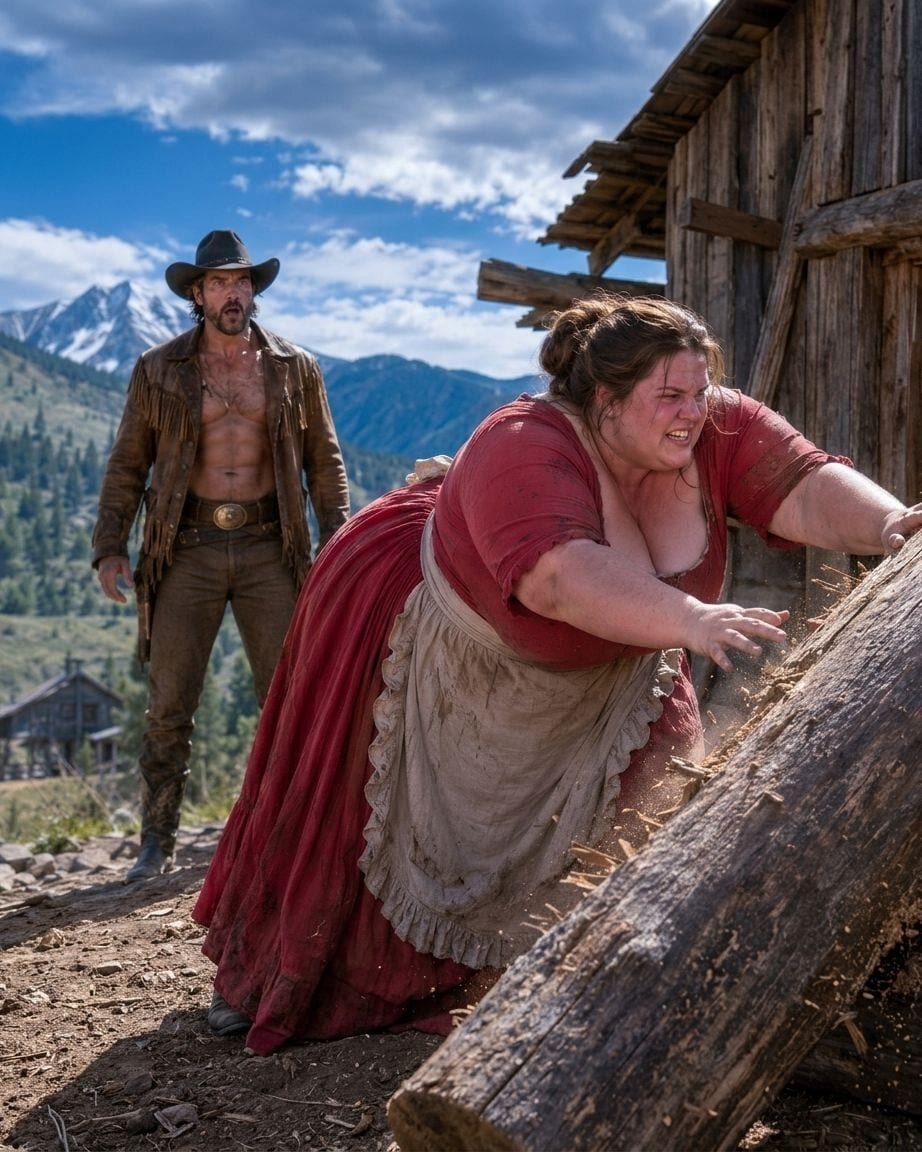
She had tied her auburn hair into a thick braid and pinned it behind her head. Her mustard-yellow dress was covered by a worn cream apron, and her sleeves were rolled above her wrists.
She stood before the cast-iron stove, turning pieces of salted pork in a heavy skillet.
A pot of coffee simmered nearby.
On the table sat six thick biscuits.
Caleb blinked.
"What time is it?"
"Nearly six."
"You been up long?"
"Long enough."
He pushed himself upright.
"You should've woken me."
"You looked tired."
He stared at her.
Nobody had worried about whether Caleb Hayes looked tired in a very long time.
He pulled on his boots.
"That skillet's heavy."
"I noticed."
"Handle gets hot."
"I noticed that too."
He opened his mouth.
Then closed it.
Martha turned toward him.
"Coffee?"
"Please."
She poured a cup and set it on the table.
Caleb sat.
The biscuits were golden on top, dense in the middle, and better than anything he had made for himself in years.
He ate two before speaking.
"Where'd you learn to cook?"
"My grandmother."
"She run a boardinghouse?"
"No. She raised six children and a husband who believed hunger was a personal insult."
Caleb almost smiled.
Almost.
Martha noticed.
She returned her attention to the stove.
He watched her move through the cramped cabin.
She was undeniably large. Her hips brushed the edge of the table, and she had to turn sideways to pass between the stove and the shelves.
But she moved with careful purpose.
Nothing spilled.
Nothing broke.
Every movement seemed planned.
Caleb remembered his calculations from the previous day.
More flour.
More beans.
More meat.
He looked at the food on Martha's plate.
One biscuit.
A small portion of pork.
Coffee without sugar.
"That all you're eating?"
Martha stiffened.
"Yes."
"Long day ahead."
"I'm aware."
"You'll need more than that."
She set down her fork.
"Mr. Hayes, if you're concerned about how much food I consume, you may tell me directly."
Caleb frowned.
"What?"
"I know what you were thinking yesterday."
He looked away.
"Don't know what you're talking about."
"Of course you do."
Her voice remained steady.
"You looked at me and wondered how much it would cost to feed me through winter."
Caleb felt heat rise beneath his collar.
He could have denied it.
He could have lied.
Instead, he said nothing.
Martha nodded once.
"That's what I thought."
She pushed back her chair.
"Don't worry. I know how to make food last."
Caleb watched her carry her plate to the washbasin.
He had spent twenty dollars to bring this woman from Boston.
He had expected labor in exchange for shelter, food, and the legal protection of his name.
But he had not expected her to see straight through him.
And he certainly had not expected to feel ashamed.
By midmorning, the mountain had begun testing its newest resident.
Caleb showed Martha the woodpile, the chicken enclosure, the smokehouse, and the narrow trail leading down to the creek.
He explained which logs burned hottest.
Which vegetables needed protecting from frost.
Which mushrooms were poisonous.
And which parts of the forest she should never enter alone.
"Why?" Martha asked when he pointed toward the northern ridge.
"Old mine shafts."
"Are they marked?"
"Some."
"And the others?"
"That's why you stay away."
She nodded.
Caleb handed her a pair of thick work gloves.
"These belonged to my father. Might fit."
They were too small around her palms.
She tried anyway.
The leather split along one seam.
Caleb saw it.
Martha saw him see it.
For a moment, the old humiliation returned.
"I can mend them," she said.
"Wasn't going to say anything."
"You didn't have to."
He looked at the torn glove.
Then at her hands.
"There's another pair in the shed."
He retrieved them without another word.
The second pair fit.
They spent the morning stacking firewood beneath the cabin's overhanging roof.
Caleb carried the larger logs.
Martha arranged them in tight rows, leaving narrow spaces for air.
She worked slowly.
Her breathing became heavy after the first hour.
Sweat darkened the back of her dress.
Several times, Caleb noticed her pause with one hand against the wall.
He pretended not to see.
At noon, he finally said, "Take a rest."
"I'm nearly finished."
"Wasn't a suggestion."
Martha straightened.
Her face was flushed.
"I don't take orders particularly well."
"Then you're going to have a difficult marriage."
She looked directly at him.
"Perhaps you should have mentioned that in your advertisement."
Caleb stared.
Then a short laugh escaped him.
It surprised them both.
Martha's expression softened for a fraction of a second.
But she did not laugh.
She sat on an overturned chopping block and accepted the water flask he offered.
Caleb leaned against the shed.
For several minutes, they listened to the wind moving through the pines.
Then Martha asked, "Why did you send for a wife?"
He glanced at her.
"Needed help."
"That's all?"
"That's plenty."
"Did you ever consider hiring a farmhand?"
"Farmhands leave when the weather turns bad."
"And wives don't?"
He looked toward the mountains.
"Depends on the wife."
Martha turned the flask between her hands.
"Why didn't you marry someone from Bitter Creek?"
Caleb's expression hardened.
"Wasn't interested."
"In any of them?"
"No."
She waited.
He offered nothing more.
Then she asked the question she had been carrying since the night before.
"Was Eliza your wife?"
Caleb's head turned sharply.
"Don't."
Martha remained still.
"I wasn't trying to hurt you."
"Then leave it alone."
He pushed away from the shed.
"Got traps to check."
He collected his rifle and a coil of rope from the cabin.
Before leaving, he stopped beside her.
"Don't go beyond the creek."
"I won't."
"And keep the stove going."
"I will."
He hesitated.
For a moment, Martha thought he might say something about Eliza.
Instead, he walked into the trees.
The first time Martha had seen her own name printed in the Boston matrimonial agency's register, she had cried.
Not because she was happy.
Because she was desperate.
At forty-two, she had exhausted nearly every respectable means of supporting herself.
She had worked in kitchens.
Taken in sewing.
Washed laundry until her hands cracked and bled.
Cared for elderly women who thanked her in public and mocked her weight in private.
Her mother had died believing Martha's unmarried state was a family disgrace.
Her sisters had married young.
Both had husbands, children, and houses with polished windows.
Neither had offered Martha a permanent place to stay.
When she answered Caleb Hayes's advertisement, she had written honestly about her abilities.
She could cook.
Sew.
Preserve vegetables.
Manage household accounts.
Tend chickens.
Care for the sick.
She had also written that she was a large woman.
The agency clerk had read the letter and shaken his head.
"Best leave that part out, Miss Jenkins."
"Why?"
"Because men want wives, not warnings."
She had stared at him.
Then taken back the paper.
But when the final letter was sent, that sentence was gone.
Not by her choice.
By the agency's.
Now, standing alone in Caleb's cabin, Martha wondered whether she should tell him.
Would he believe her?
Would he think she had deceived him?
Would he send her back?
She opened her trunk and removed a folded envelope.
Inside was the agency's original receipt.
Twenty dollars.
That was what Caleb had paid.
Twenty dollars to bring a stranger into his life.
Martha ran one finger across the ink.
She had spent years being told she was worth less than other women.
Now she possessed a document that seemed to prove it.
She folded the receipt and returned it to the trunk.
Then she went back to work.
By afternoon, the cabin smelled of fresh bread.
Martha had scrubbed the table, cleaned the stove, and repaired the torn glove.
She also discovered that one of the kitchen shelves had begun pulling away from the wall.
She found a hammer.
Two nails.
And a short length of scrap wood.
The repair took twenty minutes.
When she finished, the shelf was stronger than before.
She stood back to inspect it.
Then she noticed something unusual.
The lowest section of the wall near the stove had been repaired with newer boards.
The surrounding timber was dark with age.
These boards were pale.
And one had a small mark carved into its surface.
An E.
Martha crouched.
The letter had been cut carefully into the wood.
Not scratched by accident.
She touched it.
Eliza.
The name returned to her immediately.
She glanced toward the floorboard Caleb had struck during the night.
A narrow gap ran along one edge.
Martha pressed her fingertips against it.
The board shifted.
Only slightly.
She pulled her hand away.
She had no intention of searching through a man's secrets on her second day in his home.
But the knocking troubled her.
So did Caleb's reaction.
She stood.
And forced herself to return to the bread.
Caleb returned shortly before sunset.
He carried two rabbits and a bundle of pelts.
His boots were muddy, and his face was drawn.
Martha met him outside.
"Any luck?"
"Enough."
She noticed blood on his sleeve.
"You're hurt."
"Scratch."
"Let me see."
"It's nothing."
She stepped closer.
"Mr. Hayes."
He sighed.
Then rolled back his sleeve.
A long cut crossed his forearm.
It wasn't deep, but the skin around it was dirty.
Martha frowned.
"Inside."
"I've had worse."
"Then you should know better."
He followed her into the cabin.
She boiled water, found clean linen, and washed the wound.
Caleb sat at the table while she worked.
Her hands were surprisingly gentle.
He watched her face.
She was concentrating so completely that she seemed unaware of his attention.
"Where'd you learn this?" he asked.
"I cared for my grandmother before she died."
"She sick long?"
"Three years."
"That's a long time."
"Not long enough."
Caleb looked away.
Martha tied the bandage.
"There."
He examined it.
"Good work."
"Thank you."
He hesitated.
Then said, "I was wrong this morning."
She looked up.
"About what?"
"The food."
Martha's hands stopped.
Caleb rubbed his beard.
"Was thinking about winter stores. About whether we'd have enough."
"I know."
"Should've asked what you needed instead of making assumptions."
She studied him.
It was not an elaborate apology.
Caleb Hayes did not appear capable of elaborate apologies.
But it was sincere.
"Thank you," she said quietly.
He nodded.
Then his gaze drifted toward the stove.
He noticed the repaired shelf.
"That was loose."
"It isn't anymore."
"You fix it?"
"Yes."
He stood and examined her work.
"Good brace."
"My grandfather was a carpenter."
"Teach you?"
"Enough to be dangerous."
Caleb gave another of those rusty laughs.
For the first time, Martha felt something inside her loosen.
Perhaps this marriage would not be entirely miserable.
Perhaps the mountain man could learn to see her as a person.
Perhaps—
Caleb suddenly stopped laughing.
His eyes had settled on the pale boards beneath the stove.
The boards marked with the letter E.
His face changed.
"Did you touch those?"
Martha turned.
"The shelf?"
"The boards."
"No."
He crossed the room.
Knelt.
Pressed his hand against the wood.
Then looked back at her.
"Did you hear anything today?"
She hesitated.
"No."
"Any knocking?"
"No."
He stood.
"Good."
But he did not look relieved.
He looked like a man waiting for something terrible to happen.
They ate supper quietly.
Afterward, Caleb checked the door latch twice.
He secured the shutters.
Then he moved a heavy wooden chest against the wall near the stove.
Martha watched.
"Is there something wrong?"
"No."
"Then why are you moving that chest?"
"Draft comes through the boards."
She looked toward the window.
The evening was cold, but there was hardly any wind.
Caleb avoided her eyes.
At last, Martha said, "You don't have to tell me everything about your past."
He stopped.
"But if there's something dangerous in this cabin, I deserve to know."
Caleb remained silent.
Then he turned toward her.
"Eliza was my sister."
Martha felt her breath catch.
He stared at the floor.
"She lived here years ago."
"What happened to her?"
His expression became unreadable.
"She went away."
"Where?"
"I don't know."
Martha waited.
Caleb's voice dropped.
"One winter, she was here. The next morning, she wasn't."
Martha stared at him.
"She disappeared?"
He nodded.
"Did you look for her?"
"For months."
"And nobody found her?"
"No."
The stove popped softly.
Caleb looked toward the boarded section of wall.
"Sometimes I hear things."
Martha said nothing.
"Old wood. Animals. Wind. I know what it is."
But he did not sound convinced.
He rubbed both hands over his face.
"I shouldn't have said her name last night."
"Why?"
He looked at her.
"Because for one second, I thought she had come home."
Martha felt an unexpected ache in her chest.
This hard, suspicious man had spent years alone with a grief he could not bury.
She wanted to reach for his hand.
Instead, she said, "I'm sorry."
Caleb nodded.
Then he rose.
"Get some sleep."
Martha climbed into the loft.
Below her, Caleb extinguished the lamp.
The cabin settled into darkness.
For a while, she listened to his breathing.
Then the sound came again.
A scrape.
A pause.
Three knocks.
Martha sat upright.
This time, Caleb was already standing.
She heard the chest drag across the floor.
Then the metallic click of a rifle being loaded.
"Mr. Hayes?"
"Stay up there."
His voice was barely audible.
Martha moved toward the edge of the loft.
Caleb stood near the stove, rifle in hand.
The knocking came again.
Not from the wall.
Not from the roof.
From directly beneath the loose floorboard.
Caleb crouched.
He reached for the iron poker.
Wedged its tip into the narrow gap.
And pulled.
The board lifted.
Cold air rose from the darkness beneath.
Martha leaned forward.
"What's down there?"
Caleb did not answer.
He lifted the board farther.
Something pale lay beneath it.
A folded piece of cloth.
He reached down.
Pulled it free.
And froze.
It was a woman's handkerchief.
Yellowed with age.
Embroidered in one corner with the initials E.H.
Caleb stared at it.
His breathing became uneven.
Martha watched from above.
"Was that hers?"
He nodded slowly.
Then a faint sound rose from the opening.
Not a knock.
Not a scrape.
A woman's voice.
So quiet that Martha almost believed she had imagined it.
"Caleb."
The rifle slipped slightly in his hands.
He leaned closer.
The voice came again.
"Caleb... help me."
Martha gripped the loft railing.
Caleb slowly turned toward the dark opening beneath the floor.
Then, from somewhere inside it, a small wooden latch clicked.
A narrow panel shifted.
And a hidden door began opening from the other side.






Comments 0