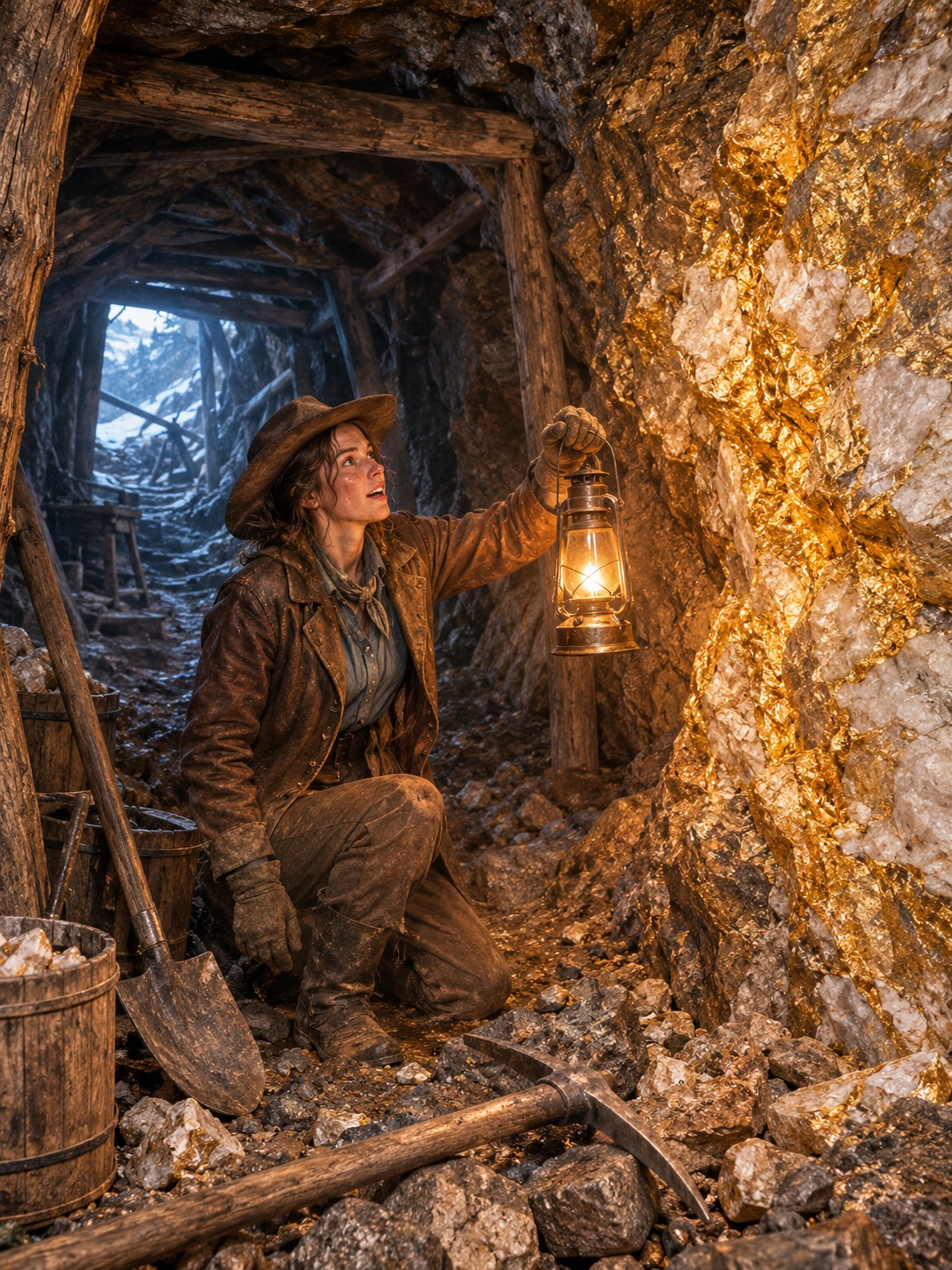
"Put the paper down, Eleanor."
The voice echoed through the ruined chapel.
Eleanor Hayes stood beside the broken altar, holding the final document her mother had hidden beneath the old mission. Moonlight spilled through the collapsed roof, illuminating the pistol aimed at her chest.
For a moment, she couldn't believe what she was seeing.
"Daniel?"
Daniel Mercer stepped into the light.
The young miner who had warned her about Crowe's men.
The man who had brought armed workers to rescue her in the canyon.
The man who had stood beside her when the richest man in Black Creek finally fell.
He was smiling.
But it was not the uncertain, friendly smile she remembered.
"Hello, Eleanor."
Thomas Hayes moved in front of his daughter.
"Lower that weapon."
Daniel shifted the pistol toward him.
"Stay where you are, Mr. Hayes."
Eleanor looked down at the document.
The final name on her mother's list was written in careful black ink.
DANIEL MERCER.
Beside it was one word.
Betrayer.
Her fingers tightened around the paper.
"You worked for Crowe."
Daniel shrugged.
"Sometimes."
"You warned me about his men."
"Because I wanted you to trust me."
"You helped us escape."
"Because I needed you alive."
Eleanor felt her stomach turn.
Daniel looked toward the metal cylinder on the altar.
"And because I knew your mother had hidden something Crowe never found."
Thomas stared at him.
"How old are you?"
Daniel's smile widened.
"Old enough."
"You were a child when those miners disappeared."
"That's true."
"Then how could you have betrayed Margaret?"
Daniel's expression changed.
For the first time, the smile faded.
"Because she trusted me with something fifteen years ago."
Eleanor studied his face.
He had always looked young.
Perhaps twenty-five.
But now, beneath the moonlight, she noticed the lines around his eyes.
The faint scars near his jaw.
The careful way he carried himself.
"You're not Daniel Mercer," she whispered.
He laughed softly.
"No."
Thomas took a step forward.
Daniel raised the pistol.
"Don't."
Eleanor looked at the name again.
Then at the man.
"Who are you?"
He hesitated.
Finally, he said, "My name is Jonathan Mercer."
Thomas went pale.
Eleanor turned toward him.
"Papa?"
Thomas stared at the stranger.
"Jonathan Mercer died in the western shaft."
Daniel smiled.
"That's what Crowe told everyone."
The chapel fell silent.
Then Eleanor understood.
Jonathan Mercer had been one of the seventeen miners listed among the dead.
One of the men whose families had mourned an empty grave.
One of the men Crowe had supposedly buried alive.
But he had survived.
And he had returned to Black Creek under a younger brother's name.
"Why?" Eleanor asked.
Jonathan looked at the document.
"Because your mother knew what I did."
Thomas's expression hardened.
"What did you do?"
Jonathan swallowed.
"I opened the western gate."
Eleanor felt a chill.
"The gate Crowe used to trap the miners?"
He nodded.
"Yes."
Thomas stepped closer.
"You helped him."
Jonathan looked away.
"I was supposed to let the men out after Crowe finished questioning them."
Eleanor stared.
"Questioning them about what?"
"The gold. The records. The hidden passage."
Jonathan's voice grew quieter.
"Crowe promised nobody would die."
Thomas shook his head.
"And you believed him?"
Jonathan's expression twisted.
"I was nineteen years old. He offered me more money than I'd ever seen."
Eleanor thought of the seventeen men.
The pounding behind the wall.
The families waiting for husbands and fathers who would never come home.
"And when he ordered the passage sealed?"
Jonathan lowered his eyes.
"I ran."
Thomas stared at him.
"You left them."
Jonathan nodded.
"I crawled through a drainage opening before the blasting started. Crowe thought I was still inside."
Eleanor felt anger rise.
"You could have told someone."
"I was afraid."
"Everyone keeps saying that."
Jonathan looked at her.
She continued, "Reed was afraid. Pike was afraid. Samuel was afraid for his son. And every time someone was afraid, Crowe became more powerful."
Jonathan said nothing.
Eleanor held up the document.
"My mother found you."
He nodded.
"She recognized me at a freight station outside Sacramento."
"What happened?"
"She asked me to testify."
"And?"
Jonathan looked toward the pistol.
"I promised I would."
Eleanor felt cold.
"But you didn't."
"No."
"What did you do?"
He swallowed.
"I told Crowe she was gathering evidence."
Thomas's face changed.
"You betrayed Margaret."
Jonathan closed his eyes.
"Yes."
For several seconds, the only sound was wind moving through the ruined chapel.
Then Eleanor asked the question that had haunted her since she found her mother's name in Crowe's ledger.
"Did you kill her?"
Jonathan's head snapped up.
"No."
"Did Crowe?"
"No."
"Then tell me what happened."
Jonathan hesitated.
Eleanor stepped closer.
"Tell me."
He looked at Thomas.
Then back at her.
"Your mother came home after Crowe had her arrested. She was frightened, but she wasn't defeated. She kept the evidence hidden. She wrote letters to lawyers. She made copies of everything she could."
Eleanor felt tears rise.
Jonathan continued.
"Years later, when she became ill, she sent for me."
"Why?"
"She wanted me to make one final promise."
Eleanor stared.
"What promise?"
"That if anything happened to her, I would help you find the truth."
He looked down.
"I promised."
"And you broke it."
Jonathan nodded.
"Yes."
Eleanor looked at the pistol.
"Why come back now?"
"Because Crowe's fortune is finished."
His expression hardened.
"And I intend to claim what he owes me."
Eleanor stared.
"You want the gold."
Jonathan nodded.
"Half."
Thomas gave a bitter laugh.
"You think my daughter owes you half her inheritance?"
Jonathan pointed the pistol toward the metal cylinder.
"Without me, those miners would never have found the lower passage."
Thomas shook his head.
"Without you, some of them might still be alive."
Jonathan flinched.
Then his face hardened.
"Give me the documents."
Eleanor looked at him.
"No."
He raised the pistol.
"Don't make this difficult."
She slowly placed the cylinder on the altar.
Then set the documents beside it.
Jonathan watched carefully.
"Step away."
Eleanor obeyed.
He moved forward.
His eyes fixed on the papers.
Thomas stood motionless beside her.
Jonathan reached for the cylinder.
And Eleanor spoke.
"There's something you should know."
He stopped.
"What?"
"My mother didn't trust you."
Jonathan's expression changed.
Eleanor pointed toward the final document.
"That's why she wrote your name."
He stared.
"She knew you would come looking for the papers."
Jonathan swallowed.
Eleanor continued.
"And she knew you'd be more interested in the gold than in the truth."
He looked toward the cylinder.
"What's your point?"
Eleanor held his gaze.
"The document you want isn't in there."
Jonathan froze.
"What?"
"The survey records are there. The ownership certificates are there. But the document that proves what happened to the seventeen miners is somewhere else."
His eyes narrowed.
"Where?"
Eleanor glanced toward the chapel doorway.
"With the people you betrayed."
Jonathan turned.
And stopped.
Benjamin Whitcomb stood in the entrance.
Beside him was Samuel.
Behind them stood Daniel Mercer's former mining companions, led by a gray-bearded worker named Elias Turner.
Their rifles were raised.
Jonathan's face drained of color.
Benjamin stepped forward.
"Put the pistol down."
Jonathan looked from one man to another.
"You don't understand."
Benjamin's expression hardened.
"I understand enough."
Eleanor moved away from the altar.
Jonathan swung the pistol toward her.
Thomas lunged.
The gun fired.
The shot cracked through the chapel.
Eleanor screamed.
"Papa!"
Thomas stumbled against the altar.
For one terrible second, Eleanor thought he had been hit.
Then she saw the bullet hole in the stone behind him.
Thomas grabbed Jonathan's wrist.
The two men struggled.
Jonathan tried to raise the weapon again.
Benjamin rushed forward.
He struck Jonathan's arm with a wooden beam.
The pistol fell.
Elias kicked it away.
Thomas shoved Jonathan against the wall.
Benjamin seized his shoulders.
And together, they forced him to the ground.
"Enough!" Benjamin shouted.
Jonathan struggled once.
Then stopped.
His breathing came in ragged bursts.
Eleanor rushed to her father.
"Are you hurt?"
Thomas shook his head.
"No."
She searched his coat.
His arms.
His chest.
No blood.
He caught her hands.
"Ellie. I'm all right."
She pressed her forehead against his shoulder.
For a moment, she was a little girl again.
A child terrified that the man she loved most would disappear.
Thomas held her.
"I'm here."
She closed her eyes.
This time, she believed him.
By morning, Jonathan Mercer was in custody.
Elias Turner and the other miners escorted him to Black Creek, where Silas Crowe remained under armed guard.
Sheriff Amos Pike had surrendered his badge and weapons. His confession, along with the evidence recovered from the mountain, was placed in the custody of a temporary citizens' committee.
But Eleanor refused to celebrate.
There was still one task left.
The records had to reach Judge Barlow.
And Crowe's final rider was still somewhere on the road to Sacramento.
Thomas insisted on accompanying her.
Benjamin volunteered.
Samuel wanted to come too, but Eleanor persuaded him to remain in Black Creek.
"You've waited fifteen years for your son," she told him. "You don't have to spend another day chasing danger."
Samuel looked at Benjamin.
His eyes filled with tears.
"She's right."
Benjamin smiled.
"Then I'll be back before you know it."
Samuel embraced him.
"See that you are."
Reed remained behind under a doctor's care.
His wound had worsened during their escape from the mine.
But he was conscious.
And when Eleanor visited him before leaving, he asked her to sit.
She remained standing.
"What is it?"
Reed looked ashamed.
"I want to testify."
"You will."
"Not just against Crowe."
Eleanor waited.
"Against myself."
She studied him.
Reed continued.
"I lied to your mother. I took Crowe's money. I helped cover up what happened to Thomas. I watched your family suffer."
His voice broke.
"I can't undo any of it."
Eleanor looked at him for a long moment.
"No."
Reed lowered his eyes.
She continued, "But you can stop lying."
He nodded.
"I will."
Eleanor turned toward the door.
Then stopped.
"Nathaniel."
He looked up.
"Tell the whole truth."
"I promise."
She held his gaze.
"Don't promise me. Prove it."
Then she left.
The ride to Sacramento took two days.
They traveled through wooded valleys, across dry creek beds, and along roads crowded with wagons carrying supplies toward the goldfields.
Eleanor slept little.
Every unfamiliar rider made her tense.
Every sound in the darkness reminded her of Crowe's men.
But they encountered no ambush.
On the second afternoon, they reached the courthouse.
Judge Henry Barlow was alive.
He was a stern, silver-haired man who listened without interruption as Eleanor explained what had happened in Black Creek.
She showed him the ledgers.
The forged deeds.
The survey records.
The original claim certificates.
The confession signed by Amos Pike.
And the document Margaret Hayes had hidden beneath the old mission.
Barlow examined everything.
Then he removed his spectacles.
"Miss Hayes."
Eleanor straightened.
"Yes, Your Honor?"
"Do you understand what you've brought me?"
She nodded.
"Evidence."
The judge looked at the papers.
"Evidence of one of the most extensive criminal enterprises I've encountered in this territory."
Thomas stood beside her.
Barlow continued.
"Land theft. Fraud. Conspiracy. Unlawful imprisonment. Murder."
Eleanor felt her throat tighten.
"And my mother's claim?"
The judge lifted the survey record.
"This document is authentic."
Her heart quickened.
He examined the original certificate.
"So is this."
Thomas closed his eyes.
Barlow looked at Eleanor.
"The transfer Crowe used to claim Widow's Ridge was forged. Your mother never legally surrendered ownership."
Eleanor stared.
"Then the land—"
"Belongs to her lawful heirs."
She could barely breathe.
The judge continued.
"And based on the documents you've provided, you are the sole surviving heir to Margaret Hayes's interest."
Eleanor turned toward Thomas.
He smiled through tears.
Barlow placed the papers on his desk.
"Miss Hayes, Widow's Ridge is yours."
For several seconds, Eleanor couldn't speak.
Then she asked, "What about the miners Crowe robbed?"
Barlow studied her.
"Those claims will have to be reviewed individually."
"And the families of the men who died?"
"They may have grounds for compensation."
Eleanor looked at the judge.
"Then I want to help them."
Barlow nodded slowly.
"That would be a worthy use of your inheritance."
She shook her head.
"Not charity."
He raised an eyebrow.
"What, then?"
Eleanor looked at the documents.
"Restitution."
The judge studied her.
Then smiled.
"I believe your mother would have approved."
Eleanor felt tears rise.
For the first time since Margaret's death, she wished she could tell her mother something and believe the words would somehow reach her.
We did it, Mama.
They can't take our home anymore.
The investigation began immediately.
Judge Barlow sent officers to Black Creek with warrants for Silas Crowe, Amos Pike, Jonathan Mercer, and several men named in the ledgers.
The rider Crowe had sent to kill Barlow was intercepted near the eastern road.
He carried a pistol, money, and written instructions bearing Crowe's signature.
The orders were added to the evidence.
Crowe's remaining allies began abandoning him.
Some fled.
Others surrendered.
Several agreed to testify in exchange for consideration at sentencing.
The miners who had once been afraid to speak came forward with their own stories.
Men described stolen wages.
Families produced deeds Crowe had forced them to sign.
Widows brought letters from husbands who had vanished.
And slowly, the truth that had been buried beneath Black Creek began to emerge.
The seventeen miners had not died in an ordinary cave-in.
Crowe had ordered them confined in the western passage after they discovered records of his fraudulent claims and refused to surrender their own rights.
Amos Pike had helped seal the passage.
Jonathan Mercer had opened the gate that allowed Crowe's men to trap them.
Nathaniel Reed had helped conceal the aftermath.
The evidence also established that Thomas Hayes had opposed Crowe and tried to reach the trapped workers.
He had helped establish the mining partnership years earlier, but the documents proved he had not authorized the murders.
The confession Crowe had once held against him was a forged version of an earlier statement.
Thomas's original statement acknowledged his role in the partnership and his failure to recognize Crowe's intentions soon enough.
It did not confess to murder.
Crowe's copy had been altered to make Thomas appear responsible.
Samuel Whitcomb had replaced the forged paper with a copy of the original during Crowe's attempt to intimidate Eleanor at the mine gate. That was why Crowe had turned pale when he tried to read it aloud.
Samuel had risked his life to expose the lie.
And the missing final page of Thomas's journal was recovered from the old mission documents, where Margaret had hidden it years earlier.
It described Crowe's plan to seal the western passage.
It also recorded Thomas's desperate attempt to stop him.
Eleanor read the page alone.
When she finished, she folded it carefully and placed it beside her mother's letter.
For fifteen years, she had wondered whether her father had abandoned her.
Now she knew he had spent those years trying to survive a conspiracy that had stolen his freedom.
She also knew he had made mistakes.
He had trusted Crowe.
He had ignored warnings.
He had allowed ambition to blind him to danger.
But he had not abandoned his family willingly.
And Eleanor decided that the truth, even when imperfect, was better than the beautiful lies that had nearly destroyed them.
The trial began the following spring.
By then, Black Creek had changed.
Crowe's mining offices were closed.
His armed guards were gone.
His property was under court supervision.
The workers who had once lowered their eyes when he passed now walked openly through the streets.
Eleanor attended every day of the proceedings.
She sat beside Thomas.
Benjamin and Samuel sat behind them.
Families of the seventeen miners filled the courtroom.
Some carried photographs.
Others held letters.
One elderly woman wore her husband's wedding ring on a chain around her neck.
When Silas Crowe entered, nobody stood.
He looked smaller without his expensive coat.
Without his armed men.
Without the fear that had made him powerful.
His eyes found Eleanor.
For a moment, he stared.
Then he looked away.
The prosecution presented the ledgers.
The forged deeds.
The survey records.
The testimony of the miners.
Reed confessed to accepting money and lying about Thomas's disappearance.
Pike admitted his role in sealing the western passage and falsely imprisoning Margaret.
Jonathan Mercer described opening the gate and fleeing before the miners were trapped.
Benjamin testified about the collapse, his escape, and the years he spent hiding from Crowe's men.
Thomas described the partnership, the discovery of the gold, and Crowe's attempt to seize the claim.
Finally, Eleanor took the witness stand.
The courtroom fell silent.
She described arriving in Black Creek.
The laughter.
The warnings.
The map.
The mine.
The records.
The threats.
And the moment she learned that the mountain her family had spent fifteen years fighting for had belonged to her mother all along.
Crowe's attorney asked whether she had come to Black Creek hoping to become wealthy.
Eleanor looked at him.
"Yes."
A murmur moved through the courtroom.
The attorney smiled.
"So you admit your motives were financial?"
Eleanor nodded.
"At first."
"And later?"
She looked toward the families seated behind her.
"Later, I discovered that gold wasn't the only thing buried in that mountain."
The attorney frowned.
"What do you mean?"
Eleanor took a breath.
"Seventeen men were buried there. So were the truth, the evidence of stolen homes, and the lives of people who were too frightened to speak."
She looked toward Crowe.
"I came looking for my father's fortune."
Then she turned back toward the attorney.
"I found the reason he never came home."
The courtroom was silent.
The attorney asked no further questions.
Weeks later, the jury returned its verdict.
Silas Crowe was found guilty of murder, conspiracy, fraud, and multiple related offenses.
He received a sentence of life imprisonment.
Amos Pike, Jonathan Mercer, and Nathaniel Reed were also convicted for their respective roles. Their sentences reflected the seriousness of their crimes and their cooperation with the investigation.
Eleanor listened without satisfaction.
No verdict could bring back the seventeen men.
No sentence could restore her mother's lost years.
But the truth had finally been spoken aloud.
And this time, nobody could bury it.
Summer came slowly to Widow's Ridge.
The snow melted from the higher slopes.
Wildflowers appeared along the trails.
The old mining camp grew busy again, but the sound was different now.
There were no armed guards at the entrances.
No workers whispering about missing wages.
No men forced to surrender their claims.
Eleanor had made her decision.
She would not operate the mine the way Crowe had.
Instead, she established a mining company in which workers received fair wages, a share of the profits, and the right to inspect the accounts.
Benjamin Whitcomb became the superintendent.
Thomas agreed to oversee geological surveys and safety inspections.
Eleanor insisted that no one enter the lower tunnels until engineers declared them secure.
The western passage, where the seventeen miners had died, was permanently closed.
Not to hide what happened.
But to honor it.
At the entrance, Eleanor commissioned a stone memorial.
Seventeen names were carved into its surface.
Beneath them were the words:
They came seeking a better life. Their lives were worth more than the gold they found.
The dedication took place on a clear September morning.
Families traveled from across California to attend.
Some had waited fifteen years to learn what happened to their loved ones.
Others had only recently discovered that Crowe had lied about the circumstances of their deaths.
Eleanor stood beside the memorial.
Thomas held her hand.
Benjamin and Samuel stood nearby.
When the ceremony ended, an elderly woman approached Eleanor.
Her name was Ruth Pike.
She was the widow of Matthew Pike, the sheriff's brother.
Her hands trembled as she held a faded photograph.
"My husband was one of them."
Eleanor nodded.
"I know."
Ruth looked toward the memorial.
"For fifteen years, I thought he died because he was careless."
Her voice broke.
"That's what they told me."
Eleanor felt tears rise.
Ruth continued.
"I blamed him for leaving me alone."
She pressed the photograph against her chest.
"And now I know he was trying to protect the others."
Eleanor took her hand.
"I'm sorry it took so long."
Ruth shook her head.
"No."
She looked at Eleanor.
"Thank you for finding him."
Eleanor embraced her.
And for the first time, the fortune beneath Widow's Ridge felt like something more than a burden.
It had become a way to repair what could still be repaired.
By autumn, Eleanor had established a fund for the families Crowe had harmed.
Part of the mine's profits paid compensation to widows and children.
Another portion restored stolen claims.
A third helped build a school in Black Creek.
Samuel Whitcomb donated books from his store.
Benjamin helped repair the building.
Thomas spent evenings teaching older children how to read maps and understand the mountains.
And Eleanor found herself doing something she had never imagined.
She began teaching girls.
Not sewing.
Not etiquette.
Not how to become agreeable wives.
She taught them arithmetic.
Geography.
Geology.
And how to read a legal document before signing it.
One afternoon, a girl of about twelve raised her hand.
"Miss Hayes?"
Eleanor smiled.
"Yes?"
"Is it true you found enough gold to buy the whole town?"
The other children laughed.
Eleanor considered the question.
"Enough to change quite a few things."
The girl leaned forward.
"Then why don't you live in the biggest house?"
Eleanor looked through the classroom window.
Beyond the town, Widow's Ridge rose against the blue sky.
"Because I already have the house I want."
The girl frowned.
"Which one?"
Eleanor smiled.
"The one where my father comes home for supper."
The house stood on a small hill overlooking Black Creek.
It was not grand.
It had a wide porch, a stone chimney, and a garden Eleanor had planted herself.
Thomas lived in a cottage nearby, close enough to visit whenever he pleased.
Most evenings, he arrived carrying something.
A basket of apples.
A new map.
A strange rock he thought Eleanor might enjoy examining.
Sometimes he brought nothing at all.
He simply knocked.
And she opened the door.
Every time, she felt a small, quiet happiness.
The kind she had once believed was gone forever.
One evening, as the first cold winds of November moved through the valley, Thomas arrived carrying an old wooden box.
Eleanor opened the door.
"What's that?"
He smiled.
"Something I've been meaning to give you."
She stepped aside.
He entered the kitchen.
A pot of stew simmered on the stove.
Bread cooled on the table.
Outside, the mountains were dark beneath the setting sun.
Thomas placed the box before her.
Eleanor recognized it.
The old leather map case.
The cracked brass compass.
Her father's journal.
And the silver watch he had carried before disappearing.
She touched the watch.
"Papa..."
Thomas sat beside her.
"I spent fifteen years thinking about everything I wanted to say when I saw you again."
Eleanor looked at him.
He smiled sadly.
"And now that I'm here, I find there aren't enough words."
She reached for his hand.
"You don't have to say everything."
He looked at her.
"I should have come home sooner."
Eleanor felt her throat tighten.
"You tried."
"I should have found another way."
"Papa."
He fell silent.
She held his hand.
"I spent so many years being angry with you."
He nodded.
"I know."
"I thought you had chosen the mountain over us."
His eyes filled with tears.
"I never did."
Eleanor swallowed.
"I know that now."
Thomas looked down.
She continued.
"But I don't want us to spend the years we have left apologizing for the years we lost."
He slowly raised his eyes.
She smiled through tears.
"I want us to live."
Thomas covered her hand with his.
Then he began to cry.
Not from fear.
Not from shame.
But from the relief of finally being allowed to come home.
Eleanor moved around the table and embraced him.
For a long time, neither spoke.
Outside, the wind moved through the trees.
Inside, the fire burned warmly.
And the man who had once vanished into the mountain sat safely in his daughter's kitchen.
The following spring, Eleanor returned to the lightning-split pine.
The tree still stood above Widow's Ridge.
Its trunk was scarred by the old lightning strike.
Its branches reached toward the sky.
Eleanor dismounted and walked to the flat gray stone where she had first found the three carved arrows.
She knelt.
Ran her fingers across the markings.
Where the lightning struck.
The words had guided her into the mountain.
They had led her through danger, betrayal, and discoveries she could never have imagined.
Now she understood why her father had chosen them.
A lightning strike could split a tree.
It could leave a scar that lasted for generations.
But sometimes the tree survived.
And sometimes it grew stronger around the wound.
Eleanor stood.
She looked across the valley.
Black Creek was no longer the town that had laughed when she arrived.
The school bell rang in the distance.
Wagons moved along the road.
Smoke rose from homes built by miners who now owned their claims.
Near the western entrance, the memorial stood beneath the pines.
And beyond it, the mountain shone in the afternoon sunlight.
Benjamin rode up beside her.
"Miss Hayes."
She smiled.
"Benjamin."
He dismounted.
"There's something you should see."
Eleanor raised an eyebrow.
"That sounds dangerous."
He laughed.
"Not this time."
He handed her a small ledger.
She opened it.
The latest accounts from the mine.
Wages paid.
Equipment purchased.
Compensation distributed.
And at the bottom—
the first full year's profit.
Eleanor stared.
Then laughed.
"Good heavens."
Benjamin grinned.
"Not bad for a woman who didn't belong in the mines."
She looked at him.
"Careful, Mr. Whitcomb."
He laughed.
"Yes, ma'am."
Eleanor closed the ledger.
"How's your father?"
Benjamin smiled.
"Complaining that I don't visit enough."
"Do you?"
"Every evening."
Eleanor laughed.
"Then perhaps he needs you twice a day."
Benjamin shook his head.
"Don't encourage him."
They stood together for a moment, looking across the valley.
Then Benjamin turned toward her.
"Do you ever regret coming here?"
Eleanor considered the question.
She remembered the long journey.
The laughter.
Crowe's threats.
The mine.
The darkness.
The moment she heard her father's voice after fifteen years.
And the day the judge told her that Widow's Ridge belonged to her.
"No," she said.
Benjamin smiled.
"Not even a little?"
Eleanor shook her head.
"Not even a little."
He mounted his horse.
"See you at supper?"
She nodded.
"Bring your father."
Benjamin laughed.
"I couldn't stop him if I tried."
He rode down the trail.
Eleanor remained beneath the lightning-split pine.
She looked toward the mountains one final time.
Then turned toward home.
That evening, the house was filled with laughter.
Thomas sat at the head of the table.
Samuel Whitcomb argued cheerfully with Benjamin about the proper way to cook potatoes.
Elias Turner told a story about a mule that had wandered into the new schoolhouse.
The children laughed.
Eleanor carried a tray of bread from the kitchen.
She placed it on the table.
Then looked around.
These were the people who had survived.
The people who had helped one another when fear might have driven them apart.
They were not all related by blood.
But they had become something just as important.
A family.
Thomas raised his glass.
Everyone quieted.
He looked at Eleanor.
"Fifteen years ago, I thought the greatest thing I could leave my daughter was a fortune."
Eleanor smiled.
Thomas continued.
"I was wrong."
He looked around the table.
"The greatest thing I could leave her was the truth."
Samuel nodded.
Benjamin raised his glass.
Thomas turned back toward Eleanor.
"And she took that truth and built something better than anything I ever imagined."
Eleanor felt tears rise.
Thomas smiled.
"To my daughter."
Everyone raised their glasses.
"To Eleanor."
She laughed through tears.
Then stood.
"I have something to say too."
The room fell quiet.
She looked at her father.
At Samuel.
At Benjamin.
At the friends who had become her family.
"When I first came to Black Creek, I thought I was looking for gold."
She smiled.
"And I found it."
Laughter moved around the table.
Eleanor continued.
"But the gold wasn't what I needed most."
She looked at Thomas.
"I needed to know my father hadn't forgotten me."
Then at Benjamin and Samuel.
"I needed to know that people could come home after everyone believed they were lost."
Then at the others.
"And I needed to know that a town built on fear could become a place where people stood up for one another."
She raised her glass.
"So here's to the people who came home."
Thomas's eyes filled with tears.
"To the people who told the truth."
Benjamin nodded.
"And to the people who finally got the chance to begin again."
Everyone raised their glasses.
"To new beginnings."
They drank.
Then the laughter returned.
The fire crackled.
The stew was served.
And outside, the mountains rested beneath a sky filled with stars.
Later that night, after the guests had gone, Eleanor stood on the porch beside her father.
The valley was quiet.
A soft breeze moved through the garden.
Thomas looked toward Widow's Ridge.
"Do you think your mother would be proud?"
Eleanor smiled.
"I think she'd be furious that we took so long."
Thomas laughed.
Then his expression softened.
"She was an extraordinary woman."
Eleanor nodded.
"Yes."
He looked at her.
"You're very much like her."
Eleanor felt tears rise.
For years, she had feared that she would forget her mother's voice.
Her laughter.
The way she held her hand when she was frightened.
But now she realized something.
Margaret Hayes had never truly disappeared.
She lived in the letters she had written.
In the courage she had shown.
In the truth she had protected.
And in the daughter she had raised.
Eleanor reached for her father's hand.
"Come inside, Papa."
Thomas smiled.
"In a moment."
She looked at him.
He took one final look at the mountains.
Then turned toward the warm light spilling from the doorway.
"All right, Ellie."
Together, they walked into the house.
Eleanor closed the door behind them.
Not because she was afraid of what waited outside.
But because everyone she loved was finally safe within.
And for the first time in fifteen years, she no longer needed to search for the fortune her father had promised.
She had found something worth far more.
She had found the truth.
She had found justice.
She had found her family.
And at last, she had found her way home.






Comments 0