"GET BACK TO YOUR KITCHEN!" a miner shouted as Eleanor Hayes unloaded her pickaxe in front of the Black Creek general store.
Silas Crowe, the richest man in town, stepped onto the porch holding a cigar and noticed an old leather map case hanging from her saddle.
Four faded words were scratched into its brass clasp.
Where the lightning struck.
Crowe stopped laughing.
For the first time in fifteen years, he recognized something he thought had been buried forever.
But Eleanor Hayes didn't notice the change in his expression.
Not yet.
She was too busy counting the men who had gathered around her horse.
There were eleven of them.
Eleven grown men standing beneath the wooden awning of Whitcomb's General Store, watching a woman unload mining equipment as though she had arrived wearing a wedding dress to a battlefield.
One spat tobacco juice into the dirt.
Another leaned against a barrel and laughed.
A third looked at her shovel and shook his head.
"Well, I'll be damned," he said. "She's serious."
Eleanor placed the shovel beside her horse.
"Usually am."
That earned another round of laughter.
She didn't join them.
California, October 1852.
Three years earlier, the discovery of gold had transformed quiet mountain valleys into settlements overflowing with desperate men, ambitious merchants, gamblers, thieves, and dreamers.
Black Creek was one of those settlements.
It had a muddy main street, two saloons, a blacksmith's shop, a boardinghouse, and a general store whose owner charged twice what anything was worth.
Men arrived with empty pockets and dreams of becoming millionaires.
Most left with neither money nor dreams.
Some never left at all.
And in Black Creek, one man controlled nearly everything.
Silas Crowe.
He owned the largest mining operation in the valley.
Forty miners worked beneath his authority.
He controlled the best equipment, purchased claims from desperate prospectors, and financed half the businesses along the main street.
People said he could make a man rich with a handshake.
They also said he could ruin a man with a whisper.
Eleanor had heard both stories before she arrived.
Neither impressed her.
She had traveled nearly two hundred miles through mountain trails and dangerous country to reach Black Creek.
Her horse was exhausted.
Her supplies were running low.
Her boots had begun separating at the seams.
But she had not come this far to turn around because a few men found her amusing.
"What's your name, sweetheart?"
The question came from the largest man on the porch.
He wore an expensive black waistcoat beneath a dark wool coat. His boots were polished, his beard neatly trimmed, and the gold watch chain across his stomach probably cost more than Eleanor's horse.
Silas Crowe.
She recognized him immediately.
"Eleanor Hayes."
Crowe took the cigar from his mouth.
"Hayes?"
Something passed across his face.
It disappeared almost instantly.
"That's an interesting name."
"Common enough where I come from."
"Where's that?"
"Farther away than you'd care to ride."
Several miners chuckled.
Crowe smiled without warmth.
"You've got a sharp tongue."
"I've been told."
"And what exactly brings Miss Eleanor Hayes to our little town?"
"Supplies."
"For what?"
"Mining."
Crowe stared at her.
Then he laughed.
Not a polite laugh.
Not a surprised laugh.
He threw back his head and roared.
The other men joined him.
One slapped his knee.
Another nearly spilled his coffee.
"Mining!" Crowe repeated. "Did you hear that, boys? She's come to dig for gold!"
Eleanor waited.
She had learned something important during her years traveling with her father.
People who enjoyed humiliating others usually became irritated when their victims refused to participate.
Crowe wiped his eyes.
"Tell me something, sweetheart. You planning to dig that gold yourself?"
"That's the idea."
"With those little hands?"
She looked at her gloved fingers.
"They've managed worse."
Crowe stepped down from the porch.
He was taller than she expected.
Broad shoulders.
Heavy hands.
The easy confidence of a man who had never been forced to apologize.
"Listen carefully," he said. "Those mountains aren't a place for women. Men twice your size have frozen, starved, and disappeared up there."
"I know."
"Do you?"
"Yes."
"Then why are you here?"
Eleanor met his eyes.
"Because gold doesn't care who finds it."
The laughter stopped.
A horse snorted somewhere behind her.
Crowe's expression hardened.
For several seconds, he said nothing.
Then he moved closer.
"Let me explain something about Black Creek."
Eleanor remained still.
"Men like me built this town. Men like me keep it alive. And men like me decide who gets to make money here."
"That sounds expensive."
His eyes narrowed.
"What?"
"Having to decide everything for everyone."
A miner behind Crowe coughed to hide a laugh.
Crowe turned his head.
The man immediately looked away.
Then Crowe faced Eleanor again.
"You think you're clever."
"No. I think I'm here to buy flour."
She stepped around him.
He moved to block her.
"One more thing."
Eleanor stopped.
"When you fail out there, don't come begging me for help."
"I won't."
"You'll be crying before the first snow."
"Then you won't have to listen very long."
She walked past him.
This time, no one laughed.
Inside the general store, Samuel Whitcomb had watched the entire exchange through the dusty window.
He was sixty-eight years old, with a bent back, white whiskers, and the tired eyes of a man who had spent too many years watching decent people lose everything.
He stood behind a counter cluttered with nails, coffee tins, tobacco, and folded blankets.
"That was either the bravest thing I've seen this month," he said, "or the dumbest."
Eleanor removed her hat.
"Can it be both?"
Samuel smiled.
"Usually is."
She placed a small list on the counter.
"Flour. Beans. Salt. Lamp oil. Rope. Candles. And blasting powder, if you've got any."
Samuel examined the list.
"Planning to stay awhile?"
"Long enough."
He glanced toward the window.
Crowe was still standing outside.
Watching.
Samuel lowered his voice.
"You shouldn't have embarrassed him."
"I didn't intend to."
"That won't matter."
He began gathering supplies.
Eleanor studied the shelves.
Everything cost more than it should.
A small sack of flour was nearly twice the price she had paid in Sacramento.
She looked at Samuel.
"Your prices always this high?"
"Only when the roads are bad."
"The roads are always bad."
"Then you've answered your own question."
Despite herself, Eleanor almost smiled.
Almost.
She had not smiled much since her father died.
Samuel noticed the sadness that briefly crossed her face.
He also noticed her hands.
The gloves were worn through at the fingertips.
The leather around her palms was hardened by years of gripping tools.
Those were not the hands of someone playing at mining.
"Where'd you learn to work a pickaxe?" he asked.
"My father."
"Was he a miner?"
"The best one I ever knew."
Samuel looked up.
"What was his name?"
Eleanor hesitated.
"Thomas Hayes."
The shopkeeper's hand stopped above a sack of beans.
For a moment, the only sound was the ticking of a small clock behind the counter.
"Thomas Hayes," Samuel repeated.
"Did you know him?"
Samuel stared at her.
"Maybe."
Eleanor leaned forward.
"Maybe?"
"Lot of men passed through these mountains."
"My father was here fifteen years ago."
Samuel's face changed.
He set the beans down.
"Fifteen years?"
"Yes."
"What happened to him?"
"He died."
"I'm sorry."
Eleanor nodded.
She had heard those words so many times that they no longer seemed connected to anything.
Samuel glanced toward the window again.
Crowe had disappeared.
That appeared to make the old shopkeeper even more nervous.
"Your father ever mention Black Creek?"
"Often."
"Did he tell you why he left?"
Eleanor studied him.
"Why?"
Samuel shook his head.
"No reason."
"Mr. Whitcomb."
He looked at her.
"If you knew my father, I'd appreciate the truth."
The old man lowered his eyes.
"Truth is a dangerous thing around here."
"Only to people who have something to hide."
Samuel said nothing.
Eleanor reached into her coat.
She removed a small leather pouch and counted out several coins.
It was nearly everything she had left.
Samuel watched her.
"You sure about this?"
"About buying supplies?"
"About going into those mountains alone."
"Yes."
"There's easier ways to earn a living."
"Not for what I came to do."
Samuel tied the last sack closed.
Then his eyes moved toward the old map case hanging from her shoulder.
Its brass clasp caught the light.
He stared.
"Where did you get that?"
Eleanor looked down.
"My father."
"May I see it?"
She hesitated.
Then she handed him the case.
Samuel turned it over.
His thumb moved across the four scratched words.
Where the lightning struck.
The color drained from his face.
"Good Lord."
Eleanor stepped closer.
"What?"
Samuel looked toward the door.
Then toward the back room.
Then at the case again.
"Your father wrote this?"
"He carved it himself."
Samuel swallowed.
"Miss Hayes, you need to listen carefully."
Eleanor waited.
"Whatever you've come looking for, you ought to leave it alone."
"Why?"
"Because some things in these mountains were buried for a reason."
"My father didn't believe that."
"Your father was a good man."
The words struck Eleanor harder than she expected.
"You did know him."
Samuel closed his eyes briefly.
"Yes."
"Then tell me what happened."
He opened his mouth.
A bell rang above the store entrance.
Both turned.
Silas Crowe stood in the doorway.
His smile had returned.
"Well, well," he said. "Making friends already?"
Samuel quickly placed the map case on the counter.
Crowe noticed.
His eyes moved from the case to Eleanor.
Then to Samuel.
"Something interesting?"
"Just settling her bill," Samuel answered.
Crowe stepped inside.
He picked up a tin of tobacco, examined it, and put it down.
"Where you headed, Miss Hayes?"
"North."
"North's a big place."
"So I've heard."
"Which ridge?"
Eleanor folded her arms.
"Does it matter?"
"Everything matters when people start digging on land they don't understand."
Samuel spoke quietly.
"Silas, she's paid for her supplies."
Crowe ignored him.
"There's a place up north called Widow's Ridge. Bad country. Old shafts. Rotten timber. Men have vanished there."
Eleanor watched him carefully.
She had not mentioned Widow's Ridge.
Not once.
But the name was written on her father's map.
And now Crowe had spoken it without being asked.
"Sounds unpleasant," she said.
"Very."
"Then I suppose I'll avoid it."
Crowe studied her face.
"You do that."
He turned toward the door.
Then stopped.
"One more thing, Miss Hayes."
"Yes?"
"Sometimes people inherit things that don't belong to them."
Eleanor felt the leather map case against her hip.
"Sometimes people mistake wanting something for owning it."
Crowe's smile vanished.
For one brief moment, she saw something ugly beneath his polished manners.
Then he tipped his hat.
"Enjoy the mountains."
He left.
Samuel waited until the sound of his boots faded.
Then he grabbed Eleanor's wrist.
"Don't go north."
She pulled her hand free.
"Why?"
"Because Crowe doesn't warn people unless he already knows something."
"About my father?"
Samuel looked miserable.
"About that map."
Eleanor felt a cold sensation move through her chest.
"What do you know?"
The old man glanced toward the front window.
"Not here."
"Then where?"
Samuel leaned closer.
"There's a churchyard behind the old mission ruins. Your father buried something there before he disappeared."
Eleanor stared.
"My father didn't disappear."
Samuel looked at her.
"What did they tell you?"
"That he died of fever."
"Who told you?"
"The man who brought his belongings home."
Samuel's face tightened.
"What man?"
Eleanor remembered a tall stranger arriving at their farmhouse when she was fourteen.
He had worn a black coat.
He had carried her father's hat, a pocket watch, and a folded letter.
He had told her mother that Thomas Hayes had died peacefully.
There had been no body.
No funeral.
Only a wooden box containing his possessions.
"I don't know his name," Eleanor admitted.
Samuel's voice dropped.
"Did he have a scar across his left hand?"
Eleanor felt her breath catch.
"Yes."
Samuel turned away.
He gripped the counter.
"Dear God."
"What?"
He shook his head.
"Samuel."
The old man looked back.
Eleanor's voice was steady.
"Tell me."
He opened his mouth.
Then the store's back door slammed.
Samuel flinched.
A young delivery boy appeared carrying a crate.
"Mr. Whitcomb? Where you want these?"
Samuel exhaled sharply.
"Out back, Danny."
The boy nodded and disappeared.
When Samuel turned back, his expression had changed.
He looked older.
More frightened.
"I can't tell you everything," he said.
"Why not?"
"Because I made a promise."
"To whom?"
"Your father."
Eleanor stared at him.
For years, she had carried the belief that her father had died far from home, alone and forgotten.
Now a stranger in a mining town was telling her that Thomas Hayes had left secrets behind.
Secrets connected to the very map that had brought her here.
"What promise?"
Samuel shook his head.
"Not until you know what you're dealing with."
He reached beneath the counter.
Eleanor watched as he removed a small wrapped bundle.
He placed it beside her supplies.
"Take this."
She unfolded the cloth.
Inside was a brass compass.
Old.
Scratched.
Its glass face was cracked.
On the back, someone had engraved two initials.
T.H.
Eleanor's throat tightened.
"This belonged to my father."
Samuel nodded.
"He left it with me."
"When?"
"Fifteen years ago."
"Why?"
Samuel looked toward the door again.
"He said a day might come when someone carrying his name would need it."
Eleanor turned the compass over.
The needle trembled.
Then settled north.
She opened the small hinged cover.
Inside, scratched so faintly she almost missed them, were three words.
Trust the stone.
She looked up.
"What does that mean?"
Samuel shook his head.
"I never knew."
Eleanor closed the compass.
"Then I'll find out."
The old man caught her eye.
"Miss Hayes, listen to me. Gold changes men. Not because it makes them rich. Because it shows them what they're willing to do to become rich."
She slipped the compass into her pocket.
"My father taught me that."
Samuel's voice softened.
"Then he taught you well."
Eleanor gathered her supplies.
She paid him.
Then she stepped outside.
The miners were still gathered near the porch.
But the laughter had quieted.
Several watched her with open curiosity.
Others looked away.
Crowe was nowhere to be seen.
Eleanor loaded her horse carefully.
Flour.
Beans.
Rope.
Lamp oil.
Tools.
The rifle went into its leather saddle scabbard.
The map case remained close to her body.
As she tightened the final strap, a voice spoke behind her.
"Miss Hayes."
She turned.
A young miner stood near the water trough.
He couldn't have been older than twenty.
His face was dirty, and one sleeve of his shirt had been crudely repaired.
He looked nervous.
"Name's Daniel Mercer."
Eleanor nodded.
"Hello, Daniel."
He glanced toward the saloon.
Then stepped closer.
"I heard you're heading north."
"That's right."
"Don't take the eastern trail."
"Why?"
"Crowe's men have been working up there."
"Mining?"
Daniel hesitated.
"Watching."
Eleanor studied him.
"Watching what?"
He swallowed.
"People."
A door opened across the street.
Daniel immediately stepped backward.
"That's all I can say."
He hurried away.
Eleanor watched him disappear behind the blacksmith's shop.
Then she climbed into the saddle.
She had expected danger.
Her father had warned her about unstable shafts, sudden storms, and men who would kill for a handful of gold.
But she had not expected the entire town to react to her arrival as though she had disturbed something buried beneath its streets.
She guided her horse north.
Behind her, Black Creek grew smaller.
The buildings disappeared.
The muddy road narrowed.
The sound of voices faded.
Ahead rose the mountains.
Dark forests.
Sharp ridges.
Snow already gathering along the highest peaks.
Somewhere among those mountains stood a pine tree split by lightning.
And somewhere beyond that tree lay the place her father had spent the final years of his life searching for.
Eleanor touched the compass in her pocket.
Trust the stone.
She repeated the words silently.
Her father had always loved riddles.
When she was a little girl, he had hidden small pieces of quartz around their home and given her clues to find them.
Sometimes the prize had been a silver coin.
Sometimes a piece of candy.
Once, on her tenth birthday, it had been a tiny gold nugget.
She still remembered what he had told her that day.
"Gold isn't found by the people who stare at the ground, Ellie. It's found by the people who understand what the ground is telling them."
She had spent the next nineteen years trying to understand.
Now she was finally close.
The trail climbed steeply.
By late afternoon, the air had turned colder.
Eleanor stopped beside a narrow stream to water her horse.
She removed the map.
The paper was yellowed and fragile.
Several landmarks had been drawn in her father's careful handwriting.
Black Creek.
Widow's Ridge.
The northern pass.
And a small symbol resembling a tree struck by lightning.
Beyond it was a dark circle.
No name.
No explanation.
Only a tiny mark that looked like a cross.
Eleanor traced it with her finger.
"What did you find, Papa?"
The forest offered no answer.
She folded the map.
Then she noticed something.
Across the stream, beneath a cluster of pine trees, the ground was disturbed.
Fresh hoofprints.
At least two horses.
She crouched.
Touched the mud.
Still soft.
Someone had passed through recently.
Very recently.
Eleanor looked back down the trail.
Nothing moved.
She returned to her horse and continued north.
But she no longer rode casually.
She listened.
Every snapped twig.
Every shifting branch.
Every distant sound.
The forest thickened as evening approached.
Finally, she reached a narrow ledge overlooking a deep valley.
There, standing against the fading sky, was a massive pine tree.
Its trunk had been split almost perfectly down the middle.
One half was dead.
The other still carried dark green needles.
A long black scar ran from its highest branches to the roots.
Lightning.
Eleanor dismounted.
For a moment, she simply stared.
The tree was exactly where her father's map said it would be.
She approached slowly.
At its base, partially hidden beneath moss, lay a flat gray stone.
She knelt.
Brushed away the dirt.
There were marks on its surface.
Not natural cracks.
Carved lines.
Three of them.
Parallel.
Deliberate.
Eleanor's heart began to beat faster.
She pulled the brass compass from her pocket.
The needle pointed north.
She turned the stone over.
Nothing.
Then she remembered the words.
Trust the stone.
She examined it again.
The three lines were not scratches.
They were arrows.
All pointing toward the mountain wall behind the tree.
Eleanor stood.
She followed their direction.
Thirty paces.
Forty.
Fifty.
Then she stopped.
A section of the hillside had collapsed long ago, leaving a narrow opening between two enormous boulders.
The entrance was almost completely concealed by roots and fallen branches.
Cold air flowed from the darkness.
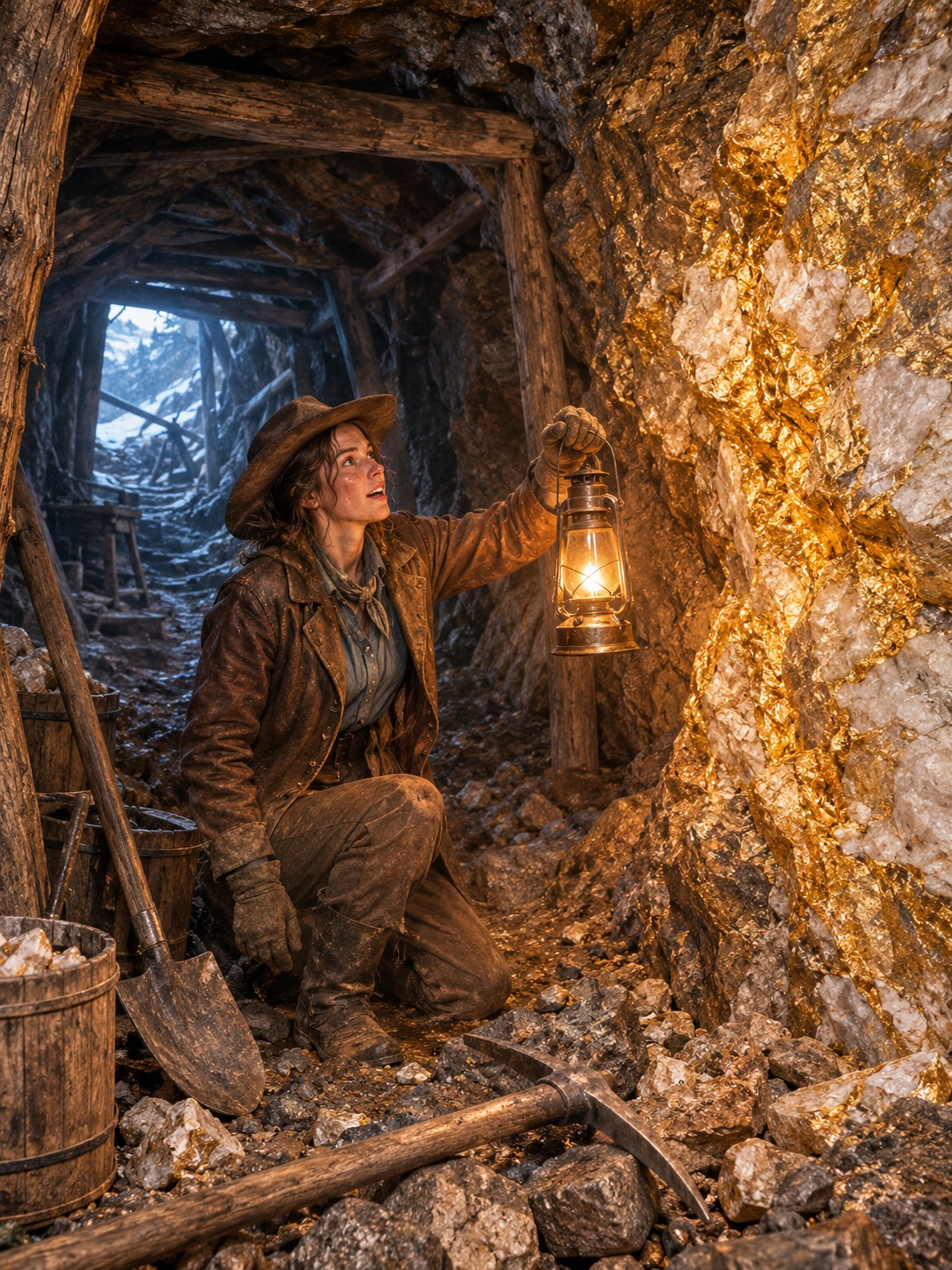
Eleanor raised her lantern.
A mining tunnel.
Old wooden beams supported the entrance.
Beyond them, darkness stretched into the mountain.
She had found it.
Her father's forgotten mine.
For several seconds, she couldn't move.
Then she whispered, "I made it, Papa."
She secured her horse beneath the trees.
Took her lantern.
Picked up her tools.
And stepped toward the opening.
Behind her, somewhere among the pines, a branch snapped.
Eleanor stopped.
She listened.
Silence.
Then another sound.
A horse snorting.
Not hers.
She slowly turned.
Between the trees, fifty yards away, a dark shape moved.
A rider.
Watching her.
Eleanor tightened her grip on the lantern.
"Who's there?"
No answer.
The figure remained motionless.
Then the rider moved forward just far enough for the last daylight to reveal a black coat.
And a gloved left hand resting on the saddle.
Across the back of that glove was a long, unmistakable scar.
The same scar Eleanor remembered from the man who had brought her father's belongings home fifteen years earlier.
The rider lifted his head.
And spoke her name.
"Eleanor Hayes."
She froze.
Because the voice was one she had heard only once before.
The man leaned forward in his saddle.
Then he said five words that made her blood run cold.
"Your father didn't die of fever."






Comments 0