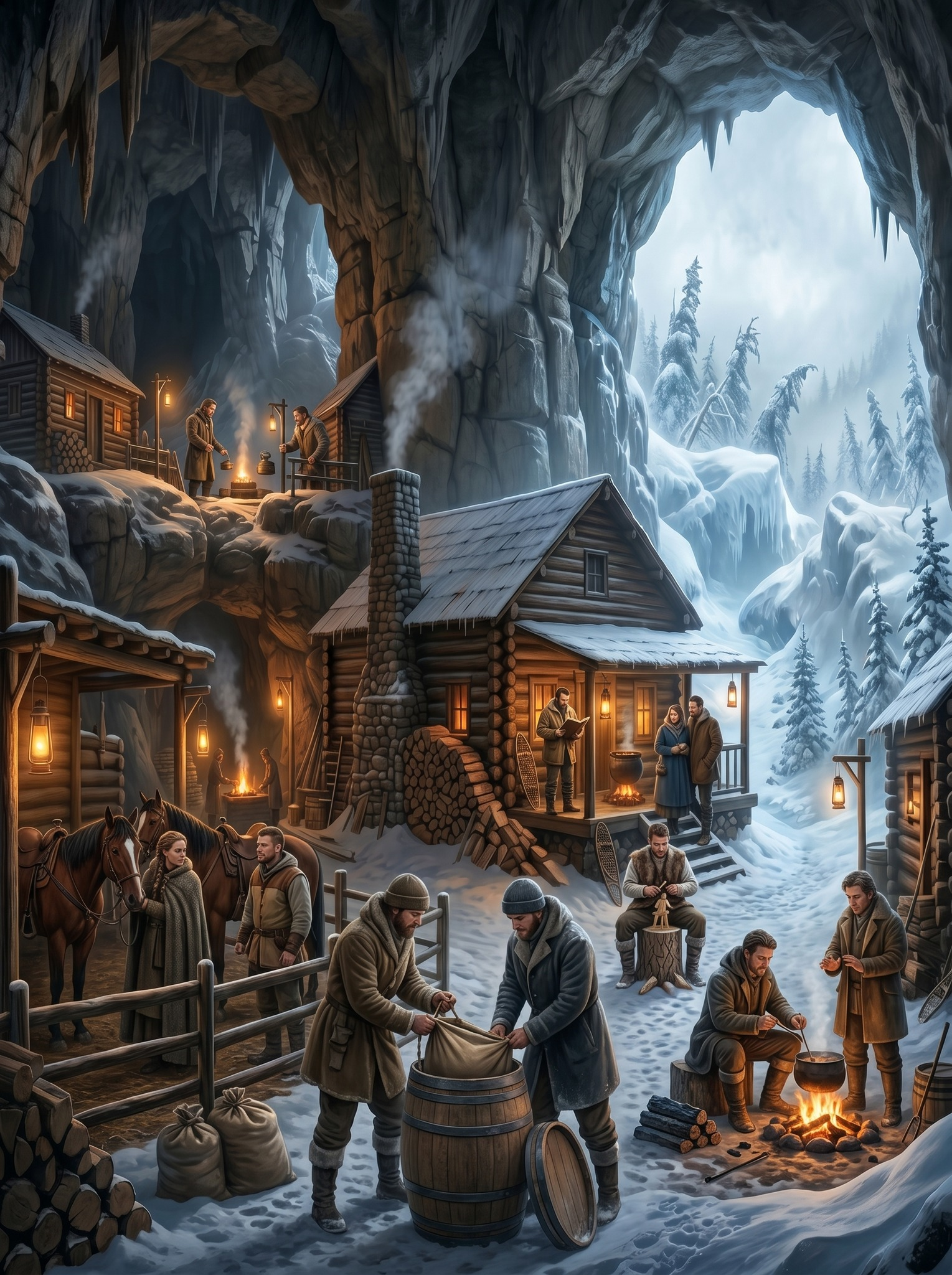
The pounding on the unfinished cabin door came just after sunset.
"Thornton! Open up! You need to hear this!"
James dropped the wooden mallet he had been using and turned toward the entrance.
Ada stood beside the stove they had not yet installed, holding a lantern.
Outside, a horse snorted nervously.
James recognized the voice before he reached the door.
It belonged to Samuel Whitcomb, the oldest carpenter in Endurance.
And Samuel Whitcomb had never visited anyone after dark without a serious reason.
James pulled the door open.
Samuel stood on the unfinished porch, his gray beard damp with sweat despite the cool evening air. His horse waited behind him, shifting its weight on the uneven ground.
"Samuel? What's happened?"
The old carpenter glanced over his shoulder.
"May I come inside?"
James stepped aside.
Samuel entered, removed his hat, and looked around the half-finished cabin.
For several seconds, he said nothing.
His eyes traveled over the double-planked walls, the heavy roof beams, and the thick limestone surrounding the structure.
Then he turned toward James.
"Thomas Brennan has been talking to the mayor."
James frowned.
"Thomas talks to everybody."
"Not like this."
Samuel lowered his voice.
"He's telling Hutchkins that your cabin is a danger to the town. Says if something happens here, people will have to risk their lives coming after you."
Ada set the lantern on a workbench.
"That doesn't make sense. We're nearly an hour from Endurance."
"I know."
"Then why would the mayor listen?"
Samuel looked uncomfortable.
"Because Thomas is building half the houses in town. And he doesn't like a man telling people there's a better way to survive winter."
James folded his arms.
"I haven't told anybody how to build their homes."
"You don't have to. Your house is doing the talking."
The words settled heavily between them.
Outside, Copper stamped a hoof.
Samuel reached inside his coat and removed a folded sheet of paper.
"I thought you ought to see this before tomorrow."
James unfolded it.
It was a notice calling for a meeting at the land office.
The mayor intended to discuss whether the Thornton property presented an unacceptable hazard.
At the bottom, written in Thomas Brennan's unmistakable handwriting, were four words.
UNFIT FOR HUMAN HABITATION.
Ada read them over James's shoulder.
Her face tightened.
"They haven't even inspected the place."
Samuel nodded.
"That's why I came."
James studied the paper for another moment.
Then he folded it carefully.
"Thank you, Samuel."
The old man looked surprised.
"That's all you've got to say?"
"What would you have me say?"
"That you're angry. That you'll fight them."
James glanced around the unfinished room.
"We have a roof to finish before October. I don't intend to spend the night shouting about a piece of paper."
Samuel studied him.
Then he gave a quiet chuckle.
"Your father was the same way."
James looked up.
Samuel had known his father years earlier, before the family moved west.
"He used to say a man who knows what he's building doesn't need to argue with every fellow holding a hammer."
James smiled faintly.
"Sounds like him."
Samuel replaced his hat.
"Just be careful. Thomas has a way of making trouble look like public concern."
After the old carpenter left, Ada stood beside the lantern, watching James.
"Are you going to the meeting?"
"Yes."
"Will you let them stop us?"
James looked toward the heavy timber walls.
"No."
Ada nodded once.
"Then tomorrow we go together."
The next morning, the land office was crowded.
Word had spread that the mayor intended to question James Thornton's right to live on the property he had purchased.
Thomas Brennan stood near the front, surrounded by several builders and merchants.
Mayor Hutchkins sat behind his desk.
James and Ada entered without ceremony.
Conversations stopped.
Thomas smiled.
"Well, if it isn't the king and queen of the mountain."
Ada ignored him.
James approached the desk.
"I understand there's a concern about my property."
Hutchkins cleared his throat.
"James, this isn't personal."
"Then let's discuss the facts."
The mayor glanced toward Thomas.
Thomas stepped forward.
"The facts are simple. You're building a house inside a cave. Nobody knows whether it's safe. If it collapses, somebody will have to dig you out."
James placed his notebook on the counter.
"I've examined the rock formations, drainage, and floor stability. I've also recorded the measurements."
Thomas laughed.
"You're a railroad surveyor, not a mining engineer."
"That's true."
"Then you admit you don't know whether it's safe."
"I admit there are things I don't know. That's why I've taken precautions and avoided unstable sections."
The mayor leaned forward.
"What precautions?"
James opened the notebook.
He showed the location of the cabin relative to the cave walls.
He explained why he had chosen a level area away from loose rock.
He described the natural drainage channels and the areas where water might collect during spring thaw.
He showed how the cabin would stand independently on its timber foundation rather than relying on the cave ceiling for support.
Then he turned to a page filled with temperature measurements.
"These are readings I've taken at different times of day."
Hutchkins examined them.
"What am I looking at?"
"The difference between the outside air and the deeper cave."
James pointed to the figures.
"The cave changes temperature much more slowly. The rock absorbs and releases heat over time. It doesn't follow every sudden change in the weather."
Thomas crossed his arms.
"That doesn't mean you'll be warm in January."
"No. That's why I'm building insulated walls and installing a stove."
"Then what's the point of the cave?"
James looked directly at him.
"The stove warms the cabin. The mountain helps keep that warmth from being stripped away by the wind."
A few people exchanged glances.
Samuel Whitcomb, standing near the back, nodded.
Thomas noticed.
"You're all listening to a man who wants to live underground."
James closed the notebook.
"I'm not asking anyone else to live there."
Hutchkins studied the papers.
Then he sighed.
"Legally, Thornton owns the land. Unless we can establish that he's violating a territorial requirement, there's no basis for stopping construction."
Thomas's smile vanished.
"You're letting him do this?"
"I'm acknowledging the property deed."
James picked up his notebook.
"Then I believe we're finished."
He turned toward the door.
Thomas called after him.
"When that mountain swallows your house, don't say nobody warned you!"
James stopped.
For a moment, Ada thought he might finally lose his temper.
Instead, he turned around.
"Thomas, I hope every house you build stands for fifty years."
The room went quiet.
James continued.
"Because there are families living inside them."
Then he walked out.
Ada followed.
Behind them, nobody laughed.
By early September, construction became a race against the calendar.
The mornings were cooler.
The prairie grass had begun to lose its summer color.
James knew the first hard frost could arrive earlier than expected.
He and Ada worked nearly every daylight hour.
The cabin's outer walls were complete, but the interior still needed attention.
The floorboards had to be fitted.
The windows required careful installation.
The chimney needed additional stonework.
The door had to be strong enough to resist drafts without becoming impossible to open when the wood expanded or contracted.
And the stable remained little more than a sheltered section of rock with temporary fencing.
James made a list.
Ada made another.
His list contained structural tasks.
Hers contained everything necessary to live.
Food storage.
Water containers.
Bedding.
Cooking utensils.
Lamp oil.
Candles.
Medicine.
Clothing.
Horse feed.
Spare leather straps.
Needles and thread.
When James compared the two lists, he shook his head.
"I thought I had everything."
Ada raised an eyebrow.
"You remembered the roof."
"That's important."
"And forgot the plates."
"We can eat from the cooking pot."
"For one evening, perhaps."
James laughed.
It was the kind of laughter that came easily when they were alone.
In town, people saw him as stubborn.
Inside the cave, Ada saw the man who sometimes forgot to eat because he was so absorbed in measuring a beam.
She saw the man who quietly repaired her worn boots without being asked.
The man who always gave Copper the last apple.
The man who had spent years studying the Dakota landscape because he believed careful observation could protect the people he loved.
And she knew his stubbornness had a purpose.
One afternoon, James began installing the final sections of insulation.
He packed wool between the two layers of planking, taking care not to leave open spaces around the window frames.
Ada worked beside him.
Her fingers were sore from handling rough timber and fabric.
James noticed her rubbing her hands.
"Take a rest."
"I'm fine."
"Ada."
She looked at him.
"You've been working since sunrise."
"So have you."
"I've got thicker skin."
She held up her hands.
"Then perhaps you should lend me some."
He smiled.
But when she turned away, he gently took the bundle of wool from her arms.
"Go sit down for ten minutes."
She started to protest.
He gave her a look.
"Ten minutes."
Ada sighed dramatically.
"You're becoming difficult to live with."
"We haven't moved in yet."
"That gives me time to reconsider."
He watched her settle on a wooden crate near the entrance.
Then he returned to the wall.
The work was slow, but every layer mattered.
He remembered a winter years earlier when he had been surveying near the northern railroad line.
A sudden storm had trapped his party in a poorly insulated shack.
They had burned nearly all their wood trying to keep warm.
The walls leaked heat.
The wind forced its way through the cracks.
By morning, their water had frozen inside the building.
One man had suffered severe frostbite.
Another had nearly lost consciousness from the cold.
James had never forgotten the sound of that wind.
It was not simply the temperature that frightened him.
It was how quickly an ordinary shelter could become useless when exposed to the full violence of the prairie.
He pressed another section of wool into place.
He would not allow that to happen to Ada.
Not if he could prevent it.
The chimney became their greatest challenge.
James had designed a stone flue to carry smoke safely away from the stove.
But building it inside a cave required careful planning.
Smoke could not be allowed to collect beneath the limestone ceiling.
The chimney needed a reliable draft and a protected route to the outside air.
James spent several days examining the available passages and working with Samuel Whitcomb to develop a practical arrangement.
They constructed the flue through a suitable opening leading toward the exterior.
The masonry had to be secure.
The joints had to be sealed.
And the stove needed enough fresh air to burn properly without filling the cabin with smoke.
Samuel inspected the work.
"You're taking more trouble with this chimney than most men take with an entire house."
James adjusted a stone.
"Most houses don't have a mountain over their heads."
Samuel chuckled.
"Fair point."
When they finally lit the first small test fire, Ada stood beside the open door with a bucket of water.
James crouched near the stove.
A thin ribbon of smoke rose.
For several seconds, nothing happened.
Then the draft established itself.
The smoke moved steadily into the flue.
James watched carefully.
Samuel examined the joints.
Ada leaned toward the stove.
"Is it working?"
James waited another moment.
Then he nodded.
"It's working."
Ada exhaled.
Samuel grinned.
"Well, I'll be."
The three of them stood watching the small fire.
It was not a dramatic moment.
There was no cheering.
No applause.
But James felt a deep satisfaction.
The cabin was becoming more than a structure.
It was becoming a place where they could survive.
As September continued, the town's opinion grew harsher.
People who had initially treated the project as a joke began speaking of it with irritation.
Thomas Brennan told customers that James was encouraging dangerous ideas.
He claimed other settlers might abandon proper construction methods and waste money on unsuitable land.
He complained that James had made him look foolish at the land office.
But the real reason for his anger was more personal.
Thomas had built his reputation on knowing how houses should be constructed in Endurance.
He had spent years selling the same basic design.
Timber walls.
A pitched roof.
A stove.
A chimney.
A foundation above the prairie.
It was familiar.
It was accepted.
And it was profitable.
James's cave home challenged the assumption that familiar methods were always the best methods.
Thomas did not like being questioned.
One Saturday, he approached Ada outside the general store.
She was loading flour and dried beans into the wagon.
"Mrs. Thornton."
She turned.
"Mr. Brennan."
"I hope your husband knows what he's doing."
"He does."
Thomas glanced toward the wagon.
"Winter can be cruel to people who make foolish choices."
Ada tied the last sack securely.
"That's why we're preparing."
He stepped closer.
"You're a sensible woman. You don't have to follow him into every bad idea."
Ada looked at him calmly.
"Mr. Brennan, my husband has never asked me to follow him blindly."
Thomas frowned.
"He hasn't?"
"No. He explains what he believes, shows me what he's learned, and listens when I disagree."
She climbed onto the wagon.
"Perhaps that's why I trust him."
Thomas stood speechless.
Ada gathered the reins.
"Good afternoon."
She drove away before he could answer.
By September 20, the cabin was nearly complete.
The walls were sealed.
The roof was finished.
The windows were installed.
The chimney drew properly.
The floorboards had been sanded smooth enough to walk on without splinters.
Ada had arranged a simple wooden table near her favorite window.
Two chairs stood beside it.
A small shelf held their dishes.
The bed was positioned along the interior wall, away from the door.
A chest contained their clothing.
Their food supplies were stacked in a cool storage area.
James had built sturdy racks for firewood.
He had also begun constructing the stable for Copper.
The horse's shelter was protected by the limestone walls and separated from the living quarters.
James installed a secure gate and prepared space for hay and water.
He made sure the animal could move comfortably.
Copper inspected the new stable with obvious curiosity.
He sniffed the wooden posts.
He nudged the water trough.
Then he lowered his head and began eating hay.
Ada watched him.
"I think he approves."
James leaned against the gate.
"He's easier to please than the mayor."
"Most horses are."
They laughed together.
For a few minutes, the entire project felt almost complete.
Then Ada noticed something.
A dark stain had appeared along one section of the cave wall near the storage area.
She pointed toward it.
"James, was that there yesterday?"
He turned.
The stain was small.
A narrow line of moisture had formed beneath a natural crack in the limestone.
James walked over and touched it.
His expression changed.
Ada noticed immediately.
"What is it?"
"Water."
"Is that bad?"
"Not necessarily."
He examined the crack.
Then he looked toward the ceiling.
"But I need to find out where it's coming from."
The next morning, James began investigating.
He followed the damp section along the wall and checked the surrounding stone.
The moisture appeared to be moving through a narrow natural channel.
He suspected recent rainfall had entered the rock farther up the bluff.
The amount was small, but he refused to ignore it.
Water could freeze.
Water could weaken materials.
Water could damage stored food.
And water could become dangerous if it collected where people needed to walk.
James spent two days studying the drainage.
He marked the damp area.
He checked whether the flow increased after rain.
He examined the floor for signs of pooling.
Then he constructed a shallow drainage channel to direct the water away from the cabin's foundation and storage area.
He also moved the nearest supplies to a drier section.
Ada helped him carry the sacks.
"Do you think it will be enough?"
"We'll keep watching it."
"You're not worried?"
"I'm cautious."
She smiled.
"There's a difference?"
"A very important one."
He looked toward the dark limestone wall.
"Worry tells you something might go wrong. Caution makes you do something about it."
Ada considered that.
Then she picked up another sack.
"Then let's be cautious."
The first frost arrived before the end of September.
James woke early and stepped outside the cave.
A thin white coating covered the grass.
His breath formed a cloud in the morning air.
The prairie was silent.
He stood for several minutes, watching the distant horizon.
Then he returned to the cabin.
Inside, Ada was preparing breakfast.
The small stove had been burning gently through the night.
The room was comfortable.
James checked the thermometer.
The cabin was holding its warmth.
He opened the door and stepped into the larger cave.
The air was cooler than the cabin, but far less harsh than the exposed prairie.
He recorded the readings in his notebook.
Outside temperature.
Cave temperature.
Cabin temperature.
Fuel consumed.
He intended to continue these measurements throughout the winter.
Not because he wanted to prove Thomas Brennan wrong.
But because he wanted to understand exactly how the home performed.
A good design, James believed, should be tested.
And improved.
On October 1, 1883, James and Ada officially moved into their mountain home.
They did not hold a celebration.
There were no guests from town.
No speeches.
No ribbons.
They simply loaded the last of their belongings onto the wagon and made the familiar journey toward the limestone bluff.
Ada carried a small wooden box containing her mother's Bible, several letters, and a faded photograph.
James carried his surveying instruments and notebooks.
Copper pulled the wagon steadily along the rocky path.
When they reached the cave entrance, Ada stopped.
She looked at the cabin.
The finished timber walls stood beneath the towering limestone ceiling.
The windows reflected the morning light.
The stone chimney rose beside the roof.
The stable waited nearby.
The structure looked modest compared with the houses in Endurance.
But it was theirs.
James stepped down from the wagon.
He offered Ada his hand.
She took it.
Together, they walked toward the door.
James placed the key in her palm.
"You should open it."
Ada looked at him.
"Why?"
"Because you made this place a home."
She smiled softly.
Then she unlocked the door.
Inside, the cabin smelled of fresh timber, wool, and woodsmoke.
Sunlight entered through the small windows.
The table stood ready.
The stove waited.
Their bed was made.
Ada stepped into the room.
She looked around slowly.
Then she turned toward James.
"It's beautiful."
He looked at the plain furniture and unfinished shelves.
"It's not much."
"It's everything we need."
James closed the door behind them.
For the first time, the cabin felt truly occupied.
The first weeks were a period of adjustment.
Ada learned how the light moved through the cave entrance during different hours.
James adjusted the stove's draft and monitored fuel consumption.
They discovered that the cabin required surprisingly little firewood during mild autumn weather.
The thick limestone surroundings moderated the temperature.
The insulated walls reduced heat loss.
The sheltered position protected the structure from direct wind.
James compared their wood use with estimates from similar-sized homes in town.
The difference was substantial.
Under the conditions he measured, their cabin sometimes used roughly seventy percent less wood.
He wrote the figures carefully.
He knew winter would be a more demanding test.
But the early results encouraged him.
Ada noticed the difference in another way.
She no longer woke to cold drafts slipping beneath the bedroom door.
She could prepare breakfast without standing beside a roaring stove.
And on windy evenings, the cabin remained quiet.
The sound of the prairie wind reached them only as a distant murmur.
One night, she sat beside the table while James studied his notes.
"Do you miss town?" she asked.
He looked up.
"Sometimes."
"What do you miss?"
"The convenience."
She nodded.
"The store?"
"The blacksmith. The post office. Having Samuel nearby when I need another pair of hands."
Ada looked toward the window.
"And the people?"
James considered the question.
"Some of them."
She smiled faintly.
"I miss Martha's bread."
"We can visit."
"I know."
She paused.
"But I don't miss being watched every time I buy flour."
James closed his notebook.
"They'll lose interest eventually."
Ada gave him a doubtful look.
"Will they?"
He smiled.
"Perhaps."
In November, the first serious snow arrived.
It came quietly.
Large flakes drifted across the prairie and settled on the rocky bluff.
By morning, the world beyond the cave entrance was white.
James stepped outside to inspect the roof and drainage.
The cabin remained protected from the worst of the snowfall.
Some snow had accumulated near the entrance and along exposed edges, but the sheltered areas were clear.
He checked the chimney.
He checked the stable.
He checked the stored firewood.
Everything was in order.
Inside, Ada was baking bread.
The smell filled the cabin.
Copper stood comfortably in his stable, chewing hay.
James returned and removed his boots.
Ada looked up.
"Well?"
He hung his coat.
"The mountain is doing its job."
She placed the bread near the stove.
"And so is the house."
James smiled.
For a moment, he allowed himself to feel proud.
They had taken a piece of land everyone dismissed as worthless and turned it into something useful.
But he knew the real test was still ahead.
Dakota winters did not reveal their full strength in November.
The worst storms often came later.
And a mild beginning could make people careless.
As December approached, James began storing additional supplies.
He increased their firewood reserves.
He filled extra water containers.
He purchased more oats and hay for Copper.
He inspected the stable gate and reinforced the sections most likely to be affected by drifting snow.
Ada prepared dried vegetables, preserved meat, beans, and flour.
They organized their supplies so they could remain inside for an extended period if necessary.
James also checked the lanterns.
He kept spare wicks.
Extra lamp oil.
Matches stored in dry containers.
Tools for clearing snow.
Rope.
Blankets.
A first-aid kit.
Ada watched him arranging everything.
"How long are you planning to stay trapped in here?"
James looked at the shelves.
"As long as we need to."
"Days?"
"Possibly."
"A week?"
He paused.
"If a storm is severe enough."
Ada studied him.
"Have you ever seen a storm last that long?"
James did not answer immediately.
He remembered stories from railroad workers.
Men who had been stranded by drifting snow.
Families who had burned furniture after running out of wood.
Travelers who had lost their way only a few hundred yards from shelter.
He remembered how quickly familiar landmarks could disappear.
"Not one exactly like that," he said.
"But I've seen what happens when people underestimate winter."
Ada looked toward the window.
Outside, snow moved gently through the pale afternoon light.
It was difficult to imagine that peaceful scene becoming dangerous.
But she trusted the seriousness in his voice.
"Then we'll prepare for a week."
James nodded.
"Better to have too much than too little."
Two days before Christmas, Samuel Whitcomb visited.
He arrived carrying a small package wrapped in brown paper.
Ada welcomed him inside.
The old carpenter removed his coat and stood beside the stove.
He looked around.
Then he laughed softly.
"Well, I'll be damned."
James raised an eyebrow.
"Something wrong?"
Samuel shook his head.
"No. That's the trouble."
He walked toward the wall.
Touched the timber.
Looked at the windows.
Then glanced at the thermometer.
"It's colder than a graveyard out there, and you've got this place warm with a fire that wouldn't heat my workshop."
James smiled.
"The mountain helps."
Samuel nodded slowly.
"I can see that."
Ada poured him coffee.
He accepted the cup gratefully.
For a while, the three of them talked about town.
Business had been slow.
Several families were worried about the rising cost of firewood.
Thomas Brennan had taken on two more construction jobs.
Mayor Hutchkins was discussing improvements to the main road.
Then Samuel's expression grew serious.
"There's something else."
James looked at him.
"What?"
Samuel set down his cup.
"Thomas has been telling people your wood-saving figures are lies."
James sighed.
"Of course he has."
"He says you're trying to make the town look foolish."
"I'm trying to keep my home warm."
"I know."
Samuel leaned forward.
"But I think it's bothering him that people are starting to ask questions."
"What questions?"
"About insulation. About wind protection. About why your chimney burns less wood."
James glanced toward the stove.
"Those are reasonable questions."
"Not to Thomas."
Samuel paused.
"He's proud, James. And proud men don't always take kindly to being proven wrong."
Ada looked at her husband.
James remained quiet.
Then he said, "I haven't proven anything yet."
Samuel frowned.
"What do you mean?"
James looked toward the window.
"We haven't seen the worst of winter."
Christmas passed quietly.
James and Ada shared a simple meal.
They read from Ada's mother's Bible.
They exchanged small gifts.
James had carved a wooden box for her sewing supplies.
Ada had knitted him a thick scarf.
Outside, snow lay across the prairie.
Inside, the fire burned steadily.
They spoke of the coming year.
Perhaps they would plant a small garden near the bluff when spring arrived.
Perhaps they would build additional storage shelves.
Perhaps James would take on more surveying work.
Ada hoped they might invite Samuel and his wife for supper.
James agreed.
They had plans.
Ordinary plans.
The kind people make when they believe tomorrow will resemble today.
But by January, the weather began changing.
The cold became sharper.
The wind grew less predictable.
Snowstorms arrived more frequently.
James recorded each one.
He watched how the snow accumulated near the cave entrance.
He observed which sections remained sheltered.
He adjusted the placement of supplies.
He checked the chimney more often.
And every morning, he studied the sky.
Ada noticed.
One evening, she found him standing near the entrance long after sunset.
He was looking toward the western horizon.
She approached quietly.
"James?"
He turned.
"Yes?"
"You've been out here for half an hour."
"I know."
"What are you looking for?"
He hesitated.
Then he pointed toward the distant prairie.
"Changes."
"In the clouds?"
"In everything."
She looked out.
The sky was dark.
The wind moved lightly across the snow.
Nothing seemed unusual.
James continued.
"The birds have been moving differently. The pressure has been changing. And the wind hasn't settled the way it should."
Ada studied his face.
"Does that mean a storm?"
"Not necessarily."
"But you're worried."
He looked toward the cabin.
"I'm paying attention."
She took his arm.
"Then I'll pay attention, too."
They returned inside together.
By the beginning of February 1884, Endurance had settled into the hard routine of winter.
Smoke rose from every chimney.
Woodpiles shrank.
People traveled only when necessary.
The town's streets were packed with snow and frozen mud.
James rode Copper into town on February 3 to purchase additional supplies.
He visited the general store.
Martha Bell greeted him.
"How's life in the mountain?"
"Comfortable."
She looked surprised.
"Even now?"
"Even now."
She shook her head.
"I don't understand it."
James smiled.
"You don't have to."
He purchased flour, lamp oil, salt, and a few other necessities.
As he prepared to leave, Thomas Brennan entered.
The builder looked tired.
His coat was covered with snow.
His hands were red from the cold.
When he saw James, he stopped.
"Still living in that cave?"
James nodded.
"Still building houses?"
Thomas frowned.
"Very funny."
Martha turned away to hide a smile.
Thomas stepped closer.
"Don't get too comfortable, Thornton. February's when Dakota reminds fools what winter really means."
James looked at him.
"That's why I came for supplies."
Thomas laughed.
"Afraid of a little snow?"
"No."
"Then why all the preparation?"
James picked up his packages.
"Because preparation is easier before you need it."
Thomas shook his head.
"You're a strange man."
James walked toward the door.
"Stay warm, Thomas."
The builder did not answer.
On February 7, James noticed the first sign that truly disturbed him.
The birds had vanished.
Normally, small winter birds could be seen near the sheltered areas of the bluff.
They searched for seeds.
They gathered near exposed patches of ground.
They appeared even during cold weather.
But that morning, the cave entrance was silent.
James stood outside for nearly twenty minutes.
Not one bird appeared.
He looked toward the sky.
A strange gray layer stretched across the horizon.
The air felt heavy.
He checked his barometer.
The reading had fallen.
He checked it again later.
It continued to fall.
That evening, he inspected every part of the cabin.
He secured the door.
Checked the windows.
Tested the stove.
Examined the chimney.
Counted the food supplies.
Measured the water.
Checked Copper's hay.
Ada watched him.
Finally, she asked, "How bad do you think it will be?"
James stood beside the table.
"I don't know."
It was the first time he had said those words with such seriousness.
Ada waited.
He looked toward the window.
"But I think we should be ready for something worse than an ordinary storm."
She nodded.
"Then we will be."
The next morning, February 8, James saddled Copper.
Ada met him at the stable.
"You're going into town?"
"Yes."
"For supplies?"
"No."
She studied his face.
"Then why?"
He tightened the saddle strap.
"To warn them."
Ada looked toward the distant prairie.
The sky had turned a dull, ominous gray.
The wind was strangely quiet.
She reached for his hand.
"Be careful."
James squeezed her fingers.
"I'll be back before dark."
He mounted Copper.
The horse shifted beneath him.
Then James turned toward the road leading to Endurance.
He had spent seven months building a home that could withstand the worst of Dakota's winter.
Now he was riding toward a town that had spent those same months laughing at him.
He did not know whether anyone would listen.
But he knew he had to try.
By the time James reached the outskirts of Endurance, the streets were unusually quiet.
Several shopkeepers were bringing goods indoors.
A few men stood outside the general store, looking toward the western sky.
James dismounted and tied Copper near the hitching post.
He stepped onto the wooden sidewalk.
Inside the store, Thomas Brennan was speaking loudly to a group of men.
"People are getting spooked over nothing. It's February in Dakota. Of course it's cold."
James entered.
The conversation stopped.
Thomas turned.
"Well, look who crawled out of his hole."
James ignored the insult.
He looked at the men gathered around the stove.
"I think a severe storm is coming."
Thomas rolled his eyes.
"Here we go."
James continued.
"The pressure has been falling. The birds have disappeared. The wind is changing. You need to prepare."
Mayor Hutchkins, who had been standing near the counter, stepped forward.
"Prepare for what, exactly?"
"A major blizzard."
Thomas laughed.
"It's winter in Dakota, Thornton. Don't go getting spooked in that hole of yours."
James looked at him.
"I'm not frightened."
"Then stop trying to frighten everyone else."
James turned toward the mayor.
"Make sure people have enough wood. Keep livestock sheltered. Tell families to store water and food. Nobody should travel if the weather turns."
Hutchkins frowned.
"How long do you think this storm will last?"
James hesitated.
"I can't say."
Thomas threw up his hands.
"Wonderful. A man who can't tell us when the storm will arrive or how long it'll last wants the whole town to panic."
James remained calm.
"I'm asking people to prepare, not panic."
The mayor looked toward the window.
The sky was darkening.
For a moment, he seemed uncertain.
Then Thomas spoke again.
"Mayor, if we start telling everyone to hide indoors every time Thornton sees a gray cloud, this town will never get anything done."
Several men nodded.
James looked around the room.
He recognized nearly every face.
Men who had purchased timber from Thomas.
Men who had laughed at his cave.
Men who had watched him build for months.
He had hoped at least one of them would understand.
But nobody spoke.
Finally, Hutchkins sighed.
"James, I appreciate your concern. But we've survived winters before."
James nodded slowly.
"Yes."
He looked toward the door.
"But you may not have seen one like this."
Then he left.
Outside, Copper was restless.
The horse tossed his head and pulled against the reins.
James untied him.
He looked toward the western horizon.
The clouds had thickened.
The air felt wrong.
He mounted quickly.
As he turned toward the road, he heard footsteps behind him.
"James!"
He looked back.
Samuel Whitcomb was hurrying toward him.
The old carpenter stopped beside Copper.
"I heard what happened inside."
James nodded.
"Then you know they won't listen."
Samuel glanced toward the store.
"Some of us are listening."
James studied him.
Samuel lowered his voice.
"I've got extra wood at home. I'll bring it inside. And I'll tell my wife to fill every container we've got."
"Good."
Samuel hesitated.
Then he asked, "How serious is this?"
James looked toward the sky.
"Serious enough that I wouldn't wait until morning."
Samuel's expression changed.
He nodded once.
"Then neither will I."
James reached down and shook his hand.
"Take care of yourself."
"You too."
James turned Copper toward the road.
He had traveled only a short distance when Samuel called after him.
"James!"
He looked back.
The old carpenter stood in the middle of the street.
"If you're right about this storm..."
He stopped.
James waited.
Samuel swallowed.
"God help the people who laughed at you."
James said nothing.
He urged Copper forward.
Behind him, the town disappeared slowly into the gray afternoon.
Ahead, the limestone bluff waited beneath the darkening sky.
And somewhere beyond the western horizon, something enormous was moving toward Dakota.
James reached the cave shortly before sunset.
Ada was waiting near the entrance.
She hurried toward Copper.
"Did they listen?"
James dismounted.
"Samuel did."
"And the others?"
He shook his head.
Ada looked toward the prairie.
The wind had begun to rise.
She could hear it moving through the distant trees.
James led Copper toward the stable.
"We need to finish preparing."
They worked without wasting time.
Ada filled the remaining water containers.
James secured the stable gate.
They checked the food supplies.
They brought additional firewood closer to the cabin.
They examined the chimney and stove.
They made sure every lantern was ready.
By the time darkness fell, the wind had become a steady moan.
James stood near the cave entrance.
Snow was beginning to move across the distant ground.
Ada approached with his coat.
"You should come inside."
He took it.
Then he looked toward the western sky.
A low, dark cloud was advancing across the prairie.
It seemed to swallow the last traces of daylight.
James had seen storms before.
But there was something about this one that made his chest tighten.
He turned toward Ada.
"Get inside."
She looked at him.
"James?"
"Now."
Ada hurried toward the cabin.
James followed, but stopped when he heard something.
A distant sound.
Faint at first.
Then clearer.
It was not thunder.
It was not the wind.
It was the sound of a horse galloping over frozen ground.
James turned toward the cave entrance.
A dark figure appeared through the blowing snow.
The rider was bent low over the saddle.
The horse stumbled as it approached the rocky path.
James stepped forward.
"Who's there?"
The rider did not answer.
Instead, the horse stopped abruptly.
The man nearly fell from the saddle.
James rushed toward him.
"Easy! Easy!"
He caught the reins.
The rider lifted his head.
His face was pale.
His lips trembled.
James recognized him.
It was one of Thomas Brennan's young construction workers.
The man grabbed James's coat.
"Mr. Thornton..."
His voice broke.
James steadied him.
"What happened?"
The young man looked back toward Endurance.
Then he pulled a folded paper from inside his coat.
His hand was shaking so badly that he could barely hold it.
"Mr. Brennan told me not to show you this."
James stared at the paper.
"What is it?"
The young man swallowed.
"It's from the mayor's office."
James reached for it.
The paper was wet with melting snow.
A red official seal marked the bottom.
And across the front, in large handwritten letters, was a single word.
EVICTION.
James unfolded the notice.
Then he saw the date.
February 9, 1884.
Tomorrow.
And beneath the mayor's signature was an order that made James's blood run cold.
The town intended to send men to the mountain at dawn.
Not to seek shelter.
Not to ask for help.
But to force James and Ada out of the only home that might survive the coming storm.
The young worker gripped James's sleeve.
"There's something else, Mr. Thornton."
James looked at him.
The young man's eyes filled with terror.
"Before I left town, I heard Mr. Brennan tell the mayor what he planned to do if you refused."
James held the paper tightly.
"What did he say?"
The young man opened his mouth.
And then, from somewhere beyond the cave entrance, a second horse screamed.






Comments 0