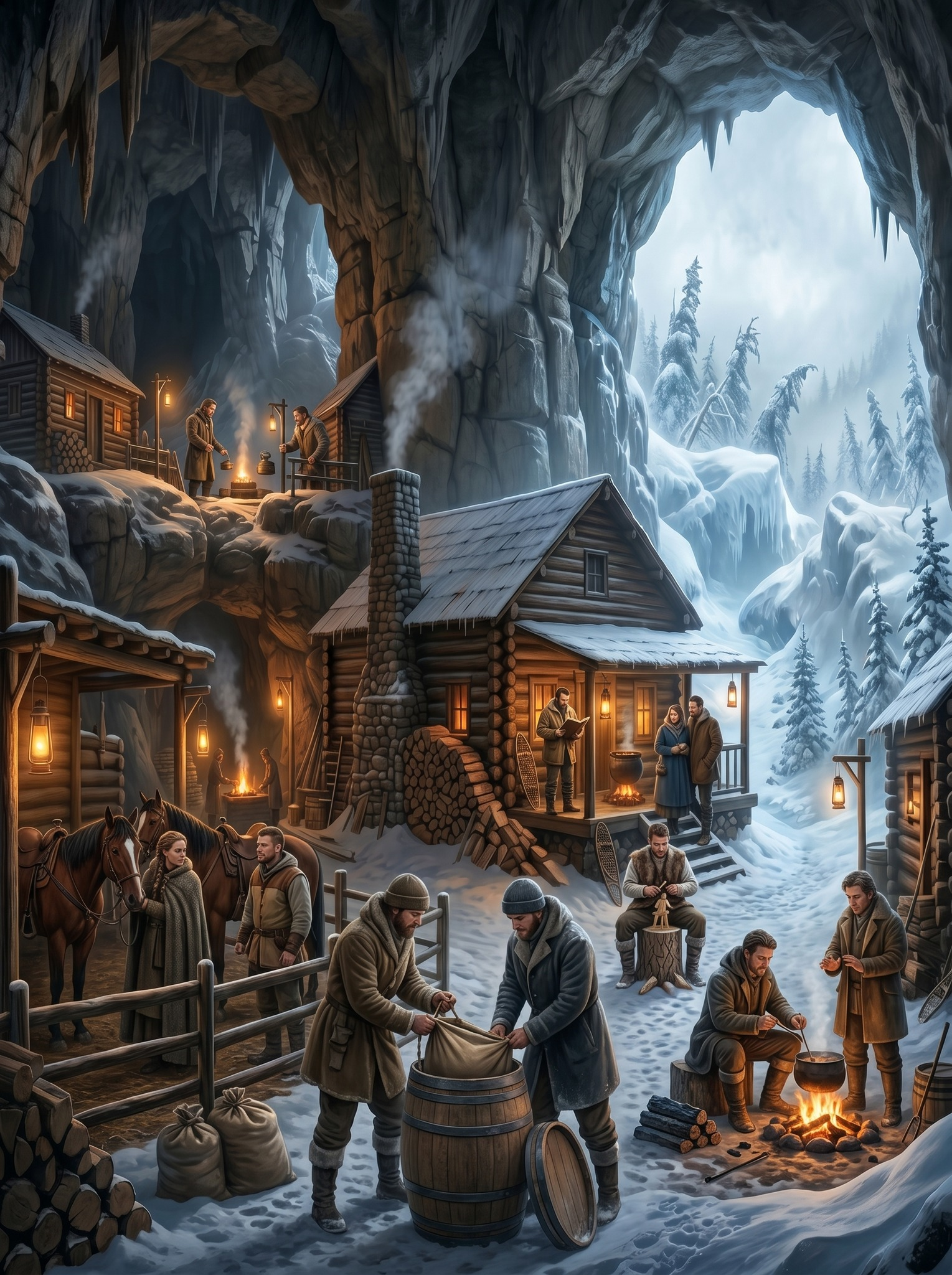
The knocking came again.
"William! Open this door!"
James Thornton stood beside the entrance, holding his lantern.
Behind him, more than seventy exhausted people waited in silence.
William Brennan looked as though he had seen a ghost.
Thomas stepped toward his father.
"Who is that?"
William didn't answer.
The voice outside grew louder.
"William! I know you're in there! You cannot hide forever!"
James turned toward Mayor Hutchkins.
"Open the entrance carefully."
Thomas moved beside him.
Together, they removed the wooden brace and pulled the heavy door inward.
A man stood outside.
He was tall, thin, and covered in snow.
His beard was almost entirely white.
Beside him stood a young boy wrapped in an oversized coat.
The stranger looked directly at William.
Then he smiled.
"Hello, brother."
William staggered backward.
The lantern slipped from his hand.
It struck the floor.
The man outside was Samuel Brennan.
Not the Samuel who had spent seventeen years beneath the mountain.
Another Samuel.
William's younger brother.
The one he had believed dead since 1867.
For several seconds, nobody spoke.
The two men stared at each other.
Then the Samuel standing outside stepped forward.
"Well, William. You look terrible."
William gripped the wall.
"You're dead."
Samuel shook his head.
"Apparently, nobody in this family knows how to stay dead."
Thomas looked between the two men.
"How many uncles do I have?"
Despite everything, James almost laughed.
But William remained frozen.
The first Samuel Brennan slowly approached from beside the stove.
The two brothers faced each other.
One had survived beneath the mountain.
The other had survived beyond the mountains, far from Dakota.
They looked at one another.
Then the first Samuel whispered:
"Daniel?"
The newcomer nodded.
"Sam."
The brothers embraced.
Thomas stared.
Then he turned toward William.
"You told me Uncle Samuel was dead."
William looked down.
"I thought he was."
The newcomer, Daniel Brennan, pulled away from his brother.
"That's what everyone thought."
He glanced toward the wooden box on the table.
"Until I found the original survey records."
James stepped forward.
"Where have you been?"
Daniel looked toward the crowded chamber.
"That's a long story."
Mayor Hutchkins approached.
"Then we'd better hear it."
Daniel nodded.
He looked at the young boy beside him.
"First, this is my grandson, Peter."
The boy looked around nervously.
James crouched.
"Hello, Peter."
The child nodded.
"Are you the man who built this house inside the mountain?"
James smiled.
"With a little help from my wife."
Peter looked toward Ada.
"Thank you for letting us in."
Ada touched his shoulder.
"You're welcome, sweetheart."
Daniel watched the exchange.
Then he turned toward William.
"I came back because the town needs to know the truth."
William closed his eyes.
"I know."
Daniel placed a leather folder on the table.
"And because someone has to explain what happened seventeen years ago."
Daniel's story began in the winter of 1867.
He had been working with William and Samuel during the original survey.
The three brothers had discovered the underground passages and the natural reservoir.
They had also found evidence of an older settlement beneath the limestone.
The discovery attracted investors.
Some wanted to search for silver.
Others wanted to purchase the land and build a railroad storage depot.
Daniel opposed the plan.
He believed the water system was unstable.
He wanted the passages closed and the land left untouched.
William disagreed.
He believed the silver deposit could make the family wealthy.
Samuel, meanwhile, had become trapped after the original collapse.
Daniel had tried to organize a rescue.
But the investors refused to allow further excavation.
They feared the discovery would attract government attention and delay their land purchases.
One night, Daniel found documents proving that the investors had known about the underground reservoir.
They had concealed the danger from the land agents.
He confronted them.
They threatened him.
A fight followed.
Daniel was injured and forced to flee.
He eventually reached a railroad settlement several hundred miles away.
He tried to send letters to William.
None received a reply.
Years passed.
He married.
He raised a family.
And eventually, he believed his brothers had died.
Only recently had he discovered that the old land records were still being kept in a county archive.
A clerk had found a letter bearing William's signature.
The letter mentioned the underground gate.
Daniel immediately recognized the location.
He returned to Dakota.
But the blizzard had already begun.
He had traveled with his grandson and two other men.
They had become separated from their wagon during the storm.
The two men had reached a neighboring settlement.
Daniel and Peter had continued toward Endurance.
They had found the town buried beneath snow.
Then they saw the smoke rising from the mountain.
They had followed it.
Daniel looked at William.
"I didn't come back to punish you."
William's eyes filled.
"Then why?"
"Because I wanted to know whether my family was still alive."
He paused.
"And because I wanted to make sure nobody else was hurt by what we buried."
Mayor Hutchkins opened the leather folder.
Inside were original land agreements.
Survey records.
Letters.
And a detailed account of the investors' involvement.
He read several pages in silence.
Then he looked at Daniel.
"These documents prove the railroad company knew about the reservoir."
Daniel nodded.
"They did."
"And the town was built on land that should never have been sold without inspection."
"Yes."
The mayor looked toward William.
"Did you know?"
William nodded slowly.
"I knew the system existed."
Hutchkins's jaw tightened.
"Did you know the land was dangerous?"
William looked at the floor.
"I knew there were risks."
The mayor closed the folder.
"People died because of those decisions."
William nodded.
"I know."
Thomas stepped forward.
"My father made those mistakes."
He looked toward the mayor.
"But I made my own."
Hutchkins turned.
Thomas continued.
"I knew about the tunnels. I knew there were old workings beneath the town. I kept quiet because I wanted the land."
He swallowed.
"I let people believe the property was worthless when I knew it had value. I wanted James and Ada to abandon their home."
The room became silent.
Thomas looked toward James.
"I was wrong."
James studied him.
"Yes."
Thomas nodded.
"I don't expect forgiveness."
James glanced toward the people gathered in the chamber.
"Then don't ask for it."
Thomas lowered his head.
James continued.
"Show them what you've learned."
Thomas looked up.
For the first time, he did not argue.
He nodded.
"I will."
The following morning, the blizzard finally ended.
Not gradually.
Not with another warning.
The wind simply stopped.
A pale winter sun appeared above the eastern horizon.
Its light entered the cave through the narrow opening.
For the first time in seven days, the people of Endurance could see the world outside clearly.
James stepped out with Ada.
They stood beneath the limestone overhang.
Before them lay a landscape transformed beyond recognition.
The prairie was covered in snow.
The roads had disappeared.
The fences were buried.
The roofs of several buildings had collapsed beneath the weight.
The church was almost completely destroyed.
The town looked as though it had been erased.
Ada slipped her hand into James's.
"Seven days."
He nodded.
"Seven days."
She looked toward the mountain.
"Do you think we'll ever see Endurance the way it was?"
James considered the question.
"No."
Ada looked at him.
He continued.
"But we can build something better."
She smiled faintly.
"Together?"
He kissed her forehead.
"Always."
Behind them, people began emerging from the shelter.
Some cried when they saw the destruction.
Others stood silently.
Mayor Hutchkins organized the first search parties.
Daniel and the two Samuel Brennans helped identify the safest routes.
Thomas volunteered to lead the structural inspections.
William stayed beside his brothers.
And for the first time in seventeen years, the Brennan family stood together without secrets between them.
The first priority was finding the missing.
James organized teams.
They searched the church ruins.
The general store.
The old school.
The railroad camp.
They found several people alive in sheltered buildings.
Others had taken refuge in barns or beneath overturned wagons.
Some had not survived.
The losses were painful.
Every name written on Hutchkins's list represented a family.
A home.
A life.
But the search continued until every known survivor had been accounted for.
By the third day after the blizzard, the number of confirmed survivors had reached nearly three hundred.
More than one hundred people had died or remained missing.
It was a terrible loss.
Yet Endurance had survived.
And the people who remained had something they had never possessed before.
A reason to rebuild together.
The mountain home became the center of the recovery effort.
James and Ada opened their storage rooms.
They shared food.
They provided blankets.
They allowed injured families to sleep in the warm chambers.
The stable housed animals rescued from the surrounding farms.
Copper became something of a local celebrity.
Children brought him pieces of hay.
Lucy Bell decorated his stall with a ribbon.
Samuel Price insisted that the horse had saved everyone.
James smiled whenever he heard the claim.
Copper had certainly done his part.
But the true strength of the mountain home had come from the work James and Ada had invested in it months earlier.
The thick limestone walls had remained stable.
The double-planked timber construction had protected the interior.
The wool insulation had prevented heat from escaping.
The carefully designed stove had consumed very little fuel.
And the natural temperature regulation had kept the living space from becoming dangerously cold.
The people who had laughed at their home now depended on it.
One afternoon, Mayor Hutchkins approached James.
He carried a folded document.
"I'd like you to read this."
James opened it.
It was an official declaration from the remaining town council.
The document recognized the mountain property as an emergency shelter and community refuge.
It also established a committee to inspect the underground water system and prevent further construction over dangerous passages.
James looked up.
"What is this?"
Hutchkins smiled.
"An apology, perhaps."
James looked down at the document.
The mayor continued.
"I cannot undo what I said. But I can make sure the town never makes the same mistake again."
James folded the paper.
"Then let's make it useful."
Hutchkins nodded.
"That's exactly what I hoped you'd say."
In the following weeks, the town began rebuilding.
The work was slow.
Snow still covered the ground.
The roads required clearing.
Supplies had to be brought from neighboring settlements.
But the people of Endurance refused to abandon their home.
They rebuilt the school first.
It was placed on higher ground, away from the old drainage channels.
Then came the general store.
Martha Bell insisted on reopening it before the end of March.
She refused to let anyone pay for bread during the first week.
When James asked why, she replied:
"Because some of these people have lost everything. They can pay when they're standing on their own feet again."
Thomas helped construct the new buildings.
He used stronger supports.
Better foundations.
And careful drainage.
He no longer laughed at unconventional ideas.
Instead, he asked questions.
He consulted Samuel Whitcomb.
He listened to Elias Mercer.
And he made sure every structure was inspected before anyone moved inside.
William and Daniel worked beside him.
The three brothers eventually began repairing their relationship.
It was not easy.
Some conversations ended in anger.
Others ended in tears.
But they continued.
Samuel, the brother who had survived beneath the mountain, shared his knowledge of the old passages.
He helped Elias map the underground channels.
Together, they identified the dangerous reservoir and permanently sealed the abandoned prospecting chambers.
The original emergency overflow was reinforced.
The lower gate was removed.
And a new drainage channel was built outside the town.
For the first time, Endurance had a proper understanding of the ground beneath it.
In April, the county authorities arrived.
They examined Daniel's documents.
They interviewed survivors.
They inspected the old survey records.
Their investigation confirmed that the original investors had concealed information about the underground water system.
Several of the old land agreements were declared fraudulent.
The county also recognized that James and Ada had legally purchased their property in good faith.
The mountain home remained theirs.
More importantly, the authorities offered assistance to rebuild the town.
Mayor Hutchkins publicly acknowledged the mistakes made by the former council.
He also asked James to join the new safety committee.
James accepted.
But he made one condition.
"Nobody gets to make decisions about the land without listening to the people who live on it."
The mayor smiled.
"Agreed."
Thomas became one of the committee's strongest supporters.
He also made a public statement admitting his role in misleading the town.
Some residents were angry.
Others refused to speak to him.
But Thomas did not run away.
He stayed.
He worked.
And slowly, people began to judge him by what he did rather than what he had done.
The Brennan family found a new beginning.
Daniel settled in a small house near the eastern edge of town.
Samuel chose to remain close to the mountain.
William moved into a modest cabin with his brothers nearby.
He never expected Thomas to forgive him completely.
But their relationship began to heal.
One evening, Thomas visited his father.
They sat beside a small stove.
For a long time, neither spoke.
Then William handed him a leather notebook.
Inside were the original survey drawings.
Thomas looked through them.
"Why are you giving me this?"
William smiled sadly.
"Because you know how to build."
Thomas turned another page.
The drawings showed the old water channels.
The underground reservoir.
And the first sketches of a timber house built inside the limestone.
Thomas looked up.
"These are your original plans."
William nodded.
"I started them years before the accident."
Thomas studied the drawings.
"Why didn't you ever build the house?"
William looked toward the fire.
"Because I became too interested in what I could take from the mountain."
He paused.
"Your mother always said a home should protect the people inside it."
Thomas looked down.
William continued.
"I think she would have liked what James built."
Thomas closed the notebook.
"She would have."
For the first time in many years, they spoke about Thomas's mother without anger.
And when Thomas left that evening, he did not leave as a man seeking an apology.
He left as a son who had finally begun to understand his father.
Summer returned to the Dakota prairie.
The snow disappeared.
Grass emerged.
The creek resumed its natural course.
Birds returned to the trees.
The town slowly regained its life.
New houses appeared.
The school reopened.
Martha's store became busy again.
The church was rebuilt on higher ground.
And the mountain home remained exactly where James and Ada had built it.
On October 1, 1884, one year after they had moved inside, the town gathered near the limestone bluff.
Mayor Hutchkins stood before the crowd.
A wooden sign had been placed beside the entrance.
It read:
THORNTON MOUNTAIN HOUSE COMMUNITY REFUGE BUILT OCTOBER 1883
James looked at the sign.
Then at Ada.
She smiled.
"One year."
He nodded.
"One year."
The mayor stepped forward.
"Last summer, many of us laughed at James and Ada Thornton for choosing to build their home inside this mountain."
A few people smiled.
Hutchkins continued.
"We called the land worthless. We called their plans foolish. We believed we understood the prairie better than the people who had spent years studying it."
He looked toward James.
"We were wrong."
The crowd became quiet.
Hutchkins continued.
"When the seven-day blizzard buried Endurance, this home became a refuge for families who had nowhere else to go."
He paused.
"It sheltered our children. It protected our injured. It gave our town a chance to survive."
Then he turned toward the couple.
"On behalf of Endurance, thank you."
The applause began slowly.
Then it grew.
James felt uncomfortable.
He had never built the house for recognition.
He had built it because he believed the mountain could provide a safer home.
But when he looked at the people gathered around him, he understood that the house had become something much larger.
It had become a symbol of what could happen when people listened, prepared, and worked together.
After the gathering, James and Ada walked toward the stable.
Copper stood beside the fence.
His chestnut coat shone in the afternoon sunlight.
Ada brought him an apple.
The horse took it gently.
James leaned against the fence.
"Do you remember our first night here?"
Ada smiled.
"Of course."
"We had one lantern, two blankets, and a terrible meal."
She laughed.
"You burned the potatoes."
"I was distracted."
"By what?"
James looked toward the limestone.
"By the thought that everyone in town believed we were making a mistake."
Ada shook her head.
"I never believed that."
James turned.
"Not once?"
"Not once."
She stepped closer.
"I knew the mountain could protect us. But more than that, I knew we could build something together."
James took her hand.
They stood quietly.
The wind moved through the grass.
Copper lowered his head.
Far beyond the bluff, the rebuilt town was alive with voices.
James looked toward the houses.
Then toward the mountain.
For seven days, the storm had tested everything they believed.
It had taken homes.
It had separated families.
It had revealed old lies.
It had exposed the consequences of greed and pride.
But it had also shown the strength of a community willing to stand together.
And it had proved that sometimes the most valuable thing in a place was the thing everyone else had overlooked.
That evening, Ada prepared supper.
The table was set beside the cabin window.
Warm light filled the room.
A fire burned quietly in the stove.
James entered carrying a small wooden box.
Ada looked up.
"What's that?"
He placed it on the table.
"Something I've been working on."
She opened the lid.
Inside lay two small silver rings.
Her eyes widened.
"James..."
He smiled.
"They aren't expensive."
She picked one up.
"That's not what matters."
He took her hand.
"I know we already have each other. But after everything we've been through, I wanted to give you something that reminds us of this year."
Ada looked at him.
Then at the rings.
"What does it say?"
James turned the inside of one ring toward her.
Three words had been engraved.
STILL STANDING TOGETHER.
Ada's eyes filled.
She looked up.
"You didn't have to do this."
"I wanted to."
She slipped the ring onto her finger.
Then she handed him the other.
James put it on.
They embraced beside the table.
Outside, the prairie was peaceful.
The mountain stood quietly beneath the evening sky.
No wind howled through the ravines.
No water threatened the foundations.
No one was waiting in the darkness.
There was only the warmth of their home.
And the knowledge that they had built something that could endure.
Years later, the people of Endurance would still tell the story of the seven-day blizzard.
Children would hear how the town had disappeared beneath the snow.
They would learn about the families who survived inside the mountain.
They would hear about the old water gates, the forgotten tunnels, and the three Brennan brothers.
They would also hear about the couple who had chosen a rocky bluff everyone else considered worthless.
Some would call James Thornton a visionary.
Others would call him lucky.
But those who had survived the storm knew the truth.
He had not survived because he was stronger than the mountain.
He had survived because he had learned to work with it.
Ada understood that too.
And whenever someone asked why they had chosen to live inside a cave, she always gave the same answer.
"Because we didn't need the mountain to change for us. We only needed to understand it."
The mountain home remained standing for generations.
Its limestone walls continued to shelter families.
Its timber rooms remained warm through the winters.
Its stable held horses.
Its kitchen welcomed neighbors.
And its door was never locked against someone in need.
James and Ada grew older there.
They watched children become parents.
They watched the town rebuild.
They watched the prairie change with the seasons.
And every winter, when the snow began falling, James would look toward the mountain and remember February 1884.
He would remember the people who had mocked him.
The people who had trusted him.
The children who had crossed the broken ground.
The families who had found shelter.
And the moment when he had looked at the buried town and realized that their little home might be the only thing standing between an entire community and disaster.
Then he would turn toward Ada.
She would be beside the stove, smiling.
The fire would be burning.
The table would be set.
And the home they had built together would remain warm.
Not because the world had become predictable.
But because they had learned how to face its uncertainties together.
On the anniversary of the blizzard, the town gathered every year at the mountain house.
They shared food.
They told stories.
They remembered those who had been lost.
And they celebrated those who had survived.
Nobody called the bluff worthless anymore.
Nobody laughed at the house inside the mountain.
Instead, the children learned that the strongest shelter was sometimes found in the place nobody else thought to look.
James and Ada never asked for praise.
They had already received something better.
A home.
A family.
A town that had learned to stand together.
And a lifetime of ordinary mornings after the most extraordinary winter of their lives.






Comments 0