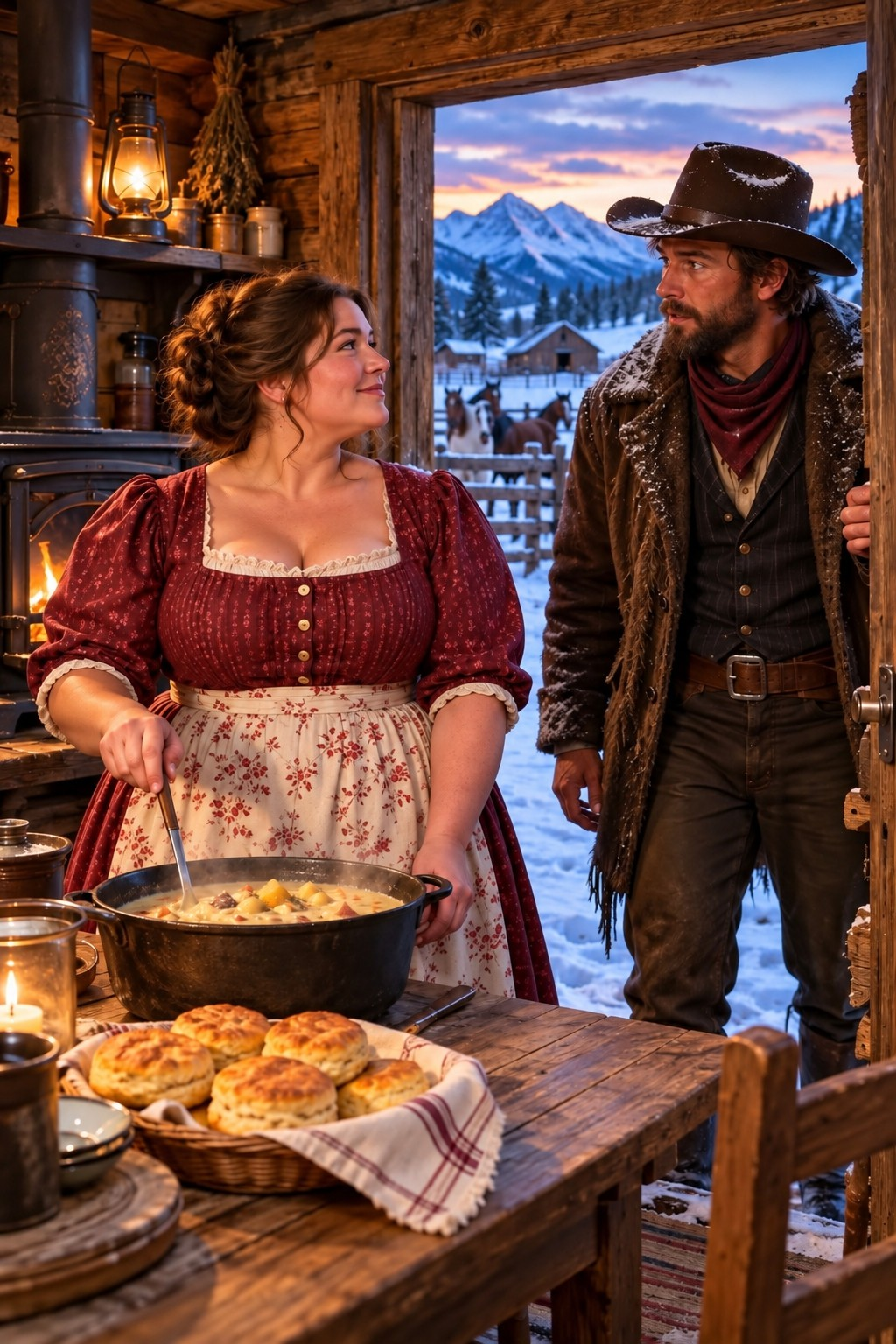
"That's Thomas Hayes," the stranger whispered. "And he knew exactly who you were."
Beatatrice stared through the kitchen window at the tiny photograph inside her mother's silver pocket watch.
The face belonged to Caleb's father.
For a moment, she could hear nothing but the blood rushing in her ears.
Thomas Hayes.
The man who had paid for her mother's doctor.
The man who had written letters to Eleanor Whitcomb.
The man whose death had left Broken Spur drowning in debt.
His photograph had been hidden inside Margaret Miller's watch for more than twenty years.
"Who are you?" Beatatrice demanded.
The stranger glanced over his shoulder.
"Open the window. We haven't much time."
"Tell me your name first."
"Samuel Reed."
Beatatrice studied him.
He was perhaps sixty, with a narrow face, graying hair, and a scar running from his left eyebrow toward his temple. His coat was expensive but badly worn, and his boots were coated with mud.
He looked like a man who had once possessed money and had spent years running from the consequences of losing it.
"Why was your face scratched out of the photograph?" she asked.
Samuel's expression changed.
"Because your mother had good reason to hate me."
Beatatrice felt a cold weight settle in her stomach.
"Then you can explain yourself from where you're standing."
He looked toward the western trail.
"Silas Voss has men watching the road. If they see me here, neither of us will have another chance to speak."
"Why should I believe anything you say?"
"Because I brought you something your mother wanted you to have."
He raised the watch.
Beatatrice's fingers tightened around the curtain.
She remembered that watch.
Margaret Miller had worn it on a chain tucked beneath her dress. As a child, Beatatrice had loved listening to its steady ticking while her mother held her.
After Margaret died, the watch disappeared.
Beatatrice had searched for it for weeks.
Mrs. Whitcomb told her that some possessions were lost when people moved from one room to another.
She had accepted that explanation.
Now she wondered how many other things she had accepted because she was too young to question them.
"Where did you get it?" she asked.
"Your mother gave it to me."
"When?"
"Before she died."
"Why?"
Samuel looked toward the cabin door.
"May I come inside?"
Beatatrice hesitated.
Then she remembered the rifle Caleb kept above the mantel.
She crossed the kitchen, took it down, and checked that it was loaded.
When she returned, Samuel was still waiting.
She opened the back door.
"Come in slowly."
He stepped inside.
His eyes moved immediately toward the rifle.
Then he looked at her.
"Margaret raised a sensible daughter."
"Don't speak about my mother as though you knew her."
Samuel's face tightened.
"I knew her better than I deserved to."
Beatatrice shut the door.
"Sit down."
He obeyed.
She remained standing.
The difference in their positions was deliberate.
All her life, men had expected her to make herself smaller.
To apologize for taking up space.
To lower her eyes when they spoke.
She had learned that a large woman could be treated as invisible and threatening at the same time.
But she was no longer a frightened girl working sixteen-hour days in a boardinghouse kitchen.
This was her home now.
And Samuel Reed was the visitor.
"Start talking," she said.
Samuel placed the watch on the table.
"Your mother worked for Eleanor Whitcomb when Thomas Hayes came east to negotiate a land investment."
Beatatrice frowned.
"That was more than twenty years ago."
"Yes."
"What investment?"
"A transportation company. Freight routes, livestock contracts, access to mountain water."
"Who owned it?"
"Three men held interests in the company. Thomas Hayes, Silas Voss, and me."
Beatatrice glanced toward the old photograph.
The three men.
Her mother standing between them.
"Why was Margaret involved?"
Samuel lowered his eyes.
"Because she kept the books."
Beatatrice said nothing.
"She was better with figures than any of us," he continued. "Thomas trusted her. I trusted her. Silas pretended to."
Beatatrice thought of her own years copying accounts for Mrs. Whitcomb.
Her mother's handwriting.
Her careful calculations.
The lessons she had taught her daughter.
Never let a man tell you a number is correct simply because he wrote it down.
"What happened?" Beatatrice asked.
Samuel rubbed his hands together.
"Silas began moving money between accounts. At first, the amounts were small. Then he forged signatures and borrowed against property that wasn't his."
"Broken Spur?"
"Among other properties."
Beatatrice felt her pulse quicken.
"Did my mother discover it?"
"Yes."
"And what did you do?"
Samuel looked away.
She understood before he answered.
"You helped him."
His silence confirmed it.
Beatatrice stepped back.
"Get out."
"Please."
"You helped a thief destroy honest people, and now you come here carrying my mother's watch?"
"I was a coward."
"That doesn't excuse you."
"No."
He looked up.
"It doesn't."
Beatatrice stared at him.
Samuel's hands were shaking.
She noticed a faded scar across his knuckles.
An old injury.
Not a fresh one.
Whatever he had suffered, it had not begun recently.
"Why come now?" she asked.
"Because Silas knows the original records still exist."
"Where?"
Samuel hesitated.
Beatatrice lifted the rifle slightly.
"Don't waste my time."
"They were divided."
"Between whom?"
"Your mother kept one portion. Thomas kept another. I was supposed to hold the third."
"Supposed to?"
Samuel swallowed.
"I gave mine to Silas."
Beatatrice stared.
"You betrayed them."
"Yes."
"And my mother?"
Samuel closed his eyes.
"She paid for my betrayal."
For several seconds, the kitchen was silent.
Then Beatatrice asked the question she had feared since seeing the watch.
"Was Thomas Hayes my father?"
Samuel opened his eyes.
"No."
The answer came so quickly that she almost staggered.
He continued.
"Thomas was your mother's friend. He helped her when others turned away. He protected you because Margaret asked him to."
Beatatrice gripped the back of a chair.
"Then why was his picture in her watch?"
"Because she wanted you to remember the man who kept his promise."
"What promise?"
Samuel's expression became guarded.
"That is something I cannot tell you until I know where the other papers are."
Beatatrice laughed once.
A sharp, bitter sound.
"You've spent twenty years hiding the truth, and now you want me to trust you with more secrets?"
Samuel lowered his head.
"I deserve that."
"Yes, you do."
She moved toward the door.
"You should leave."
He rose slowly.
"Beatatrice, listen to me. Silas doesn't want the ranch because of the cattle. He wants the creek. There's a mineral survey tied to the original deed."
"I know about the water."
"Then you know enough to be in danger."
She opened the door.
Samuel stopped beside her.
"Your mother was not an ordinary woman."
Beatatrice's eyes hardened.
"She was extraordinary to me."
"I know."
"No, Mr. Reed. You don't."
He looked at her for a long moment.
Then he placed the watch in her palm.
"Keep this."
She looked down.
The silver was scratched.
The chain was missing.
But the tiny second hand still moved.
Tick.
Tick.
Tick.
Her throat tightened.
Samuel stepped onto the porch.
"One more thing," he said.
She looked up.
"Don't tell Caleb about the watch until you've read the letter hidden beneath its lining."
Beatatrice stared.
"What letter?"
Samuel was already descending the steps.
He turned once.
"Your mother trusted you to find it."
Then he disappeared toward the trees.
Beatatrice locked the door.
She stood in the kitchen with the watch resting in her palm.
For several minutes, she did nothing.
Then she sat at the table.
Her mother's watch.
Her mother's handwriting.
Her mother's secrets.
Everything seemed to have followed her across the country.
She opened the back cover.
The photograph of Thomas Hayes rested inside a narrow metal frame.
Beneath it was a thin layer of faded blue fabric.
Beatatrice touched the edge.
It lifted.
Underneath lay a folded strip of paper no wider than her thumb.
She carefully removed it.
The writing was tiny.
But unmistakable.
Bea, if you ever reach Broken Spur, remember that the truth must be earned by those who seek it. Do not trust the man who offers to save you for a price.
Beatatrice read the words twice.
Then she turned the strip over.
On the back was a number.
17.
Nothing else.
She frowned.
Seventeen.
A page?
A date?
A location?
She examined the watch again.
Inside the metal casing, near the hinge, someone had scratched the same number.
Seventeen.
She closed the watch.
Then looked toward Thomas Hayes's notebook.
Caleb had left it on the mantel after their conversation.
She would not read the sealed letter addressed to him.
But the notebook had already been opened in her presence, and its contents concerned the ranch they now shared.
She carried it to the table.
The first pages contained ordinary entries.
Weather.
Cattle births.
Feed purchases.
Repairs.
Then the writing changed.
Thomas had begun recording meetings with Silas Voss.
Beatatrice turned the pages slowly.
Page eleven described an argument over the mortgage.
Page thirteen mentioned a missing survey.
Page fifteen contained a list of names.
She turned another page.
Seventeen.
Her breath caught.
The page had been cut out.
Only a narrow strip remained near the binding.
Beatatrice touched the torn edge.
Someone had removed it carefully.
Not ripped it in anger.
Cut it with a blade.
She turned the notebook toward the light.
A faint indentation marked the next page.
She recognized it immediately.
Writing pressure.
Someone had written on page seventeen while the following page lay beneath it.
The words might still be visible.
At the boardinghouse, she had learned how to recover faint writing from damaged ledgers by using angled light.
She carried the notebook to the window.
Then tilted the page.
A few letters appeared.
Not enough.
She fetched a pencil.
Very gently, she shaded the surface with the side of the graphite.
Lines emerged.
A date.
A location.
And three words.
Beneath the hearthstone.
Beatatrice stared.
She looked toward the stove.
Then toward the old stone hearth beneath it.
For a moment, she imagined pulling the entire structure apart.
But she stopped herself.
Caleb had worked all morning repairing fences.
The stove was finally functioning properly.
And she had no intention of destroying the only reliable source of heat without knowing what she was looking for.
She closed the notebook.
Whatever lay beneath the hearthstone would have to wait.
By late afternoon, the temperature had fallen sharply.
Beatatrice stepped outside to bring in firewood.
The sky was gray.
Snow gathered along the fence rails.
She carried three small logs into the kitchen and stacked them beside the stove.
Then she examined the pantry.
The potatoes were soft but usable.
The flour was coarse.
The salt pork was nearly gone.
She counted the remaining supplies.
Again.
There was enough to make a proper meal tomorrow if she was careful.
But tonight, she would have to stretch what remained.
She peeled two potatoes.
Chopped them into small pieces.
Added water, salt, and a little fat.
Then she mixed flour with warm water to make a simple dough.
Her hands moved automatically.
Work steadied her thoughts.
It always had.
When her mother died, Beatatrice had been twenty.
She remembered standing beside the grave with no money for a proper marker.
Mrs. Whitcomb had offered her a room.
A job.
A place at the kitchen table.
But charity had never been free from judgment.
Some guests complained about the large young woman carrying their meals.
Others laughed when she climbed the stairs.
One man had once told her she should eat less and work more.
She had been carrying his third helping of supper at the time.
Beatatrice remembered setting down the plate.
Then calmly asking whether he wanted dessert.
He had laughed.
She had not.
Over the years, she had learned to survive humiliation without allowing it to define her.
She had also learned that people revealed themselves most clearly when they believed they were speaking to someone powerless.
Men discussed money in front of her.
Women whispered about marriages.
Businessmen left contracts on tables.
They assumed she was too busy washing dishes to notice.
But Beatatrice noticed everything.
She remembered names.
Dates.
Figures.
Promises.
And lies.
That was how she had recognized the irregularities in Caleb's accounts.
That was how she had understood Silas Voss's interest in Broken Spur.
And that was why she knew Samuel Reed had not told her the whole truth.
He had answered her question about Thomas Hayes too quickly.
He had expected it.
Perhaps he had rehearsed the answer.
She looked toward the watch resting beside the stove.
Do not trust the man who offers to save you for a price.
She wondered which man her mother meant.
Silas Voss.
Samuel Reed.
Or someone she had not yet met.
Caleb returned after sunset.
He entered quietly, carrying a coil of rope and a broken fence staple.
Beatatrice looked up from the stove.
"You're late."
He removed his hat.
"Fence took longer than I thought."
"Did you eat?"
He glanced toward the empty parcel in his hand.
"Yes."
"All of it?"
He looked surprised.
"Yes, ma'am."
She almost smiled.
"Good."
Caleb stood near the doorway.
He noticed the clean floor.
The folded blankets.
The repaired curtain.
Then he looked toward the stove.
"Smells better in here."
"Potatoes."
"Again?"
"Unless you've been hiding a cow full of beef in the barn."
He laughed.
A real laugh.
Short, but warm.
Beatatrice turned toward him.
For a moment, she saw the man he might have been before grief and debt hardened him.
His face looked younger when he smiled.
Less guarded.
Less tired.
Caleb set down the rope.
"Need help?"
Beatatrice looked at him.
"With supper?"
"Anything."
She considered the offer.
Then handed him a knife.
"Peel those."
He stared at the potatoes.
"That's it?"
"Unless you'd prefer washing the floor."
He took the knife.
"Potatoes sound fine."
They worked side by side.
Caleb peeled badly.
He removed too much skin.
Beatatrice corrected him twice.
The third time, he deliberately made an exaggerated cut.
She shook her head.
"You're wasting half the potato."
"Then perhaps you married the wrong man."
The words escaped before he considered them.
Silence followed.
Caleb looked at her.
His expression changed.
"I'm sorry."
Beatatrice continued stirring.
"Why?"
"That was a foolish thing to say."
She looked at him.
"Perhaps."
He waited.
Then she added, "But I don't believe I've decided whether I married the wrong man."
Caleb stared.
She returned to the stove.
A faint smile appeared on her face.
He looked down at the potato in his hand.
Then smiled too.
For a few minutes, they worked without speaking.
It was an ordinary moment.
A man peeling potatoes.
A woman stirring supper.
A stove burning steadily.
But for Caleb, it felt unfamiliar.
He could not remember the last time someone had stood beside him in the kitchen without asking for money, complaining about the ranch, or reminding him how badly things were going.
He looked at Beatatrice.
Her braid rested over one shoulder.
Her sleeves were rolled above her elbows.
A small patch of flour marked her apron.
She was not the woman he had imagined when he answered the marriage agency's letter.
But he was beginning to wonder whether the woman he had imagined would have been half as capable.
"Beatatrice," he said.
She looked up.
"Yes?"
"About the depot."
Her expression grew still.
"I've already told you—"
"I know."
He set down the knife.
"But I should've said something when those men laughed."
She studied him.
"Yes," she said.
"I was ashamed."
"Of me?"
Caleb looked at her.
The question struck harder than he expected.
He wanted to deny it.
He wanted to say something kind.
But he had already caused enough hurt with careless words.
"At first," he admitted.
Beatatrice lowered her eyes.
He continued quickly.
"Not because you'd done anything wrong. Because I was a fool who thought he knew what kind of wife he needed."
She said nothing.
"I thought I needed someone who could lift feed sacks and mend fences. I never considered what else a person might bring to a ranch."
Beatatrice looked toward the clean stove.
"There's more than one kind of strength."
"I know that now."
She studied his face.
Then nodded.
"Good."
It was not forgiveness.
Not entirely.
But it was a beginning.
After supper, Caleb went outside to check the horses.
Beatatrice remained at the table.
She took out her mother's watch.
Opened the back.
And looked again at the photograph of Thomas Hayes.
She had not told Caleb about Samuel Reed.
Not yet.
She wanted to understand why the man had come.
And why he had warned her against revealing the watch.
But she was beginning to regret the silence.
Caleb had trusted her with his father's notebook.
He had asked for her help with the accounts.
He had apologized.
Perhaps she owed him the same honesty.
She closed the watch.
Then heard footsteps on the porch.
Caleb returned.
He was carrying a small wooden box.
"Found this in the barn," he said.
Beatatrice looked up.
"What is it?"
"Something my father kept."
He placed the box on the table.
The wood was dark with age.
A brass clasp held it shut.
Caleb opened it.
Inside were several old tools, a broken compass, and a folded piece of blue cloth.
Beatatrice stared.
The cloth matched the fabric hidden inside her mother's watch.
Caleb noticed her expression.
"What?"
She reached toward it.
"Where did your father get this?"
"I don't know."
She unfolded the cloth.
Inside was a small brass key.
A number had been stamped into its head.
Seventeen.
Beatatrice felt the room grow cold.
Caleb leaned closer.
"What's wrong?"
She looked at the key.
Then at the watch.
Then toward the hearthstone.
"Caleb," she whispered, "I think your father left us something."
He followed her gaze.
"The stove?"
"Underneath it."
Caleb frowned.
"What are you talking about?"
Beatatrice opened Thomas Hayes's notebook to the missing page.
She showed him the faint words she had recovered.
Beneath the hearthstone.
Caleb stared.
Then he looked toward the stove.
His father had built that hearth himself.
He remembered helping carry the stones when he was a boy.
He remembered Thomas carefully fitting each piece into place.
And he remembered one stone near the back that had always seemed slightly different.
Caleb stood.
"Get the lantern."
Beatatrice hesitated.
"The fire is still burning."
"We'll let it die."
He reached for the iron poker.
Then stopped.
A sound came from outside.
Hoofbeats.
Fast.
Too fast for someone approaching casually.
Caleb moved toward the window.
A rider was coming down the eastern trail.
The horse stumbled near the corral.
The rider nearly fell.
Then the man shouted.
"Hayes!"
Caleb opened the door.
The rider pulled his horse to a stop.
It was Jonah Pike.
His face was pale.
His coat was torn.
And blood stained one sleeve.
Caleb stepped onto the porch.
"Jonah? What happened?"
The older man struggled to dismount.
"Voss knows."
Caleb caught his arm.
"Knows what?"
Jonah looked past him.
His eyes found Beatatrice standing in the doorway.
"The woman," he gasped. "The woman from Missouri."
Beatatrice felt her stomach tighten.
"What about her?"
Jonah grabbed Caleb's coat.
"She's not who you think she is."
Caleb stared.
"Who?"
Jonah tried to speak.
But his knees buckled.
Caleb caught him before he fell.
Beatatrice hurried forward.
Together, they carried him inside.
His breathing was shallow.
Blood soaked the cloth around his upper arm.
Beatatrice reached for clean towels.
Caleb lowered Jonah into a chair.
"Who did this?"
Jonah struggled to lift his head.
"Voss sent men to the old survey office. They found the register."
Caleb frowned.
"What register?"
Jonah looked at Beatatrice.
His expression was filled with fear.
"The one that proves who owns the land."
Beatatrice stopped moving.
Jonah reached into his coat.
His fingers closed around a folded document.
He tried to pull it free.
Then his eyes widened.
"Don't let him see it."
"Who?" Caleb demanded.
Jonah pointed toward the window.
Caleb turned.
A dark figure stood beyond the glass.
The man raised one hand.
In it was a revolver.
And he was aiming directly at Beatatrice.






Comments 0