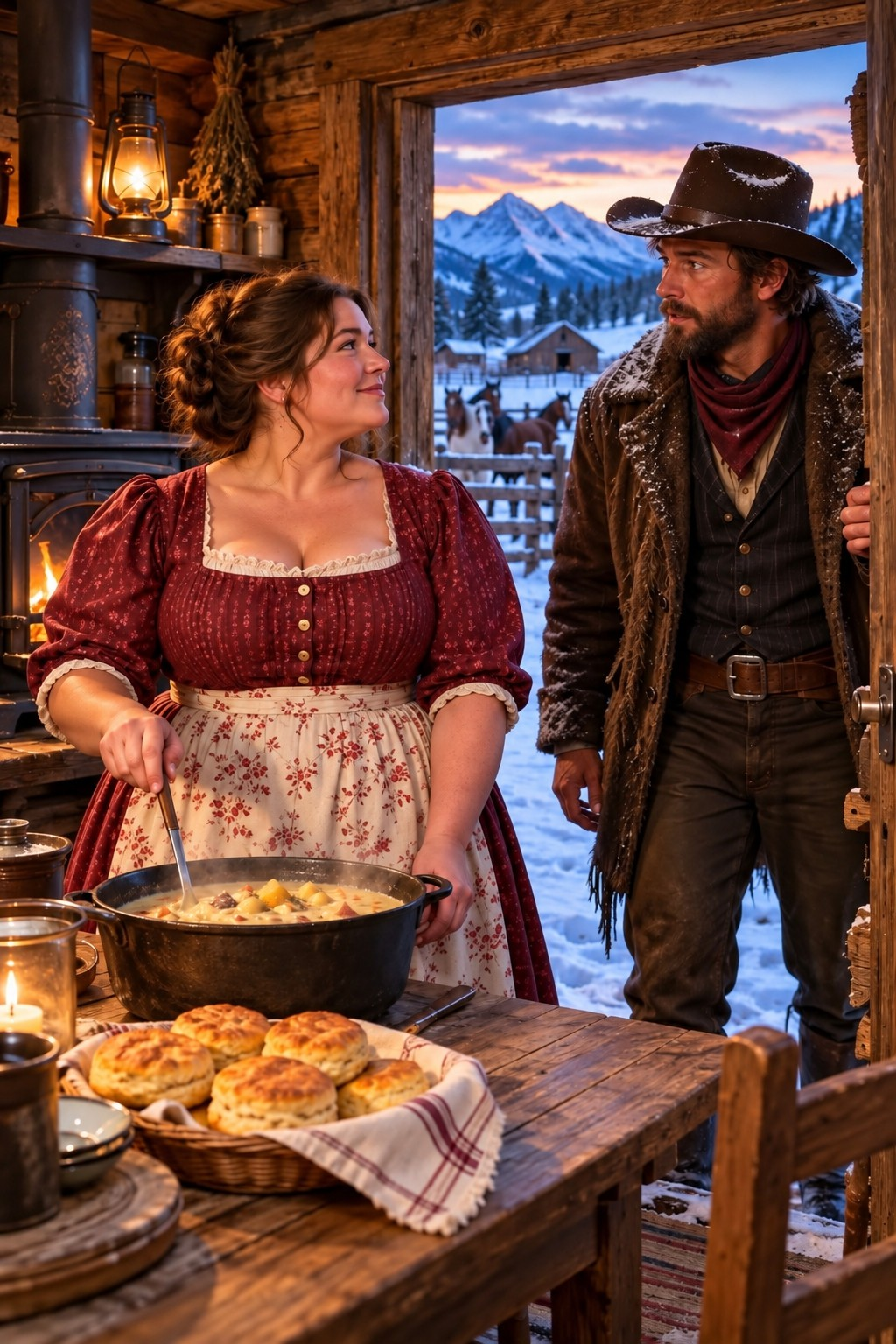
The key turned slowly in the lock.
Beatatrice Hayes stood in the center of the kitchen, watching the brass handle move.
Someone outside possessed a key to her husband's cabin.
And that someone had just spoken her dead mother's name.
"Mrs. Hayes," Silas Voss called through the door. "I suggest we conduct this conversation like civilized people."
Beatatrice did not answer.
She looked toward the bedroom, where the photograph still lay on the bedspread. Then she glanced at the account book resting open on the kitchen table.
The numbers were wrong.
The signatures were wrong.
And the man responsible was standing less than ten feet away.
The handle turned again.
This time, it stopped halfway.
A faint metallic scrape followed.
Beatatrice understood.
The key fit the lock, but the wooden bar Caleb had installed across the inside of the door prevented it from opening.
She had noticed the bar the previous evening.
Caleb had called it a precaution against wolves and wandering thieves.
Now she was grateful for it.
"That key won't help you," she said.
Silence followed.
Then Voss laughed softly.
"Well, now. You've got more sense than I expected."
Beatatrice moved closer to the door but kept her distance from the handle.
"What business do you have with my husband?"
"Bank business."
"Then you should speak to him."
"I intend to."
"He's working."
"So I gathered."
A second voice came from the porch.
"Just break the thing, Silas."
Beatatrice's stomach tightened.
Voss answered sharply.
"Keep your mouth shut, Deke."
The other man fell silent.
Beatatrice memorized the name.
Deke.
She had learned long ago that names mattered. Men who frightened others often believed themselves untouchable, but they became considerably less confident when someone could identify them.
"Mrs. Hayes," Voss continued, "I have no desire to frighten you."
"Then you've chosen a peculiar way to introduce yourself."
Another pause.
She imagined his expression.
Men like Silas Voss disliked being answered without fear.
"I understand you've recently arrived from Missouri," he said.
"That's correct."
"And I understand you worked at Eleanor Whitcomb's boardinghouse."
Beatatrice felt her throat tighten.
Eleanor had died the previous spring.
The woman who had once helped her mother, and who had kept Thomas Hayes's letters safe, could no longer defend herself.
"I worked in several boardinghouses," Beatatrice replied.
"Of course. A woman must earn her keep."
She said nothing.
"I also understand," Voss continued, "that Mrs. Whitcomb left certain papers in the care of her sister."
Beatatrice looked toward her apron pocket.
The folded receipt felt suddenly heavy.
"I don't know what you're referring to."
"Come now. We're both adults."
"Then speak plainly."
His voice hardened.
"Those papers are private business records. They belong to the bank."
"Do they?"
"Yes."
"Then I imagine the bank can produce proof of ownership."
For several seconds, neither man spoke.
Beatatrice heard a horse snort near the porch.
Then Voss said, "Your husband owes my institution twelve hundred and forty dollars."
She glanced at the account book.
The last figure recorded was twelve hundred and eighteen.
Twenty-two dollars had appeared overnight.
"That's a considerable amount," she said.
"It is."
"Especially for a loan that began at eight hundred."
Silence.
Beatatrice immediately regretted revealing how much she knew.
Then Voss spoke.
"So you've been examining the books."
"I've been examining my household."
"Your household?"
"My husband's debts concern me."
Voss gave a short, humorless laugh.
"You've been married less than twenty-four hours, Mrs. Hayes. I'd be careful about involving yourself in matters you don't understand."
Beatatrice looked at the clean plate beside the stove.
She thought of the men who had spoken to her that way throughout her life.
Employers.
Merchants.
Landlords.
Men who saw her size and assumed she was slow, simple, or easily embarrassed.
She had survived every one of them.
"I understand numbers perfectly well, Mr. Voss."
"Then understand this. Broken Spur belongs to the bank if your husband fails to pay."
"According to which agreement?"
The question landed heavily.
She heard Deke shift his boots.
Voss did not answer immediately.
"Your husband has a signed mortgage."
"Then he should have a copy."
"He does."
"Excellent. I'll ask to see it."
"You do that."
His voice was no longer friendly.
Beatatrice heard the faint rustle of paper.
"There's another matter," he said.
"What matter?"
"Your mother."
Her fingers went cold.
"Leave my mother out of this."
"Margaret Miller was an interesting woman."
"She was a hardworking woman."
"She was also someone who knew when to keep quiet."
Beatatrice stared at the door.
Her mother had died more than twenty years earlier.
She remembered a narrow bed, a thin blanket, and hands that had once been strong enough to carry heavy laundry baskets.
She remembered the final winter.
The coughing.
The medicine they could barely afford.
And her mother's warning.
Never trust a man who tells you kindness must be repaid with silence.
"What did you know about my mother?" Beatatrice asked.
Voss waited.
Then he said, "Enough to know she should have burned certain letters."
Beatatrice's pulse quickened.
"You're mistaken."
"Am I?"
"Yes."
"Then you won't mind giving me the papers."
"They aren't yours."
A heavy boot struck the porch.
Deke spoke again.
"Silas, we ain't got all morning."
Voss lowered his voice.
"Mrs. Hayes, I'm going to give you some advice. Your husband is already in serious trouble. Don't make his situation worse."
Beatatrice drew herself upright.
"Are you threatening him?"
"I'm offering you an opportunity."
"To do what?"
"Put the papers in an envelope. Leave them on the porch before sundown. No questions asked."
"And if I refuse?"
The answer came without hesitation.
"Then your husband may discover that the bank is considerably less patient than he believes."
Footsteps moved away from the door.
Beatatrice waited.
She heard one man mount his horse.
Then another.
The horses shifted on the frozen ground.
But they did not immediately leave.
Voss called one final time.
"One more thing, Mrs. Hayes."
She remained silent.
"I'd advise you not to mention this visit to Caleb."
"Why?"
"Because some men become dangerous when they learn how little they know about their own families."
The horses turned.
Hooves struck the hard earth.
Beatatrice stood motionless until the sound faded into the distance.
Only then did she remove the wooden bar.
She opened the door a few inches.
The yard was empty.
Two sets of hoofprints led toward the western trail.
She looked down.
Something had been placed beneath a loose board on the porch.
A small folded card.
She picked it up.
On one side was the name of Oak Haven Mercantile Bank.
On the other, someone had written:
Three days.
Beatatrice closed the door.
She locked it.
Then she replaced the wooden bar.
Her hands were steady.
But her heart was not.
Caleb Hayes spent the morning repairing a section of northern fence that had collapsed beneath the weight of an old cottonwood limb.
The work was miserable.
The ground had begun freezing.
His fingers ached inside his gloves.
Every fence post seemed determined to resist him.
By noon, he had repaired less than half the damaged section.
He sat on an overturned bucket and opened the small parcel Beatatrice had placed beside his coat before he left.
Inside were two pieces of bread and a slice of cold salt pork.
He stared at the food.
He had not asked her to prepare anything.
In fact, he had barely spoken to her that morning without sounding irritated.
Yet she had packed him a meal.
He took a bite.
The bread was dry.
The pork was salty.
But it was more than he usually carried.
He remembered her standing beside the table, asking about the household accounts.
He had spoken to her as though she were an inconvenience.
And she had answered him with the patience of someone who had spent years being underestimated.
Caleb looked toward the distant cabin.
A thin ribbon of smoke rose from the chimney.
He wondered what she was doing.
Probably discovering another dozen things that needed fixing.
He almost smiled.
Then he remembered the letter.
His father's handwriting.
The accusation against an unnamed lender.
And Beatatrice's strange connection to the past.
His smile disappeared.
He reached into his coat and withdrew the folded page.
He had brought it with him.
He read it again.
I signed papers I did not fully understand.
Caleb rubbed his jaw.
Thomas Hayes had been many things.
Stubborn.
Proud.
Sometimes careless with money.
But he had never been a fool.
If his father believed something was wrong with the mortgage, Caleb needed to understand why.
He looked at the final paragraph.
If something happens to me, please keep this letter until you can be certain it will not place him in greater danger.
Greater danger.
Those words bothered him most.
What danger?
A bank loan was a bank loan.
A man borrowed money, paid interest, and lost his property if he failed to repay it.
There was nothing mysterious about that.
Unless the figures were false.
Caleb thought of Silas Voss.
The banker had first appeared at Broken Spur shortly after Thomas Hayes died.
He had offered condolences.
Then he had offered financial assistance.
At the time, Caleb had been grateful.
The ranch needed feed.
The cattle needed medicine.
And the previous winter had left them nearly ruined.
Voss had spoken kindly.
He had promised reasonable terms.
Caleb had signed.
Now he wondered whether he had ever read the agreement carefully enough.
A gust of wind swept across the pasture.
Caleb folded the letter and returned it to his pocket.
He stood.
There was still work to do.
Questions would have to wait.
Back at the cabin, Beatatrice spread the account book and her papers across the table.
She had never been frightened of difficult work.
But this was different.
A dirty kitchen could be cleaned.
An empty pantry could be managed.
A torn blanket could be repaired.
A dishonest man with a bank behind him was another matter.
She examined the receipt again.
Eight hundred dollars.
Thomas Hayes's name.
A signature that did not match.
Then she compared it with the figures in Caleb's account book.
She wrote the amounts on a separate sheet.
Principal.
Interest.
Fees.
Penalties.
Additional charges.
By the time she finished, she had identified three entries that made no mathematical sense.
One charge had been added before the payment was due.
Another appeared twice.
A third had no explanation at all.
She leaned back.
Silas Voss had not merely charged excessive interest.
He appeared to be manufacturing debt.
But suspicion was not proof.
She needed the original mortgage.
She needed bank records.
And she needed to understand why Thomas Hayes had been afraid.
Beatatrice looked toward the mantel.
The sealed letter remained where Caleb had placed it.
She would not touch it.
It belonged to him.
Whatever secrets it contained, he deserved to discover them himself.
She gathered the other papers and returned them to her tin box.
Then she turned toward the kitchen.
The counters were sticky.
The stove was clogged with ash.
The floorboards had not been scrubbed in months.
And the pantry contained barely enough food to last a week without careful planning.
She looked around.
For a moment, exhaustion threatened to overwhelm her.
She had traveled hundreds of miles.
Married a man who clearly regretted choosing her.
Discovered that his father's debts might be fraudulent.
And received threats from a banker who somehow knew her mother's name.
She could have sat down and cried.
No one would have blamed her.
But crying would not clean the stove.
And it would not feed Caleb when he returned.
Beatatrice rolled up her sleeves.
"One thing at a time," she whispered.
She began with the dishes.
There were eleven plates.
Four bowls.
Six tin cups.
Three skillets.
And a roasting pan so coated in grease that she doubted Caleb remembered its original color.
She heated water.
Scraped away hardened food.
Washed.
Rinsed.
Dried.
Then she attacked the counters.
Years of grease had darkened the pine.
She scrubbed until her shoulders burned.
The work was slow.
Her knees complained whenever she bent.
But she knew how to pace herself.
At the boardinghouse, she had learned that strength did not mean moving quickly.
It meant knowing how to continue.
By midafternoon, the kitchen looked different.
Not beautiful.
Not comfortable.
But cleaner.
She stood beside the window and stretched her aching back.
Outside, the mountains rose beyond the ranch.
She remembered the wagon ride the previous afternoon.
Twelve miles from Oak Haven.
Twelve miles of silence beside a man who had already decided she was a disappointment.
She remembered the way Caleb had refused the food she offered.
Then quietly eaten it when he thought she wasn't watching.
She remembered his face when he first saw the cabin through her eyes.
Ashamed.
Not angry.
Ashamed.
That distinction mattered.
A cruel man might have blamed her for noticing the dirt.
Caleb had blamed himself.
He simply didn't know what to do with the feeling.
Beatatrice understood that kind of pride.
She had seen it in hardworking men who believed asking for help was the same as admitting defeat.
And she suspected Caleb Hayes had been fighting a losing battle alone for years.
She looked toward the broken stove.
Then at the small collection of tools hanging beside it.
A wire brush.
An iron scraper.
A rusted screwdriver.
She smiled faintly.
There was work she knew how to do.
Caleb returned just before sunset.
He expected the usual smell of stale grease and damp wood.
Instead, he smelled soap.
He stopped inside the doorway.
The dishes were stacked neatly.
The table had been wiped.
The floor near the stove was clean.
Beatatrice stood beside the counter, rubbing her hands with a towel.
"Good evening," she said.
Caleb looked around.
"What happened?"
"I washed a few things."
"A few?"
She glanced at the dishes.
"The rest can wait."
He stepped inside.
His boots left muddy prints on the floor.
He immediately noticed.
Beatatrice noticed him noticing.
"Don't worry about that," she said. "It's a working ranch."
He looked at her.
For a moment, he didn't know what to say.
Then he removed his hat.
"Looks better."
"Thank you."
He hung his coat beside the door.
"Did you have enough wood?"
"Yes."
"Stove behave?"
"Mostly."
He nodded.
Their conversation might have ended there.
But Beatatrice had been waiting all afternoon to tell him about Silas Voss.
She watched Caleb cross toward the table.
He looked exhausted.
His hands were cracked.
A small cut marked his cheek.
She thought of the threat.
Three days.
"Mr. Hayes," she began.
He turned.
"Yes?"
"Does anyone besides you have a key to this cabin?"
Caleb frowned.
"No."
"Are you certain?"
"Why?"
She hesitated.
Then she told him.
Not everything.
Not about the photograph.
Not about the scratched-out face.
But about the visit.
The two riders.
The key.
The demand for papers.
And the threat against Broken Spur.
Caleb's expression darkened with every sentence.
When she finished, he stood completely still.
"Silas Voss came here?"
"Yes."
"While I was gone?"
"Yes."
"And he tried to open my door?"
"He had a key."
Caleb swore under his breath.
Beatatrice did not flinch.
"Did he hurt you?"
The question surprised her.
"No."
"Did he come inside?"
"No. The wooden bar stopped him."
Caleb looked toward the door.
Then toward the window.
His jaw tightened.
"I'll speak to him."
"I think you should be careful."
"Careful?"
"He's not behaving like a man who merely wants repayment."
Caleb turned toward her.
"What do you know about him?"
Beatatrice met his eyes.
"Not enough."
He studied her.
"Mrs. Hayes, if there's something you're keeping from me—"
"There are things I don't yet understand."
"That's not what I asked."
"No," she said quietly. "It isn't."
The honesty of her answer stopped him.
He rubbed his forehead.
Then he sat heavily at the table.
For a long moment, neither spoke.
Finally, Caleb said, "I don't know what kind of trouble my father got himself into."
Beatatrice pulled out the chair opposite him.
"Then perhaps we should find out together."
He looked up.
Together.
The word seemed unfamiliar.
He had spent years making every decision alone.
He had grown accustomed to carrying burdens without asking whether anyone else could help.
Now this woman, whom he had privately judged incapable of surviving ranch life, was offering to stand beside him.
He wanted to refuse.
Instead, he said, "There's something I haven't told you."
Beatatrice waited.
Caleb reached into his coat.
He withdrew a folded notice.
"The bank sent this last week."
He placed it on the table.
Beatatrice opened it.
Her eyes moved across the page.
The document demanded immediate payment of the outstanding mortgage balance.
Failure to comply would result in foreclosure proceedings.
She looked at the date.
Then at the deadline.
"Caleb," she said softly, "this says you have seven days."
He nodded.
"Six now."
She read the final paragraph.
Then she noticed something strange.
The document had been signed before the latest interest charge appeared in the account book.
She turned the paper over.
A second notation had been stamped on the back.
It was not a bank seal.
It was a land transfer reference.
Beatatrice recognized the format from legal papers she had once copied for Mrs. Whitcomb.
Her fingers tightened.
"Caleb, who owns the property east of your boundary?"
He frowned.
"Why?"
"Please."
"Silas Voss bought it last year."
"And the land west of your ranch?"
"Some mining company. Why?"
She stared at the document.
Broken Spur lay between the two properties.
A narrow valley.
A creek.
A wagon trail.
And access to the only reliable water source for miles.
Suddenly, the debt looked less like a financial dispute.
It looked like a plan.
Before she could speak, a loud crash came from outside.
Caleb jumped to his feet.
The horses were screaming.
Something heavy struck the barn wall.
He grabbed his rifle.
"Stay here."
Beatatrice rose.
"Caleb—"
"Lock the door."
He rushed outside.
She hurried to the window.
In the fading light, she saw movement near the corral.
A horse broke loose.
Then another.
The gate swung wildly.
Someone had cut the rope holding it shut.
Caleb ran toward the barn.
Beatatrice watched a dark figure emerge from behind the woodpile.
The man was moving toward the cabin.
He carried something in his hand.
Not a rifle.
A small leather document case.
The same kind Silas Voss had brought that morning.
Beatatrice backed away from the window.
The man reached the porch.
She heard his boots.
Then a sharp knock.
"Mrs. Hayes."
She recognized the voice.
Deke.
"Open the door."
She did not move.
Another knock.
Harder.
"Your husband is busy. We need to talk."
Beatatrice reached for the wooden bar.
Then stopped.
A folded paper slid beneath the door.
She bent down and picked it up.
There was only one sentence.
Ask Caleb what really happened at the creek.
Her heart began pounding.
Outside, Deke laughed softly.
Then he said, "Your husband's father didn't fall from that horse, Mrs. Hayes."
Beatatrice stared at the paper.
From the direction of the barn came a gunshot.
Then Caleb shouted her name.
She turned toward the window.
A second shot rang out.
And someone began pounding on the back door.






Comments 0