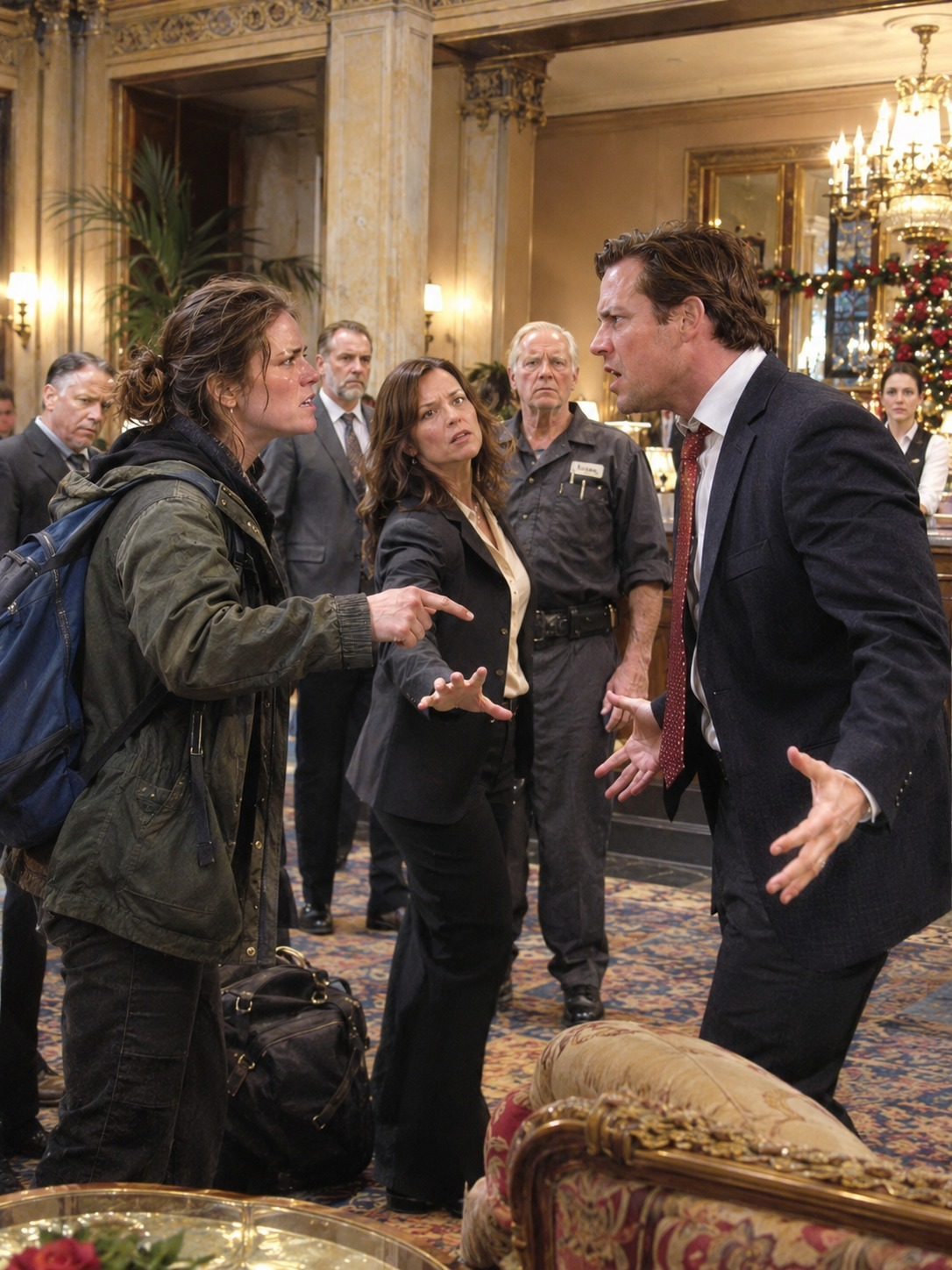
"Christmas feels brighter without you. Stay away."
My father's message flashed across my phone as I stood outside Savannah's airport, gripping the handle of my suitcase.
Three minutes later, another message arrived from my mother.
"Find a cheap motel. Garrett's wife doesn't want you here."
I looked down at the thick legal envelope sticking out of my travel bag.
Near the bottom of its address label were three words I hadn't noticed before.
Magnolia Grand Holdings.
I had traveled four thousand miles to see my family.
But something about that envelope was about to change who needed whom.
I just didn't know it yet.
My name is Greta Ashford. I was thirty years old that Christmas, and for the previous five years, I had worked as a rescue coordinator in northern Alaska.
I had helped search teams locate missing hikers in blizzards. I had ridden in helicopters through weather that made experienced pilots grip their controls a little tighter. I had spent entire nights sitting beside injured strangers, promising them that help was coming even when I wasn't entirely certain it would arrive in time.
I had learned to stay calm when people screamed.
I had learned to make decisions when everything around me was falling apart.
But nothing in Alaska had prepared me for the feeling of standing outside an airport while my own father told me Christmas would be better without me.
People hurried past carrying brightly wrapped packages. A little boy ran toward his grandmother, who dropped her handbag just to catch him in her arms.
A young woman about my age stood beside a waiting SUV while her father loaded her suitcase into the trunk.
He kissed the top of her head.
I looked away.
Two weeks earlier, I had called my mother from my apartment in Alaska.
"I'm thinking about coming home for Christmas," I'd told her.
There had been a pause.
Then she'd said, "Well, that's your decision, Greta."
I should have recognized the warning.
Instead, I'd asked whether everyone would be there.
"Your brothers will be here," she'd answered. "Garrett and Vanessa are hosting the Christmas dinner at the hotel."
"And Dad?"
"Of course."
I'd swallowed the nervousness rising in my throat.
"It would be nice to see everyone."
My mother hadn't answered immediately.
Then she had said, "We'll see."
An hour later, she'd sent me a heart emoji.
One tiny red heart.
I had stared at it for almost a minute.
It was the warmest thing she'd sent me in years.
I bought my plane ticket that evening.
Now, standing outside the airport, I realized how desperately I'd wanted that little heart to mean something.
My phone buzzed again.
For one ridiculous second, I hoped my father had changed his mind.
Instead, it was my younger brother, Jasper.
Did you land?
I stared at the message.
Jasper was twenty-six, four years younger than me. When we were children, he'd followed me around the Magnolia Grand carrying a toy flashlight and pretending we were hotel detectives.
He had always been the gentlest member of our family.
But gentleness wasn't the same as courage.
Five years earlier, when our parents told me to leave, Jasper had stood in the hallway with tears in his eyes.
He hadn't said a word.
I typed back.
Yes.
His reply came almost immediately.
I'm sorry.
I waited.
There was nothing else.
No offer to pick me up.
No invitation to dinner.
No explanation.
Just two words.
I put my phone away.
The taxi driver who eventually stopped for me was an older man with a gray beard and a Savannah accent thick enough to make every sentence sound like it belonged on someone's front porch.
"Where to, ma'am?"
I almost said the Magnolia Grand.
The name had lived inside me for thirty years.
Instead, I gave him the address of a budget motel I'd found online.
He glanced at me in the rearview mirror.
"Long trip?"
"Alaska."
He whistled softly.
"Coming home for Christmas?"
I watched the airport disappear behind us.
"Something like that."
He smiled.
"Well, welcome home."
Those two words nearly broke me.
I turned toward the window before he could see my eyes.
Savannah looked almost exactly as I remembered.
Spanish moss hung from the trees. Christmas wreaths decorated old brick buildings. Warm lights glowed behind the windows of historic homes.
We passed streets I had walked as a child, sidewalks where Garrett had raced his bicycle and Jasper had scraped his knees.
Then we turned onto a road that led toward the historic district.
For a moment, I saw the distant roofline of the Magnolia Grand.
My family's hotel.
Or what I still believed was my family's hotel.
The Magnolia Grand wasn't just a business.
It was where I'd learned to ride a bicycle in the service courtyard.
It was where my grandmother had taught me to fold napkins into elaborate shapes for Sunday brunch.
It was where I'd spent summers carrying clean towels through hallways while Garrett practiced introducing himself as the future owner.
Our father used to laugh when Garrett said that.
"That's my boy," he'd tell guests.
When I asked whether I could help run the hotel someday, Dad would pat my shoulder.
"You'll always have a place here, sweetheart."
I used to believe him.
The taxi pulled up outside the motel twenty minutes later.
The building was two stories high, with faded cream paint and a sign missing one letter.
The woman at the front desk gave me a key card without looking up from her television.
"Room 214. Ice machine's broken. Coffee's in the lobby until nine."
"Thank you."
She finally looked at me.
"You okay, honey?"
I smiled automatically.
"Just tired."
She nodded as if she'd heard that answer a thousand times.
Maybe she had.
Room 214 smelled of old carpet and cleaning solution.
The heater made a rattling noise every few minutes. One curtain hung slightly crooked. The bedspread had a faded floral pattern that looked older than I was.
I set my suitcase on the bed.
For a long time, I didn't open it.
I sat beside it, staring at the wall.
Five years.
That was how long it had been since I'd walked through the Magnolia Grand's front doors as a member of the Ashford family.
Five years since I'd discovered Garrett had taken two hundred thousand dollars from the hotel's accounts.
Five years since I'd brought the evidence to our parents.
And five years since my father had looked me directly in the eyes and said, "If you insist on destroying this family, you don't belong in it."
I could still remember every detail of that evening.
The smell of coffee in Dad's office.
The ticking grandfather clock near the fireplace.
My mother's pearl necklace.
Garrett standing beside the window, refusing to look at me.
I'd brought bank statements.
Transfer records.
Invoices from companies that didn't exist.
I hadn't wanted Garrett arrested.
I hadn't wanted the hotel damaged.
I'd wanted someone to stop him before the missing money became a disaster.
Instead, my father had accused me of jealousy.
My mother had called me cruel.
Garrett had smiled.
Not a big smile.
Just a tiny movement at the corner of his mouth.
That smile had followed me all the way to Alaska.
I stood and walked toward the motel window.
Across the parking lot, a family was unloading gifts from a minivan.
A little girl held a stuffed reindeer.
Her mother called her back before she stepped into the driveway.
I watched them disappear into a room downstairs.
Then I opened my banking app.
The latest mortgage contribution had cleared three days earlier.
$4,800.
Every month, I had sent money to help keep the Magnolia Grand afloat.
Sometimes the amount was smaller.
Sometimes, after overtime shifts or emergency rescue assignments, I could send more.
Over five years, those payments had consumed most of what I could have saved.
I had postponed replacing my aging truck.
I had lived in a modest apartment.
I had turned down vacations with coworkers.
And whenever I wondered whether I was being foolish, I pictured the hotel's old brass elevator doors.
I remembered my grandmother saying, "Buildings are only worth saving when they hold something worth remembering."
I thought I was saving my childhood.
Maybe I had been trying to buy back my family.
My phone rang.
Mother.
I stared at her name until the call ended.
A message appeared.
Please don't make this difficult.
I almost laughed.
I had traveled four thousand miles.
I had been rejected before leaving the airport.
I was sitting alone in a motel room on Christmas Eve.
And somehow, I was the one making things difficult.
I typed a reply.
I won't come to the hotel.
I hesitated.
Then I added:
Merry Christmas, Mom.
She read it.
She didn't respond.
I placed the phone facedown.
For the first time in five years, I didn't feel the familiar urge to explain myself.
I didn't want to convince anyone that I was a good daughter.
I didn't want to remind my parents how much money I'd sent.
I didn't want to ask Garrett why he'd never apologized.
I was simply tired.
Tired in a way sleep wouldn't fix.
I opened my suitcase and began putting away my clothes.
Two sweaters.
A pair of jeans.
A small wrapped gift for Jasper.
A tin of Alaskan smoked salmon for Dad.
A wool scarf I'd bought for Mom from a woman in Fairbanks who knitted them by hand.
I looked at the gifts for a moment.
Then I placed them on the dresser.
At the bottom of the suitcase was the legal envelope.
I'd received it in Alaska shortly before my trip.
The return address belonged to a Savannah law firm.
I'd assumed it concerned another mortgage renewal or financial statement.
Those documents had become so routine that I rarely gave them much thought.
Years earlier, my father had asked me to sign papers connected to the hotel's financing.
"Just a formality," he'd said.
"The bank needs another family signature."
I'd trusted him.
At twenty-five, I'd still believed that parents didn't deliberately put their children at financial risk.
I picked up the envelope.
It was heavier than I'd remembered.
The paper inside was thick, and a second sealed packet appeared to be enclosed.
I sat on the bed.
For a moment, I considered leaving it unopened until morning.
It was Christmas Eve.
I had already endured enough.
But then I remembered the mortgage payment that had cleared three days earlier.
And the message from my father.
Christmas feels brighter without you.
Something cold settled in my chest.
I took a breath and opened the envelope.
The first page was a formal notice addressed to me.
Greta Elizabeth Ashford.
Below my name was a reference to the Magnolia Grand Hotel and its primary secured loan.
I frowned.
I knew I had signed as a guarantor.
That part wasn't new.
But the next paragraph referred to a default.
I read it once.
Then again.
The default date was eighteen months earlier.
I stared at the page.
That couldn't be right.
My parents had continued accepting my payments.
Garrett had continued managing the hotel.
Mother had sent me occasional updates about renovations and holiday bookings.
Nobody had mentioned a default.
I turned to the next page.
There was a reference to a transfer provision in the original agreement.
I remembered sitting in Dad's office years earlier, signing documents while he took a business call.
He'd pointed to the signature lines.
"Here, sweetheart. And here."
I'd signed.
I hadn't asked enough questions.
Now I was reading the consequences.
Under the agreement described in the notice, the ownership interest securing the obligation was to transfer to the guarantor after the specified default process.
I stopped breathing for a moment.
The guarantor.
Me.
I checked the date again.
Eighteen months.
My hands began to shake.
I turned another page.
A completed transfer was referenced.
Then a valuation report.
The number printed near the top looked so impossible that my brain refused to understand it.
$986,000,000.
Nine hundred eighty-six million dollars.
I blinked.
Surely I was reading it wrong.
Perhaps the valuation concerned a larger portfolio.
Perhaps there was some technical meaning I didn't understand.
I wasn't a lawyer.
I coordinated rescue operations.
I knew how to read weather reports and emergency maps, not complicated property agreements.
But I knew how to recognize my own name.
And it was there.
Again.
And again.
I spread the documents across the bed.
My father's signature appeared on one of the older agreements.
A bank officer's signature appeared beside it.
Farther down was a section labeled with the words Ownership Transfer Confirmation.
I leaned closer.
Before I could read the entire paragraph, my phone began vibrating on the bedside table.
Dad.
I watched it ring.
It stopped.
Then Mother called.
Then Dad again.
I stared at the phone.
An hour earlier, they had wanted me nowhere near the hotel.
Now they couldn't seem to leave me alone.
I turned back to the papers.
There was one more page tucked behind the valuation report.
Unlike the others, it was a short letter from the law firm.
At the top was the date.
Below it was a sentence informing me that the firm had been unable to confirm whether I had received earlier correspondence regarding the transfer.
I read farther.
The letter mentioned a meeting.
A meeting that had apparently taken place without me.
My father's name appeared.
So did Garrett's.
And then I saw the final paragraph.
It referred to an attached record of communications concerning the ownership transfer.
I reached for the second sealed packet.
My phone vibrated again.
This time, a message appeared from a number I didn't recognize.
Ms. Ashford, this is attorney Eleanor Whitcomb. I understand you've arrived in Savannah. Before you speak with your family, there is something you need to see.
I sat perfectly still.
Another message arrived.
Please check the signature on the last document.
I looked at the packet.
The seal had already been broken once.
Someone had opened it before it reached me.
I slid the papers out.
At the bottom of the final page was a signature.
My signature.
Except I had never signed it.
And directly beneath it was the name of the person who had witnessed it.
Garrett Ashford.






Comments 0