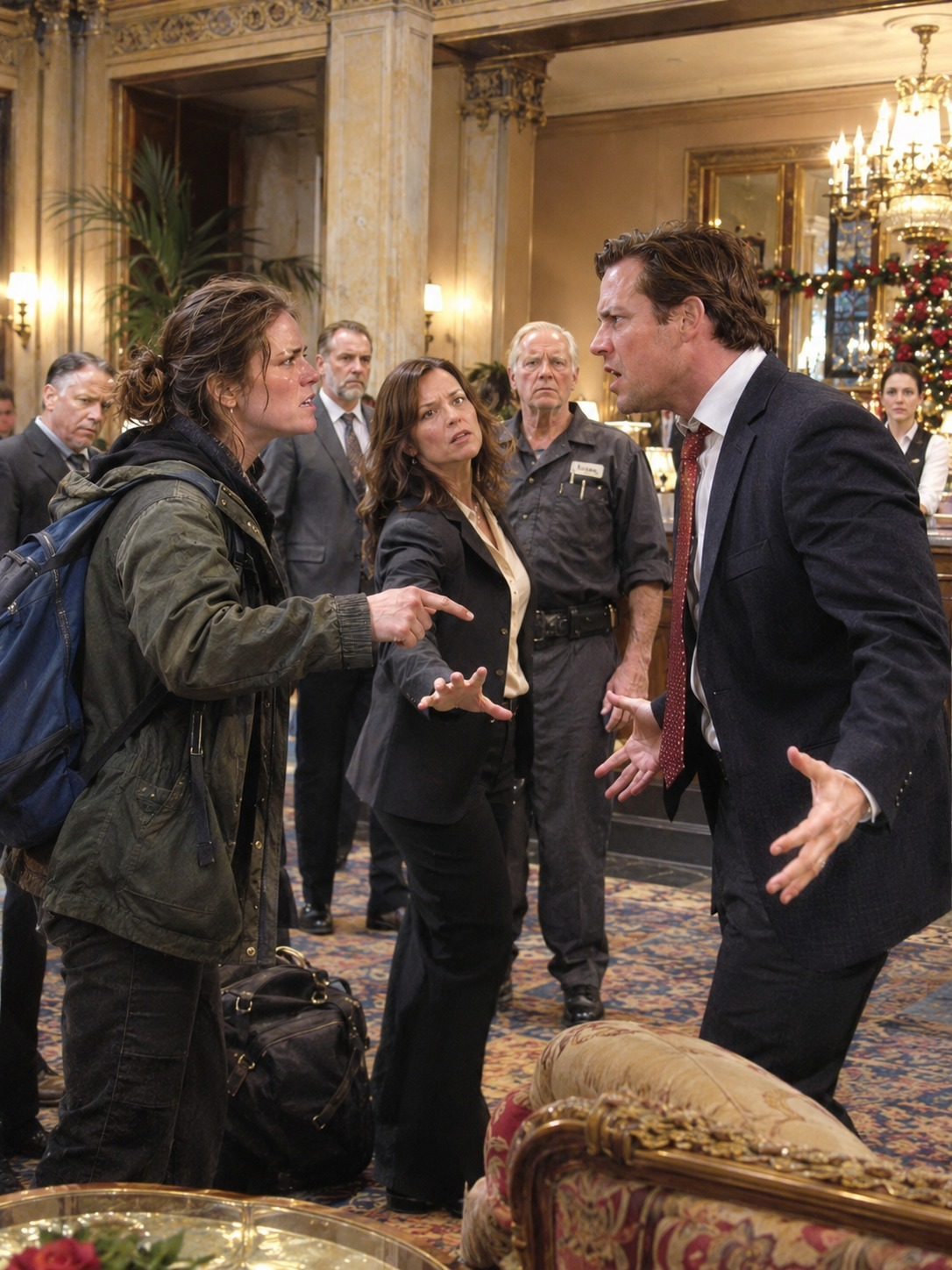
"Open the door, sweetheart."
My mother's voice came through the thin motel door as though she were standing outside my childhood bedroom, asking me to come downstairs for breakfast.
For one terrible second, I almost obeyed.
Then Garrett slammed his fist against the wood.
"Greta! We know you have the documents!"
I stepped backward.
My laptop sat open on the bed, displaying a proposed $240 million financing transaction bearing a signature that looked like mine.
A signature I had never written.
My mother had told me to stay away from Christmas dinner.
Now, barely two hours after midnight, she was standing outside my cheap motel room with the brother who had helped drive me out of our family five years earlier.
And they weren't there to wish me Merry Christmas.
"Greta," Mom called again. "Please don't make a scene."
I looked at the door.
There it was.
The same sentence, dressed in different words.
Don't embarrass us.
Don't question us.
Don't make things difficult.
For thirty years, my family had treated my silence like a debt I owed them.
I was beginning to understand how expensive that silence had become.
"What do you want?" I asked.
Garrett answered immediately.
"Open the damn door."
"No."
The hallway went quiet.
I could almost picture his expression.
Garrett had never handled refusal well.
As children, he would take the largest piece of birthday cake, then accuse me of being selfish if I complained. As teenagers, he borrowed my things without asking and returned them damaged. When I confronted him, Dad always said the same thing.
"He's your older brother, Greta. Show some respect."
Apparently, thirty years of practice hadn't made Garrett any better at hearing the word no.
Mom lowered her voice.
"Honey, we're worried about you."
I stared at the door.
"Worried?"
"Of course."
"You told me to find a cheap motel because Vanessa didn't want me around."
"That was before—"
She stopped.
I waited.
"Before what, Mom?"
No answer.
I glanced at the legal papers spread across the bed.
Before they realized I knew the hotel belonged to me?
Before Garrett discovered I had proof of the forged signature?
Before someone warned them that their financial arrangement was about to collapse?
"Greta," Garrett said, "we need to talk about the envelope."
My fingers tightened around my phone.
"What envelope?"
"Don't play games."
"I thought you wanted me gone."
"This is business."
I almost laughed.
For five years, I had been family whenever the hotel needed money.
Now that I was asking questions, I had suddenly become business.
I opened my phone's recording application and started recording the conversation.
Then I moved closer to the door.
"I'm listening."
Garrett exhaled loudly.
"Some documents were sent to you by mistake."
"Really?"
"Yes."
"Which documents?"
"The ones concerning the hotel."
I glanced toward the bed.
There were dozens of pages.
A completed ownership transfer.
A valuation report.
A questionable authorization.
And a proposed $240 million financing arrangement scheduled for December 26.
"That's a lot of mistakes," I said.
Mom spoke before Garrett could respond.
"Greta, your father has been under enormous pressure. The hotel has responsibilities you don't understand."
I closed my eyes.
I had spent my childhood working inside that hotel.
I'd cleaned guest rooms, reconciled invoices, handled complaints, and covered employee shifts.
I had helped keep the business operating during emergencies.
And for five years, I had sent money from Alaska because my parents insisted the mortgage needed help.
Yet somehow, I was still the daughter who didn't understand.
"Then explain it to me," I said.
Garrett's voice hardened.
"Not through a locked door."
"That's where the conversation is happening."
A heavy silence followed.
Then Mom said something that made my stomach turn.
"We brought an agreement. All you need to do is sign it."
I looked toward the laptop.
Another agreement.
Another signature.
Another document my family expected me to accept without asking questions.
"What kind of agreement?"
"A temporary authorization," Garrett answered. "It lets us continue operating the hotel without interruptions."
"You've been operating it for eighteen months without asking me."
"Because you were in Alaska."
"Phones work in Alaska."
"Greta, stop being difficult."
I felt a strange calm settle over me.
"Does this agreement have anything to do with the two hundred forty million dollars?"
Silence.
Absolute silence.
Even the motel heater seemed to stop rattling.
Then I heard my mother whisper something to Garrett.
I couldn't make out the words.
When Garrett spoke again, his voice had changed.
"Who told you about that?"
I didn't answer.
"Greta."
"Is the financing real?"
"That's none of your concern."
I looked at the ownership transfer.
"My name is on the documents."
"Your name is on a lot of things you don't understand."
"Then why do you need my signature?"
He didn't answer.
Mom tried again.
"Sweetheart, please. Your father is waiting at the hotel. We can settle everything quietly."
I looked at the clock.
12:31 a.m.
Christmas morning.
Five years earlier, I would have opened the door.
I would have listened.
I would have accepted whatever explanation my father offered, because the possibility of being welcomed home mattered more to me than the truth.
But the woman standing inside Room 214 was no longer twenty-five.
She had spent five winters in Alaska.
She had watched people survive conditions that should have killed them.
She had learned that staying calm didn't mean surrendering.
"I'm not signing anything tonight," I said.
Garrett struck the door again.
"You're making a huge mistake."
"Then I guess I'll have to live with it."
Mom's voice cracked.
"Greta, think about what this will do to your father."
Something inside me finally gave way.
Not my composure.
My willingness to feel guilty.
"What about what he did to me?"
Neither answered.
I continued.
"He threw me out because I found missing money. He let me believe I was destroying the family. Then he accepted my payments for five years while keeping the truth about the hotel from me."
"Your father did what he thought was necessary," Mom said.
"For whom?"
"Greta—"
"For Garrett?"
I heard my brother mutter something.
I kept going.
"For you? For Dad? Because it certainly wasn't for me."
Mom began crying softly.
Once, that sound would have ended any argument.
I would have apologized.
I would have comforted her.
I would have forgotten why I was upset.
But tonight, I remembered the email.
Greta has agreed to help with the mortgage.
She won't ask questions?
She trusts us.
My mother hadn't simply watched me sacrifice my savings.
She had counted on it.
"I'm going to meet my attorney tomorrow," I said.
Garrett's response was immediate.
"You don't need an attorney."
"I disagree."
"Greta, listen carefully. If you bring outsiders into this, you could destroy everything Grandma built."
There it was.
My grandmother.
The one person whose memory could still make me hesitate.
I looked at the framed photograph on my phone's lock screen.
Grandma Evelyn standing beside the Magnolia Grand's Christmas tree, smiling as twelve-year-old me held a box of ornaments.
She had died when I was twenty-three.
Two years before I left Savannah.
I wondered what she would have said if she knew how the family had treated me.
Then I remembered something she'd told me when I was seventeen.
"Greta, people who love you don't need you to stay small so they can feel important."
At the time, I thought she was talking about a difficult guest.
Now I wasn't so sure.
"Grandma built a hotel," I said quietly. "She didn't build a place for people to hide stolen money."
Garrett swore.
Mom gasped.
Then Garrett said, "You have no idea what you're accusing us of."
"I'm not accusing anyone yet."
"Then open the door."
"No."
I heard footsteps moving away.
For a moment, I thought they were leaving.
Then Garrett returned.
"Fine. Have it your way. But when the bank comes after you, don't expect us to save you."
The words landed exactly where he intended.
The bank.
My signature.
The guarantor agreement.
The possibility of debt.
I had spent years worrying that the hotel might collapse and take my family's livelihood with it.
Garrett knew that.
He knew fear had kept me sending money.
But I had something tonight that I hadn't possessed five years earlier.
Evidence.
And an attorney.
"I'll discuss the bank with Eleanor Whitcomb," I said.
Garrett went silent.
Mom whispered, "Let's go."
I listened as their footsteps moved down the hallway.
A car door opened.
Then another.
An engine started.
I waited until the sound faded before checking the peephole.
The hallway was empty.
Only then did I stop recording.
My hands were trembling.
I leaned against the door and slowly slid to the floor.
I hadn't realized how hard my heart was beating.
I sat there for almost a minute, listening to my own breathing.
Then I opened the recording and saved it in three places.
My phone.
My laptop.
A secure online folder.
Daniel's advice echoed in my head.
Document everything.
I had learned that lesson in Alaska.
During rescue operations, every radio call mattered.
Every change in weather.
Every decision.
Sometimes a detail that seemed insignificant became the difference between finding someone alive and arriving too late.
Now I was beginning to treat my family's financial records with the same care.
I returned to the bed and picked up the original legal envelope.
It had been delivered to my apartment in Alaska shortly before my trip.
The return address belonged to Whitcomb & Associates.
I studied the postmark.
Then I looked at the shipping label.
There was something odd about it.
The label had been placed over an older one.
I carefully lifted a loose corner.
Beneath it was part of another address.
Savannah, Georgia.
I frowned.
Why would a legal envelope addressed to me in Alaska have previously carried a Savannah address?
I took a photograph.
Then I examined the adhesive.
The envelope had clearly been handled more than once.
The seal on the second packet had also been disturbed.
Someone had opened it before I received it.
I remembered the message from Eleanor.
Please check the signature on the last document.
I opened my laptop and drafted an email.
Eleanor, my mother and Garrett came to my motel after midnight. They wanted me to sign an authorization. Garrett became upset when I mentioned the proposed $240 million financing. I also noticed the legal envelope appears to have been relabeled and one packet was previously opened.
I attached photographs and the audio recording.
Then I added:
Can you confirm whether your office mailed the envelope directly to Alaska?
I sent it.
I didn't expect a reply at that hour.
But six minutes later, my phone vibrated.
Eleanor.
Are you safe?
I typed:
Yes. They left.
Her next message arrived immediately.
Do not sign anything. Preserve the envelope and all packaging.
Then:
Our office did not send the original ownership notice directly to your Alaska address.
I stared at the screen.
Then who did?
Her reply took almost a minute.
I need to check the delivery history before answering that.
I looked at the envelope again.
Someone had possessed these documents before they reached me.
Someone had opened them.
And someone had eventually sent them to Alaska.
Why?
I spread the contents across the bed and began arranging them by date.
The original loan agreement was several years old.
The default notice was eighteen months old.
The transfer confirmation followed shortly afterward.
The valuation report was more recent.
The questionable authorization had been signed after the ownership transfer.
And the proposed financing documents were dated only days earlier.
They didn't belong to one single transaction.
They were pieces of a much longer story.
A story my family had been keeping from me.
I checked the envelope's contents against the index printed on the first page.
Document A.
Document B.
Document C.
Document D.
I counted the packets.
Something was missing.
The index listed a supplemental disclosure statement.
I searched the bed.
Nothing.
I checked inside the envelope.
Still nothing.
Then I noticed a thin strip of paper stuck to the inner seam.
I pulled it loose.
It was part of a document receipt.
The recipient's name had been partially torn away.
Only the final letters remained.
...nett.
Bennett.
Caroline Bennett?
I stared at the scrap.
Caroline had worked in accounting.
She had been fired after helping me investigate Garrett's transfers.
She had contacted me tonight.
And she had access to financial records that my family apparently wanted hidden.
Had she handled the envelope?
Or had someone else tried to make it look that way?
I opened our message thread.
Caroline, did you send me a legal envelope in Alaska?
She answered several minutes later.
No. Why?
I sent a photograph of the receipt.
Her reply came quickly.
Where did you get that?
It was inside the envelope.
Three dots appeared.
Then disappeared.
A minute passed.
Finally, she wrote:
Greta, please don't throw anything away. That receipt may be important.
I frowned.
Important how?
She didn't answer immediately.
Then:
I need to check something before I tell you.
I stared at the message.
I was becoming tired of people knowing things they wouldn't explain.
For five years, my parents had hidden information from me.
Now even the people trying to help seemed to be speaking in fragments.
I typed:
Caroline, I need the truth. All of it.
Her reply arrived after a long pause.
You deserve it. And tomorrow, I'll give you what I can prove.
I put the phone down.
Outside, the rain had stopped.
A faint glow from the parking lot lights filtered through the curtains.
It was almost two in the morning.
I should have slept.
Instead, I opened the flash drive Thomas had given me.
The folder labeled Pending Transactions contained more than the proposed financing documents.
There were emails between Garrett and representatives of the private investment firm.
Most were routine.
Scheduling.
Document requests.
Financial projections.
But one email stood out.
It was dated four days earlier.
The sender was a man named Victor Langford.
I remembered Thomas showing me his photograph.
The property investor who had persuaded Garrett to put hotel money into failing deals.
The man connected to Coastal Development Partners.
His message was short.
We cannot proceed without satisfactory confirmation of the owner's authority. The December 26 closing remains conditional.
Garrett had replied:
The family situation is being handled.
I stared at those words.
The family situation.
Was that what I was?
A problem to be handled?
I scrolled farther.
Langford had written again.
Your father assured us the guarantor would cooperate.
Garrett's response was even shorter.
She always does.
I felt my face grow hot.
She always does.
I remembered every time I'd said yes.
Every time I'd sent money.
Every time I'd ignored a question because I didn't want to upset my parents.
Garrett had mistaken my loyalty for permanent obedience.
And apparently, he'd built a financial plan around it.
I downloaded the email chain and forwarded it to Eleanor.
Then I opened the valuation report.
$986 million.
The figure still seemed impossible.
The Magnolia Grand I remembered had been a beautiful historic hotel, but not an empire.
I examined the report more carefully.
It referred to the hotel's operating business, associated real estate holdings, development rights, and several adjacent properties included in the valuation.
That explained part of the enormous number.
The business had apparently expanded while I was away.
But the report also included projected values and assumptions I didn't understand.
I made a note to ask Eleanor whether the figure represented an independently supported current market value or a broader investment estimate.
I wasn't going to build my future around a number simply because it looked impressive.
That was the kind of mistake Garrett made.
And I had spent enough years paying for his mistakes.
At 2:26 a.m., I received a message from Jasper.
Are you okay?
I answered:
Yes. Mom and Garrett left.
He replied:
I'm sorry.
I stared at the familiar words.
Then I typed:
Jasper, did you know they were coming?
A long pause.
No. Garrett found out where you were after Thomas and I left.
How?
I don't know.
I considered asking whether he'd told them.
But something stopped me.
He had brought Thomas to me.
He had given me records.
He had warned me that Garrett was coming.
For the first time in years, Jasper was taking risks to help me.
I didn't want to punish him for every failure of our family.
Instead, I wrote:
Please be careful.
His reply came almost immediately.
You too.
I closed the conversation.
Then I remembered the first Christmas I'd spent in Alaska.
I had been twenty-five.
My apartment was barely furnished.
I owned a folding table, a secondhand couch, and a mattress on the floor.
My coworkers invited me to a holiday dinner, but I declined because I was embarrassed by how badly I missed home.
I spent Christmas Eve eating instant noodles and watching old movies.
At midnight, I called my parents.
Nobody answered.
On Christmas morning, my mother sent a message.
Hope you're doing well.
That was all.
I had cried for nearly an hour.
Then I'd put on my uniform and volunteered for an extra shift.
Working was easier than feeling unwanted.
The following Christmas, I sent gifts.
The year after that, I sent money for a holiday renovation.
By the fourth Christmas, I had learned not to expect a phone call.
But I still sent a card.
I still wrote Love, Greta.
I still hoped.
Now, sitting in Room 214, I realized how much of my life had been shaped by that hope.
I had stayed single partly because I didn't trust myself to recognize healthy love.
I had worked too many hours because exhaustion made loneliness easier to ignore.
I had treated every small gesture from my parents like proof that things might improve.
A heart emoji.
A birthday message.
A photograph of the hotel.
I had accepted crumbs and called them progress.
My phone buzzed again.
Daniel.
You awake?
I smiled faintly.
Unfortunately.
Figured. You always overthink when you're upset.
I'm not overthinking. I'm reviewing financial documents.
That's somehow worse.
I laughed softly.
Then another message appeared.
Seriously, Greta. Get some sleep. Whatever's happening down there, you don't have to solve it in one night.
I looked at the papers.
He was right.
But I couldn't stop.
Not yet.
I typed:
Someone tried to use my name to arrange a $240 million deal.
His reply took longer.
That sounds like something your lawyer needs to handle immediately.
She knows.
Good. And Greta?
Yeah?
Don't let them convince you that protecting yourself is the same as hurting them.
I read that sentence several times.
Then I saved it.
Because I knew exactly what would happen when I confronted my family.
My father would accuse me of destroying the hotel.
My mother would cry.
Garrett would threaten me.
And somewhere inside me, the frightened twenty-five-year-old who'd packed her suitcase five years earlier would want to apologize.
I needed to remember that asking for the truth wasn't betrayal.
It was the beginning of protecting myself.
At 3:11 a.m., Eleanor sent another email.
I located the original delivery record.
I opened it immediately.
The initial notice was delivered to the Magnolia Grand's executive office eighteen months ago. It was accepted by an authorized hotel representative.
My pulse quickened.
Who signed for it?
Her answer arrived seconds later.
The receipt lists Margaret Ashford.
My mother.
I stared at the name.
She had received the original notice.
She had known the hotel transferred into my ownership.
She had continued accepting my mortgage payments.
And tonight, she'd stood outside my motel door asking me to sign another agreement.
I felt something inside me become very still.
Not numb.
Clear.
I typed:
Does the delivery record show what happened afterward?
Eleanor replied:
Not yet. But there's another issue. The supplemental disclosure listed in your envelope was supposed to identify any outstanding claims against the property.
I looked at the missing document index.
That page isn't here.
I know.
I sat upright.
How do you know?
Because our office received a copy of the packet inventory. The disclosure was removed before the envelope was forwarded to you.
My heart began pounding.
What was on it?
There was no immediate response.
I waited.
One minute.
Two.
Then Eleanor wrote:
I'm requesting the original from the records custodian. I don't want to speculate until I see it.
I looked toward the window.
The sky was still dark.
Somewhere across Savannah, my parents were probably awake.
Perhaps they were arguing.
Perhaps Garrett was trying to find another way to secure the financing.
Perhaps my mother was crying because I hadn't opened the door.
I wondered whether any of them had stopped to consider what they'd done to me.
Then I realized that question no longer mattered as much as it once had.
I didn't need them to admit I was hurt.
I needed to understand what had happened.
And I needed to stop it from happening again.
At 6:18 a.m., I finally closed my laptop.
I had slept less than an hour.
My eyes burned.
My shoulders ached.
But I had organized the documents into folders and created a list of questions for Eleanor.
I showered, changed into clean jeans and a dark sweater, and tied my hair back.
Then I put on my olive-green jacket.
The same jacket I'd worn through countless Alaskan winters.
Its left pocket had a small tear near the seam.
I had intended to replace it for two years.
Somehow, there had always been another hotel payment to make.
I looked at myself in the bathroom mirror.
For the first time since arriving in Savannah, I didn't look like a daughter waiting to be welcomed home.
I looked like someone preparing to ask difficult questions.
At 6:47 a.m., I left the motel.
The morning air was cool.
Christmas decorations hung from nearby storefronts.
A few cars moved through the quiet streets.
I drove a rental car toward Whitaker Street, where Caroline had asked to meet me.
The coffee shop was already open.
Warm light spilled through its windows.
Inside, a handful of customers sat with paper cups and pastries.
Caroline was waiting at a table near the back.
She looked older than I remembered.
Her hair was almost entirely gray.
Her glasses still hung from a silver chain.
When she saw me, she stood.
"Greta."
I walked toward her.
For a moment, neither of us spoke.
Then she hugged me.
It was the first embrace I'd received from anyone connected to my childhood since returning to Savannah.
I hadn't realized how badly I needed it.
"I'm so sorry," she whispered.
I closed my eyes.
"For what?"
"For not telling you sooner."
We sat.
Caroline placed a worn leather folder on the table.
"I brought the original records," she said.
I looked at the folder.
"All of them?"
"Everything I was able to preserve."
She opened it.
Inside were bank statements, correspondence, and a small sealed envelope.
I recognized the Magnolia Grand's old stationery.
Caroline touched the envelope with two fingers.
"This was given to me shortly before I lost my job."
"By whom?"
She looked at me.
"Your grandmother's attorney."
I frowned.
"Grandma died two years before I left Savannah."
"I know."
"Then why would her attorney give you something afterward?"
Caroline's expression changed.
"Because your grandmother left instructions concerning the hotel's ownership and financing. Certain documents were supposed to be reviewed if the business ever entered serious financial trouble."
I stared at her.
"Why wasn't I told?"
Caroline looked down.
"Your father controlled access to the family records."
I felt my stomach tighten.
"What's in the envelope?"
"Something Eleanor needs to examine carefully."
I reached toward it.
Caroline gently placed her hand over mine.
"Greta, before you open that, there's something you need to understand."
I waited.
She took a breath.
"Your grandmother knew the family might eventually put the hotel at risk. She was trying to protect it."
"From Garrett?"
Caroline hesitated.
"From anyone who forgot what the hotel was supposed to mean."
I looked at the envelope again.
My grandmother's name was written across the front.
Evelyn Ashford.
Below it was a line in her familiar handwriting.
For Greta, when the truth can no longer be hidden.
My throat tightened.
I remembered Grandma sitting beside me in the hotel garden, teaching me how to care for the magnolia trees.
I remembered her telling me that strength didn't always look like winning an argument.
Sometimes it looked like refusing to become cruel when other people were.
I had missed her every day since she died.
Now I was holding something she'd apparently intended me to see.
I carefully lifted the envelope.
The paper was old but intact.
Caroline watched silently.
I opened the flap.
Inside was a folded letter and a small brass key.
The key had a numbered tag attached.
ROOM 307.
I frowned.
Room 307 had been closed to guests for years.
It was part of the hotel's original east wing, near the old administrative offices.
As a child, I had sometimes wandered there when I wanted to be alone.
Grandma used to find me sitting on the windowsill, watching the courtyard below.
I unfolded the letter.
The first line was written in her unmistakable handwriting.
My dearest Greta,
My eyes filled.
I swallowed and continued.
If you're reading this, then something has happened that I hoped your father would have the wisdom to prevent.
I stopped.
Caroline said nothing.
I looked at the next paragraph.
There is a reason I insisted that certain records remain separate from the hotel's regular accounting files. The truth about our family's finances is more complicated than Richard has ever admitted.
My hands began trembling.
Then I reached the final paragraph.
When you are ready, take the key to Room 307. Behind the old walnut cabinet is a locked compartment containing the documents I could not safely leave in the executive office.
I stared at the words.
Room 307.
The old walnut cabinet.
I remembered it.
A tall, dark piece of furniture with carved flowers along its doors.
Grandma had kept old photographs and guest registers inside.
I had never known there was anything behind it.
Caroline leaned closer.
"There's one more thing."
I looked up.
She pointed toward the bottom of the letter.
A sentence had been written beneath Grandma's signature.
The ink was darker.
The handwriting was different.
I read it slowly.
The key is useless unless you know what was removed.
I frowned.
"Who wrote that?"
Caroline's face went pale.
"I don't know."
Before I could ask another question, the coffee shop's front door opened.
A bell rang overhead.
Caroline looked past my shoulder.
Her expression changed instantly.
"Greta," she whispered, "don't turn around."
I froze.
"Why?"
Her hand tightened around the leather folder.
"Because the man who just walked in is Victor Langford."
I felt my pulse quicken.
Caroline stared toward the entrance.
Then she whispered something that made the blood drain from my face.
"He's carrying the missing disclosure."
I turned slowly.
Victor Langford stood near the door in an expensive gray coat.
He was looking directly at our table.
In one hand, he held a cream-colored envelope bearing the Magnolia Grand's emblem.
He began walking toward us.
Caroline reached for my wrist.
And just before he reached the table, he said—
"Greta Ashford, there's something your grandmother never told you about your father."






Comments 0