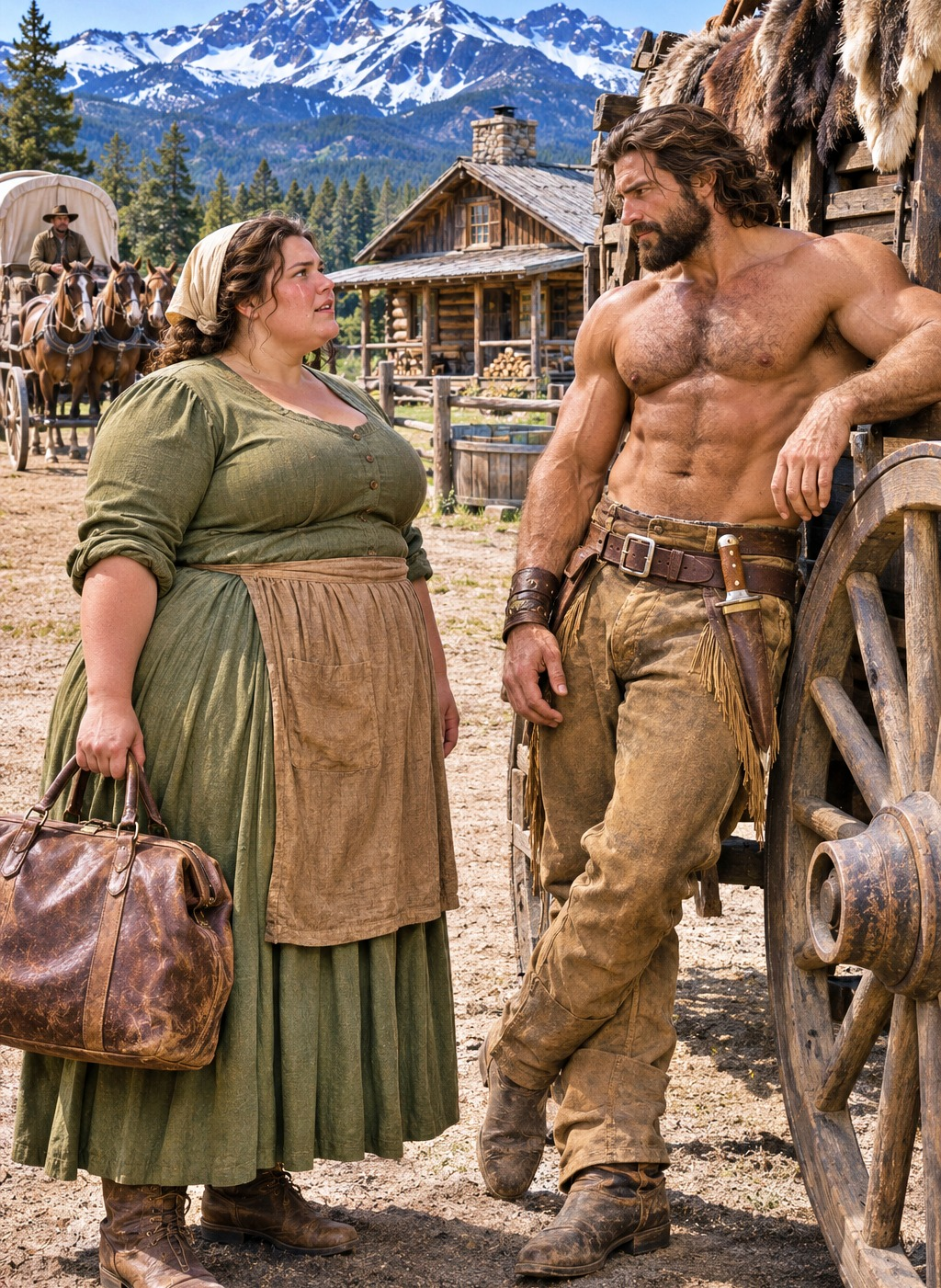
"Show yourself!" Callum shouted into the trees.
The forest answered with silence.
Eleanor stood behind him, her fingers gripping the edge of her burgundy shawl.
Bear growled beside the porch.
The man's voice had come from somewhere beyond the woodpile. Close enough to be heard clearly. Far enough that the thick pines concealed whoever had spoken.
Callum took one step forward.
"Whoever you are, you've got ten seconds to come out."
A branch snapped.
Then came the sound of a horse moving through underbrush.
Callum moved toward the woodpile, but Eleanor caught his sleeve.
"Don't."
He looked down at her.
Her face had gone pale.
"You know that voice?" he asked.
She hesitated.
"I thought I did."
"Who was it?"
"I don't know."
He studied her.
She was frightened. Not of him, not of the mountain, but of something that had followed her from a place more than a thousand miles away.
Callum had seen fear before.
He had seen it on the faces of five women.
He knew the difference between fear of a stranger and fear of someone familiar.
This was the second kind.
"Stay here," he said.
Before Eleanor could object, he crossed the yard.
Bear followed.
Callum reached the trees and stopped.
Fresh hoofprints marked the soft earth.
A broken pine branch hung at shoulder height.
Whoever had been watching them had ridden away only moments earlier.
Callum listened.
Nothing.
No approaching footsteps.
No wagon wheels.
Only the distant creek and the wind moving through the pines.
He returned to the porch.
Eleanor was still standing where he had left her.
The white envelope remained in his hand.
"He's gone," Callum said.
"Are you certain?"
"Unless he plans on walking back through seven miles of timber."
She nodded.
But her hands were trembling.
Callum noticed and looked away.
He understood what it meant to be embarrassed by something a person could not control.
"Come inside," he said. "I'll get a fire going."
Eleanor looked at the envelope.
"Are you going to open that?"
"Not unless you want me to."
She stared at him.
"Your name is on it."
"Your name's inside it, seems like."
"You don't know that."
"No. But I reckon whoever wrote it wants me asking questions about you."
"And you aren't going to?"
Callum considered her.
"I figure you'll tell me what you want me to know when you're ready."
The answer seemed to unsettle her more than an accusation would have.
She looked toward the trees again.
Then she followed him into the cabin.
The first thing Eleanor noticed was the warmth.
The second was the furniture.
Everything was enormous.
The dining table looked sturdy enough to survive a stampede. The chairs were built from thick pine, their legs reinforced with crossbeams. The fireplace occupied nearly an entire wall.
Even the shelves were higher than she expected.
But the cabin was clean.
Not the careless sort of clean produced by hiding clutter before a visitor arrived.
It was the deliberate cleanliness of someone who took pride in what he owned.
Copper pots hung above the stove.
Firewood was stacked beside the hearth.
A braided rug lay beneath the table.
There were three rooms, just as Callum had described.
The main room served as kitchen and sitting room.
A narrow hallway led to two bedrooms.
Eleanor noticed that one bedroom door stood open.
Inside was a neatly made bed with a blue quilt.
A small washstand stood beneath the window.
Fresh curtains hung from a wooden rod.
Someone had placed a jar of dried mountain flowers on the dresser.
She stopped.
"Whose room is that?"
Callum followed her gaze.
"Yours."
She turned.
"Mine?"
"If you want it."
She stepped closer.
The quilt had been sewn by hand.
The curtains were simple but carefully hemmed.
The flowers had been arranged with an awkward tenderness that made her chest tighten.
"Did you prepare this room for me?"
Callum shifted his weight.
"Some of it."
"Some?"
"The bed was already there."
"And the curtains?"
He looked uncomfortable.
"Bought the cloth in town."
"Who sewed them?"
He cleared his throat.
"I did."
Eleanor looked at him.
The enormous mountain man who frightened children and made grown men cautious had sewn curtains for a woman he believed would abandon him.
She touched the fabric.
The stitches were uneven.
Some were too large.
Others were crooked.
But every one had been made with care.
"They're lovely," she said.
Callum stared at the floor.
"Thank you."
She turned toward him.
"Callum, may I ask you something?"
"Yes."
"Did you make these curtains for the other women?"
His expression changed.
He looked toward the fireplace.
"No."
"Why not?"
"Didn't think of it back then."
"Back when?"
He was silent for a moment.
"Before I understood how much a woman might need a place that felt like hers."
Eleanor waited.
He rubbed a scarred hand across his beard.
"The first one told me the cabin didn't feel like a home. I thought she meant it needed more furniture."
"What did she mean?"
"I never found out."
He looked at the curtains.
"So I started trying to make things better."
There was something heartbreaking about the simplicity of his explanation.
He had been rejected five times.
And after each rejection, instead of growing cruel, he had tried to become more welcoming.
Eleanor lowered her eyes.
"Would you tell me about them?"
Callum went still.
"The women?"
"Yes."
He looked toward the door.
For a moment, she thought he might refuse.
Then he nodded.
"After supper."
Callum cooked beans, salt pork, and potatoes.
Eleanor offered to help, but he insisted she sit.
"You've been traveling," he said.
"So have you."
"Seven miles ain't much."
"Not compared with eleven days, I suppose."
He almost smiled.
They ate at the enormous table.
Bear lay near the hearth, occasionally lifting his head whenever Eleanor spoke.
The food was plain but good.
Callum ate carefully.
Too carefully.
He held his fork as though he were afraid of making a mistake.
Eleanor noticed.
"Do you always eat this slowly?"
His hand stopped.
"Am I doing something wrong?"
The question startled her.
"No. I was only curious."
He lowered his fork.
"One of the women didn't like how I ate."
"Didn't like it?"
"Said I ate like a bear."
Eleanor glanced toward the dog.
"Well, that must have been confusing for poor Bear."
Callum looked at her.
Then a deep laugh escaped him.
It was brief.
Rough.
Almost surprised.
Eleanor smiled into her cup.
The sound pleased her more than she wanted to admit.
When supper was finished, she helped clear the table.
Callum protested once.
She ignored him.
They washed the dishes together.
He handled the heavy pots.
She dried the plates.
Neither spoke much.
But the silence felt different from the silence Eleanor had known in St. Louis.
There, silence had meant disapproval.
Punishment.
Secrets.
Here, silence seemed to mean that two people were simply comfortable doing the same work.
Afterward, Callum built up the fire.
Eleanor sat in one of the large chairs.
He remained standing.
"Sit down," she said.
He hesitated.
"I don't want to crowd you."
She looked around the enormous room.
"Callum, I believe there's sufficient space for both of us."
He sat opposite her.
The chair creaked.
For several moments, they watched the fire.
Then Eleanor asked, "What happened with the first woman?"
Callum's face grew serious.
"Helen."
"Was that her name?"
He nodded.
"She came from Ohio. April of last year."
"How long did she stay?"
"Four days."
"What happened?"
Callum leaned forward, resting his elbows on his knees.
"She was younger than I expected. Twenty-four, maybe twenty-five. Pretty. Had yellow hair and wore gloves even when it was warm."
Eleanor listened.
"She looked at the cabin and asked where the nearest town was."
"What did you tell her?"
"Twenty-three miles."
"And?"
"She asked where the nearest church was."
"Where was it?"
"Same place."
Eleanor nodded.
"Then she asked where the nearest dress shop was."
Callum paused.
"I didn't know."
Despite herself, Eleanor almost laughed.
But she saw the sadness in his expression and remained quiet.
"Helen tried," he continued. "I'll give her that. She stayed four days. But every evening she stood on the porch looking toward the road."
"Did she tell you why she was unhappy?"
"She said she felt like she'd been buried alive."
Eleanor's expression softened.
"That must have hurt."
Callum shrugged.
"She wasn't wrong about the distance."
"That isn't what I meant."
He looked at her.
She held his gaze.
After a moment, he looked away.
"No," he admitted. "It didn't feel good."
He continued.
"Margaret came in June. From Pennsylvania."
"What was she like?"
"Quiet. Nervous. She cried a lot."
"Because of you?"
"I thought so."
"Did she say that?"
"No."
"Then why did you think it?"
Callum seemed genuinely puzzled.
"Because she cried whenever I came into the room."
Eleanor considered that.
"Perhaps she was frightened of the mountain."
"She said the silence made her feel like the world had ended."
"That sounds like loneliness."
He nodded.
"I tried talking more."
"What happened?"
"Made it worse."
"How?"
"She cried harder."
Eleanor pressed her lips together.
Not because she found it amusing.
Because she could imagine the scene too clearly.
A frightened young woman overwhelmed by isolation.
A huge, awkward man desperately trying to comfort her.
Two lonely people who had no idea how to reach each other.
"She left after three days," Callum said.
"And the third?"
"Dorothy."
His expression darkened.
"Virginia woman. Strong. Knew how to cook. Didn't mind chopping wood or carrying water."
"That sounds promising."
"I thought so."
"What happened?"
Callum stared into the fire.
"She said I took up too much room."
Eleanor frowned.
"Physically?"
"Every way."
He swallowed.
"Said she felt like she was living inside a bear."
Eleanor looked at him.
"That was cruel."
"Maybe she was just being honest."
"Honesty doesn't require cruelty."
He said nothing.
"Did you mistreat her?"
"No."
"Did you shout at her?"
"No."
"Did you stop her from doing anything?"
"Course not."
"Then perhaps she simply wasn't the right woman."
Callum gave a small, humorless laugh.
"That's what I told myself."
"Until?"
"Until Catherine."
The fourth name seemed harder for him to say.
Eleanor waited.
"She came from New York in September. Beautiful woman. Had more luggage than I knew what to do with."
"What happened?"
"She walked through the front door. Looked around. Started crying."
"Immediately?"
"Near enough."
"Why?"
"Said she'd made a terrible mistake."
Eleanor looked toward the bedroom.
"Did she stay?"
"Two days. Didn't unpack."
"And you took her back?"
"Yes."
"Did she thank you?"
Callum hesitated.
"No."
Eleanor felt anger rise inside her.
Not because the woman had chosen to leave.
Nobody should be forced to remain in a marriage they did not want.
But there was a difference between leaving honestly and treating another human being as though his existence were an insult.
"What about the fifth?" she asked.
Callum's hands tightened.
"Sarah."
He said the name quietly.
"She came in October."
Eleanor remembered the driver mentioning her.
"The one who never reached the cabin?"
He nodded.
"She stepped off the stage in town. Looked at me. Said she couldn't do it."
"Couldn't do what?"
"Marry me."
"Had you spoken to her?"
"Not yet."
Eleanor felt something twist in her chest.
"What did you say?"
"Nothing."
"Nothing?"
"Didn't seem like there was much to say."
He looked down at his hands.
"She got back on the same stage."
For a long time, Eleanor remained silent.
Five women.
Five journeys.
Five disappointments.
But what troubled her most was not that the women had left.
It was that Callum seemed to believe each departure proved something terrible about himself.
"May I ask you another question?" she said.
He nodded.
"Why did you keep trying?"
Callum looked toward the window.
Outside, the mountains were disappearing into darkness.
"Because I wanted somebody to share it with."
"Share what?"
He gestured toward the cabin.
"The place. The work. The evenings."
His voice grew quieter.
"I built that porch sixteen years ago. Faces west. Best view in the valley."
Eleanor listened.
"Every evening, when the weather's clear, the sun goes down behind the mountains. Turns the whole sky red."
He paused.
"Sometimes I sit out there and think how nice it'd be to have somebody beside me."
His eyes remained fixed on the window.
"Somebody who'd see what I see."
Eleanor felt her throat tighten.
He continued before she could answer.
"I never wanted a woman to come here just to cook or wash my clothes. I can do those things."
"I noticed."
"I wanted somebody who'd want to stay."
He lowered his head.
"After Sarah left, I figured I'd been asking for something I had no right to expect."
Eleanor leaned forward.
"Callum."
He looked up.
"Wanting to be loved isn't something you have to earn by being handsome."
He stared at her.
She continued.
"And wanting companionship doesn't make you foolish."
He swallowed.
"You don't know me."
"Not yet."
"Then how can you say that?"
"Because I've seen enough to know you're not the monster people described."
He looked away.
"People talk."
"They do."
"Sometimes they're right."
"And sometimes they're frightened by anything they don't understand."
The fire cracked.
Callum rubbed his palms together.
"There's something else," he said.
Eleanor waited.
"I didn't tell the other women about my past."
"What past?"
"Before I came up here."
His expression had changed.
The gentleness remained.
But something heavier had settled behind his eyes.
Eleanor sat very still.
"Would you like to tell me?"
He stared at the flames.
"Not tonight."
She nodded.
"Then another night."
He looked at her sharply.
As though the possibility of another night had not occurred to him.
Eleanor rose.
"I think I'll turn in."
Callum stood immediately.
"I'll bring your bag."
"It's already in the room."
"Then I'll get you more blankets."
"There's a quilt."
"Mountain gets cold."
"Callum."
He stopped.
She looked at him with quiet amusement.
"I'll be all right."
He nodded.
"Good night, Eleanor."
"Good night."
She walked toward her bedroom.
At the doorway, she paused.
"Callum?"
"Yes?"
"Thank you for the curtains."
His face softened.
"You're welcome."
She closed the door.
An hour later, Eleanor was still awake.
The cabin had grown quiet.
Through the wall, she could hear Callum moving in the main room.
A chair scraped.
The firewood shifted.
Then came the heavy sound of his boots crossing the floor.
She sat on the bed, holding the letter.
He must never know.
Those four words had followed her across the country.
She had hoped never to see that handwriting again.
Her fingers moved over the ink.
She remembered a desk in St. Louis.
A locked drawer.
A man who spoke softly while destroying other people's lives.
And a document she had signed because she believed she had no choice.
She closed her eyes.
"No," she whispered.
She had come too far.
She would not let the past take this place from her.
Not before she had even begun.
A knock sounded at her door.
She quickly folded the letter.
"Yes?"
"It's Callum."
"Come in."
He opened the door only a few inches.
"Didn't mean to disturb you."
"You haven't."
He held something in his hand.
A small wooden box.
"Found this when I was putting things away."
Eleanor stood.
"What is it?"
"Something I thought you ought to see."
He entered slowly and placed the box on the dresser.
It was old.
The corners were worn.
A brass clasp held the lid shut.
"What's inside?" she asked.
"Letters."
"From whom?"
"The other women."
Eleanor stared at him.
"They wrote to you afterward?"
"Some did."
"Why?"
Callum looked uncomfortable.
"I never opened all of them."
"Why not?"
"Didn't see much point."
Eleanor looked at the box.
"May I?"
He nodded.
She opened it.
Inside were several envelopes tied with string.
Some were yellowed.
Others looked nearly new.
She lifted the first.
Helen's handwriting.
Then Margaret's.
Dorothy's.
Catherine's.
And Sarah's.
Five names.
Five departures.
But something about the envelopes bothered her.
She examined the postmarks.
Ohio.
Pennsylvania.
Virginia.
New York.
Massachusetts.
Then she noticed the handwriting on the backs.
Each envelope bore a small notation in black ink.
A number.
A date.
And the same peculiar slant she had seen beneath her own signature.
Eleanor's pulse quickened.
"Callum, who arranged these marriages?"
"The correspondence office."
"Which office?"
"Western Matrimonial Agency. St. Louis."
Her breath caught.
"Who did you deal with?"
"A fellow named Mr. Harrow."
The room seemed to tilt.
Eleanor gripped the dresser.
Callum stepped forward.
"Are you all right?"
She forced herself to nod.
"What was his first name?"
Callum frowned.
"Edmund, I believe."
Eleanor closed her eyes.
Edmund Harrow.
The man who had ruined her life.
The man whose signature appeared on the documents she had tried to forget.
The man who had promised that if she ever spoke about what happened in St. Louis, he would make certain nobody believed her.
And now she was standing in a mountain cabin surrounded by letters connected to his agency.
"Callum," she said carefully, "did you ever meet Mr. Harrow?"
"No."
"Never?"
"Only corresponded."
"Did he choose the women?"
"He sent their names. Said they were interested."
"Did you pay him?"
Callum hesitated.
"Yes."
"How much?"
"Twenty dollars each introduction. Travel expenses besides."
Eleanor felt sick.
Five women.
Five payments.
Five broken promises.
And a sixth woman who had come because she believed she was escaping Edmund Harrow.
She looked at the letters again.
Something was wrong.
Terribly wrong.
"May I read one?" she asked.
Callum nodded.
"Go ahead."
She selected Sarah's letter.
The envelope had been opened.
Inside was a single page.
Mr. Bre,
I regret that our arrangement could not proceed. I hope you understand that my decision was not personal. Certain information was brought to my attention before our meeting, and I believe it would be unwise to continue.
I wish you well.
Sarah.
Eleanor read it twice.
"Certain information," she whispered.
Callum watched her.
"What does that mean?"
She did not answer.
She opened Catherine's letter.
Different words.
Same meaning.
I was advised that your circumstances were not as represented.
Margaret's letter contained a similar phrase.
I received a warning before my departure.
Eleanor's hands began trembling.
"Callum, these women didn't simply change their minds."
He frowned.
"What?"
"Someone frightened them."
He looked at the letters.
"Who?"
She opened Helen's envelope.
A second sheet slipped out.
It was smaller than the first.
Folded twice.
Eleanor unfolded it.
A printed notice.
At the top were the words:
CONFIDENTIAL WARNING TO PROSPECTIVE BRIDES.
Below was a description of Callum.
His height.
His scars.
His isolation.
But the final paragraph made Eleanor's blood run cold.
The gentleman in question has previously demonstrated violent tendencies and may present a danger to women living under his authority.
Eleanor stared at the page.
"Callum."
He looked at her.
"Did you know about this?"
He took the notice.
Read it.
Then read it again.
His face changed.
Not with anger.
With something worse.
Recognition.
He lowered the paper.
"That's why," he whispered.
Eleanor stepped closer.
"Callum, whoever wrote this wanted those women to leave."
He stared at the warning.
"Why would anybody do that?"
She looked at the box.
At the five envelopes.
At the handwriting she recognized.
She finally understood that the women had not been the only victims.
Someone had deliberately arranged Callum's loneliness.
Someone had taken his money.
Destroyed his hope.
And made him believe he was unworthy of love.
Eleanor reached for the final envelope.
Sarah's.
There was something tucked beneath its lining.
She carefully loosened the paper.
A small photograph slipped into her palm.
It showed three men standing outside a brick building.
One was Edmund Harrow.
The second was a stranger.
But the third—
Eleanor's breath stopped.
She knew that face.
She had seen him only hours earlier.
Standing on the porch of the trading post.
Watching her arrive.
Gideon Marsh.
Callum noticed her expression.
"Eleanor?"
She turned the photograph over.
A date was written on the back.
October 14, 1872.
Beneath it were five words.
THE FIFTH ONE MUST LEAVE.
Callum stepped closer.
"What is it?"
Before Eleanor could answer, a sharp knock struck the cabin door.
Three times.
Then a man's voice called from outside.
"Callum Bre! Open up!"
Callum recognized the voice.
Gideon Marsh.
He moved toward the door.
Eleanor caught his arm.
"Don't open it."
But Gideon spoke again.
This time, his voice was trembling.
"Callum, there's something you need to know about the woman you brought home."
A pause.
Then came the sound of a second man stepping onto the porch.
A familiar voice spoke from the darkness.
"Open the door, Eleanor."
She froze.
The voice belonged to Edmund Harrow.
And he was supposed to be dead.






Comments 0