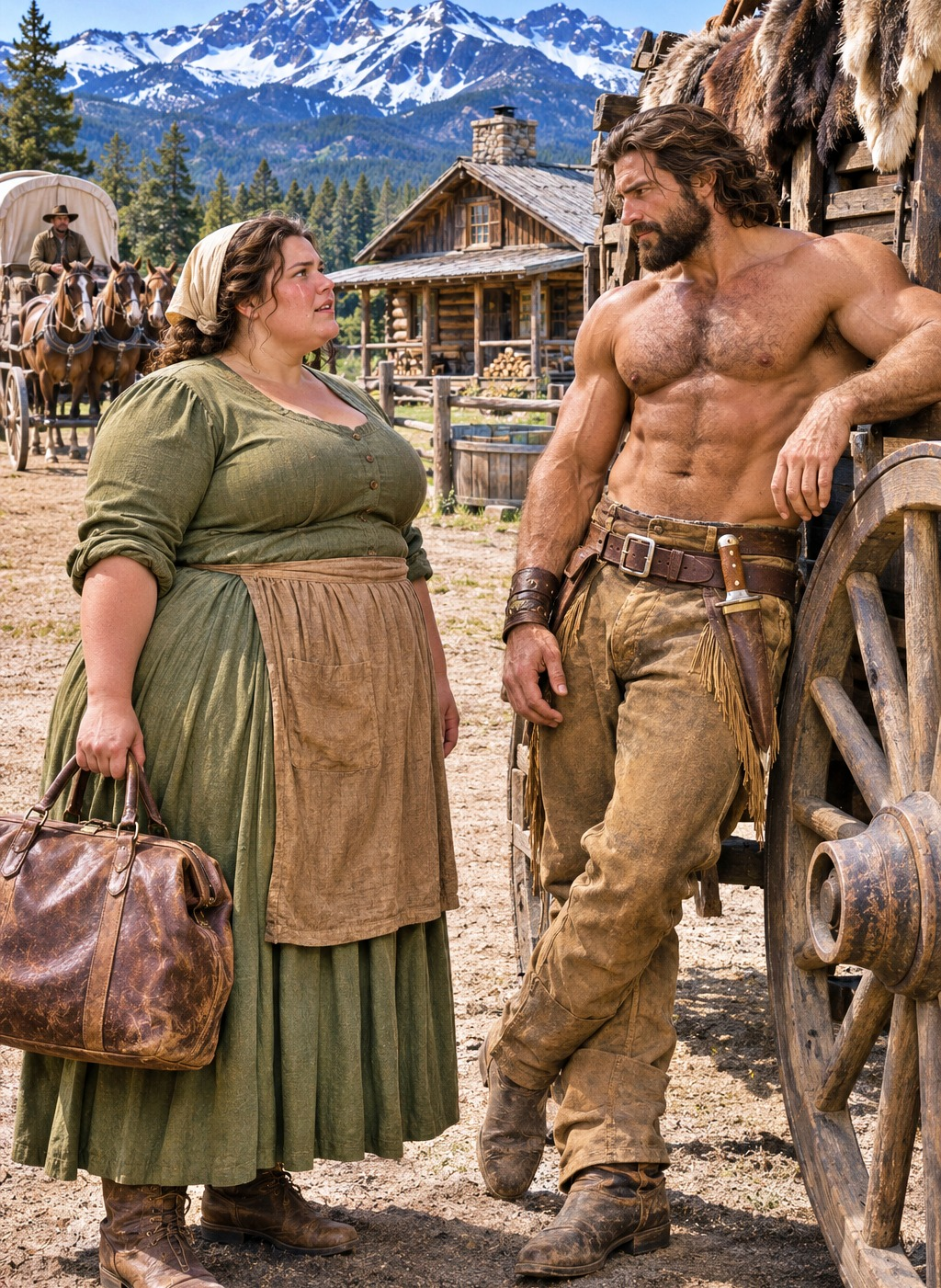
"Stay away from that door!" Eleanor whispered, grabbing Callum's arm.
The enormous mountain man stopped with his hand inches from the latch.
Outside, Edmund Harrow spoke again.
"Open it, Eleanor. We both know you can't hide forever."
Callum slowly turned toward her.
The firelight illuminated her pale face. Her gray-blue eyes were fixed on the door, and her fingers had tightened around his sleeve so desperately that he could feel them trembling through the fabric.
"That man," Callum said quietly. "You know him."
Eleanor swallowed.
"Yes."
"Who is he?"
She looked at the photograph still lying on the dresser.
Then at the letter in her hand.
"Someone I believed was dead."
Callum's expression hardened.
Outside, Gideon Marsh cleared his throat.
"Callum, I don't want trouble. Just open the door so we can straighten this out."
Callum did not move.
He looked at Eleanor.
"Do you want to see him?"
"No."
The answer came immediately.
"Then you won't."
He turned toward the door.
"Mr. Harrow," he called, "the lady says she doesn't want to speak with you."
A pause followed.
Then Edmund laughed.
It was a pleasant laugh.
Polished.
Almost friendly.
The kind of laugh a gentleman might use while discussing business over coffee.
"Mr. Bre, I believe there's been a misunderstanding."
"Then you can explain it tomorrow."
"I'm afraid tomorrow will be too late."
"That's unfortunate."
Eleanor stared at Callum.
He sounded perfectly calm.
There was no shouting.
No threat.
Just a man refusing to let strangers frighten a woman inside his home.
Edmund's voice changed.
"Mr. Bre, are you aware that the woman standing beside you is wanted in Missouri?"
Callum's jaw tightened.
Eleanor closed her eyes.
There it was.
The accusation she had feared since leaving St. Louis.
"What for?" Callum asked.
"Fraud. Theft. And the disappearance of a substantial amount of money belonging to my agency."
Gideon spoke quickly.
"He's got papers, Callum. Official-looking papers."
Callum glanced at Eleanor.
She shook her head.
"I didn't steal anything."
He nodded once.
Then addressed the door.
"Sounds like something for a sheriff."
"Precisely," Edmund replied. "Which is why I suggest you open this door before you become involved in a criminal matter."
Callum looked toward the rifle mounted above the fireplace.
He did not reach for it.
Instead, he stepped closer to the door.
"Mr. Harrow, you're standing on my property after dark, making accusations against my guest. I suggest you leave."
"You don't understand who you're protecting."
"Maybe not."
"She lied to you."
Callum glanced at Eleanor.
"Most folks have things they ain't ready to talk about."
"She is not the woman she claims to be."
Callum's voice became colder.
"She told me her name was Eleanor Whitcomb. She told me she came here hoping to make a home. Far as I can tell, both things are true."
Edmund said nothing.
Callum continued.
"You can bring a sheriff with proper authority if you've got a complaint. Until then, get off my mountain."
For several seconds, nobody moved.
Then Edmund spoke again.
"Very well, Mr. Bre. But when you learn what she did, remember that I tried to warn you."
Footsteps crossed the porch.
Gideon muttered something Eleanor could not understand.
A horse whinnied.
Then came the sound of two riders moving away through the trees.
Callum waited until the hoofbeats disappeared.
Only then did he turn.
Eleanor was standing beside the table.
Her hands were clasped so tightly that her knuckles had turned white.
"I'm sorry," she whispered.
Callum frowned.
"For what?"
"For bringing this to your home."
He looked at her for a long moment.
Then he walked to the fireplace and added another log.
"You didn't bring those men here," he said.
"They followed me."
"That ain't the same thing."
"You don't understand."
"No," he admitted. "I don't."
He straightened.
"But I reckon you can help me with that."
Eleanor sat at the dining table while Callum poured two cups of coffee.
The cabin had become painfully quiet.
Bear remained near the front door, occasionally lifting his head toward the darkness.
Callum placed a cup in front of Eleanor.
She wrapped both hands around it.
"Edmund Harrow owned the Western Matrimonial Agency," she began.
Callum sat opposite her.
"I know that much."
"He also owned several other businesses. A boardinghouse. A private employment office. A small lending company."
"Sounds like a successful fellow."
"He was."
She hesitated.
"At least, that's what everyone believed."
Callum waited.
Eleanor looked into her coffee.
"I worked for him."
The words hung between them.
"For how long?" Callum asked.
"Nearly four years."
"What did you do?"
"Correspondence. Records. Accounts. Sometimes I interviewed women who wanted to find husbands out west."
Callum's expression changed.
"You worked for the agency?"
"Yes."
"Then you knew about me?"
She looked up.
"I knew your name."
"Before you wrote?"
"Long before."
He leaned back.
For the first time since her arrival, Eleanor saw genuine suspicion enter his eyes.
It hurt more than she expected.
"Callum, please let me explain."
He said nothing.
She continued.
"Your name appeared in our records almost a year ago. I remember because the first application was unusual."
"How?"
"You wrote that you weren't looking for a servant. You wanted a partner."
Callum lowered his eyes.
"I remember writing that."
"You said you could provide a safe home, honest work, and whatever kindness you had to give."
He looked toward the fireplace.
Eleanor's voice softened.
"I remember thinking it was the most sincere application I'd ever read."
Callum remained silent.
"Most men wrote about what they expected from a wife. They wanted youth, beauty, obedience, or someone to raise their children."
"And I didn't?"
"No."
She paused.
"You wrote that you hoped to find someone who enjoyed sunsets."
Callum's face tightened.
He remembered that sentence.
He had nearly crossed it out.
It had seemed foolish even then.
"Mr. Harrow laughed when he read it," Eleanor said.
Callum looked up.
"What?"
"He passed your application around the office. Said you were a mountain giant looking for a fairy-tale princess."
Something moved across Callum's face.
Not anger.
Shame.
Eleanor hated herself for repeating the words.
But she needed him to understand.
"He told us you were an easy customer."
"Easy?"
"You paid promptly. You never complained. And every time a woman left, you blamed yourself instead of questioning the agency."
Callum stared at her.
"Are you saying he sent those women knowing they'd leave?"
"I believe so."
"Why?"
"Money."
He looked at the five letters spread across the table.
Twenty dollars for each introduction.
Travel expenses.
Gifts.
Supplies.
The improvements he had made to the cabin.
All the money he had spent trying to become a man someone might want.
"How much did he take from me?" Callum asked.
Eleanor hesitated.
"I don't know the exact amount."
"Guess."
"Several hundred dollars, perhaps more."
Callum gave a short, bitter laugh.
"That's a lot of timber."
"I know."
"No," he said quietly. "You don't."
Eleanor fell silent.
He rubbed a hand across his face.
"Every dollar I sent him came from work. Logging in winter. Hauling freight in summer. Trapping when I had to."
His voice remained steady.
But his eyes had changed.
"I thought I was paying to meet women who wanted the same things I did."
Eleanor lowered her head.
"I'm sorry."
Callum looked at her.
"Did you know what he was doing?"
She hesitated.
That hesitation was answer enough.
His expression closed.
"Eleanor."
"I suspected."
"When?"
"After the second woman."
He stood.
The chair scraped against the floor.
Eleanor flinched.
Callum noticed.
He stopped immediately.
His face changed.
He stepped backward.
"I ain't going to hurt you."
"I know."
"Then why did you—"
He stopped himself.
Eleanor looked down.
"Because I'm accustomed to men becoming angry when they hear something they don't like."
Callum stood motionless.
Then he slowly sat again.
"Tell me the rest."
Eleanor had never told the entire story aloud.
Not to her former landlady.
Not to the minister who had helped her leave St. Louis.
Not even to the woman who had secretly purchased her train ticket.
She had spent months carrying the truth like a stone beneath her ribs.
Now she was sitting across from a man who had every reason to despise her.
And somehow, that made honesty both more frightening and more necessary.
"After Margaret left," she said, "I began examining the agency's records."
"Without Harrow knowing?"
"Yes."
"I found that certain women were being offered money to travel west and then return home."
Callum frowned.
"Paid to leave?"
"Sometimes. Others were frightened by false reports about the men they were supposed to marry."
"Like those warnings about me."
She nodded.
"Not every arrangement was dishonest. Harrow needed successful marriages to protect his reputation. But some men were profitable precisely because they kept trying."
Callum stared at the table.
"Men like me."
"Yes."
"How many?"
"I found twelve."
His head lifted.
"Twelve?"
"At least."
She explained that the agency had kept two sets of accounts.
One recorded legitimate fees.
The other tracked payments from men Harrow considered unlikely to marry successfully.
Beside certain names, a clerk had written a single word.
Repeat.
Callum understood immediately.
He had been one of those men.
A repeat customer.
A lonely man whose hope could be sold back to him again and again.
"What happened when you found out?" he asked.
"I confronted Harrow."
Callum looked at her sharply.
"Alone?"
"Yes."
"That wasn't wise."
"I know that now."
Eleanor stared at the flame flickering inside the lamp.
"He told me the women had been compensated fairly. He said nobody had forced them to travel. He claimed the men were simply paying for an opportunity."
"And you believed him?"
"No."
She took a breath.
"I told him I would take the records to the authorities."
Callum waited.
"That was when he showed me the documents."
"What documents?"
"Bank drafts. Receipts. Letters authorizing payments."
She looked up.
"All bearing my signature."
Callum frowned.
"You signed them?"
"Some. Not all."
"Why?"
"Because I was his bookkeeper. He had me sign ordinary papers for years. Then he used those signatures to make it appear that I had withdrawn money from the agency."
Callum's eyes narrowed.
"Forged the rest?"
"Yes."
"How much?"
"Nearly four thousand dollars."
He stared.
Four thousand dollars was more money than Callum had seen in one place in his entire life.
"Harrow told me that if I reported him, he would accuse me of stealing everything."
Eleanor's voice grew thin.
"He said no judge would believe a woman who had handled the accounts against a respected businessman."
"What did you do?"
"I tried to collect proof."
"And?"
"He found out."
She stopped.
Callum waited.
When she did not continue, he asked gently, "What happened?"
Eleanor looked at her hands.
"One evening, I returned to the office and found my desk emptied."
She swallowed.
"My employment records were gone. My wages had been withheld. And there was a notice accusing me of embezzlement."
Callum's jaw tightened.
"He had arranged everything."
"Yes."
"Did you go to the police?"
"I tried."
She looked away.
"The officer who interviewed me was Harrow's cousin."
Callum said nothing.
"He told me to leave town before formal charges were filed."
"Did he threaten you?"
"Not directly."
She gave a humorless smile.
"He said women like me should be grateful when respectable gentlemen offered them mercy."
Callum's hands slowly closed into fists.
Eleanor noticed.
But this time, she did not flinch.
His anger was not directed at her.
It was directed at what had been done to her.
"How did you get away?" he asked.
"A minister named Reverend Bell helped me. His wife gave me a place to stay."
"And Harrow?"
"Two weeks later, there was a fire at the agency."
Callum leaned forward.
"What kind of fire?"
"The building burned during the night. Two people were injured. A body was found in Harrow's private office."
"His?"
"That's what the newspapers said."
"But he was standing outside this cabin tonight."
"Yes."
Callum looked toward the door.
"So either somebody lied about the body, or Harrow wanted folks thinking he was dead."
Eleanor nodded.
"I believed the reports."
"Did you see the body?"
"No."
"Who identified it?"
She hesitated.
"I don't know."
Callum looked at the photograph again.
Gideon Marsh stood beside Edmund Harrow.
Both men were smiling.
The photograph had been taken months before the fire.
And Gideon had never mentioned knowing the man who arranged Callum's marriages.
"There's something else," Eleanor said.
Callum looked up.
"Before the fire, I copied part of the agency's private ledger."
His eyes widened.
"You have it?"
"No."
"Where is it?"
"I hid the pages in St. Louis."
"Then how can we prove anything?"
Eleanor reached into the pocket of her apron.
She removed a small brass key.
"I kept this."
Callum studied it.
"What does it open?"
"A locked compartment in Harrow's old office desk."
"Why would that matter now?"
"Because the compartment contained something he was desperate to hide."
"What?"
She hesitated.
"A second ledger."
Callum frowned.
"You said you copied the ledger."
"I copied only a few pages. The complete book contained names, payments, and correspondence from every arrangement."
"Even mine?"
"Especially yours."
He looked at the key.
"Then why didn't you take it?"
"Because Harrow caught me before I could."
She closed her fingers around the brass.
"After the fire, I assumed the desk and everything inside it had been destroyed."
"But now?"
"Now I don't know what to believe."
Callum rose and walked toward the window.
Outside, the forest lay beneath a dark sky.
He could see nothing beyond the yard.
He had lived on this mountain for sixteen years.
He knew every trail.
Every creek crossing.
Every place a man could hide a horse.
And tonight, for the first time in a long while, he felt that his home had become part of something dangerous.
He looked back at Eleanor.
"Why did you write to me?"
She lowered her eyes.
"I told you. I remembered your application."
"That ain't all."
"No."
He waited.
She looked at the letter on the table.
"After the fire, I had nowhere to go. My reputation was ruined. My savings were gone. And I knew Harrow had made certain no respectable employer would hire me."
"Then why not choose somewhere else?"
"Because I remembered what you wrote."
Callum's expression softened.
"You remembered a letter from a stranger?"
"Yes."
"After all that time?"
She nodded.
"I remembered that you wanted someone who would stay."
He looked away.
Eleanor continued.
"I thought perhaps two people who had been rejected by the world might understand each other."
Callum swallowed.
"That's a poor reason to marry somebody."
"Perhaps."
She met his eyes.
"But it seemed better than marrying someone who only wanted what I could give him."
For several moments, neither spoke.
Then Callum asked, "Were you planning to tell me about Harrow?"
"Yes."
"When?"
"I don't know."
He looked at her.
She did not look away.
"I was afraid," she admitted.
"Of me?"
"Of losing the first place where I've felt welcome in months."
Callum stood very still.
Then he walked back to the table.
He picked up the five letters.
Placed them carefully inside the wooden box.
And closed the lid.
"You should get some sleep," he said.
Eleanor's face fell.
"Callum—"
"We can talk more tomorrow."
"Are you asking me to leave?"
He looked genuinely startled.
"No."
She searched his face.
"You're certain?"
"Yes."
"But I lied to you."
"You kept things from me."
"Isn't that the same?"
"Sometimes."
He paused.
"But I reckon fear makes people do things they wouldn't otherwise do."
Eleanor looked at him.
"You're not angry?"
"I'm angry."
Her shoulders tightened.
Callum continued.
"At Harrow. At whoever helped him. At the people who let him do this."
He looked toward the window.
"And maybe a little at myself for being so easy to fool."
"Callum, you weren't foolish."
He gave a tired smile.
"Five women left me, Eleanor. Five."
"That doesn't mean you deserved it."
He looked at her for a long moment.
Then he nodded.
Not because he fully believed her.
But because he wanted to.
It was nearly midnight when Eleanor returned to her room.
Callum remained awake.
He checked the door latch.
Banked the fire.
Then took his rifle from above the mantel and placed it beside his chair.
Bear lay near his boots.
Outside, the wind had risen.
Callum watched the dark window.
He thought about the five women.
Helen.
Margaret.
Dorothy.
Catherine.
Sarah.
For months, he had remembered their departures as proof of his own inadequacy.
Now he wondered what each woman had been told.
Had Helen truly hated the mountain?
Had Margaret cried because of loneliness?
Had Dorothy believed he was dangerous?
Had Catherine received a warning before entering the cabin?
Had Sarah been frightened by something she read before stepping off the stage?
The questions made him feel sick.
He had spent so long blaming himself that he had never considered someone might have wanted him to fail.
A faint sound interrupted his thoughts.
Scratching.
Callum looked toward the door.
Bear lifted his head.
The scratching came again.
Not from outside.
From beneath the floor.
Callum frowned.
He set down his coffee.
The sound stopped.
He waited.
Nothing.
Then he heard it again.
Three short scrapes.
A pause.
Two more.
Callum rose slowly.
He knew the cabin.
He had built every floorboard.
There were no animals beneath that section of the house.
At least, there should not have been.
He moved toward the pantry.
The scratching stopped.
Bear followed.
Callum crouched beside the floorboards.
One plank had shifted.
Only slightly.
He touched it.
The wood moved beneath his fingers.
That was impossible.
He had secured it himself.
He lifted the loose board.
Beneath it was a shallow space between the floor joists.
And inside that space lay a small leather pouch.
Callum stared.
He had never seen it before.
He reached down and pulled it free.
The leather was damp.
Mud stained the bottom.
Someone had placed it there recently.
His pulse quickened.
He opened the pouch.
Inside was a folded sheet of paper.
And a silver pocket watch.
The watch was engraved with two initials.
E. H.
Edmund Harrow.
Callum unfolded the paper.
It was a receipt.
Dated October 1872.
A payment of fifty dollars.
Recipient: Gideon Marsh.
Purpose: Transportation and removal of prospective bride.
Callum's blood ran cold.
Below the receipt was a handwritten instruction.
Ensure the fifth woman never reaches the mountain.
He stared at the words.
Then at the pocket watch.
A sound came from behind him.
"Callum?"
Eleanor stood in the hallway.
She wore her shawl over her nightdress.
Her face was pale.
"What is it?" she asked.
He held up the watch.
"Found something."
She stepped closer.
The moment she saw the engraving, she stopped.
"Where did you get that?"
"Under the floor."
Her eyes widened.
"That's impossible."
"You recognize it?"
She nodded slowly.
"Edmund carried that watch every day."
Callum looked at the receipt.
"Someone put it beneath my floorboards."
"When?"
"Recently."
Eleanor stared at the pouch.
Then she whispered, "He was inside this cabin."
Callum looked toward the front door.
The latch was secure.
The windows were closed.
But someone had entered his home.
Someone who knew where to hide evidence.
Someone who wanted him to find it.
He looked back at Eleanor.
"There's something I need to ask you."
She waited.
"Did Harrow ever mention Gideon Marsh?"
Eleanor shook her head.
"Not by name."
"Then how did they know each other?"
She looked at the photograph.
At the receipt.
At the silver watch.
"I don't know."
Callum folded the paper.
"We'll find out."
The next morning, Eleanor woke to the smell of coffee and fresh bread.
For one brief moment, she forgot everything.
The threats.
The letters.
The man who had returned from the dead.
Then she heard Callum speaking outside.
His voice was low.
Serious.
She dressed quickly.
When she entered the main room, she found the table set for breakfast.
Two plates.
Two cups.
A small jar of honey.
Callum had left a note beside her plate.
Gone to check the horses. Eat while it's warm.
Eleanor read it twice.
Then she smiled faintly.
No one had left her a note like that in years.
She sat down.
But before she could touch the bread, she noticed something beneath her cup.
A folded piece of paper.
At first, she assumed Callum had left another note.
Then she saw the handwriting.
Her smile vanished.
She unfolded it.
There was no greeting.
No signature.
Only a single sentence.
You have until sunset to return what you stole.
Eleanor's heart began pounding.
She turned the paper over.
A second message had been written on the back.
Ask Callum what happened to his brother.
She stared at the words.
His brother?
Callum had never mentioned a brother.
She looked toward the window.
He was standing near the stable, examining the horses.
For a moment, she considered calling him.
Then she noticed something else.
A small stain on the corner of the paper.
Dark red.
Dried blood.
Eleanor stood.
The chair scraped across the floor.
She hurried toward the door.
But before she reached it, a heavy knock sounded from the other side.
Not Callum's knock.
Not Gideon's.
Three deliberate blows.
She stopped.
A man's voice spoke through the wood.
"Mrs. Whitcomb, I have a message from St. Louis."
Eleanor's breath caught.
She had never heard the voice before.
"Who are you?"
"Someone who knows what happened to Edmund Harrow."
She looked through the window.
Callum was still at the stable.
Too far away to hear.
The stranger continued.
"And I know why he sent five women to this mountain."
Eleanor reached for the latch.
"Tell me your name."
A pause.
Then the man answered.
"My name is Thomas Bre."
Her fingers froze.
Bre.
Callum's name.
The name of the brother he had never mentioned.
She slowly lifted the latch.
The door swung inward.
And the man standing outside was holding a photograph of Callum beside a freshly dug grave.






Comments 0