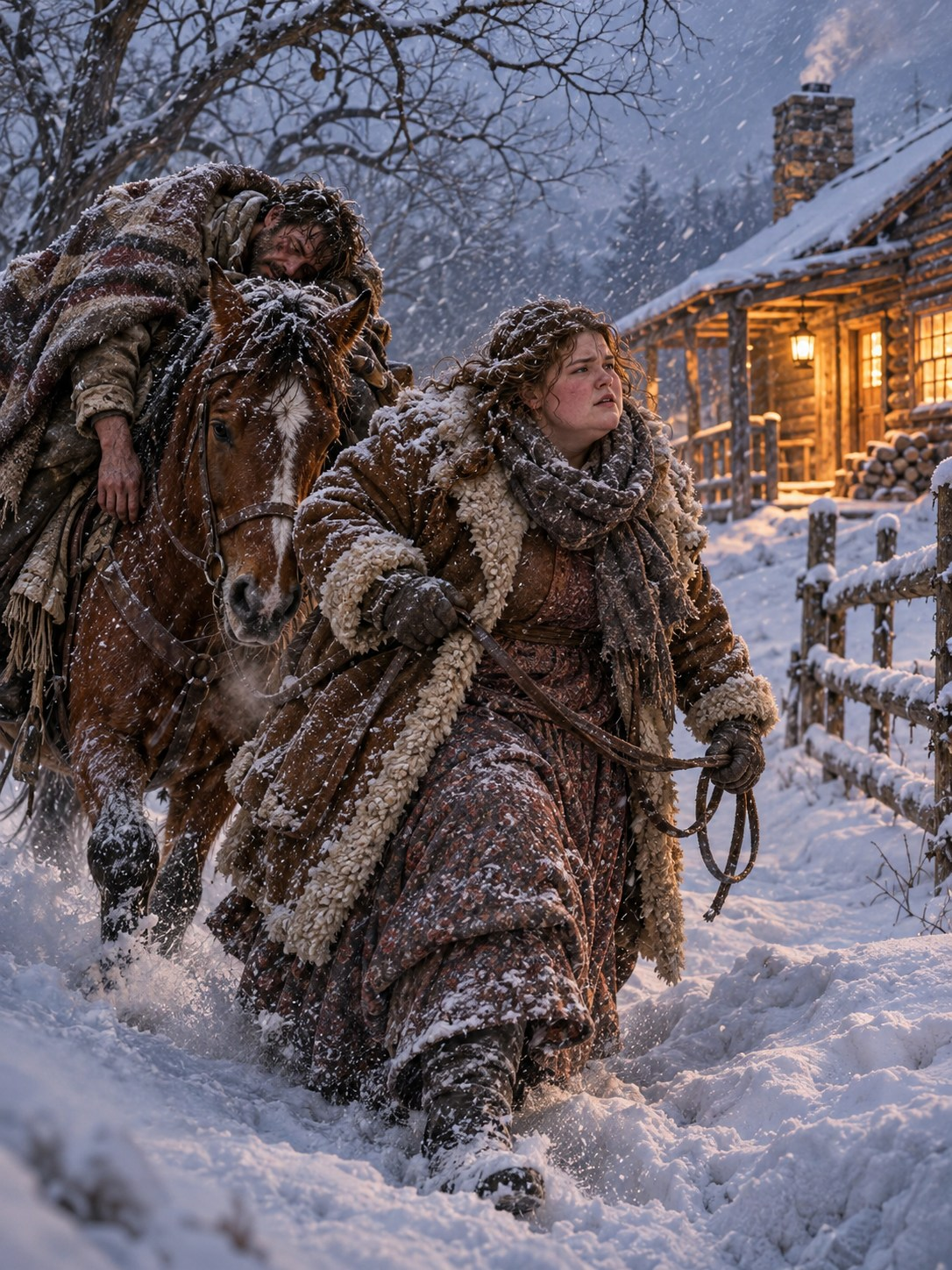
Carter Ruddock reached for the revolver beside the fireplace, but Daisy caught his sleeve.
"Don't shoot anyone on my account."
He looked down at her hand.
"That man has no business coming here."
"Then let him say what business he thinks he has."
Carter's jaw tightened. Outside, Hap Taliver struck the door again.
"Ruddock! I know you're in there!"
Carter opened the door just wide enough to see the man standing on the porch.
Hap was in his early forties, thick around the middle, with a narrow mouth and a habit of smiling whenever someone else was uncomfortable. His black hat sat low over his forehead, and a red bandanna was tucked carelessly into his coat pocket.
He glanced past Carter and spotted Daisy.
"Well, there she is."
Carter stepped farther into the doorway, blocking his view.
"Say what you came to say."
Hap chuckled.
"You're a lucky fellow. Kimball was mighty disappointed when you walked away with his girl."
"She's my wife."
"That's what I heard. Funny thing, though. Wade says she owes him something."
Daisy stepped closer.
"I don't owe Wade Kimball a thing."
Hap's smile widened.
"That's not what he says."
"Then perhaps he should come tell me himself."
Hap looked amused.
"Careful, Mrs. Ruddock. You don't want to make enemies you can't afford."
Carter's hand tightened around the edge of the door.
"Get off my property."
"Now, hold on. I'm only carrying a message."
"Carry it back."
Hap removed a folded paper from his coat.
"Two hundred dollars. That's what Wade says you owe him. He figures marrying his girl doesn't erase a man's debts."
Daisy felt the old humiliation rise in her chest.
She remembered Wade sitting at the kitchen table, discussing her future as though she were a piece of furniture he no longer needed.
She remembered his laugh when she asked whether she had any say in the arrangement.
And she remembered Carter taking off his hat and asking her, in front of that same man, whether she would marry him of her own free will.
She had said yes.
Not because Wade had commanded her.
Not because Carter had purchased her.
Because she had seen a chance to escape a life in which nobody asked what she wanted.
"Tell Wade something for me," she said.
Hap turned toward her.
Daisy held his gaze.
"I am not his property. I never was."
His smile disappeared.
For several seconds, nobody spoke.
Then Hap folded the paper and slipped it back into his coat.
"Well, you'll both find out soon enough what happens when Wade gets angry."
Carter stepped onto the porch.
"One more word about my wife, and you'll leave this place with a different understanding of hospitality."
Hap laughed, although there was less confidence in it now.
He descended the steps and walked toward his horse.
Before mounting, he looked over his shoulder.
"Enjoy your new family, Ruddock. You might not have it for long."
Then he rode away.
Carter remained on the porch until the sound of the horse disappeared beyond the old elm.
When he finally returned inside, Daisy was standing beside the kitchen table.
"You shouldn't have threatened him," she said.
"He came here to frighten you."
"I know."
"Then you understand."
She looked at him carefully.
"No, Carter. I understand why you were angry. But I don't want my life decided by men shouting at each other over a debt."
He took off his hat and placed it on the table.
For a moment, he looked almost ashamed.
"You're right."
Daisy had not expected him to agree so quickly.
He rubbed his face.
"I spent too long letting men like Kimball tell me what was owed and what wasn't. I won't let him do that to you."
"Then we should make sure he understands the marriage was my choice."
Carter nodded.
"Reverend Tull witnessed it. His wife was there. Nobody can honestly say otherwise."
"Good."
From the hallway came the sound of a floorboard creaking.
Both turned.
Eli stood in the doorway.
His arms were crossed, and his expression was hard.
"Was that Wade Kimball?"
Carter looked at his son.
"No."
"Was it someone from town?"
"Yes."
"What did he want?"
"Nothing you need to worry about."
Eli gave a bitter laugh.
"That's what you always say."
He turned to leave.
"Eli," Daisy called gently.
The boy stopped.
"Would you help me carry some water from the pump tomorrow?"
He looked at her as though she had asked him to dig up his mother's grave.
"Why?"
"Because the handle sticks, and I could use another pair of hands."
"You have your husband."
Daisy glanced at Carter.
"Your father has plenty to do."
Eli stared at her.
"You really think you're going to make us listen to you?"
"No."
"Then what are you doing here?"
Daisy took a breath.
"Trying to make sure five children have breakfast tomorrow."
Eli's face changed, but only slightly.
He looked toward the kitchen.
"We had breakfast before you came."
"Then we'll have it again."
He disappeared down the hallway.
Carter let out a tired breath.
"He's always been stubborn."
"He's twelve."
"He was never this angry before Annie died."
Daisy picked up the folded dishcloth.
"Grief makes children angry in ways grown people don't always understand."
Carter looked toward the hallway.
"Sometimes I think he hates me more than he hates you."
"Perhaps because he misses the father he had before."
The words struck him.
He lowered his eyes.
That night, Daisy slept in the large bedroom Carter had promised her.
The bed was old but clean, and someone had placed a small oil lamp beside it.
She noticed a woman's blue shawl folded carefully across the wooden chest.
She did not touch it.
Instead, she unpacked her carpetbag, hung her two dresses in the wardrobe, and placed the ring on her finger back where it belonged.
The thread she had wrapped around it was already beginning to loosen.
She thought about taking it off.
Then she decided against it.
Downstairs, she heard Carter moving around the kitchen.
A chair scraped.
Something fell.
Then came the unmistakable sound of a bottle striking the table.
Daisy sat on the edge of the bed.
For a moment, she considered going downstairs.
But she remembered his promise.
Nobody under his roof would expect anything from her that she did not choose to give.
That promise included the freedom to decide when to approach him.
She turned down the lamp.
In the morning, she awoke to the sound of arguing.
"Give it back!"
It was Ruth.
Daisy hurried downstairs.
The twins were standing beside the kitchen cupboard. Ruth had tears in her eyes, while Rachel clutched a small wooden spoon.
Eli stood between them and the table.
"What happened?" Daisy asked.
"She's taking Mama's things!" Ruth cried.
Daisy looked at Rachel.
The girl was holding a blue ceramic bowl.
Annie's bowl.
"I wasn't taking it," Rachel said. "I was only washing it."
Ruth shook her head.
"Mama's bowl doesn't belong to her."
Daisy immediately stepped back.
"You're right. It doesn't."
The twins looked at her.
"That bowl belonged to your mother," Daisy continued. "You can decide where it stays."
Ruth took it from Rachel and placed it carefully on the highest shelf.
Nobody spoke.
Daisy turned toward the stove.
"I was going to make oatmeal. Would you like some?"
Eli appeared in the doorway.
"We don't want you cooking in Mama's kitchen."
Daisy stopped stirring.
"Then tell me what you would prefer."
He seemed unprepared for the question.
"I don't know."
"All right. I'll make enough for everyone. You can decide whether to eat it."
Eli frowned.
"You always have an answer."
"Not always."
She put another piece of wood into the stove.
"Sometimes I have to figure things out just like everyone else."
Nell came downstairs carrying a rag doll with one missing button.
"Is breakfast ready?"
"Almost, sweetheart."
The little girl climbed onto her chair.
Benji followed, rubbing his eyes.
Within minutes, all five children were gathered around the table.
Carter did not appear.
Daisy filled their bowls and placed a plate of warm biscuits in the middle.
Ruth ate slowly.
Rachel kept glancing at the blue bowl on the shelf.
Eli barely touched his food.
Benji finished first and looked hopefully toward the biscuit plate.
"You can have another," Daisy told him.
He reached for one.
Then he stopped.
"Papa said we have to save some."
Daisy looked at the nearly empty basket.
"There will be more tomorrow."
Benji glanced toward the hallway.
"Sometimes there isn't."
Daisy felt those words more deeply than she wanted to show.
She stood and went to the pantry.
There was enough flour for another batch of biscuits, and she knew how to stretch a little food without making anyone feel they had less.
She returned with two more.
Benji's face brightened.
At that moment, Carter entered.
He had washed his face, but his eyes were red, and his shirt was still yesterday's.
He stopped when he saw the table.
"Morning," he said.
Nobody answered.
He pulled out a chair.
"Did you save me anything?"
Nell looked up.
"There's biscuits!"
Carter smiled faintly.
"Then I'm in luck."
He reached for one.
Eli pushed his own plate away.
"Where were you last night?"
Carter's hand stopped.
"Sleeping."
"In the barn?"
Carter looked at his son.
"Yes."
"Why?"
"Because I needed some air."
Eli laughed.
"You always need air. Or whiskey. Or somewhere else to go."
The kitchen fell silent.
Carter placed the biscuit back on the plate.
Daisy looked at him, waiting.
He could have shouted.
He could have told Eli to mind his manners.
Instead, he looked at his son and said, "You're right about one thing. I haven't been here enough."
Eli's eyes narrowed.
"Then why did you marry her?"
Carter glanced toward Daisy.
"Because I thought she might help us."
The words were honest, but they hurt.
Daisy slowly set down her spoon.
Eli looked at her triumphantly.
"See? You're just here to fix us."
Carter immediately shook his head.
"That's not what I meant."
Daisy stood.
"I know what you meant, Carter. But your children need to hear something different."
She looked at all five of them.
"I didn't come here because I thought you were broken things that needed repairing. I came because your father asked me to share his home, and I agreed. That's all."
Ruth looked down.
Rachel stopped eating.
Eli said nothing.
Daisy continued.
"You don't have to love me. You don't even have to like me today. But nobody in this house should have to earn a place at the table."
Carter looked at her for a long moment.
Then he quietly picked up his biscuit.
For the first time in many months, he finished breakfast with his children.
After the meal, Daisy asked Carter to show her where they kept the household supplies.
He led her through the back door and pointed toward the small shed.
"Tools are in there. Feed is in the larger building."
"And the barn?"
Carter's expression changed.
"What about it?"
"I'd like to see where the animals are kept."
"There's nothing you need in there."
She noticed the quickness of his answer.
"All right."
He seemed relieved.
But as they walked toward the shed, Daisy saw a small window in the barn.
The shutters were closed, and a heavy wooden latch had been fastened across the door.
She remembered Nell saying her father sometimes slept there.
She also remembered the bottle she had heard striking the kitchen table the previous night.
"Carter?"
He stopped.
"Yes?"
"Do you sleep in there because you don't want to be near the children?"
His shoulders stiffened.
"Sometimes."
"Why?"
He looked toward the barn.
"Because everything in that house reminds me of Annie."
Daisy said nothing.
He continued.
"Her chair. Her sewing basket. The place where she used to stand when she called the children in for supper. Even the sound of their voices."
His voice cracked.
"I go inside that house, and for a moment I expect to see her."
Daisy felt her throat tighten.
"Then you remember."
"Every time."
He turned away.
"I don't know how to stop."
"You don't have to stop remembering her."
Carter looked at her.
"But you do have to stop leaving your children alone with their memories."
He lowered his head.
For several seconds, the only sound was the wind moving through the old elm branches.
Then Daisy noticed something near the barn door.
A child's small handprint had been scratched into the wood.
Beside it were five initials.
E. R.
R. R.
R. R.
B. R.
N. R.
Daisy traced the marks with her eyes.
"They made those?"
Carter nodded.
"Annie did it. She wanted the children to know that the barn belonged to all of them, too."
"Then why is it locked?"
Carter didn't answer immediately.
He took a key from his pocket.
"There's something inside I haven't shown you."
Daisy watched as he unlocked the door.
The hinges groaned.
A smell of old hay, leather, and stale whiskey drifted out.
Carter stepped inside first.
Daisy followed.
The barn was dim, but sunlight entered through narrow gaps in the wooden walls. A horse shifted in its stall.
Near the back was a narrow cot, a small table, and several empty bottles.
Daisy looked away from them.
On the table sat an old wooden box.
Carter stood beside it.
"Annie kept her important things in there."
Daisy looked at the box.
"Why haven't you opened it?"
"Because I know what's inside."
"Then why keep it?"
His eyes became distant.
"Because the last time I tried, I couldn't finish."
He reached into his pocket and produced a small brass key.
Daisy watched him unlock the box.
Inside were several folded papers, a child's drawing, a small ribbon, and a sealed envelope bearing Annie's handwriting.
Carter touched the envelope but did not remove it.
"She wrote this a few weeks before she died."
Daisy felt a chill despite the warmth of the morning.
"Did you read it?"
He shook his head.
"I couldn't."
"Would you like me to leave you alone?"
Carter looked at the envelope again.
Before he could answer, a sharp cry came from the farmhouse.
It was Nell.
Then came the sound of hurried footsteps.
Daisy turned toward the open barn door.
Eli appeared in the yard, his face pale.
"Papa!"
Carter dropped the key.
"What's happened?"
Eli pointed toward the farmhouse.
"There's a man in the kitchen."
Carter stepped forward.
"Who?"
Eli swallowed hard.
Then he looked directly at Daisy.
"He says he knows something about Mama."
And before Carter could reach the house, Eli added five words that made his father's face turn white.
"He says Mama wasn't alone when she died."






Comments 0