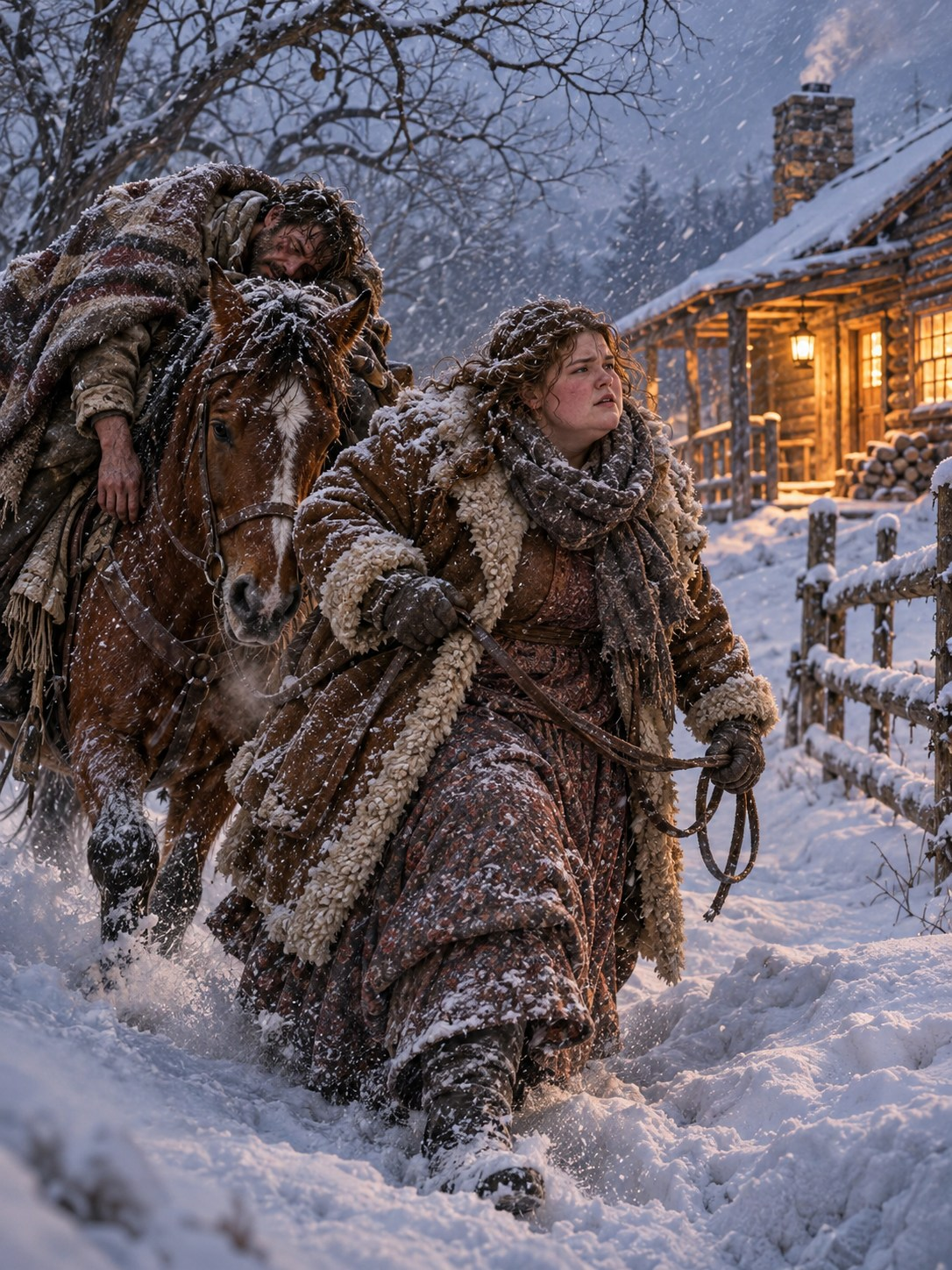
Carter Ruddock ran toward the farmhouse so quickly that he nearly stumbled over the porch steps.
Daisy followed close behind.
Eli stood in the doorway, his face pale, while a stranger waited beside the kitchen table. He was a thin, neatly dressed man in his late fifties, with silver hair, a dark traveling coat, and a worn leather medical bag resting against his chair.
Carter stopped dead.
"Doctor Whitmore?"
The stranger slowly stood.
"Hello, Carter."
Carter's expression hardened.
"What are you doing here?"
The doctor glanced toward Daisy.
"I came because I heard you had married."
"That doesn't answer my question."
"No," Whitmore replied. "It doesn't."
Daisy noticed that he was holding a folded piece of paper. His fingers were trembling slightly.
Eli moved closer to his father.
"He said he knew something about Mama."
Carter looked at the doctor.
"What did you tell my son?"
"Only that I was there when Annie died."
"Then you should have kept your mouth shut."
Whitmore sighed.
"I know you're angry with me. You have every reason to be."
Carter stepped forward.
"Get out."
The doctor did not move.
"There's something you need to understand. Annie wasn't alone during her final hours."
Carter's face went rigid.
"I was there."
"Not the entire time."
The words seemed to strike him harder than a physical blow.
Daisy looked between the two men.
"Perhaps we should sit down."
Carter turned toward her.
"This has nothing to do with you."
"Your children are listening."
He glanced toward the doorway.
Ruth and Rachel had appeared behind Eli. Benji was holding Nell's hand, and the little girl was watching the stranger with frightened eyes.
Carter swallowed.
"Children, go upstairs."
Nobody moved.
"Eli. Take your sisters and brother upstairs."
Eli looked at the doctor.
"What does he know about Mama?"
Carter's voice rose.
"Now!"
The boy flinched.
Daisy stepped between them.
"Eli, would you help Nell find her doll? I think she left it upstairs."
The little girl immediately reached for Daisy's hand.
Ruth took Rachel's arm, and Benji followed.
Eli remained for another moment.
Then he turned and walked away.
When the children were gone, Daisy pulled out a chair.
"Please sit down, Doctor."
Whitmore nodded gratefully.
Carter remained standing.
"I want this over with."
The doctor opened his medical bag and removed a small notebook.
"I treated Annie for several months before she died. You remember that."
"I remember."
"Her condition was worse than she let you believe."
Carter looked away.
"She told me she was tired. She said the children needed more rest."
"She was trying to protect them."
"From what?"
Whitmore hesitated.
"From knowing how frightened she was."
Carter's hands curled into fists.
"Why didn't you tell me?"
"I tried."
"When?"
"Several times."
"You're lying."
The doctor closed his eyes briefly.
"Do you remember the Thursday before she died? I came to the ranch in the afternoon."
Carter said nothing.
"You were not home."
"I was working."
Whitmore lowered his voice.
"You were at the Lone Elm Saloon."
The kitchen went silent.
Carter looked at him sharply.
"Watch your words."
"I am not here to humiliate you. I am telling you what happened."
Daisy noticed Carter's shoulders stiffen.
He looked toward the window.
"Go on."
"Annie was getting weaker. She asked me to speak with you about arranging help for the children. She wanted someone to stay in the house while she rested."
Carter rubbed his forehead.
"She never told me that."
"She didn't want another argument."
"What argument?"
Whitmore looked down at his notebook.
"She said you had promised to stop drinking."
Carter turned away.
For a moment, Daisy thought he might leave the room.
Instead, he pulled out a chair and sat heavily.
The doctor continued.
"Annie loved you, Carter. But she was frightened about what would happen to the children if she didn't recover."
Carter's voice was almost inaudible.
"She should have told me."
"She did."
He looked up.
"What?"
Whitmore opened the notebook to a marked page.
"On her final evening, she asked me to find you. She said she needed to speak with you before it was too late."
Carter's eyes filled.
"Why didn't you find me?"
"I did."
"Where?"
Whitmore hesitated.
"At the barn."
Carter stared at him.
Daisy looked down at the table.
She could almost see the memory forming in his mind.
The bottles.
The darkness.
His wife's voice somewhere beyond the walls, asking for him.
And him not answering.
"Was she asking for me?" he whispered.
The doctor nodded.
"Yes."
Carter covered his face with both hands.
For several seconds, nobody spoke.
Then he asked the question Daisy suspected had been hurting him for a year.
"Did she know I wasn't coming?"
Whitmore looked at him sadly.
"She knew you were struggling."
"That's not what I asked."
The doctor took a slow breath.
"Yes, Carter. She knew."
Carter stood so abruptly that his chair scraped across the floor.
"Get out."
"Carter—"
"I said get out!"
Whitmore carefully closed his notebook.
"I will leave. But I didn't come here to punish you."
"Then why?"
The doctor looked toward the staircase.
"Because Annie left something behind. Something she wanted delivered when the time was right."
Carter stopped.
"What?"
Whitmore removed a small envelope from the inside pocket of his coat.
It was yellowed with age and had a faint blue ribbon tied around it.
Daisy recognized the handwriting immediately.
Annie's.
Carter stared at it.
"Where did you get that?"
"She gave it to me two days before she died."
Carter did not reach for it.
"Why didn't you give it to me then?"
"She asked me to wait."
"Wait for what?"
The doctor looked directly at him.
"Until you were ready to listen."
Carter laughed bitterly.
"Ready? I've spent a year wishing I could hear her voice again."
Whitmore placed the envelope on the table.
"Then perhaps you should finally read what she wanted you to know."
He picked up his medical bag and walked toward the door.
Before leaving, he turned toward Daisy.
"Mrs. Ruddock, I hope you understand that Annie's children have been through more than most people realize."
Daisy nodded.
"I understand."
"Please don't let the past become another reason for them to suffer."
Then he stepped outside.
Carter remained motionless.
Daisy looked at the envelope.
"Would you like me to leave?"
He shook his head.
"No."
"Would you like me to stay?"
He looked at her.
For the first time since their marriage, his eyes held something other than exhaustion or embarrassment.
Fear.
"Yes."
She sat quietly across from him.
Carter reached for the envelope but stopped before touching it.
His thumb rubbed against the edge of the table.
"I don't deserve to read this."
Daisy spoke gently.
"Perhaps that's not for you to decide."
He looked at her.
"What if she blamed me?"
"Then you will have to face what she wrote."
"And if she hated me?"
Daisy paused.
"Then you will still have to face it."
Carter lowered his head.
After a long silence, he picked up the envelope.
The blue ribbon had been tied in a small bow.
He pulled it loose carefully.
Inside was a folded sheet of paper.
He recognized Annie's handwriting immediately.
His fingers began to shake.
He read the first line.
Then the second.
His face changed.
Daisy watched him carefully.
"What is it?"
Carter did not answer.
He read the letter again, slower this time.
Then he pushed it away as though the words had burned him.
"She knew."
Daisy leaned forward.
"Knew what?"
He shook his head.
"Nothing."
"Carter."
"Please."
He stood and walked toward the back door.
Daisy did not follow.
She waited until she heard his boots cross the porch.
Then she looked at the paper.
She knew it was not hers to read without permission.
But one sentence had caught her attention.
Annie had written it in larger letters than the rest.
The children must never believe that what happened was their fault.
Daisy felt a chill.
What had happened?
And why had Annie believed the children might blame themselves?
She folded the letter carefully and left it on the table.
Upstairs, someone was crying.
Daisy climbed the staircase and found Ruth sitting on the floor outside Nell's bedroom.
The little girl was holding her knees against her chest.
"What's wrong, sweetheart?"
Ruth wiped her cheek.
"Is Papa angry because Mama died?"
Daisy sat beside her.
"No."
"Then why does he never talk about her?"
Daisy considered her answer.
"Sometimes people become so sad that talking about the person they miss feels like hurting themselves all over again."
Ruth looked toward the bedroom.
"Mama used to sing when she brushed our hair."
"I believe she did."
"Papa doesn't sing."
Daisy smiled sadly.
"Perhaps he doesn't remember how."
Ruth leaned closer.
"Do you think he remembers Mama's favorite song?"
"I think he remembers more than he lets anyone see."
The girl lowered her eyes.
"Sometimes I hear him crying in the barn."
Daisy gently put an arm around her shoulders.
"That must be frightening."
Ruth nodded.
"Rachel says he cries because Mama doesn't want him anymore."
Daisy's heart ached.
"Your mother loved your father. Nothing that happened afterward could change the love she had for you children."
Ruth looked up.
"How do you know?"
Daisy brushed a loose strand of hair from the girl's forehead.
"Because I can see how much she cared about you in the way you talk about her."
Ruth leaned against her.
It was the first time one of the twins had willingly touched Daisy.
She did not make a fuss about it.
She simply held the child until her breathing settled.
That afternoon, Daisy decided the children needed something to occupy their minds.
She found a basket of old sewing materials in the bedroom and brought it downstairs.
Ruth and Rachel helped sort the buttons.
Benji was given the task of gathering small pieces of wood for the stove.
Nell sat beside Daisy, playing with a wooden spoon.
Eli watched from the doorway.
"What are you doing?"
"Sorting buttons."
"Why?"
"Because they're all mixed together."
He frowned.
"That's stupid."
Daisy smiled.
"Probably."
He seemed disappointed that she hadn't argued.
After a moment, he stepped inside.
"Papa's in the barn."
"I know."
"He's been there all afternoon."
Daisy continued sorting.
"Would you like to help me?"
"No."
"All right."
Eli remained in the doorway.
Then he asked, "Did the doctor tell you what happened to Mama?"
Daisy looked up.
"He told your father some things."
"Was she sick?"
"Yes."
"Did she know she was going to die?"
Daisy took a slow breath.
"I don't know exactly what she knew, Eli."
The boy stared at the floor.
"She told me she was going to get better."
Daisy put down the buttons.
"She probably wanted you to feel safe."
"She promised she'd come to my birthday."
His voice cracked.
"She never came."
Daisy moved closer, but she did not touch him.
"That must have hurt."
Eli wiped his nose with his sleeve.
"Papa wasn't there when she called for him."
Daisy went still.
"What makes you say that?"
"I heard him tell the doctor."
Eli's eyes became angry again.
"He was drinking while Mama was dying."
Daisy could not pretend otherwise.
"Your father made mistakes."
"Then why do you stay with him?"
She looked at the boy.
"Because I believe people can make better choices than the ones they made yesterday."
Eli shook his head.
"People don't change."
Daisy returned to the basket.
"Maybe you haven't seen enough people try."
He stared at her for another moment.
Then he walked away.
Near sunset, Carter finally returned from the barn.
He had washed his face and changed his shirt.
The letter was folded in his hand.
He stood beside the kitchen table while Daisy prepared supper.
"Can I ask you something?"
"Of course."
"If Annie had written you a letter, would you read it?"
Daisy turned toward him.
"Yes."
"Even if it hurt?"
"Especially if it mattered."
He looked down at the paper.
"She didn't hate me."
Daisy waited.
"She wrote that she knew I loved her. She said she knew I was frightened, too."
His voice trembled.
"She said she had been waiting for me to come home."
Daisy's eyes softened.
Carter sat down.
"I don't know how to forgive myself."
"You don't have to decide that tonight."
He unfolded the letter again.
"There was something else."
"What?"
He looked toward the staircase.
"Annie wrote that someone had been helping her. Someone she trusted."
Daisy remembered the doctor's words.
"Doctor Whitmore?"
Carter shook his head.
"No."
He stared at the final paragraph.
"She wrote that this person knew about the children. Knew about the farm. Knew things I thought nobody else knew."
Daisy felt the room grow strangely quiet.
"Did she say who?"
Carter shook his head.
"She only wrote that I must ask the right person before it was too late."
He looked at Daisy.
"And I think I know who she meant."
Before Daisy could ask, three rapid knocks sounded against the front door.
Carter stood.
"Who is it?"
A woman's voice answered from the porch.
"Carter? It's Margaret Bell."
Daisy recognized the name from town.
Margaret had been Annie's closest friend.
Carter opened the door.
Margaret stood outside wearing a dark traveling dress and holding a small leather handbag.
Her eyes moved past Carter and settled on Daisy.
Then she looked at the letter in his hand.
Her face went white.
"Oh, Carter," she whispered. "You read it."
Carter stepped aside.
"What do you know about Annie's last days?"
Margaret clutched her handbag.
For a moment, she seemed unable to speak.
Then she looked toward the staircase, where the five children were beginning to gather.
She lowered her voice.
"There's something I should have told you a year ago."
Carter stared at her.
"What?"
Margaret reached into her handbag and pulled out a small folded photograph.
She placed it on the table.
It showed Annie standing beside a man Carter had never expected to see again.
And when Daisy leaned closer, she recognized the face immediately.
It was Wade Kimball.






Comments 0